Turning Points · October 1939 to November 1940
Many of the ghetto photographs you have seen were taken by Germans.
The Warsaw ghetto, the uprising, and the record Jews buried in milk cans so somebody would know what had been done to them.
Project Witness records and preserves Holocaust survivor testimony. This page is free to use, in classrooms and out of them.
Written for readers 14 and up. Some pages describe killing methods and public humiliation.
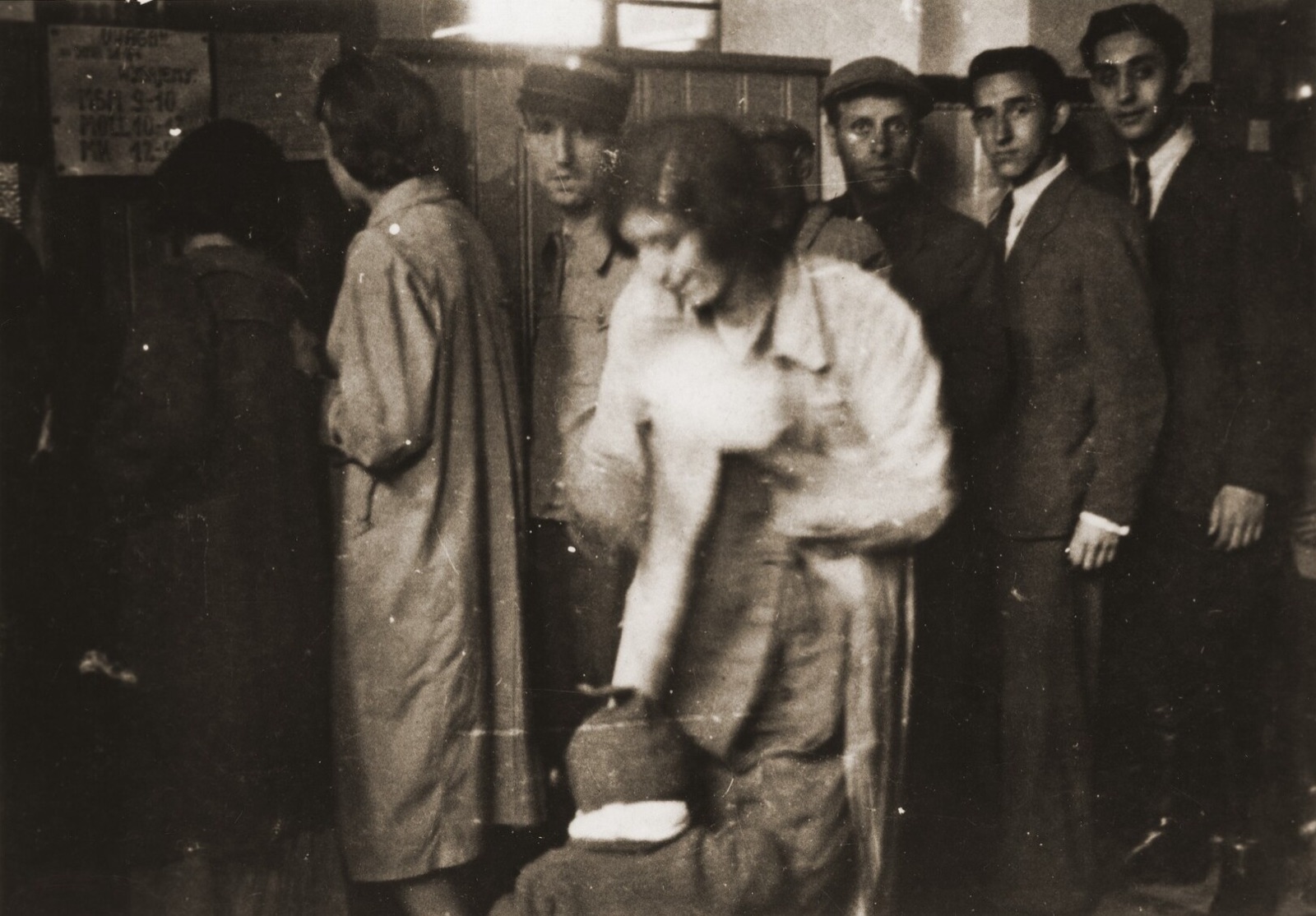
Lodz ghetto residents line up at an office in the ghetto. Photographed by the ghetto's Jewish administration; the photographer is not recorded. United States Holocaust Memorial Museum, courtesy of Muzeum Sztuki w Lodzi. Public domain.
The ghettos: the short answers
- What a ghetto was
- A district where German authorities forced Jews to live, cut off from the city around it. Most were in existing cities and towns, often in prewar Jewish neighborhoods or the poorest streets. Kovno's had no running water.
- How many there were
- More than 1,300 established by Germany and its allies, about 1,100 of them by German authorities, most in occupied Poland, the Baltic states and the occupied Soviet Union.
- What the Warsaw ghetto was
- The largest. Sealed November 16, 1940: about 400,000 people on roughly 1.2 to 1.3 square miles, almost 30 percent of Warsaw's population inside 2.4 percent of its area.
- What people were given to eat
- Officially 181 calories a day in Warsaw, 8 percent of the German ration and a quarter of the Polish one. People averaged about 1,125 calories in 1941. Smuggling, over and under the wall, made up much of the difference.
- How people died before any deportation
- Starvation, typhus, cold. USHMM records 83,000 dead in Warsaw between 1940 and mid-1942. Later research puts the toll higher: estimates run from 83,000 to 100,000.
- The uprising
- April 19 to May 16, 1943, about 700 Jewish fighters. A different event from the Warsaw Uprising of August 1944, a Polish Home Army revolt some fifteen months later.
- How the ghettos ended
- Deportation. About 265,000 went from Warsaw to Treblinka between July 22 and September 21, 1942. Lodz, the last major ghetto, was emptied to Auschwitz-Birkenau in August 1944.
- Who took the photographs
- Germans, mostly. The best known come from a trophy album an SS general had made for Himmler. Jews buried their own record: Ringelblum's archive in Warsaw, Ross and Grossman in Lodz, Kadish in Kovno.
Each of these has a fuller answer below.
What was the Warsaw ghetto?
The Warsaw ghetto was a sealed district in the middle of German-occupied Warsaw where the city's Jews were made to live. Ludwig Fischer, the German governor of the district, signed the order on October 2, 1940, and street loudspeakers announced it ten days later, on Yom Kippur. The move displaced 138,000 Jews and 113,000 Poles. On November 16 the district was closed: about 400,000 people on roughly 1.2 to 1.3 square miles, almost 30 percent of Warsaw's population inside 2.4 percent of its area. Refugees driven in from the surrounding towns pushed it toward 450,000.
The Jewish council had been ordered in March 1940 to wall in what the Germans called an epidemic area, and to pay for it out of its own funds. The wall went over ten feet high, topped with barbed wire, twenty-two guarded gates at the closing and six by June 1942. Ringelblum recorded the phrase going around the street: we have been buried alive.
The Jews had to build the ghetto, the walls. The Jews had to pay for the paint, the painting, everything.
Max Blumenstein, who was in the Warsaw ghetto from late 1940, on who built the wall and paid for it. Project Witness testimony. Watch the full testimony. This passage begins at 1:44:17: Max Blumenstein, Project Witness
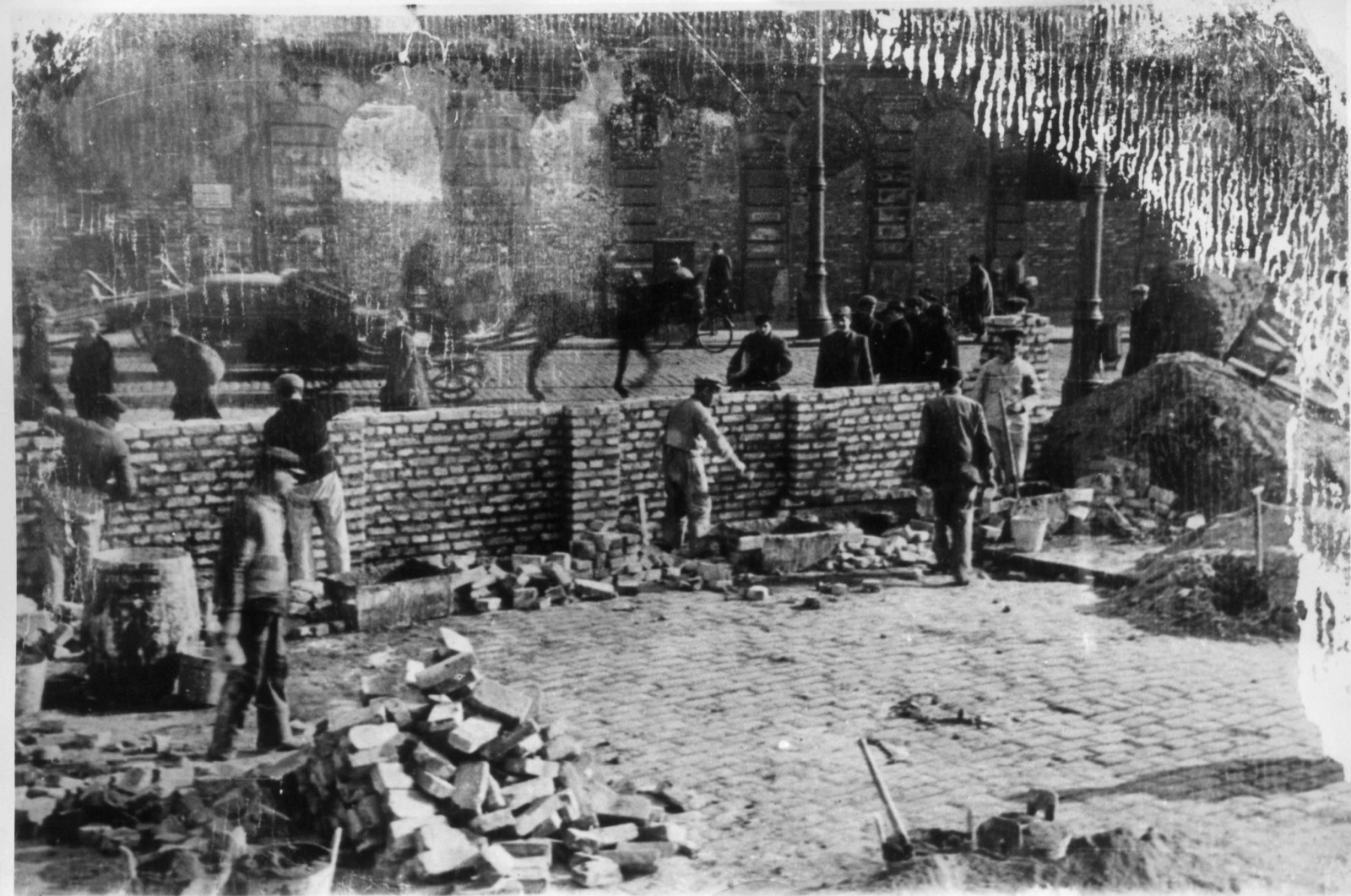
The council was ordered to build it and to pay for it, and work started on April 1, 1940. Workers building the Warsaw ghetto wall, 1940-1941. State Archive of the Capital City of Warsaw, collection of Second World War photographs 1939-1945, sig. IX-4/8, via Archiwum Glowne Akt Dawnych and Wikimedia Commons. Public domain.
Wartime photograph from a Polish source Photographer unknown · between 1940 and 1941 · State Archive of the Capital City of Warsaw (Archiwum Państwowe m. st. Warszawy), Zbiór fotografii z II wojny światowej 1939-1945, signature IX-4/8; original print 172 x 115 mm Public domain View the record: The council was ordered to build it and to pay for it, and work
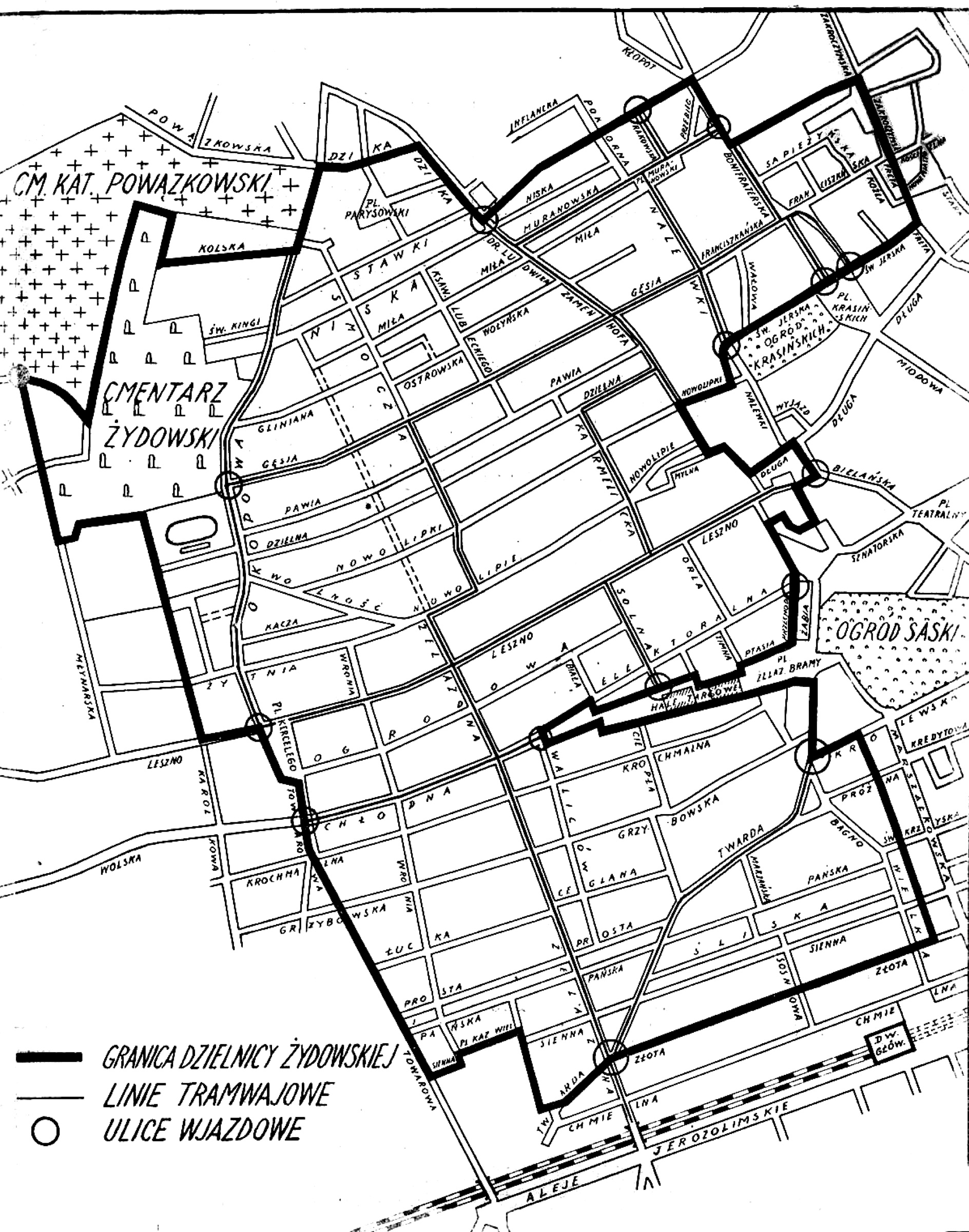
It was printed in Nowy Kurier Warszawski, the German-run Polish-language daily, three days after the loudspeakers announced the ghetto on October 12, 1940, which was Yom Kippur. Map of the Warsaw ghetto, October 15, 1940. Author unknown; via Wikimedia Commons. Public domain (anonymous work, EU 70-year term).
Issued by the German administration Photographer unknown · 1940 · Wikimedia Commons Public domain View the record: It was printed in Nowy Kurier Warszawski, the German-run
The official German ration for Jews came to 181 calories a day, 8 percent of what Germans in occupied Poland got and a quarter of what Poles got. Between 1940 and mid-1942, 83,000 people died there of starvation and disease, and later estimates run higher. A 2020 study in Science Advances argues registered deaths substantially understate the toll, and the head of the ghetto hospital's typhus ward put the peak at about 9,000 a month.
The hunger in the ghetto was so great, was so bad, that people were laying on the streets and dying, little children went around begging, and, uh, everyday you walked out in the morning, you see somebody is laying dead.
Abraham Lewent, Warsaw ghetto. US Holocaust Memorial Museum Collection. Hear it at the United States Holocaust Memorial Museum: Abraham Lewent
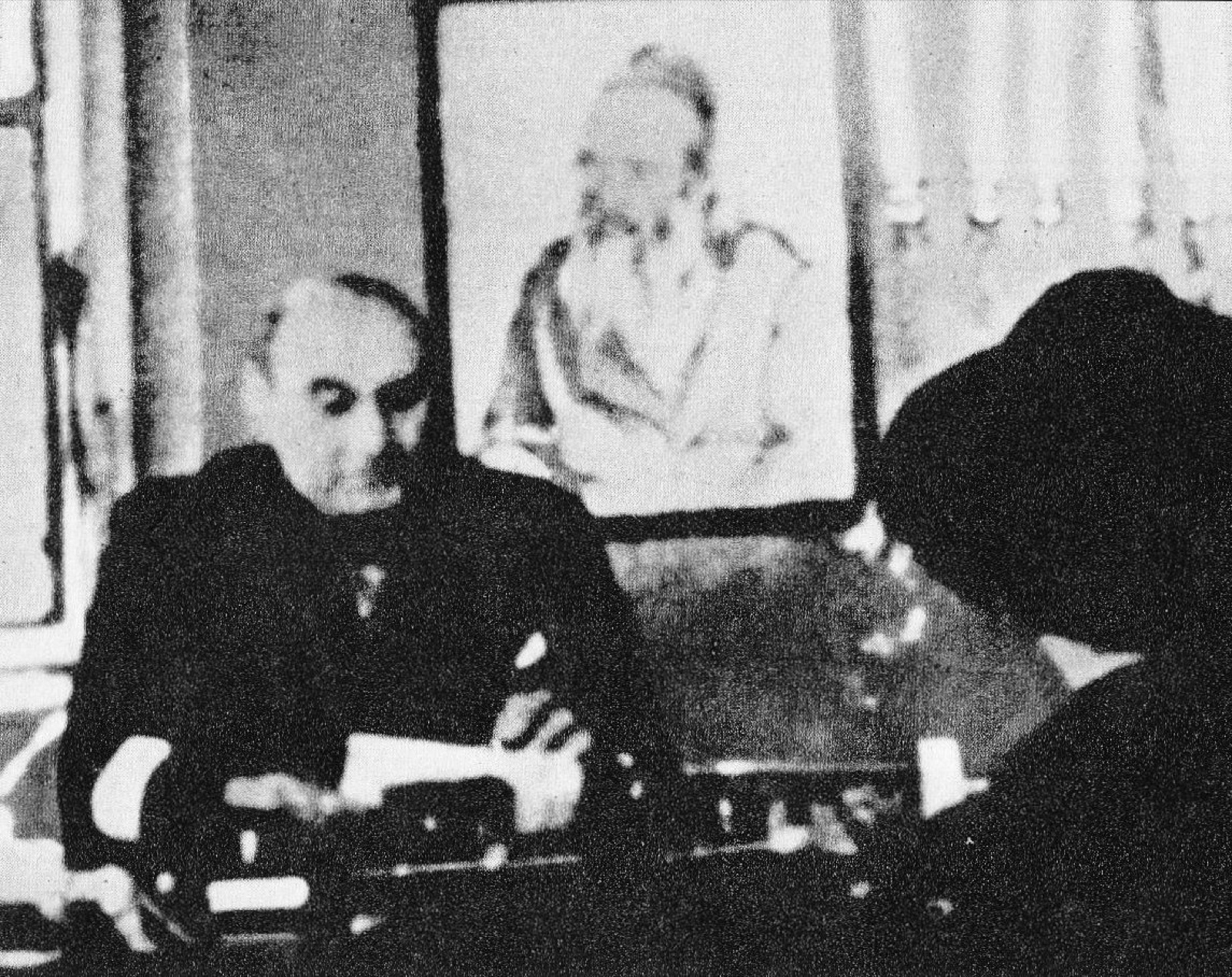
He was an engineer by training, appointed in October 1939, and he administered German orders from this desk for nearly three years. Adam Czerniakow in his office at the Warsaw Judenrat, 1940-1942. Photographer unknown; published in Wronski and Zwolakowa, Polacy Zydzi 1939-1945 (Warsaw, 1971), p. 92. Public domain, via Wikimedia Commons.
Photographer unknown · between 1940 and 1942 · Wikimedia Commons Public domain View the record: He was an engineer by training, appointed in October 1939, and he
Adam Czerniakow headed the Warsaw Jewish council from October 1939. On July 22, 1942 Hermann Hoefle told him that all Jews would be sent east, that 6,000 had to be supplied by four o'clock, and privately that if the operation failed his wife would be shot first. Czerniakow's last diary entry, the next day, includes these lines: "It is 3 o'clock. So far 4,000 are ready to go. The orders are that there must be 9,000 by 4 o'clock." He took cyanide shortly after. USHMM notes he did not call for resistance. Marek Edelman wrote in 1945 that the ghetto underground had thought at the time that he had no right to act as he did.
From July 22 to September 21, 1942, SS and police units cleared the ghetto block by block and marched people to the Umschlagplatz, a loading yard on Stawki Street. Freight cars ran to Malkinia, where a spur turned off to Treblinka. About 265,000 people were sent there and about 35,000 killed inside the ghetto during the operation.
On the morning of August 5 or 6, 1942, German police ordered Janusz Korczak's orphanage evacuated, and nearly two hundred children walked to the Umschlagplatz. Korczak had been offered false papers and a hiding place and would not consider it. Stefania Wilczynska walked with him. The date and place of his death are not known, and the story that the Germans offered to spare him is probably a myth.
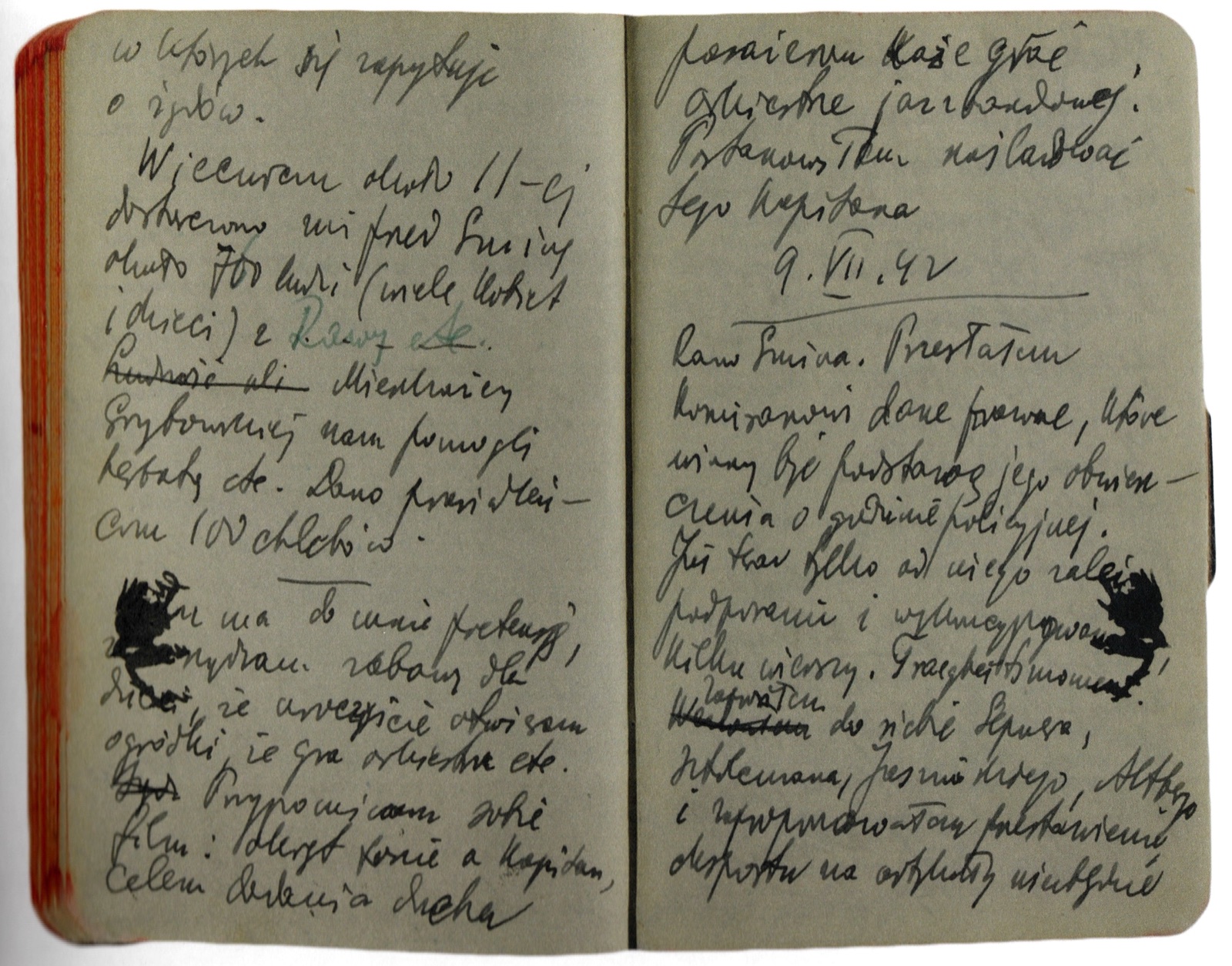
He wrote in it until the afternoon he died, and it survived to be published in English in 1979 as The Warsaw Diary of Adam Czerniakow. Pages from Adam Czerniakow's Warsaw ghetto diary, July 1942. Reproduced in Kirshenblatt-Gimblett and Polonsky (eds.), Polin. 1000 lat historii Zydow polskich (POLIN Museum, 2014), p. 301. Public domain, via Wikimedia Commons.
Portrait or personal record Adam Czerniaków (1880-1942) · July 1942 · Wikimedia Commons Public domain View the record: He wrote in it until the afternoon he died, and it survived to be
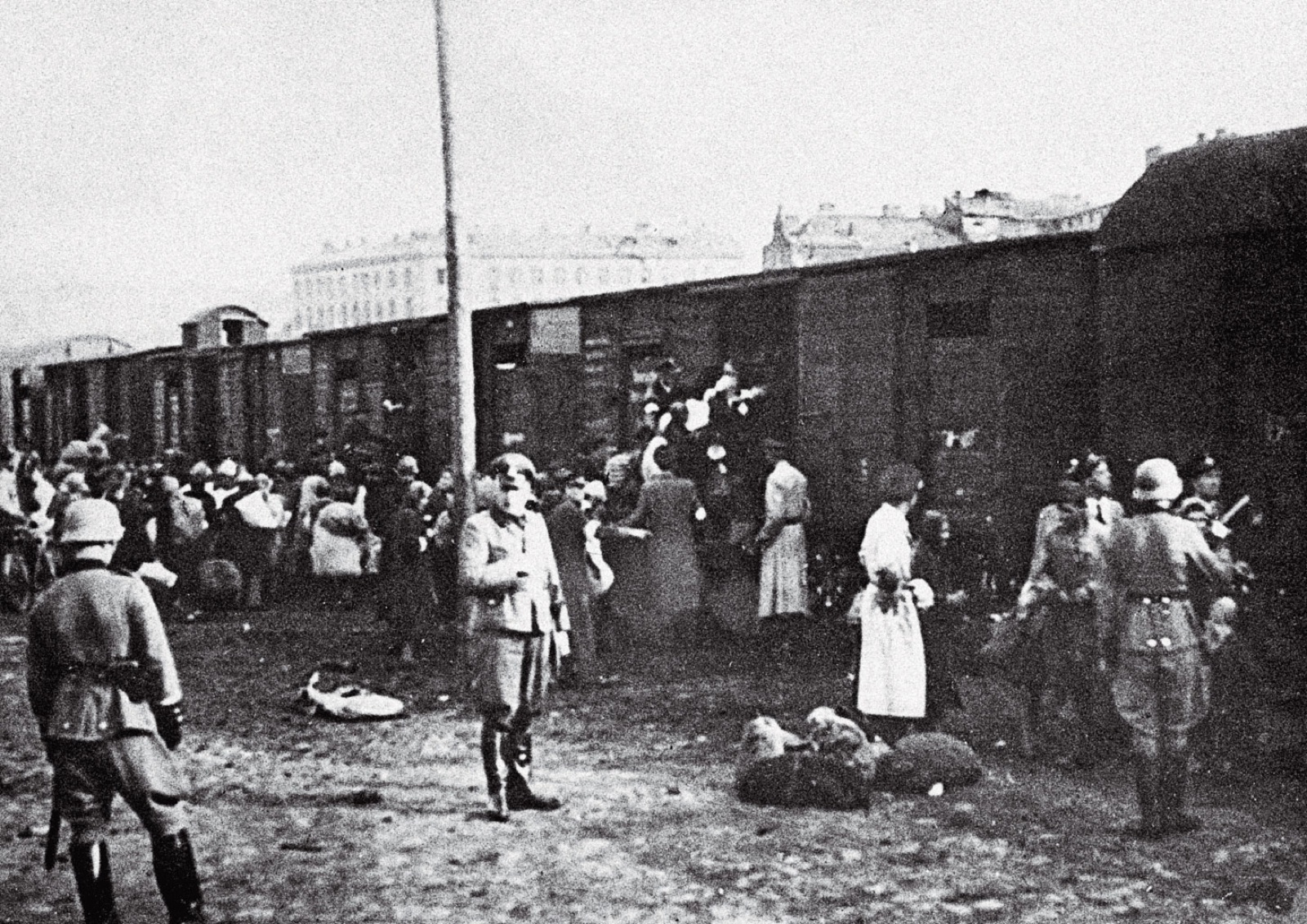
Trains from this yard ran to Malkinia, where a spur turned off to Treblinka. Jews being loaded onto deportation trains at the Umschlagplatz, Warsaw, 1942-1943. Photographer unknown. United States Holocaust Memorial Museum, courtesy of the Jewish Historical Institute, Warsaw. Public domain, via Wikimedia Commons.
Photographer unknown · between 1942 and 1943 · United States Holocaust Memorial Museum, courtesy of the Jewish Historical Institute (Żydowski Instytut Historyczny), Warsaw Public domain View the record: Trains from this yard ran to Malkinia, where a spur turned off to
What life was actually like
People already inside a ghetto boundary had to take in the people driven in. Paula Garfinkel's family of six got one room in Lodz. In Warsaw the average was about seven people to a room. Forced labor filled factories and workshops, and once the deportations began a work permit could decide who lived. The ration was not survivable. Smuggling supplemented it and, in USHMM's words, kept the death rate from increasing still further. Children carried much of it, small enough to get through a hole in the wall. The Germans shot smugglers in public and in private.
I can remember carrying butter and bread in my underwear to bring back to the ghetto and to going through the sentry and being afraid.
Judith Meisel, Kovno ghetto. US Holocaust Memorial Museum Collection. Hear it at the United States Holocaust Memorial Museum: Judith Meisel
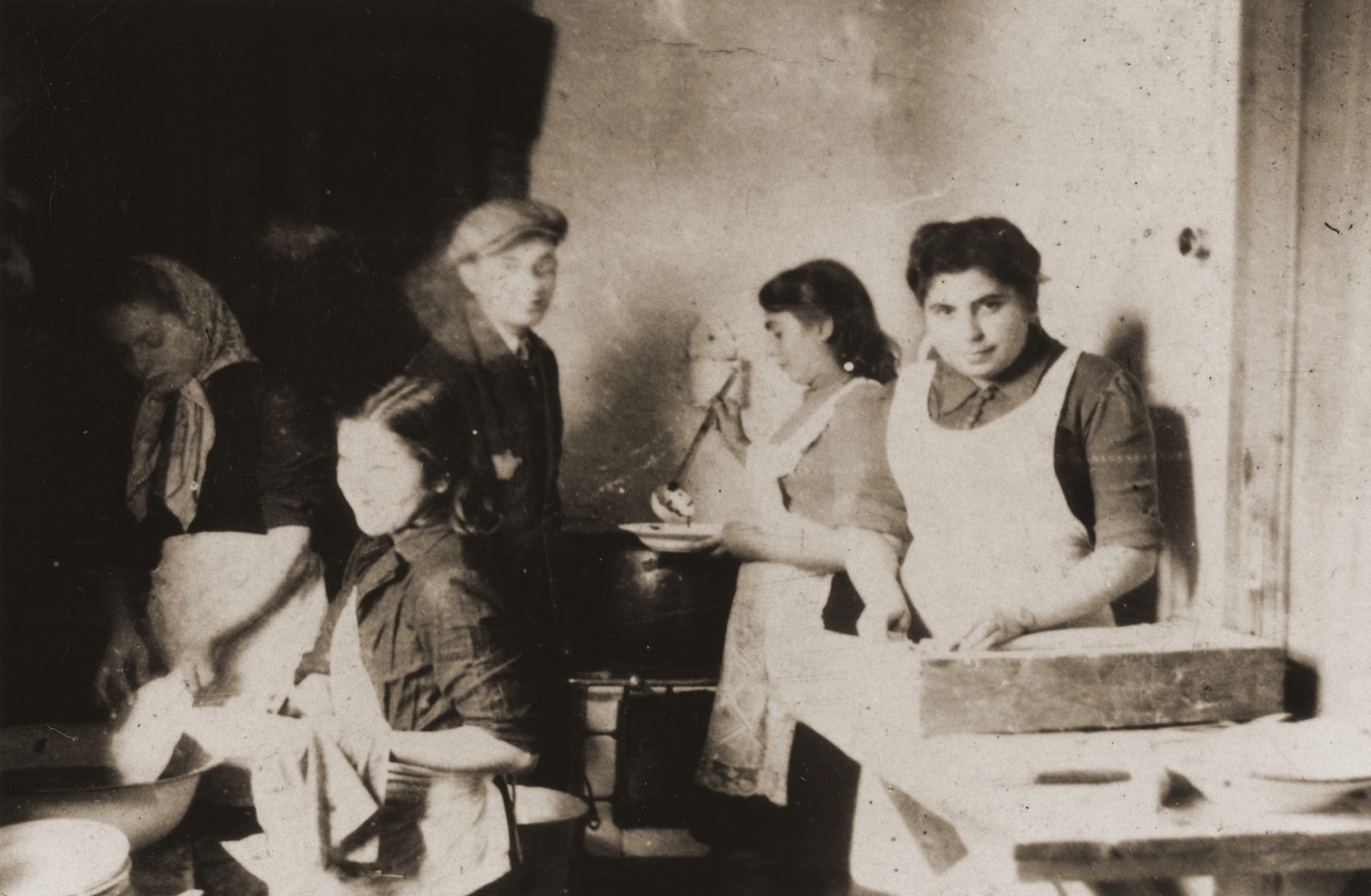
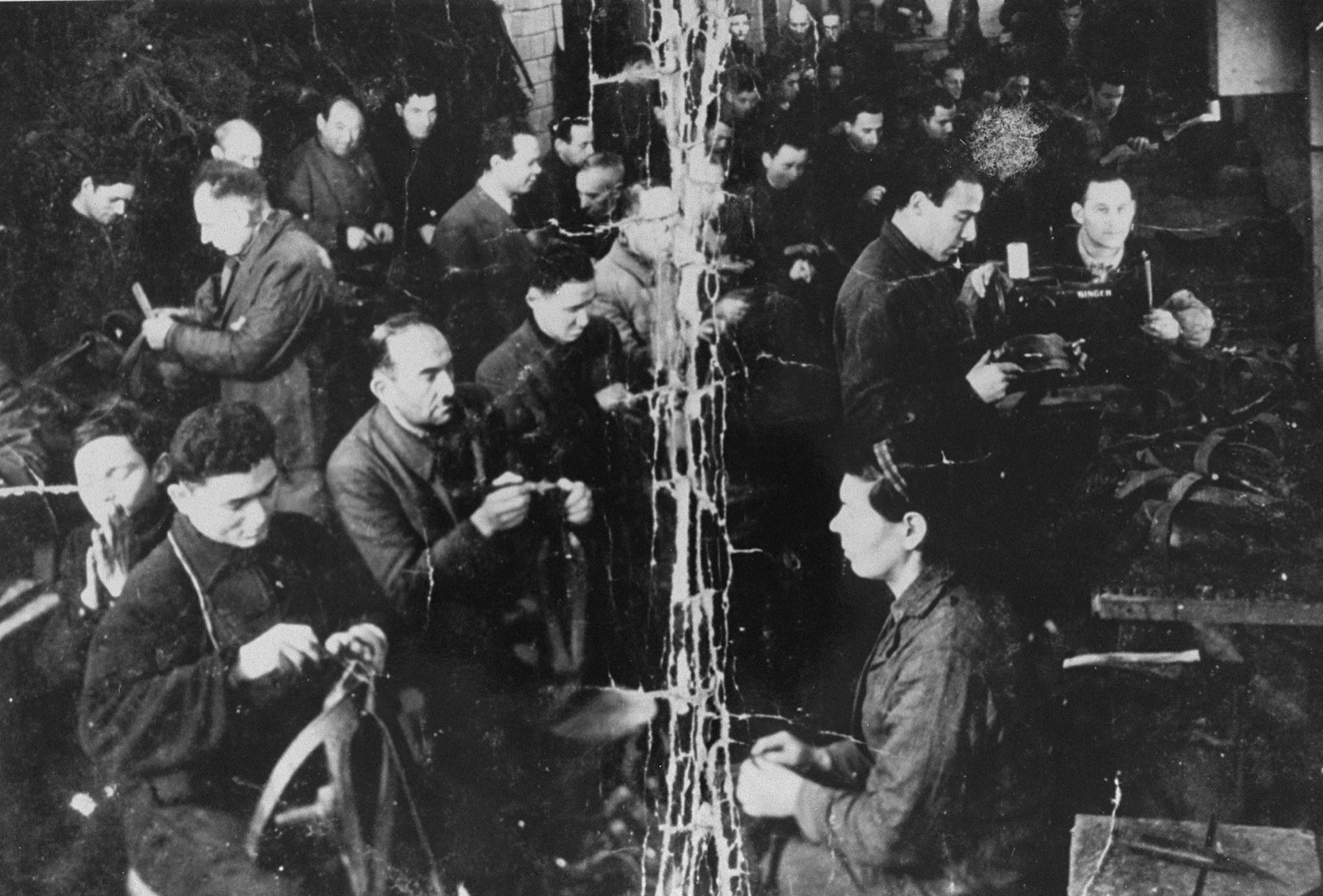
Lodz ghetto residents at work in a public kitchen. The ration came from the Germans and the kitchens did not; in Warsaw, community kitchens fed about a quarter of the ghetto. United States Holocaust Memorial Museum, courtesy of Muzeum Sztuki w Lodzi. Public domain.
Made by Jews for the ghetto administration Unidentified. Made inside the ghetto; photographer not recorded by USHMM · 1940-1944 · United States Holocaust Memorial Museum, courtesy of Muzeum Sztuki w Lodzi, USHMM pa1118571 Public domain View the record: Lodz ghetto residents at work in a public kitchen. The ration came
We came to live in the ghetto in, in October 1940. By, by March my father was dead, starved to death, literally.
Leah Hammerstein Silverstein, Warsaw ghetto. US Holocaust Memorial Museum Collection. Hear it at the United States Holocaust Memorial Museum: Leah Hammerstein Silverstein
Typhus followed the crowding. Warsaw logged 20,160 reported cases across two waves, a small one from late 1939 and a major one from early 1941, and the ghetto's own epidemiologists thought reporting caught a fifth to a quarter of infections. In late October 1941, just as winter began, when typhus normally accelerates, it collapsed. The 2020 Science Advances study credits what the ghetto did for itself: sanitary courses that drew more than 900 people, hundreds of public lectures, home isolation, an underground university training medical students. Without that work the modeling puts infections two to three times higher.
Mordechai Chaim Rumkowski, who headed the Lodz Jewish council, held that a ghetto indispensable to the German war economy would not be destroyed. Lodz outlasted the Warsaw ghetto by more than a year, and the strategy saved neither the ghetto nor the children.
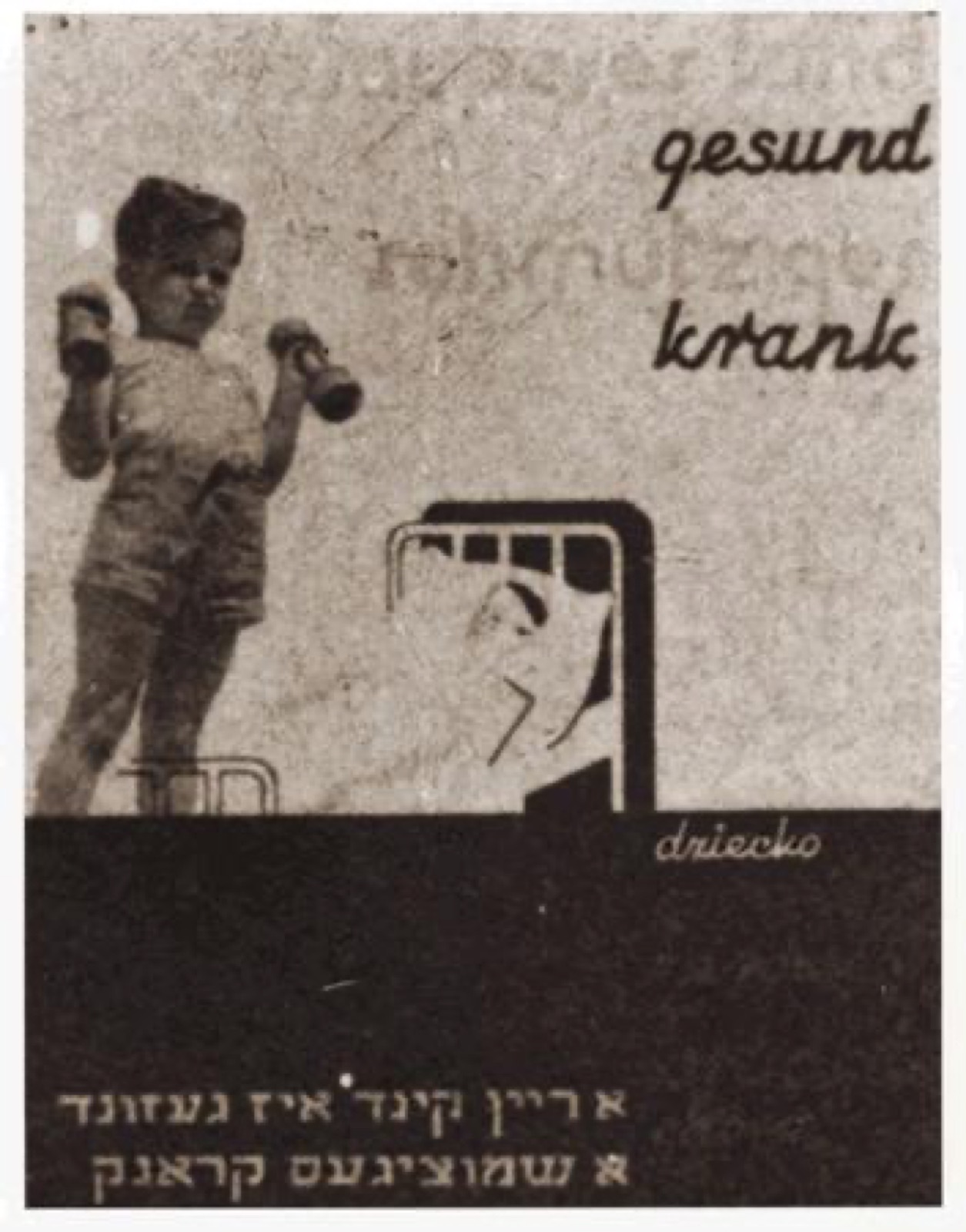
The slogan reads "A clean child is healthy. A dirty one is sick." The Lodz ghetto's Jewish council put the poster out. United States Holocaust Memorial Museum. Public domain.
Made by Jews for the ghetto administration Litzmannstadt ghetto Judenrat · 1940-1944 · United States Holocaust Memorial Museum Public domain View the record: The slogan reads "A clean child is healthy. A dirty one is sick." The
Ghettos that lasted years built institutions. Hundreds of clandestine schools ran across occupied Poland, students carrying their books under their clothes. A public library opened in the first days of the Vilna (Vilnius) ghetto at 6 Strashun Street with 45,000 books, and on December 13, 1942 the ghetto marked the loan of its hundred-thousandth book. Warsaw's Jewish Symphony Orchestra played its first concert in November 1940, and community kitchens fed about a quarter of the ghetto. In Warsaw in 1940 there were 600 Jewish prayer groups, meeting in cellars and attics with people posted to watch. Rabbis ruled on questions Jewish law had never been asked: Ephraim Oshry answered them in Kovno, wrote the rulings down, hid them and dug them out after the war. Kalonymus Kalman Shapira, the Piaseczner Rebbe, buried his Warsaw sermons before the ghetto was destroyed, and they came out of the rubble.
The ghettos argued about it at the time. When Vilna announced its first concert in January 1942 the Bund boycotted it and put up placards reading "In a graveyard you do not do theatre." Herman Kruk, who ran the library, wrote that the invitation made him feel humiliated. By March he had changed his mind and recorded that the halls were full. In Horochow (Horokhiv), Charlene Schiff's mother and other women ran a clandestine school for a few months, bartering outside the fence for paper, until there was nothing left to barter with.
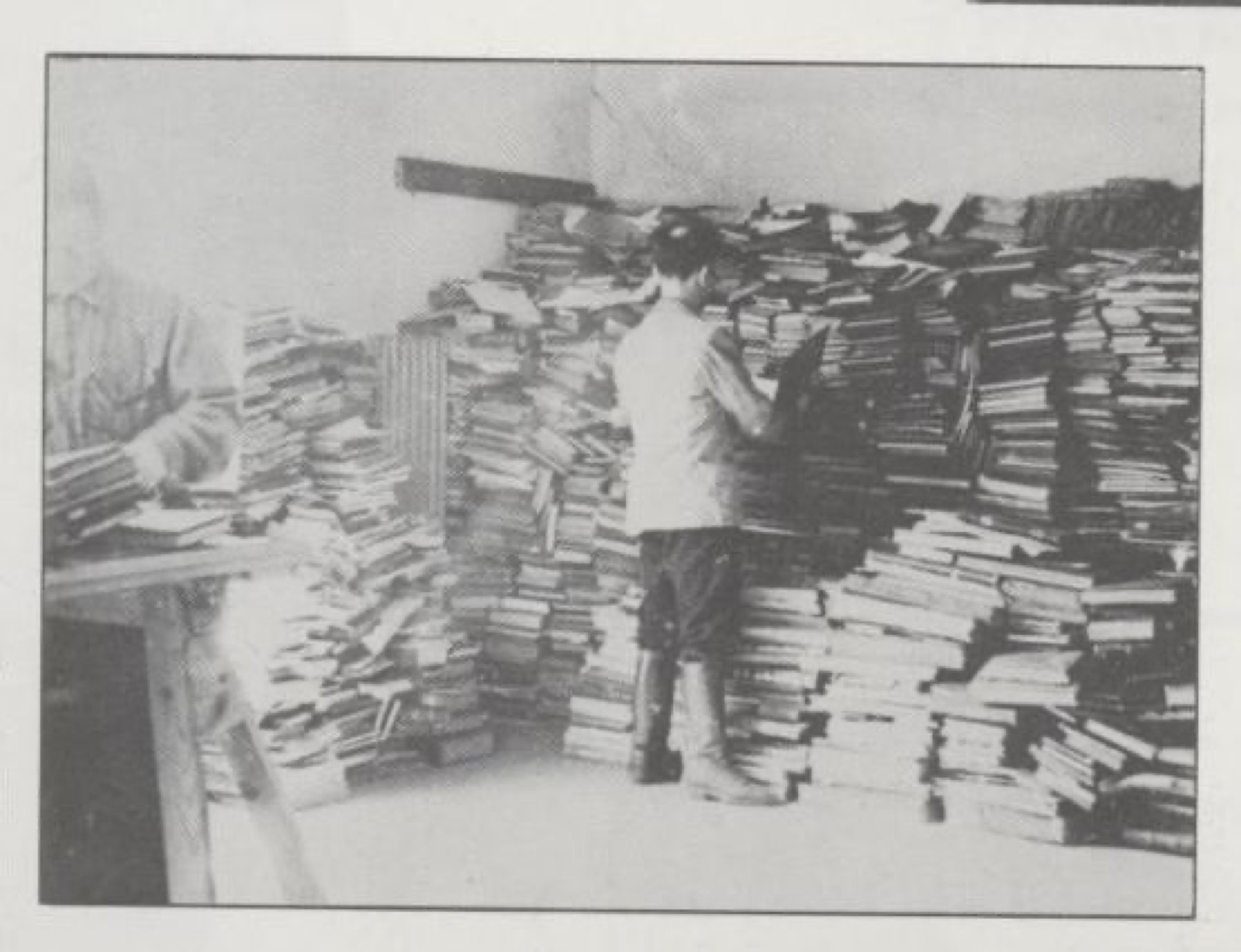
Shmerke Kaczerginski was one of about forty Jews forced to sort Vilna's Jewish books for shipment to Germany or destruction, and these are some of the books they hid instead. Vilna Gaon State Jewish Museum, via LIMIS. CC BY 4.0.
Photographed after the war Photographer unknown · late 1940s · Vilna Gaon State Jewish Museum (Valstybinis Vilniaus Gaono zydu muziejus), via LIMIS CC BY 4.0: licence for Shmerke Kaczerginski was one of about forty Jews forced to sort View the record: Shmerke Kaczerginski was one of about forty Jews forced to sort
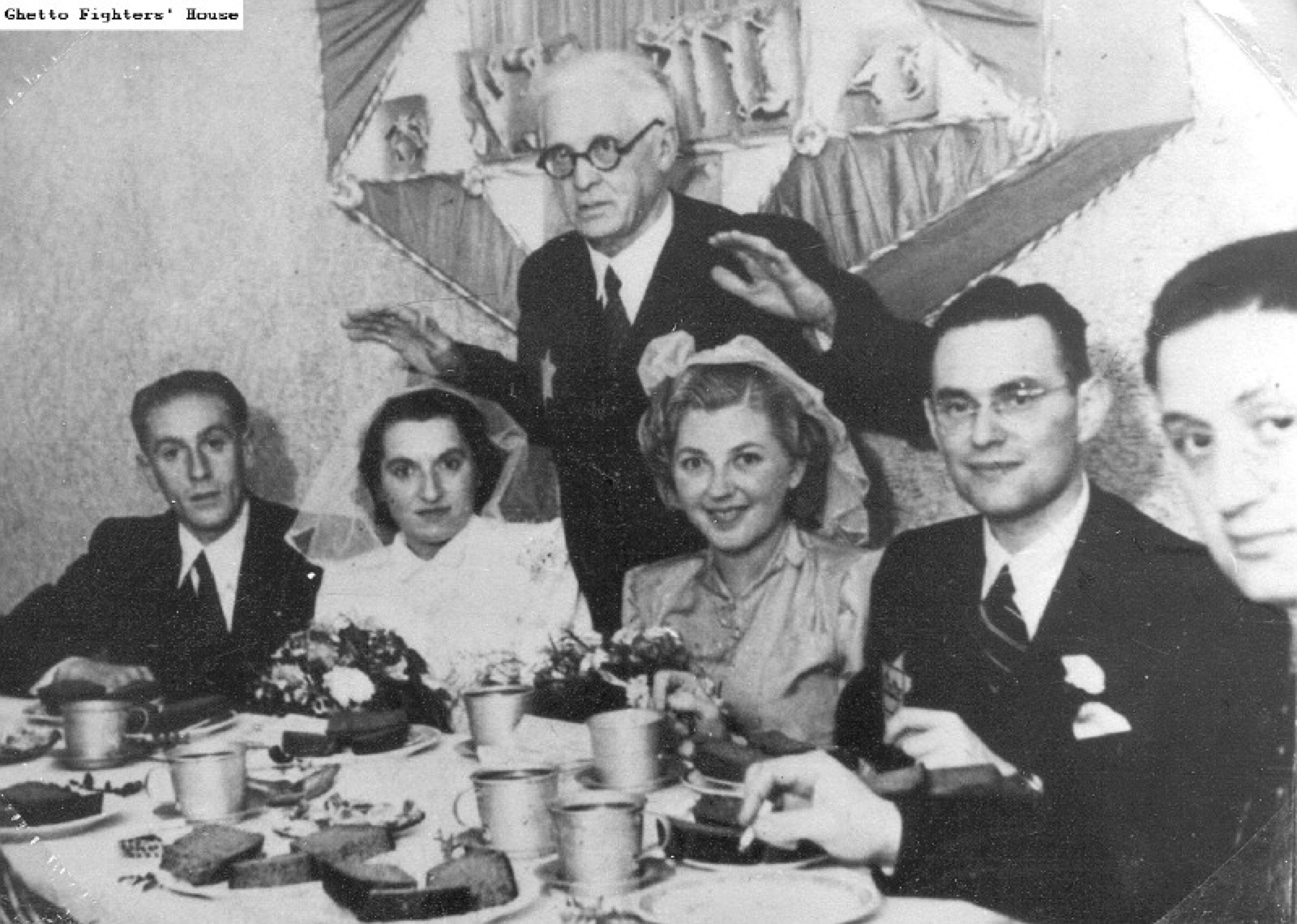
People married inside the ghetto, and in Lodz the council chairman conducted the ceremonies himself. Photograph by Mendel Grossman. Ghetto Fighters' House Archive. Public domain (author died 1945).
Photographed at the time Mendel Grossman · circa 1942-1944 · Ghetto Fighters' House Archive Public domain View the record: People married inside the ghetto, and in Lodz the council chairman
And the women came home, and they were too tired, and too hungry, and too beaten up to be able to go and, and put on a happy face for us kids. So that disintegrated into nothing also.
Charlene Schiff, Horochow ghetto. US Holocaust Memorial Museum Collection. Hear it at the United States Holocaust Memorial Museum: Charlene Schiff
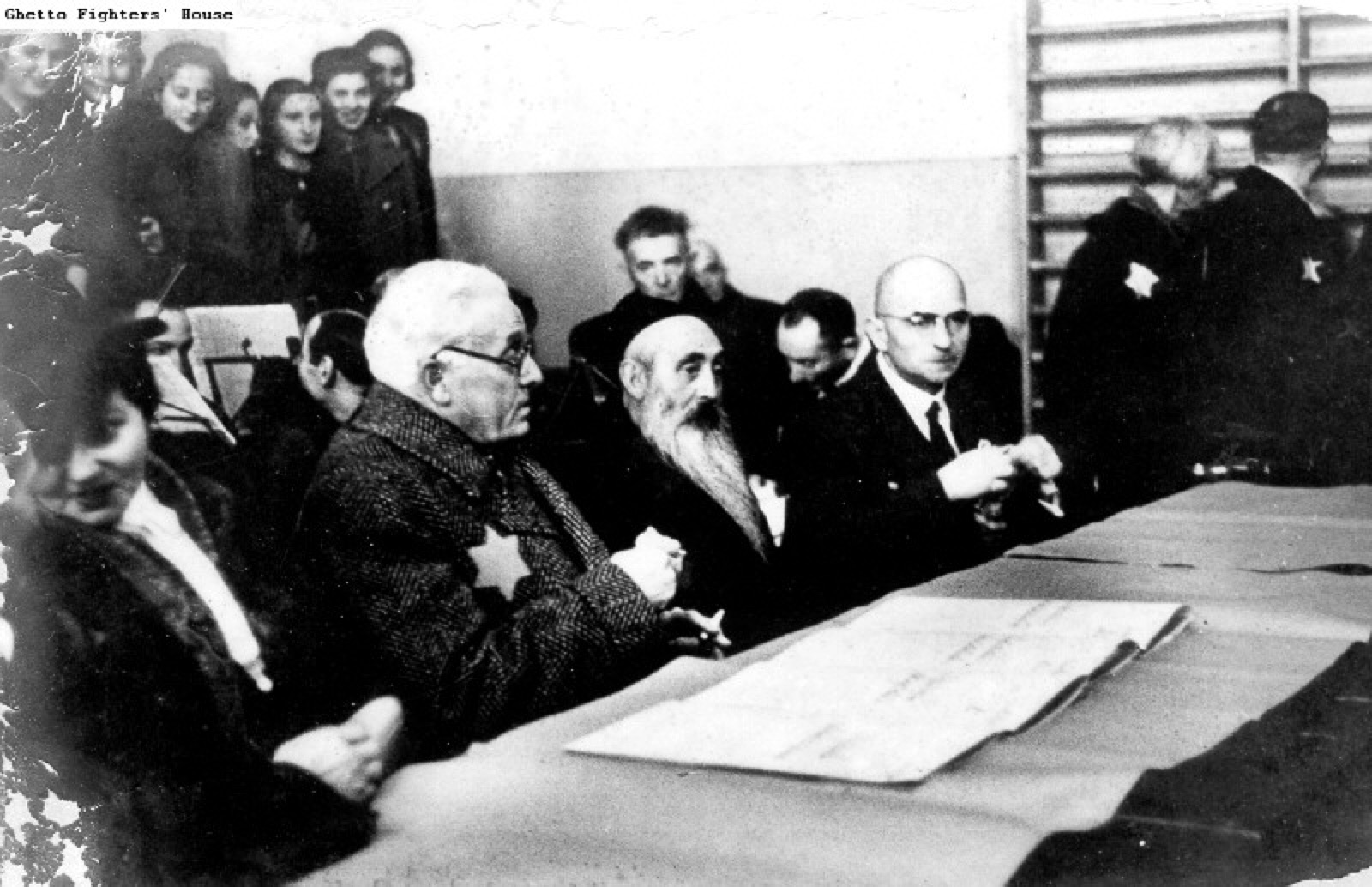
A gymnasium graduation inside the ghetto, the council chairman and a rabbi in the same frame. Photograph by Mendel Grossman. Ghetto Fighters' House Archive. Public domain (author died 1945).
Photographed at the time Mendel Grossman · 1940-1941 · Ghetto Fighters' House Archive (Beit Lohamei Haghetaot) Public domain View the record: A gymnasium graduation inside the ghetto, the council chairman and a
Who held the camera
Before you read on: who took these photographs?
Six photographs of the ghettos that many people have seen. Decide who took each one.
A boy in a cap with his hands above his head, guns behind him, Warsaw, 1943.
Show the answer
Taken by a German.
It is a page from the album Jurgen Stroop, who commanded the destruction of the Warsaw ghetto, had made for Heinrich Himmler. The album's own caption says the people in it were forcibly pulled out of bunkers. The child has never been identified with certainty.
Children waiting behind a fence in Lodz in September 1942, before they were taken away.
Show the answer
Taken by a Jew inside the ghetto.
Mendel Grossman, a Jewish photographer in the Lodz ghetto, photographed children waiting behind chain-link fences during the deportation of September 1942, when almost all the children under ten were taken from the ghetto. He could have been killed for taking these pictures.
Source: Yad VashemKovno ghetto streets, photographed through a hole in an overcoat.
Show the answer
Taken by a Jew inside the ghetto.
In Kovno a science teacher named Zvi Kadushin, later known as George Kadish, photographed through a buttonhole in his overcoat, and a Jewish policeman, Yehuda Zupowitz, hid the negatives. Zupowitz was tortured and killed at the Ninth Fort in March 1944 and never said where they were. Kadish recovered them.
Source: United States Holocaust Memorial MuseumWell-dressed people eating and drinking in the Warsaw ghetto, on film shot in May 1942.
Show the answer
Taken by a German.
On May 1, 1942 a German crew came into the ghetto to shoot an antisemitic film. Witnesses in the Ringelblum Archive describe the crew forcing people to act out staged scenes.
Source: Jewish Historical InstituteJews carrying their belongings into the Lodz ghetto, in a picture captioned as a house move.
Show the answer
Taken by a German.
It is a German photograph, now in the Bundesarchiv, Germany's federal archive, under a caption calling it a house move. Pictures like it survive because a state kept its paperwork and expected to be admired for it.
Daily life in the Lodz ghetto, on negatives buried in 1944 and dug up after liberation.
Show the answer
Taken by a Jew inside the ghetto.
Henryk Ross held a post in the Lodz ghetto's Department of Statistics, which gave him film and a darkroom, and used it to photograph what he had not been assigned. In 1944 he buried about 6,000 negatives and dug them up after liberation; somewhat more than half came out.
Source: Yad Vashem
Most of the wartime photographs on this page were made by Jews inside the ghettos. The caption under each one says who held the camera wherever the record shows it.
Jurgen Stroop, who commanded the destruction of the Warsaw ghetto, had an album made for Heinrich Himmler: a narrative summary, the daily teletype reports of April 20 to May 24, 1943, and about fifty captioned photographs. It went in at Nuremberg as document 1061-PS. A Warsaw court sentenced Stroop to death in 1951 and he was hanged the following year, convicted largely on his own report.
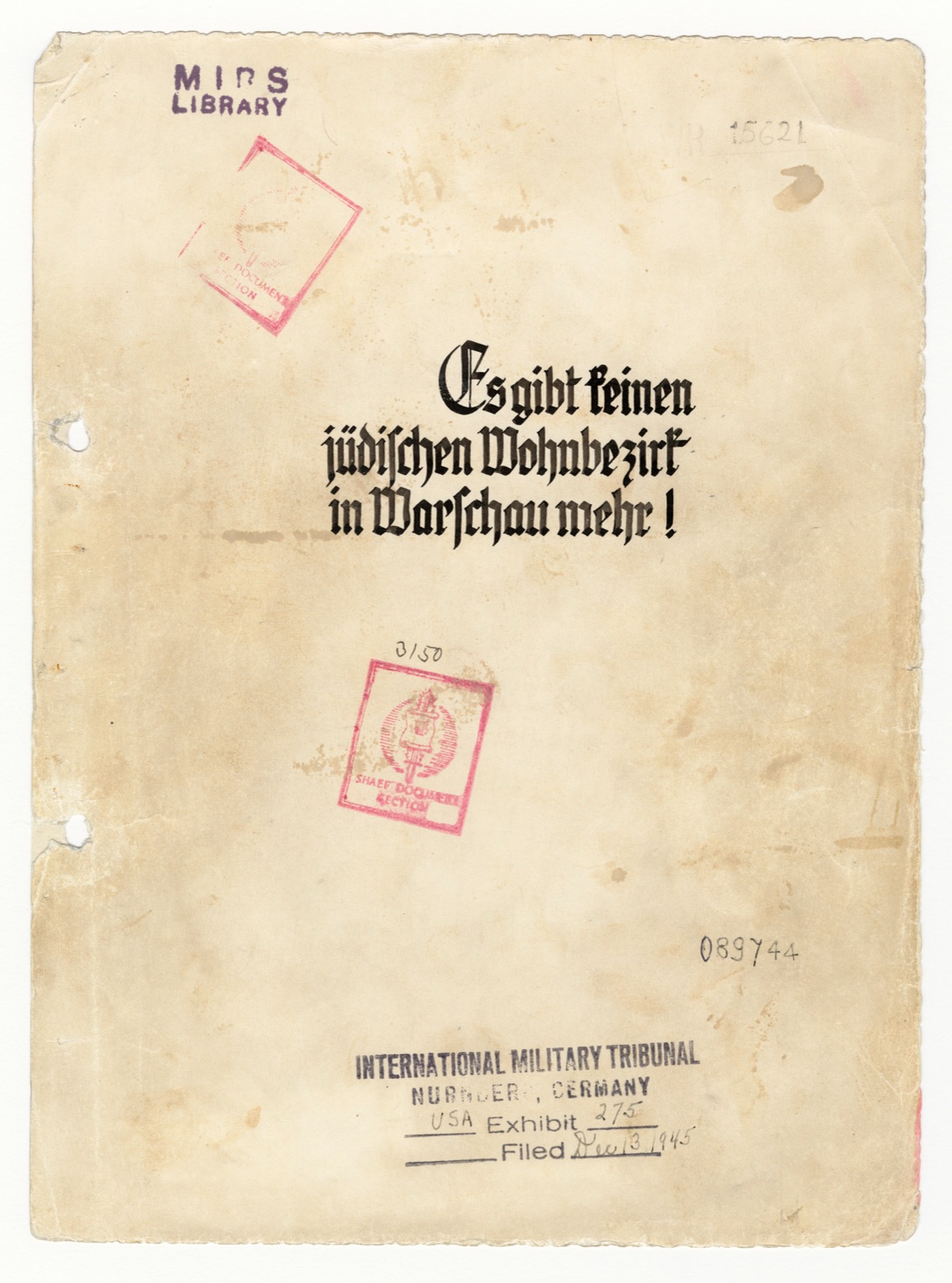
His title translates as The Jewish Quarter of Warsaw Is No More. Cover page of Jurgen Stroop's report to Heinrich Himmler on the destruction of the Warsaw ghetto, May 1943, bearing Nuremberg Tribunal evidence stamps. National Archives and Records Administration, USA Exhibit 275, RG 238 (Nuremberg document 1061-PS). Public domain, via Wikimedia Commons.
Trial exhibit Photographer unknown · May 1943 · National Archives and Records Administration, NARA: USA Exhibit 275, RG 238 (https://research.archives.gov/description/596662); Nuremberg document 1061-PS; USHMM Photograph #73853 Public domain View the record: His title translates as The Jewish Quarter of Warsaw Is No More.
One of the most reproduced photographs of the Holocaust is a page from that album. A boy in a cap, hands above his head, guns behind him. The album's own caption says the people in it were forcibly pulled out of bunkers. The child has never been identified with certainty. This page does not reprint it.
Andrzej Zbikowski, who edited the Polish scholarly edition, points out that the report's vocabulary is evidence too. Germans in it are heroic, fraternal, brave. Jews are rats, vermin, lice, or at best bandits. A photograph out of that album published with a neutral caption is a trophy reprinted as documentation.
The moving pictures have the same problem. On May 1, 1942 a German crew came into the ghetto to shoot an antisemitic film. Witnesses in the Ringelblum Archive describe the crew forcing people to act out staged scenes.
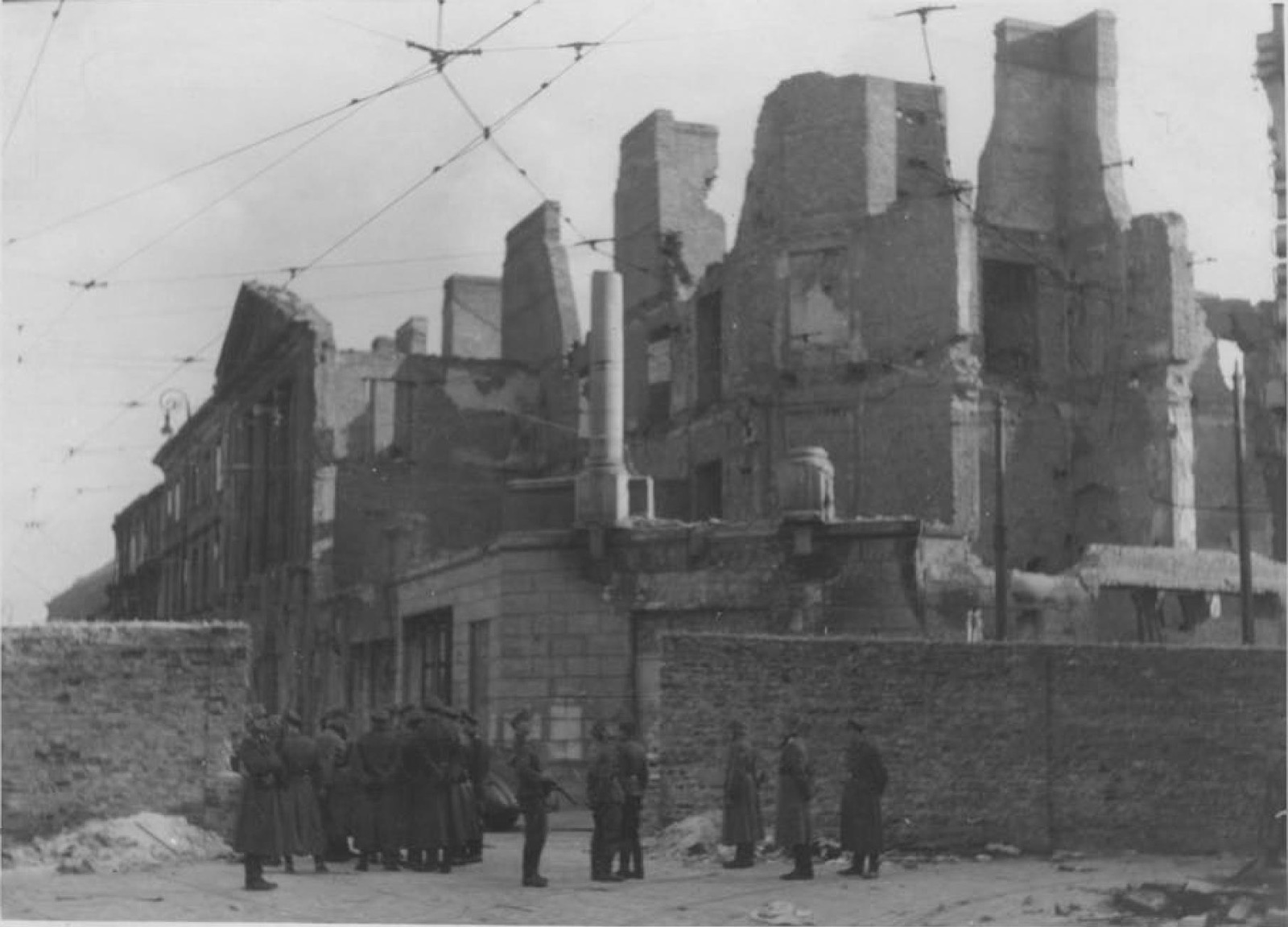
The picture and the words under it were both chosen by the man who ordered the destruction, which is what makes it a record of a perpetrator rather than of a place. From Jurgen Stroop's report to Heinrich Himmler on the destruction of the Warsaw ghetto, April-May 1943; the German album caption translates as This is how the former Jewish residential district looks after having been destroyed. Institute of National Remembrance, Warsaw copy; Nuremberg document 1061-PS. Public domain, via Wikimedia Commons.
From the SS report (photographers: SS and propaganda units) Photographer unknown · between 19 April 1943 and 16 May 1943 · Wikimedia Commons, Stroop Report photograph IPN50; Nuremberg document 1061-PS Public domain View the record: The picture and the words under it were both chosen by the man who
He said, 'They're all killed.' I said, 'How can you say they're all killed? There's no names.' ... 'I know three out of the five. Right in the middle is a friend of mine ... and on his right is his father.' ... And the man said to me, '... tell me, who's the third one?' I said, 'It's me. You're talking to me right now.'
Jack Ratz, who was held in the Riga ghetto, on a 1942 photograph of five prisoners that he found decades later on the wall of a museum in Riga, with no names under it. Project Witness testimony. Watch the full testimony. This passage begins at 2:57:01: Jack Ratz, Project Witness
Jews made their own record. Emanuel Ringelblum began a chronicle in October 1939, and after the ghetto was sealed it became an underground operation with several dozen contributors, working under cover of the Jewish Social Self-Help office beside the Great Synagogue on Tlomackie Street. They called themselves Oyneg Shabes, and they collected with postwar justice in mind, gathering duplicate material from as many towns as possible so it could establish who gave which order, when, and who helped. Some 35,000 documents came out: diaries, underground newspapers, ration cards, tram tickets, candy wrappers, theater posters, restaurant menus, hundreds of postcards from Jews about to be deported. Nearly everyone who made it was murdered.
It went into the ground in three caches. Ten tin boxes under the school at 68 Nowolipki Street on August 3, 1942, buried by the teacher Israel Lichtensztajn and two of his former pupils, Dawid Graber and Nachum Grzywacz. Two milk cans in the same cellar in February 1943. The third at 34 Swietojerska Street on the eve of the uprising. The first came up in 1946, the second in 1950. The third has never been found.
What we were unable to shout out to the world, we have buried in the ground.
Dawid Graber. Ringelblum Archive, Emanuel Ringelblum Jewish Historical Institute, Warsaw.
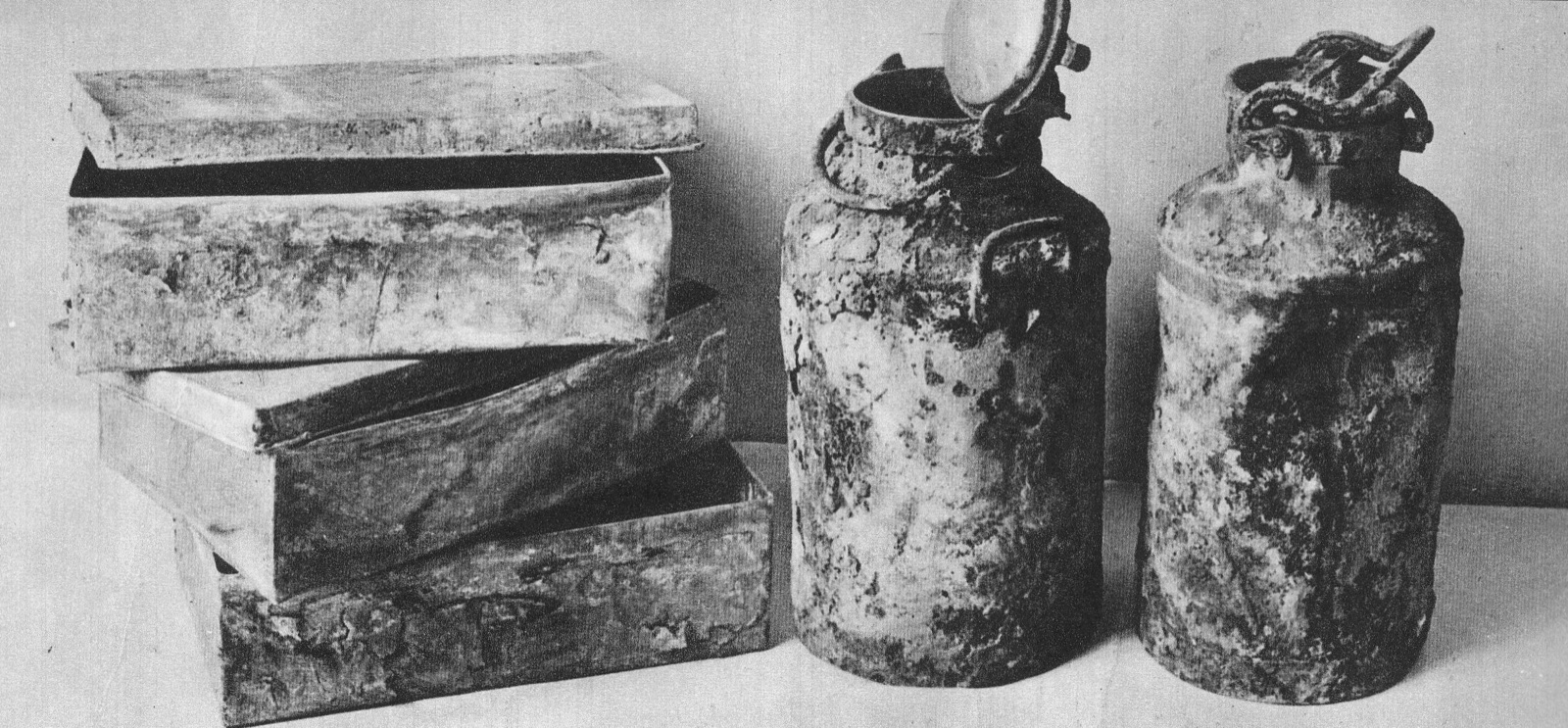
Both recovered caches came out of cellars in the same building. Three of the ten metal boxes and two milk cans in which the Ringelblum Archive was buried. Photographer unknown; published in Meczenstwo, walka, zaglada Zydow w Polsce 1939-1945 (Warsaw, 1960), photo 150. Public domain, via Wikimedia Commons.
Photograph of a surviving object Photographer unknown · Unknown date (post-1950 recovery) · Wikimedia Commons, photo no. 150 in the 1960 volume Public domain View the record: Both recovered caches came out of cellars in the same building. Three
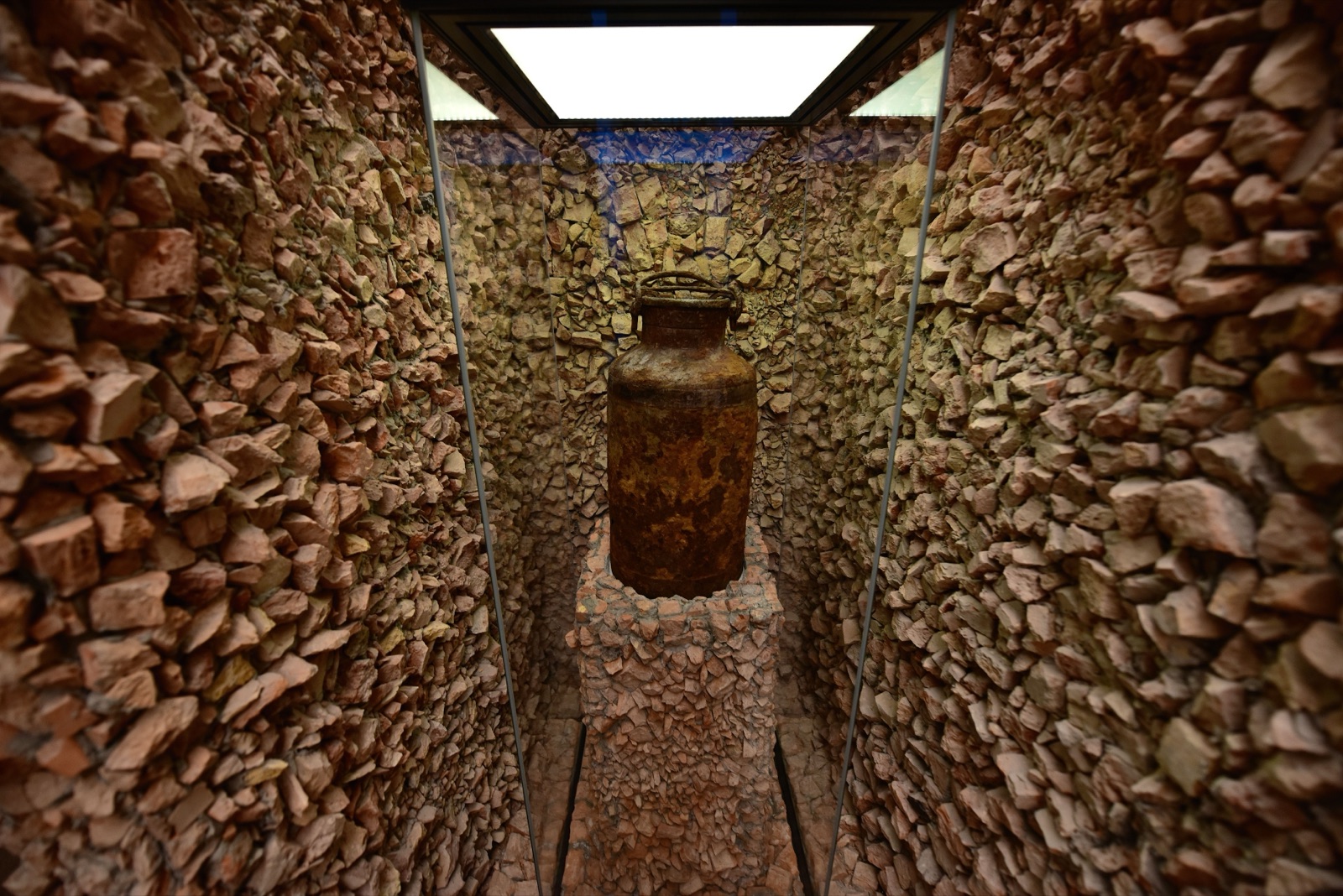
The exhibition takes its name from the line Graber wrote while he was burying the first cache, and the Institute that holds the archive stands where Ringelblum and his colleagues worked. Photo: Adrian Grycuk / Wikimedia Commons, CC BY-SA 3.0 PL. Permanent exhibition 'What we were unable to shout out to the world', Emanuel Ringelblum Jewish Historical Institute, Warsaw.
Postwar memorial photograph Adrian Grycuk · 27 December 2017 · Wikimedia Commons CC BY-SA 3.0 pl: licence for The exhibition takes its name from the line Graber wrote while he was View the record: The exhibition takes its name from the line Graber wrote while he was
The photographers worked the same way. Henryk Ross held a post in the Lodz ghetto's Department of Statistics, which gave him film and a darkroom, and used it to photograph what he had not been assigned. In 1944 he buried about 6,000 negatives and dug them up after liberation; somewhat more than half came out. Mendel Grossman and two friends hid about 10,000 negatives; his sister and the friends recovered them after the war. In Kovno a science teacher named Zvi Kadushin photographed through a buttonhole in his overcoat, and a Jewish policeman, Yehuda Zupowitz, hid the negatives. Zupowitz was tortured and killed at the Ninth Fort in March 1944 and never said where they were. Kadish recovered them.
Both records sit on the same UNESCO Memory of the World register, the Ringelblum Archive since 1999 and Stroop's report since 2017. Which of the two a reader has seen can be measured. Of 106 images in Project Witness's own ghetto learning modules, 49 were made by Germans and 3 come from the Jewish clandestine record. The pool gathered for this page runs the other way: 38 images made by Jews against 29 made by a German body, counting the SS, the propaganda companies, the occupation's civil administration and private German cameras together.
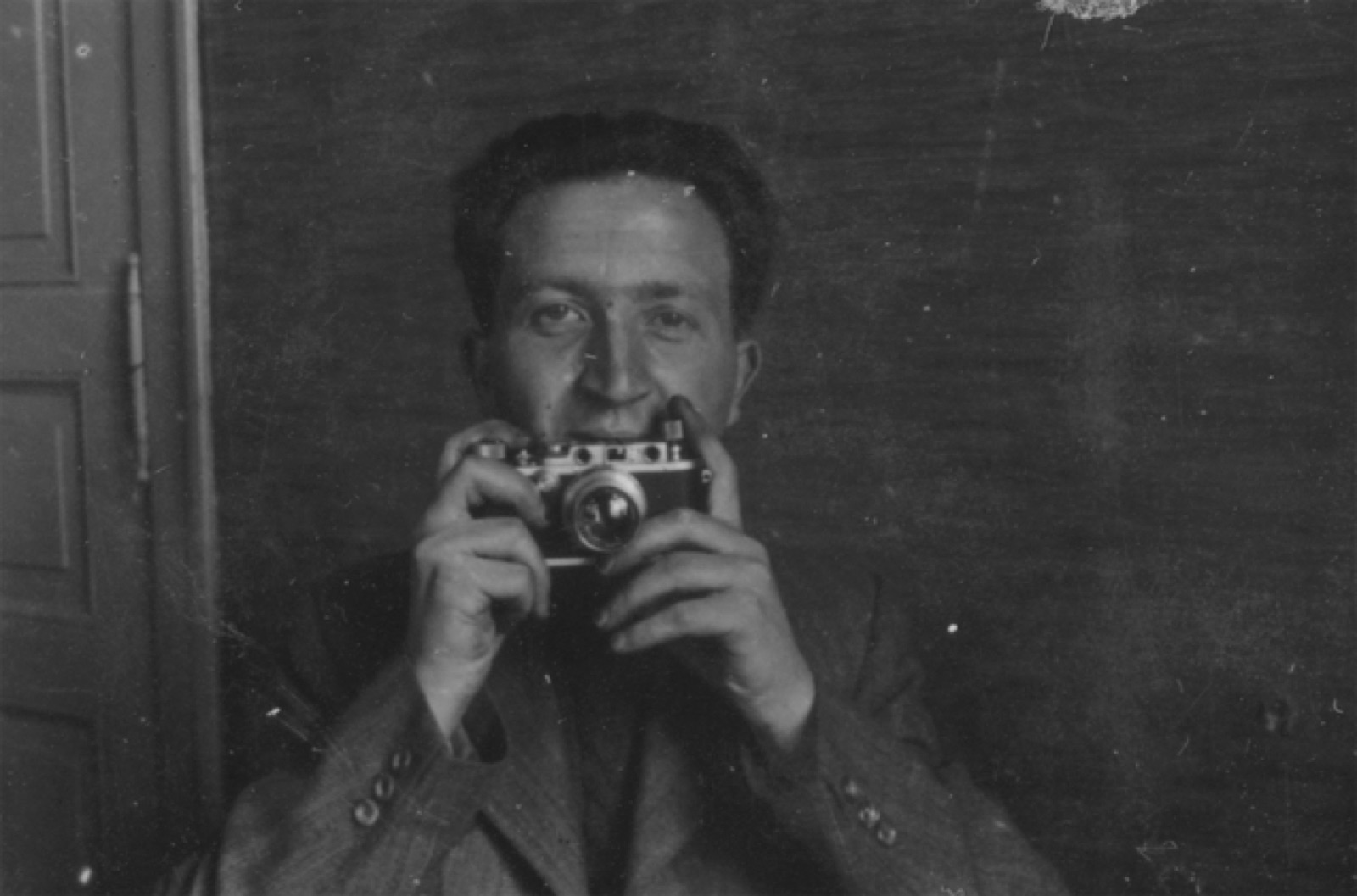
He photographed the Lodz ghetto from 1940 to 1944. Self-portrait by Mendel Grossman. Public domain (author died 1945).
Made clandestinely by a prisoner Mendel Grossman · before 1946 · Yad Vashem, via Wikimedia Commons Public domain View the record: He photographed the Lodz ghetto from 1940 to 1944. Self-portrait by
The Warsaw ghetto uprising
About seven hundred fighters with pistols and homemade grenades, and the civilians who hid with them, held off the Germans for nearly a month.
The first shots came in January. On January 18, 1943 the SS came back to resume the deportations halted in September. Fighters with pistols walked into a column bound for the Umschlagplatz and turned on the escort. Most were killed, but the column scattered, and on January 21 the Germans stopped, having taken about 5,000 to 6,500. The ghetto read that as a victory, and that winter families dug bunkers.
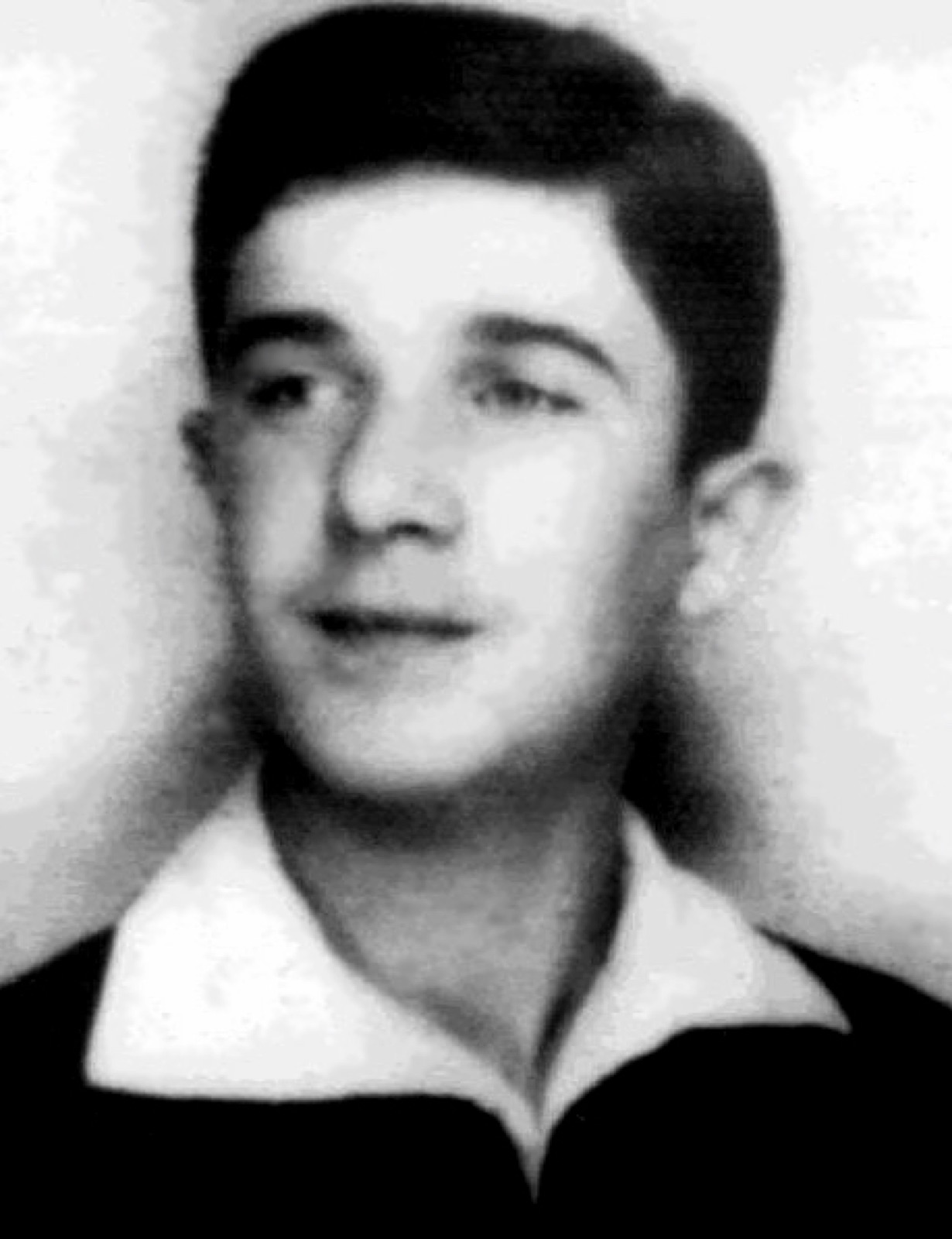
Mordechai Anielewicz in January 1938. Wikimedia Commons, sourced to Yad Vashem, public domain. He commanded the ZOB at twenty-three or twenty-four. Mordechai Anielewicz, commander of the Jewish Combat Organization (ZOB). Photographer unknown; via Wikimedia Commons, sourced to Yad Vashem. Public domain (Polish pre-1994 photographs rule).
Photographed before the war Photographer unknown · 5 January 1938 · Wikimedia Commons Public domain View the record: Mordechai Anielewicz in January 1938. Wikimedia Commons, sourced to
The Jewish Combat Organization, the ZOB, was founded on July 28, 1942 with roughly 200 members. By April it had about 500 fighters, and the Jewish Military Union, out of Betar, had about 250. The Polish Home Army sent ten pistols at the end of December and fifty more with fifty grenades at the end of January.
By now every partisan was equipped, on the average, with one pistol (and 10-15 rounds for it), 4-5 hand grenades, 4-5 Molotov cocktails. 2-3 rifles were assigned to each 'area'. There was just one machine-gun in the entire ghetto.
Marek Edelman, The Ghetto Fights, 1945
Stroop's own order of battle averages 36 officers and 2,054 men a day, with artillery and tanks, and lists the Polish Blue Police and the Polish fire brigade alongside the Waffen SS. The operation began at 6 a.m. on April 19, 1943, the eve of Passover. The first German force was driven back, and Stroop took over at 8 a.m. Unable to take the district street by street, he burned it building by building, and destroyed 631 dug-outs.
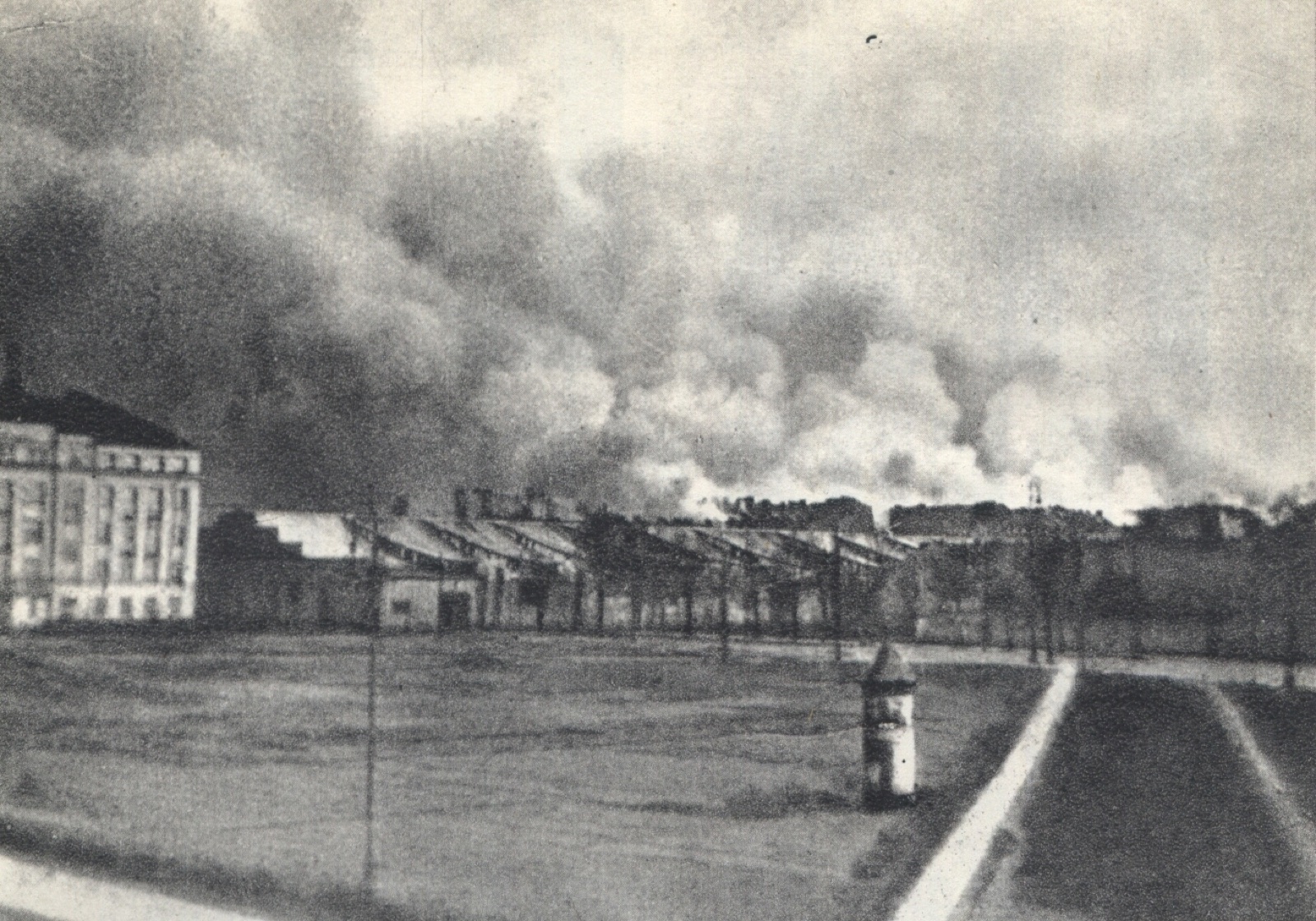
The ghetto burning, late April 1943, seen from outside the walls. Photographer unknown; Bartoszewski, Warszawski pierscien smierci (Warsaw, 1970). Public domain. Germans made almost every other image of these weeks. The Warsaw ghetto burning, late April 1943, photographed from outside the walls. Photographer unknown; published in Wladyslaw Bartoszewski, Warszawski pierscien smierci 1939-1944 (Warsaw: Interpress, 1970). Public domain, via Wikimedia Commons.
Wartime photograph from a Polish source Photographer unknown · April 1943 · Wikimedia Commons Public domain View the record: The ghetto burning, late April 1943, seen from outside the walls.
...the whole ghetto was one sea, one sea of rubble. Everything there had fallen in, and that is why the whole ground was hot, because it was burning all around. I didn't see the ghetto burning, but I felt on my skin the burning ghetto.
Krystyna Budnicka, born Hena Kuczer, who was about ten and hiding with her family in a bunker under the ghetto. Project Witness testimony, translated from Polish.Watch the full testimony. This passage begins at 1:04:16: Hena Kuczer, Project WitnessSpoken in Polish. Show the original
...całe getto to było jedno morze, jedno morze gruzów. Tam wszystko się zwaliło i dlatego cała ziemia była, była gorąca, bo to się paliło dookoła. Ja, ja nie, ja nie widziałam palącego się getta, ale czułam na ple- na, na skórze to palące się getto.
On May 8 the ZOB command bunker at 18 Mila Street was surrounded, and when it could not be stormed the Germans put gas into it. Roughly 120 people died there, Anielewicz among them; USHMM writes that he and many of his staff commanders "are thought to have committed suicide." About fifty fighters came out through the sewers on May 10. Edelman wrote: "Not all were able to get out."
Stroop ended it on May 16. The Great Synagogue on Tlomackie Street stood outside the ghetto boundary; he had it mined and set off the charges himself. We have found no photograph of the explosion.
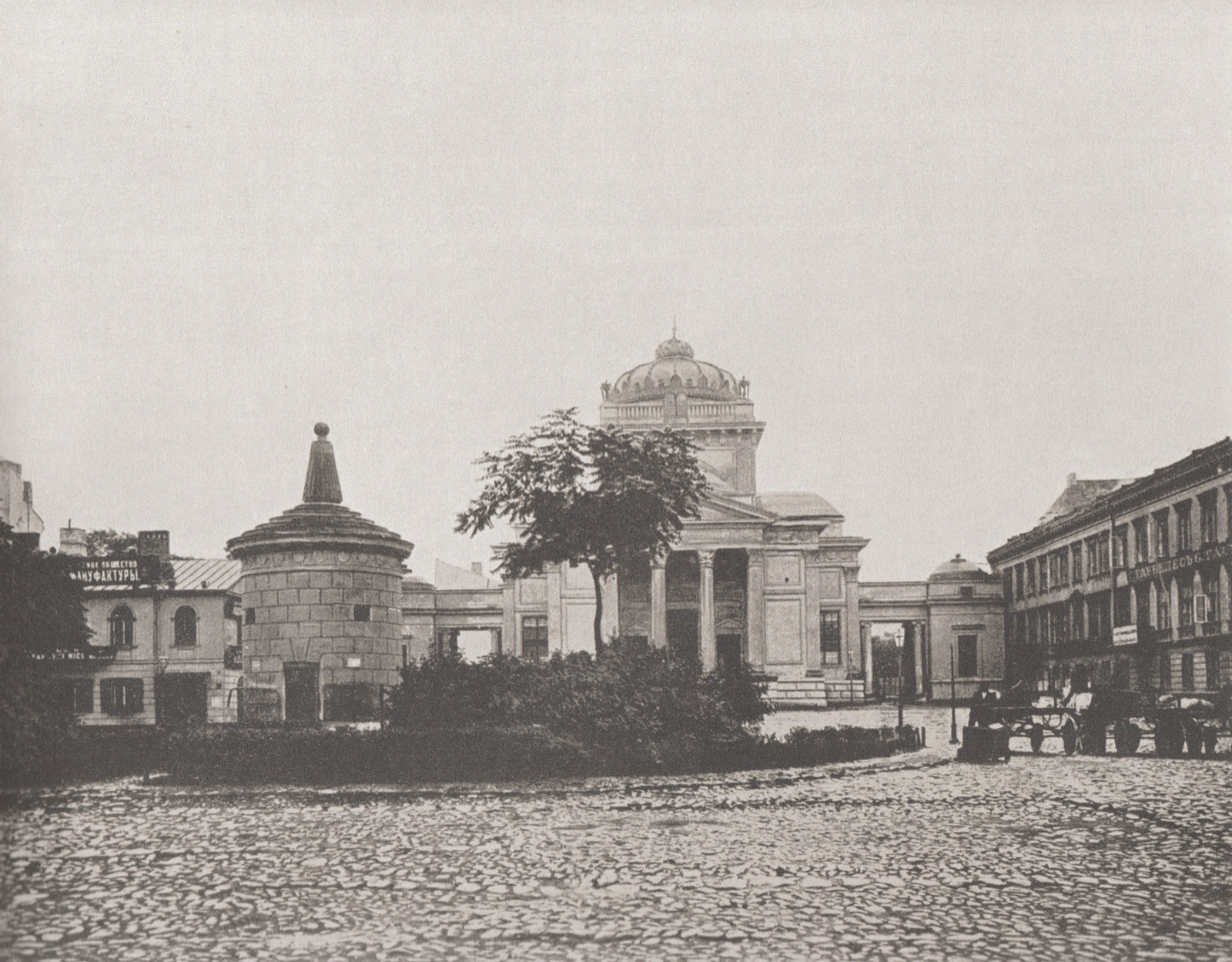
The Great Synagogue on Tlomackie Street, Warsaw, before 1898. Photographer unknown; reproduced in Kirshenblatt-Gimblett and Polonsky, Polin. 1000 lat historii Zydow polskich (POLIN Museum, 2014), p. 195. Public domain, via Wikimedia Commons. Leandro Marconi designed it and it opened in 1878. No photograph of its destruction on May 16, 1943 appears to survive.
Photographed before the war Photographer unknown · before 1898 · Wikimedia Commons Public domain View the record: The Great Synagogue on Tlomackie Street, Warsaw, before 1898.
Anielewicz had written to Yitzhak Zuckerman on the Aryan side on April 23: "The dream of my life has risen to become fact. Self-defense in the ghetto will have been a reality." What survives is the text that reached the underground press, not the letter as written.
The album claims 56,065 Jews caught, about 7,000 killed inside the ghetto and 6,929 sent to Treblinka, plus 5,000 to 6,000 more he estimated rather than counted. His phrase for the tally is "Jews whose extermination can be proved." He listed fifteen German dead. The fighters' own counts ran into the hundreds; Edelman and Lubetkin both said so after the war. Stroop was writing to impress Himmler; the fighters had no German records.
It was the largest Jewish revolt of the war and the first significant urban revolt against German occupation in Europe. It did not save the ghetto. At least 7,000 died fighting or in hiding, about 7,000 more went to Treblinka, and about 42,000 to Poniatowa, Trawniki and Majdanek, where most were shot over two days that November. See our page about the camps. This is not the Warsaw Uprising, which the Home Army fought in August 1944.
The really important things were inherent in the force shown by Jewish youth, after years of degradation, to rise up against their destroyers, and determine what death they would choose: Treblinka or Uprising.
Yitzhak Zuckerman, deputy commander of the ZOB, in 1968
The other ghettos
Warsaw was one of more than 1,300, and most of the rest are known by one date and one number.
USHMM's current count is more than 1,300 ghettos established by the Nazis and their allies, about 1,100 of them German and almost all in occupied eastern Europe. Romania built about 150 in Transnistria, Hungary more than 60 in 1944. An older figure of at least 1,000 counted German ghettos in Poland and the Soviet Union alone.
All 29 ghettos on this map, October 1939 to May 1945.
Swipe the map sideways to see all of it.
- A ghetto, all years at once
- Set up, not yet sealed
- Set up; no sealing date in our sources
- Sealed
- Its people being deported or killed
- Destroyed
- Still standing when liberated
29 of the more than 1,300 ghettos the Germans and their allies set up: the ones this page names, the largest, and the ones survivors in Project Witness's library came from. Positions are approximate. Where a source gives only a year, the change shows from December of that year. Where our sources give no date for sealing a ghetto, we say so rather than guess.
Drawn by Project Witness; every date is sourced in the table below. Base map: Natural Earth, public domain.
All 29 ghettos on the map, with their dates
| Ghetto | Set up and sealed | How it ended | What happened to the people in it |
|---|---|---|---|
| Piotrkow TrybunalskiPoland | Set up October 1939, sealed April 1942 | Destroyed from October 15, 1942 | Between 18,000 and 22,000 deported to Treblinka in October 1942 United States Holocaust Memorial Museum, Holocaust Encyclopedia |
| LodzPoland | Set up February 1940, sealed April 30, 1940 | Destroyed June to August 1944 | Deported to Chelmno in 1942 and in June and July 1944; in August 1944 almost all who remained were deported to Auschwitz-Birkenau United States Holocaust Memorial Museum, Holocaust Encyclopedia |
| BrzezinyPoland | Set up April 28, 1940; no sealing date in our sources | Destroyed from May 14, 1942 | The young and the infirm deported to Chelmno and murdered; the able-bodied sent mainly to the Lodz ghetto, May 1942 Yad Vashem, Transports to Extinction (deportation database) |
| WarsawPoland | Set up October 2, 1940, sealed November 16, 1940 | Destroyed April 19 to May 16, 1943 | About 265,000 deported to Treblinka in the summer of 1942; after the April to May 1943 uprising, survivors were deported to Treblinka, Majdanek, Poniatowa and Trawniki Emanuel Ringelblum Jewish Historical Institute, Warsaw |
| BedzinPoland | Set up 1940; no sealing date in our sources | Destroyed from August 1, 1943 | Deported to Auschwitz from May 1942; the last 12,000 sent to Auschwitz in August 1943 and about 2,000 shot in the streets United States Holocaust Memorial Museum, Collections |
| OtwockPoland | Set up 1940; no sealing date in our sources | Destroyed from August 19, 1942 | Murdered on the spot or deported to Treblinka in August 1942 Institute of National Remembrance (IPN), Przegląd Archiwalny IPN |
| SosnowiecPoland | Set up 1940; no sealing date in our sources | Destroyed from August 1, 1943 | Deported to Auschwitz in 1942 and at the August 1943 liquidation United States Holocaust Memorial Museum, Collections |
| KrakowPoland | Set up March 1941; no sealing date in our sources | Destroyed March 13 to 14, 1943 | Deported to Belzec in June and October 1942; at the March 1943 liquidation about 2,000 were shot in the ghetto, about 2,000 sent to Plaszow, and about 3,000 deported to Auschwitz-Birkenau United States Holocaust Memorial Museum, Holocaust Encyclopedia |
| LublinPoland | Set up March 1941; no sealing date in our sources | Destroyed March 17 to April 20, 1942 | Deported to Belzec in March and April 1942; most of the 4,000 moved to the small ghetto at Majdan Tatarski were deported to Majdanek in September and October 1942 Yad Vashem, This Month in Holocaust History |
| RadomPoland | Set up March 1941; no sealing date in our sources | Destroyed August 5 to 17, 1942 | Deported to Treblinka in August 1942 United States Holocaust Memorial Museum, Collections |
| CzestochowaPoland | Set up April 9, 1941, sealed August 23, 1941 | Destroyed September 22 to October 8, 1942 | About 39,000 deported to Treblinka, September 22 to October 8, 1942 Yad Vashem, Shoah Resource Center (International School for Holocaust Studies) |
| KovnoLithuania | Set up July 1941, sealed August 15, 1941 | Destroyed July 1944 | Shot at the Ninth Fort, above all on October 29, 1941; at the July 1944 evacuation, women deported to Stutthof and men to Dachau United States Holocaust Memorial Museum, Holocaust Encyclopedia |
| MinskBelarus | Set up July 1941; no sealing date in our sources | Destroyed June to October 1943 | Mass shootings from August 1941; at the 1943 liquidation, deported to Sobibor and Majdanek or killed at Maly Trostinets United States Holocaust Memorial Museum, Holocaust Encyclopedia |
| BialystokPoland | Set up August 1941; no sealing date in our sources | Destroyed August 1943 | About 10,000 deported to Treblinka in February 1943; at the August 1943 liquidation, deported to Treblinka and Majdanek, and more than 1,000 children sent through Theresienstadt to Auschwitz-Birkenau United States Holocaust Memorial Museum, Holocaust Encyclopedia |
| RigaLatvia | Set up August 1941, sealed October 1941 | Destroyed December 1943 | At least 25,000 shot in the Rumbula Forest on November 30 and December 8 and 9, 1941; the last Jews deported to Kaiserwald when the ghetto was destroyed in December 1943 United States Holocaust Memorial Museum, Holocaust Encyclopedia |
| SiauliaiLithuania | Set up August 1941, sealed September 1, 1941 | Destroyed July 1944 | Children deported to Auschwitz-Birkenau in November 1943; in July 1944 the remaining Jews were deported to Stutthof, to labor camps in Poland and to camps near Dachau Yad Vashem |
| SiedlcePoland | Set up August 1, 1941, sealed October 1941 | Destroyed November 1942 | About 10,000 deported to Treblinka in August 1942; the rest deported to Treblinka or killed when the ghetto was liquidated in November 1942 Yad Vashem, This Month in Holocaust History |
| VilnaLithuania | Set up September 6, 1941; no sealing date in our sources | Destroyed September 23 to 24, 1943 | Shot at Ponary in 1941 and after; at the September 1943 liquidation, children, the elderly and the sick were sent to Sobibor or shot at Ponary, men to camps in Estonia and women to Latvia Yad Vashem |
| Vilna Ghetto 2Lithuania | Set up September 6, 1941; no sealing date in our sources | Destroyed October 21, 1941 | Shot at Ponary Yad Vashem |
| GrodnoBelarus | Set up October 1941; no sealing date in our sources | Destroyed March 1943 | Most deported to Treblinka and Auschwitz between November 1942 and February 1943; the last sent to the Bialystok ghetto in March 1943 Yad Vashem, Untold Stories (murder sites in the occupied USSR) |
| StanislawowUkraine | Set up October 1941, sealed December 20, 1941 | Destroyed February 1943 | Deported to Belzec in 1942; at the February 1943 liquidation, shot at the Jewish cemetery United States Holocaust Memorial Museum, Holocaust Encyclopedia |
| HorochowUkraine | Set up November 1941, sealed November 1941 | Destroyed September 1942 | Shot near the village of Czujew Yad Vashem, Untold Stories (murder sites in the occupied USSR) |
| LvovUkraine | Set up November 1941; no sealing date in our sources | Destroyed June 1943 | Deported to Belzec from March 1942 or shot near the city and in the Janowska camp; at the June 1943 liquidation most were killed and several thousand sent to the Janowska camp United States Holocaust Memorial Museum, Holocaust Encyclopedia |
| TheresienstadtCzech Republic | Set up November 24, 1941; no sealing date in our sources | Liberated May 8, 1945 | About 88,000 deported to ghettos, killing sites and killing centers in the east, from October 1942 mainly to Auschwitz-Birkenau; about 34,000 died in the ghetto; the rest were liberated in May 1945 United States Holocaust Memorial Museum, Holocaust Encyclopedia |
| NowogrodekBelarus | Set up December 1941; no sealing date in our sources | Destroyed September 26, 1943 | Shot near the town in August 1942, February 1943 and May 1943; on September 26, 1943 the last 233 escaped through a tunnel and about 170 reached the Bielski partisans Yad Vashem, Untold Stories (murder sites in the occupied USSR) |
| SalonikaGreece | Set up February 1943; no sealing date in our sources | Destroyed March to August 1943 | Deported to Auschwitz-Birkenau, March to August 1943; most were gassed on arrival United States Holocaust Memorial Museum, Holocaust Encyclopedia |
| MunkacsUkraine | Set up April 1944; no sealing date in our sources | Destroyed May 1944 | Deported to Auschwitz-Birkenau in May 1944 Yad Vashem |
| SighetRomania | Set up April 20, 1944; no sealing date in our sources | Destroyed May 16 to 22, 1944 | Deported to Auschwitz-Birkenau, May 16 to 22, 1944 United States Holocaust Memorial Museum, Holocaust Encyclopedia |
| BudapestHungary | Set up November 1944, sealed December 1944 | Liberated January 17, 1945 | Not liquidated. As many as 20,000 Jews were taken from the ghetto by the Arrow Cross and shot on the banks of the Danube between December 1944 and the end of January 1945; about 3,000 died inside; the rest were liberated by Soviet forces in January 1945 United States Holocaust Memorial Museum, Holocaust Encyclopedia |
Lodz was the second largest, and it outlasted every other ghetto in occupied Poland. Sealed on April 30, 1940, it took in roughly 210,000 people, and more than a fifth of them died there of hunger and disease over its four years. Beno Helmer, a teenager there, said what that did to him: "First two, three or four, you find them as a shock. But later, you find them...it's...you get quite used to them."
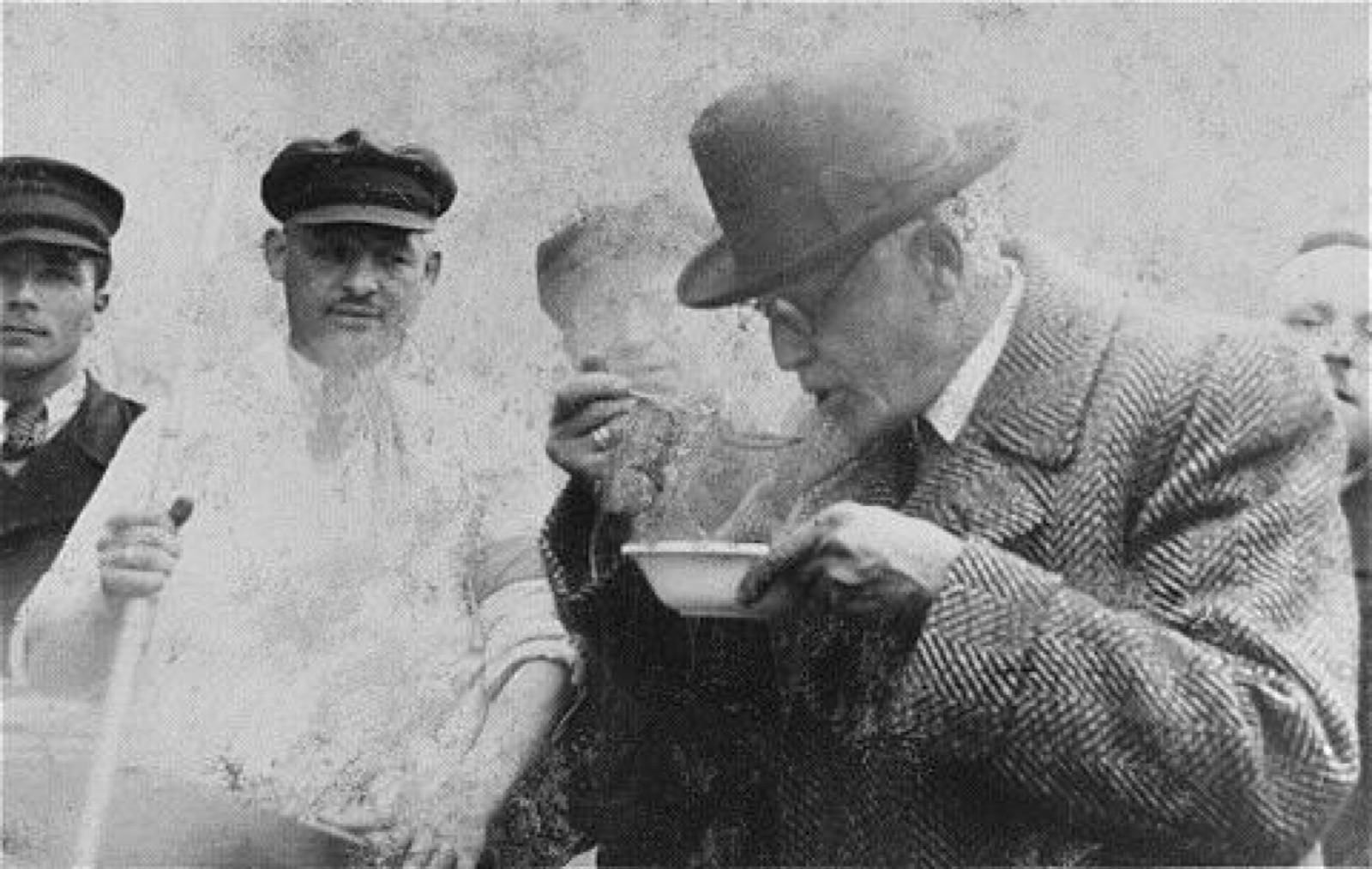
Chaim Rumkowski, who chaired its Jewish council, worked to make the ghetto indispensable to the German war economy. In September 1942 the Germans demanded its children and its elderly. On September 4 he said this.
A grievous blow has struck the ghetto. They are asking us to give up the best we possess, the children and the elderly. I never imagined I would be forced to deliver this sacrifice to the altar with my own hands. In my old age, I must stretch out my hands and beg. Brothers and sisters: Hand them over to me! Fathers and mothers: Give me your children!
Rumkowski tasting the soup at a council kitchen. USHMM, public domain.
Made by Jews for the ghetto administration United States Holocaust Memorial Museum. Public domain. View the record: Rumkowski tasting the soup at a council kitchen. USHMM, public domain.
Over eight days German police and the Jewish ghetto police searched the buildings. More than 500 people were killed in the roundup. About 15,000 went to Chelmno, roughly 6,000 of them children under ten. In May 1944 Lodz was the last ghetto standing in occupied Poland; that August about 67,000 people went to Auschwitz-Birkenau.
My siblings, we put in our last room, and put a closet for the door. They shouldn't know there's another room, because we were afraid. They were looking for children under ten, older people, and sick people.
Ann Hochman, who spent four and a half years in the Lodz ghetto, on a roundup of children, the old and the sick. Project Witness testimony. Watch the full testimony. This passage begins at 10:38: Ann Hochman, Project Witness
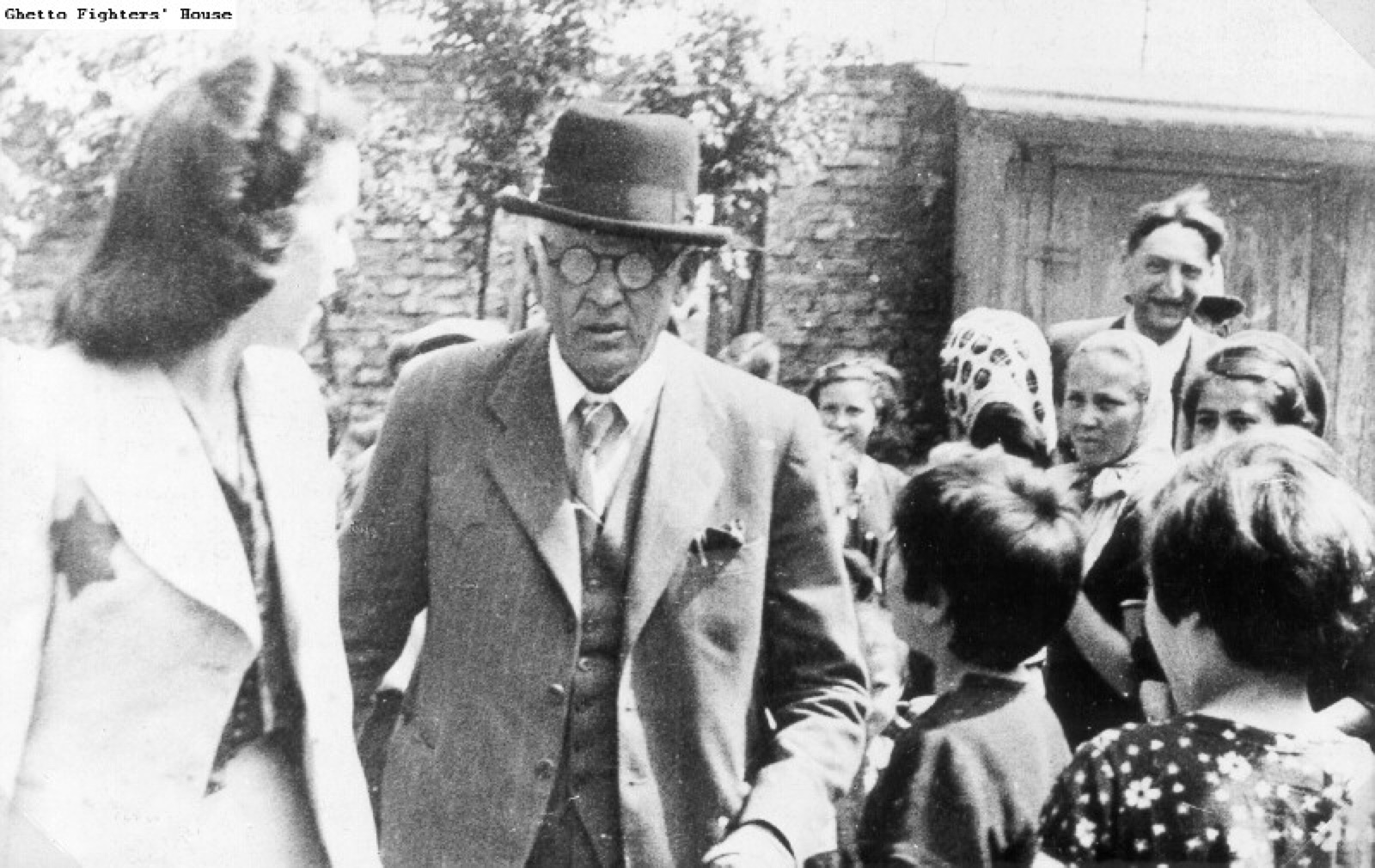
Rumkowski with a group of children in the Lodz ghetto, undated, between 1940 and 1944. Photograph by Mendel Grossman. Ghetto Fighters' House Archive. Public domain (author died 1945). Grossman photographed the ghetto across those four years and, with two friends, hid about 10,000 negatives before it was destroyed. The speech asking for the children was made on September 4, 1942.
Made clandestinely by a prisoner Mendel Grossman · 1940-1944 · Ghetto Fighters' House Archive Public domain View the record: Rumkowski with a group of children in the Lodz ghetto, undated,
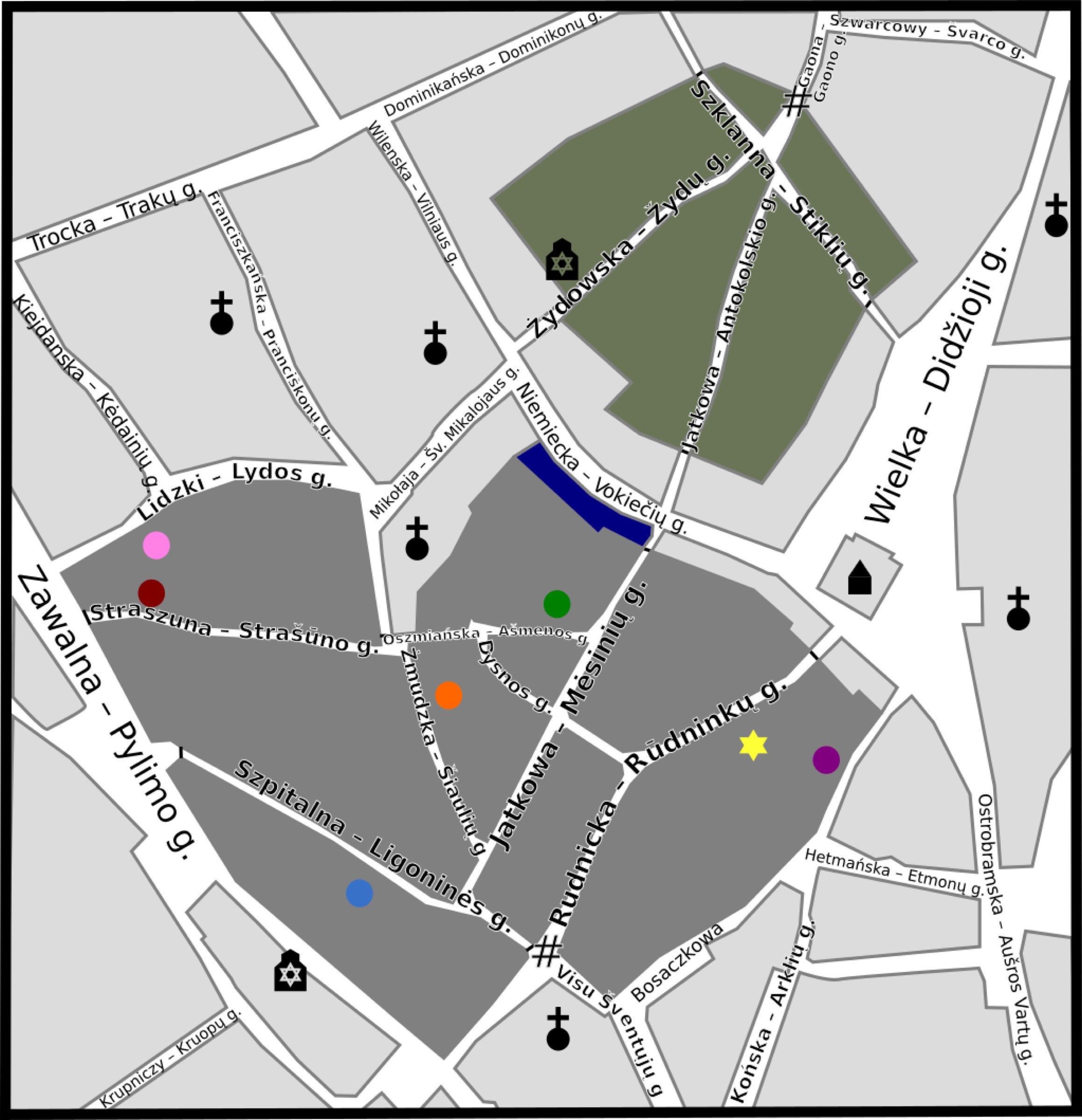
Vilna
September 1941 to September 1943
Two ghettos. The second, for those the Germans judged unable to work, was destroyed within weeks and its people shot at Ponary. A ghetto library opened with 45,000 books.
Kovno
August 1941 to July 1944
About 30,000 people were imprisoned there in 1941 and around 2,500 survived. On October 28 and 29, 1941 more than 9,200 were shot at the Ninth Fort, nearly 4,300 of them children.
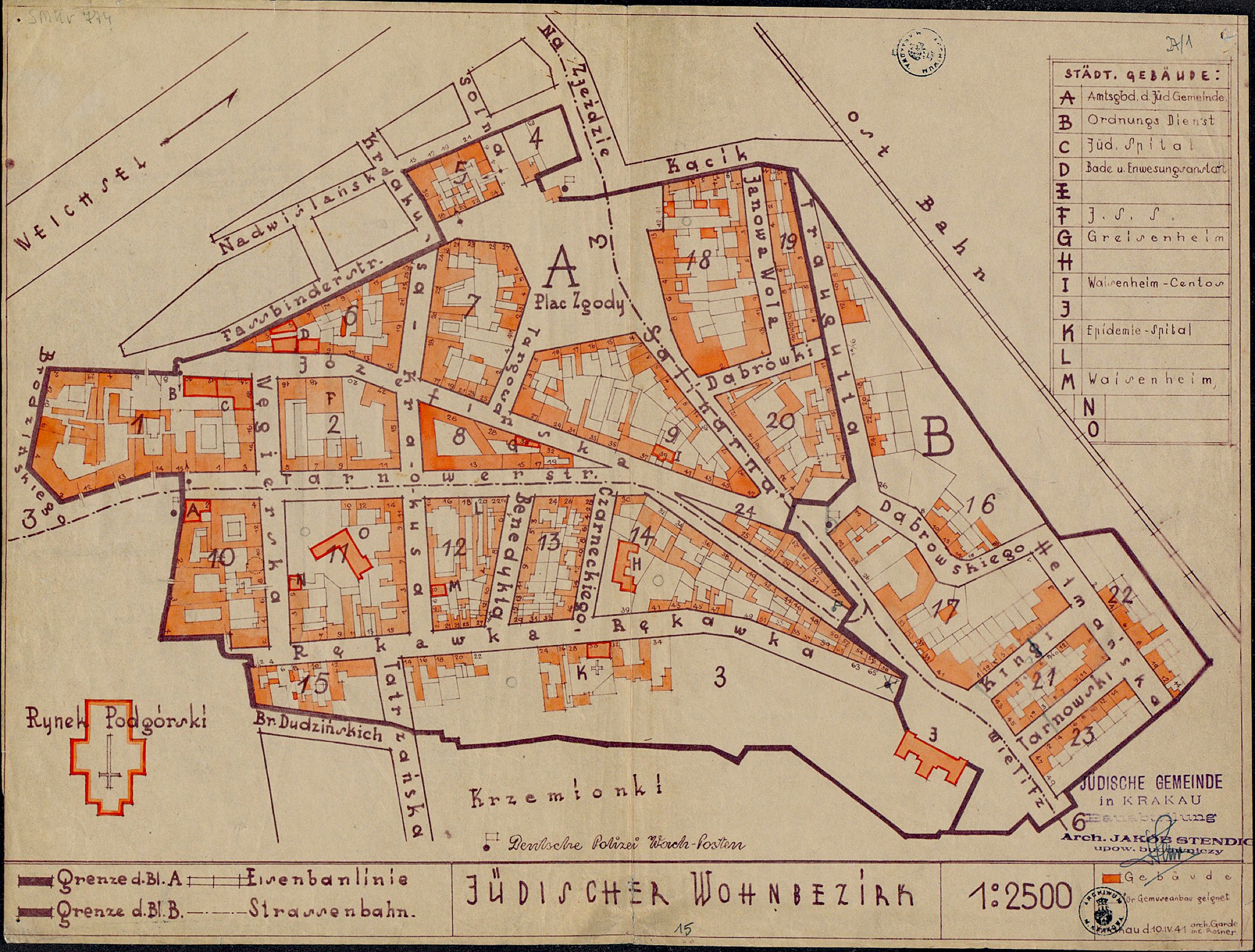
Krakow
March 1941 to March 1943
Ordered in March 1941 and placed in Podgorze, not in Kazimierz, the historic Jewish quarter. Between 15,000 and 20,000 people lived inside, behind barbed wire and, in places, walls with tops shaped like tombstones.
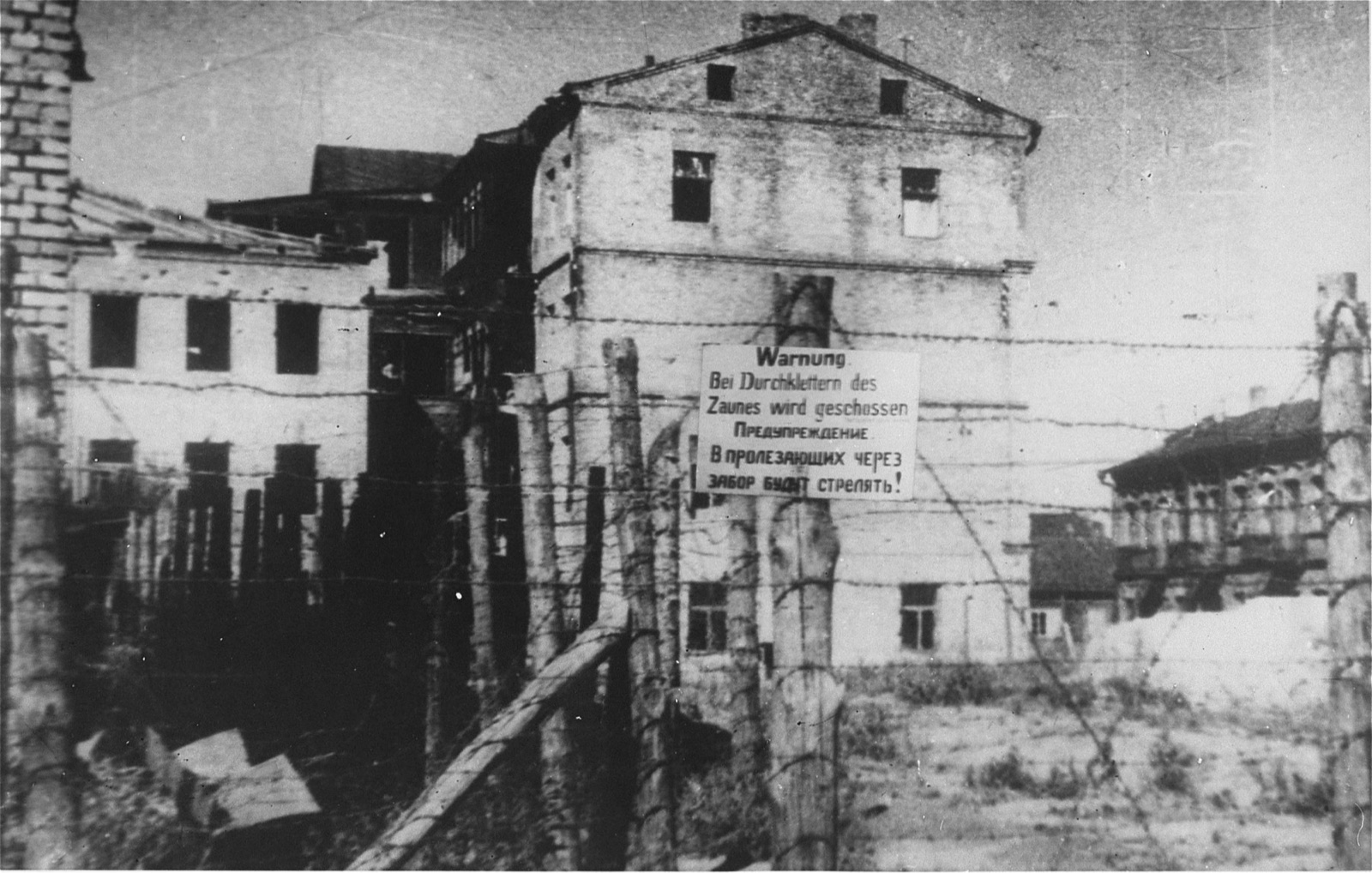
Minsk
July 1941 to October 1943
Established in late July 1941 and holding about 80,000. Most Jews deported there from Germany, Austria and the Czech lands were murdered on arrival; the rest were kept apart. Jews from Minsk formed seven partisan units.
And this time I smuggled live chickens because they were the most profitable. But can you imagine keeping a live chicken under your shawl, passing a German guard with a gun pointed at you? If I squeezed the chicken, it might squawk. If I loosened my grip, it might try to get away. The terror. But we needed to eat.
Bronia Brandman, who smuggled food into the Sosnowiec ghetto as a child. Project Witness testimony. Watch the full testimony. This passage begins at 1:37:25: Bronia Brandman, Project Witness
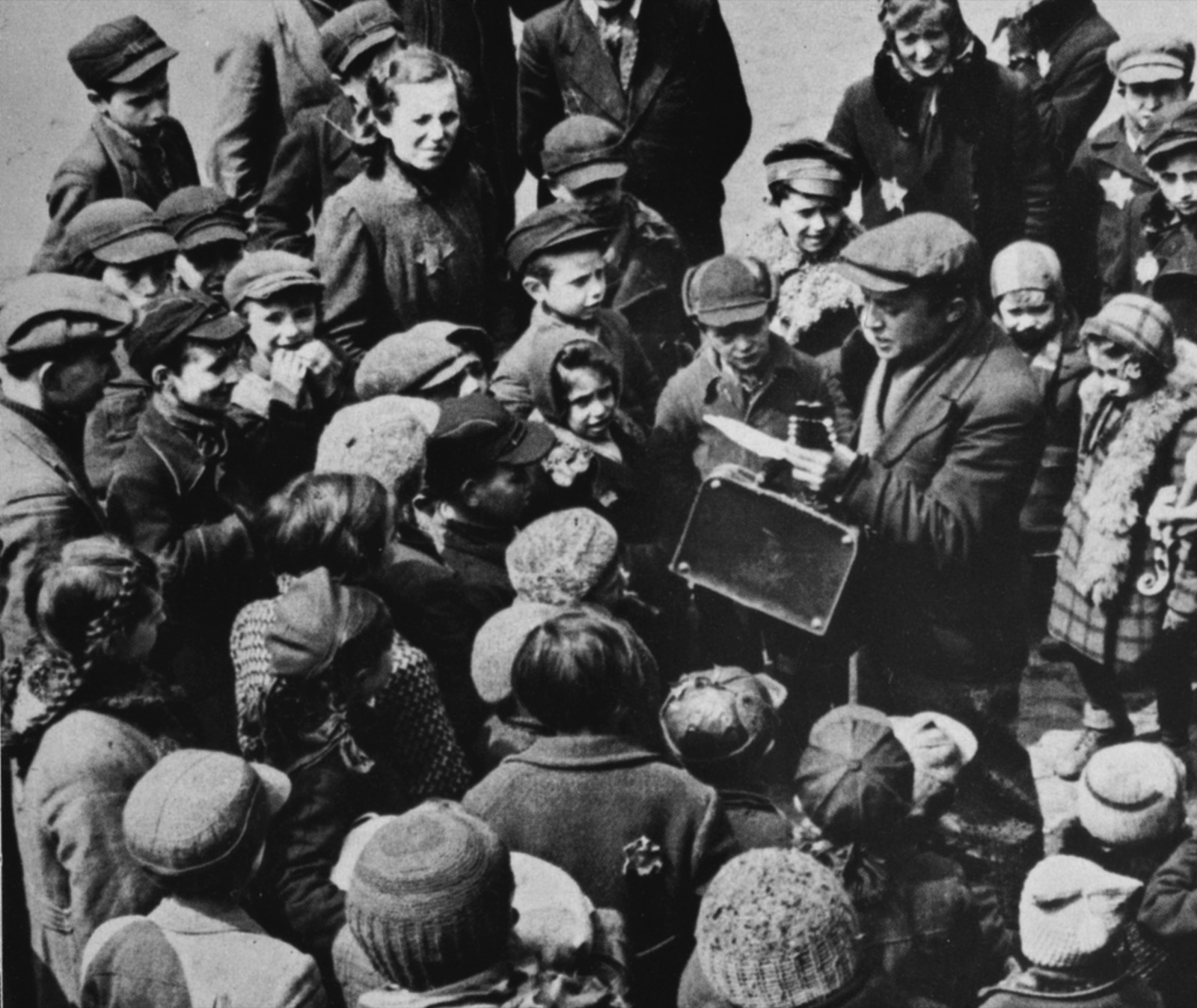
Jankiel Herszkowicz singing in the Lodz ghetto, 1941. Photograph by Mendel Grossman. Ghetto Fighters' House Archive. Public domain (author died 1945). Herszkowicz was the ghetto's street singer, and his best known song, Rumkowski Chaim, was a satire on the chairman of the Jewish council, sung in the street while the chairman was still running the ghetto.
Made clandestinely by a prisoner Mendel Grossman · 1941 · Ghetto Fighters' House Archive (via USHMM 'Music of the Holocaust') Public domain View the record: Jankiel Herszkowicz singing in the Lodz ghetto, 1941. Photograph by
Theresienstadt, in the occupied Czech lands, was a ghetto the SS also ran as a transit camp. It is covered on our page about the camps.
The councils were a German invention, ordered into existence by Reinhard Heydrich on September 21, 1939. They carried out German orders and ran the schools, the kitchens and the hospitals. USHMM's formulation is that their members "faced impossible moral dilemmas," and what chairmen did with those dilemmas has almost nothing in common. Adam Czerniakow killed himself in Warsaw rather than fill the quotas. Jacob Gens in Vilna gave the underground's leader to the Gestapo. Elchanan Elkes in Kovno helped the underground.
Raul Hilberg in 1961 and Hannah Arendt in 1963 treated the councils as part of the destruction process. Isaiah Trunk's 1972 study of the councils in Eastern Europe called it forced cooperation rather than collaboration. Dan Michman and Laurien Vastenhout argue they could barely affect German plans. Project Witness does not issue a verdict.
The ones who wrote it down
People inside the ghettos worked out that they were being erased, and set about leaving a record on purpose.
Much of what is known about life inside the ghettos comes from a decision people made while they were still in them.
Yitskhok Rudashevski was born in Vilna in 1927 and began his diary in June 1941, in Yiddish, in a small notebook. On December 13, 1942 the ghetto library marked the loan of its hundred thousandth book, and he wrote that night: "Books link us to freedom; books connect us to the world." He was shot at Ponary in 1943, a teenager. YIVO holds the notebook.
Dawid Sierakowiak began his in Lodz weeks before he turned fifteen and kept it into April 1943; he died there on August 8, 1943, probably of tuberculosis. Five notebooks survived, found by the Pole who had owned the apartment before the ghetto took it in. He wrote on April 15, 1943: "There is really no way out of this for us."
Miriam Wattenberg wrote in Warsaw and carried her notebooks out of Europe. Her mother was an American citizen, so the family was interned rather than deported. They held a privileged position inside the ghetto, and it is why she lived and why the notebooks got out. The diary appeared in February 1945 under the name Mary Berg, one of very few eyewitness accounts of the Warsaw ghetto available in English before the war ended.
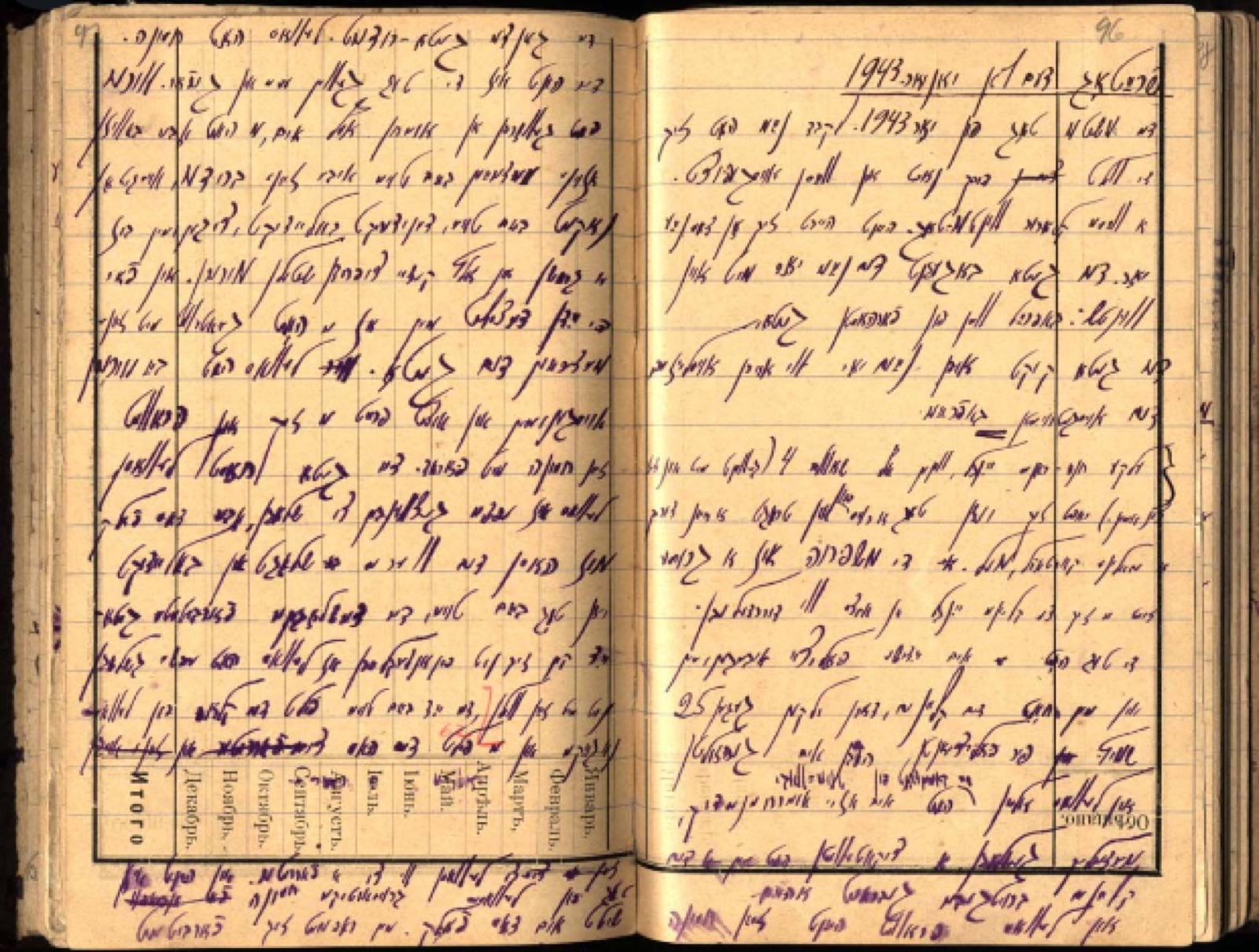
Pages from the diary of Yitskhok Rudashevski, Vilna ghetto, 1943. Public domain. Diary of Yitskhok Rudashevski, Vilna ghetto, 1943. Public domain (author died 1943).
Made clandestinely by a prisoner Yitskhok Rudashevski (1927-1943) · 1943 · Yad Vashem, via Wikimedia Commons Public domain View the record: Pages from the diary of Yitskhok Rudashevski, Vilna ghetto, 1943.
The collective version of the same act was buried under Warsaw. Emanuel Ringelblum started a private chronicle in October 1939, and after the ghetto was sealed it became an underground operation with several dozen contributors who collected with postwar justice in view, so the record would show, in USHMM's words, "who gave the orders, and who helped them." Dawid Graber was nineteen when he helped bury the first ten tin boxes on August 3, 1942, and wrote his own testament while he did it: "What we were unable to shout out to the world, we have buried in the ground." Two of the three caches came out. The third has never been found.
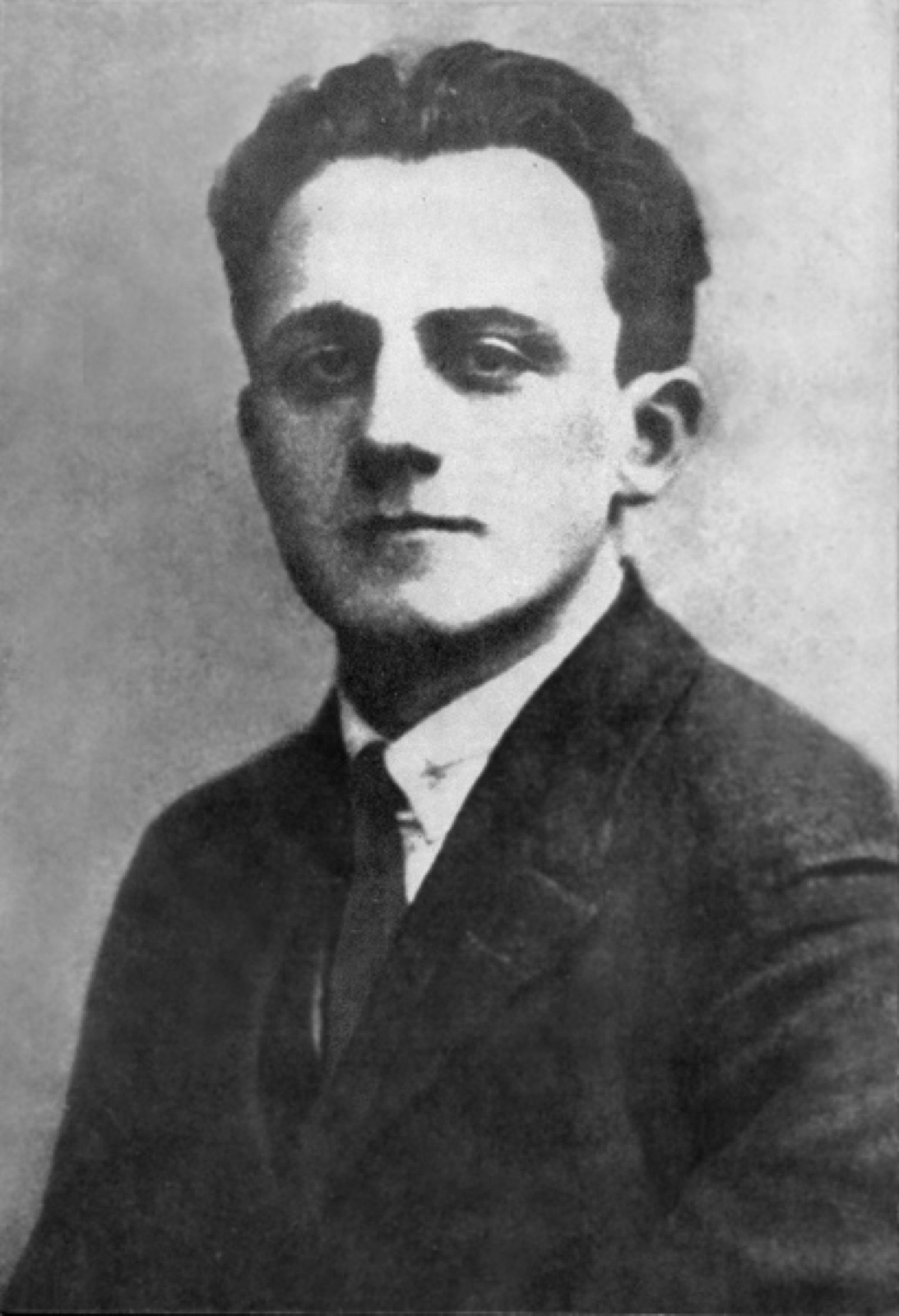
Emanuel Ringelblum. Photographer unknown; reproduced from Kronika getta warszawskiego (Warsaw: Czytelnik, 1983). Public domain, via Wikimedia Commons. He was a historian of Polish Jewry before the war and ran the archive under the cover of a Jewish welfare organization. The Gestapo found him in hiding on the Aryan side on March 7, 1944 and shot him in the ruins of the ghetto with his wife Judyta and their son Uri.
Photographed before the war Photographer unknown · unknown date · Wikimedia Commons Public domain View the record: Emanuel Ringelblum. Photographer unknown; reproduced from Kronika
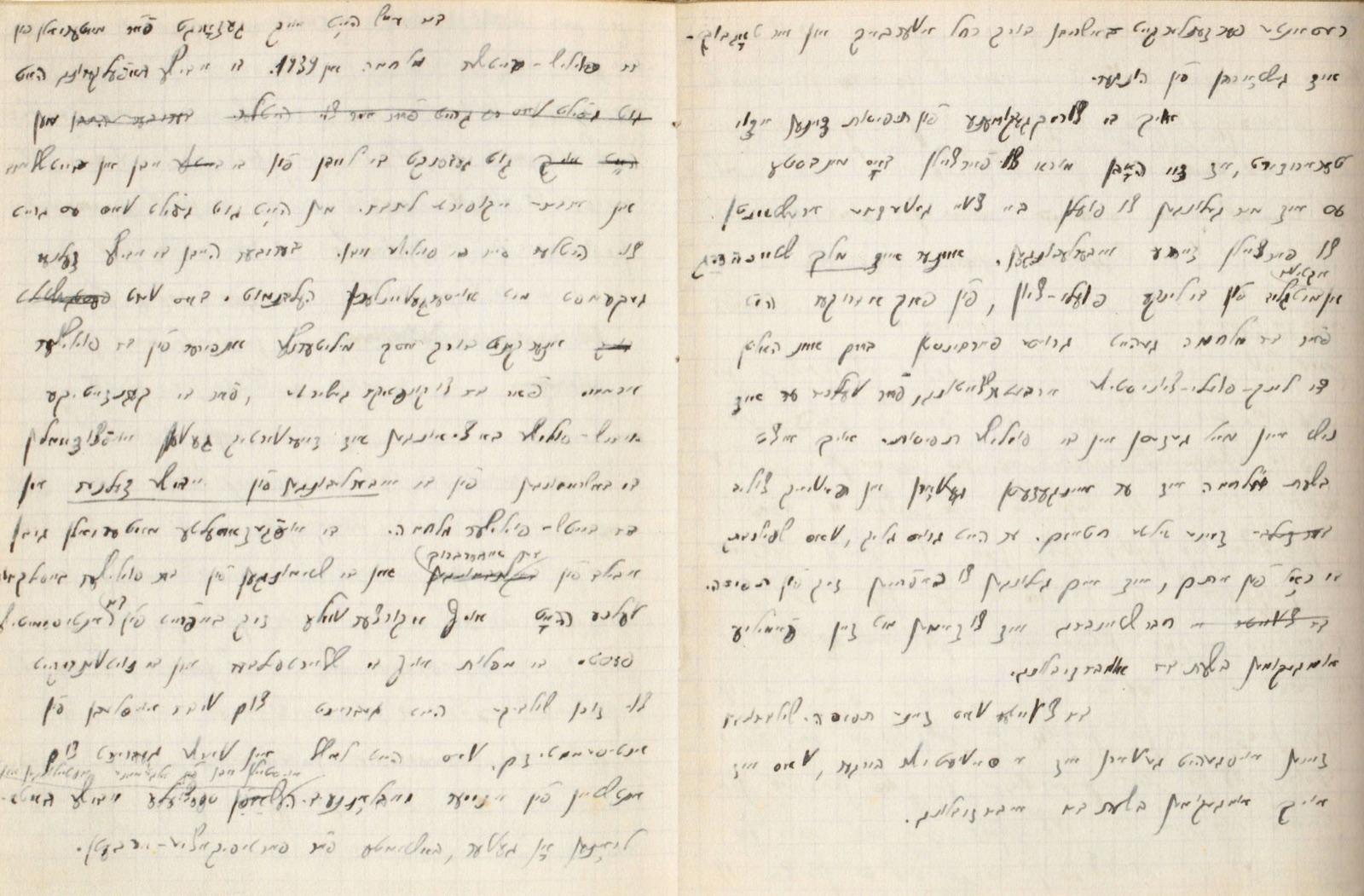
A page of Emanuel Ringelblum's chronicle, 1940 to 1943. Ringelblum Archive, Jewish Historical Institute, Warsaw. Public domain. The archive was inscribed on the UNESCO Memory of the World Register in 1999. Page from Emanuel Ringelblum's chronicle of the Warsaw ghetto, 1940-1943. Original in the Ringelblum Archive, Emanuel Ringelblum Jewish Historical Institute, Warsaw. Public domain, via Wikimedia Commons.
Made clandestinely by a prisoner Emanuel Ringelblum (1900-1944) · between 1940 and 1943 · Wikimedia Commons Public domain View the record: A page of Emanuel Ringelblum's chronicle, 1940 to 1943. Ringelblum
How the ghettos ended
Liquidation is the perpetrators' word, Liquidierung: the murder of a ghetto's people en masse, shot at nearby killing sites or deported to killing centers. The ghettos were where the trains were loaded.
Warsaw went to Treblinka. Between July 22 and September 21, 1942, about 265,000 people were put on freight cars at the Umschlagplatz on Stawki Street and about 35,000 more were killed inside the ghetto. Lodz, the last ghetto left in German-occupied Poland, went to Chelmno from January 1942 and then to Auschwitz-Birkenau, which took about 67,000 of its people in August 1944. Deportations from Lublin to Belzec began on March 17, 1942, the day mass killing began at Belzec.
Further east there was often no train. About 40,000 people were shot at Ponary, eight miles outside Vilna, by the end of 1941. At least 25,000 from the Riga ghetto were shot in the Rumbula Forest on November 30 and December 8 and 9, 1941. In Kovno, more than 9,200 people were picked out on a square inside the ghetto on October 28, 1941 and shot the next morning. Nearly 4,300 of them were children.
They were taking us right away on the Umschlag to go to Treblinka. ... They told us that we're going to work. But really to Treblinka.
Helena Wisnicki, who was caught when the Germans burned out her bunker during the uprising and was taken to the Umschlagplatz. Project Witness testimony. Watch the full testimony. This passage begins at 50:17: Helena Wisnicki, Project Witness
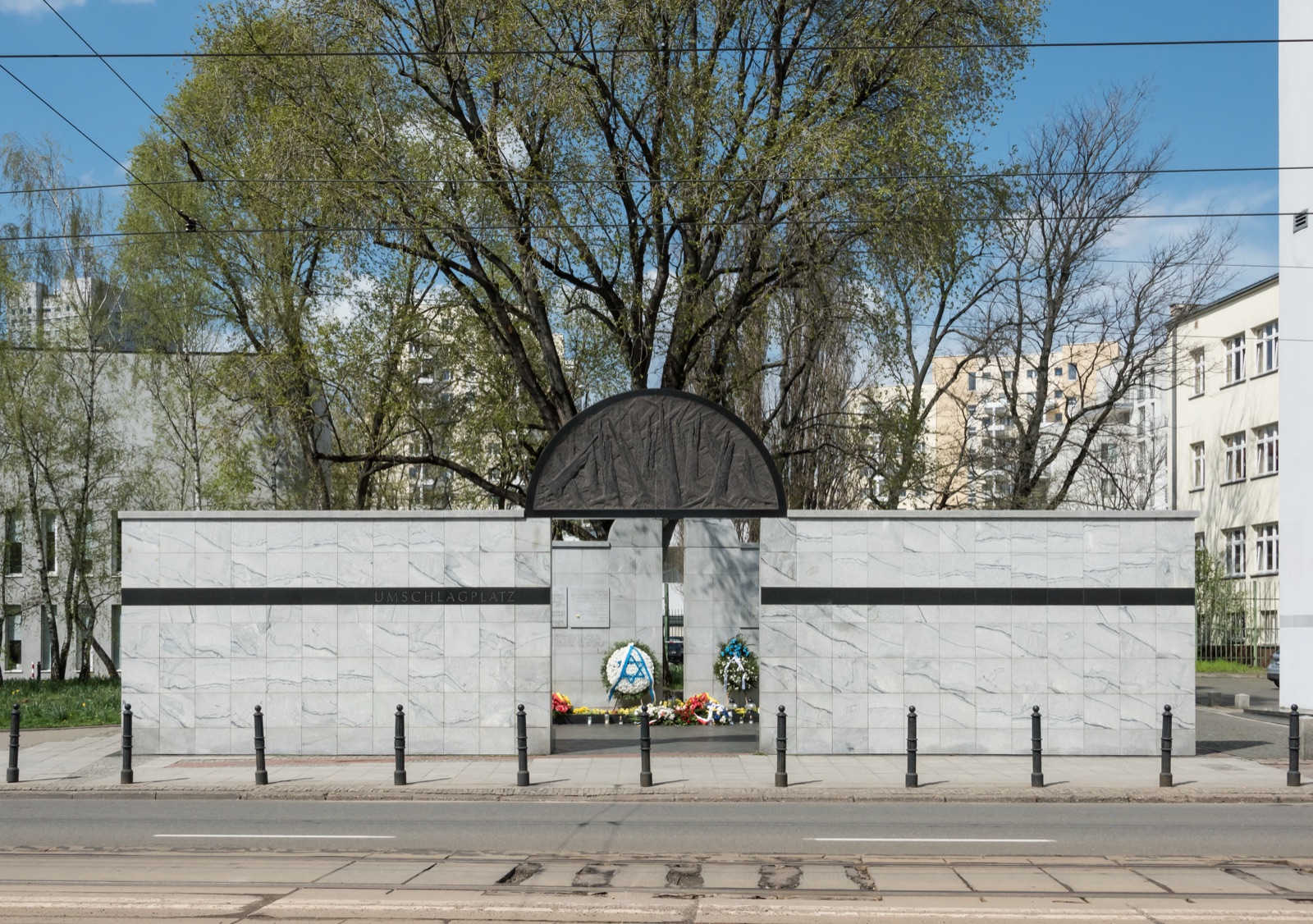
Photo: Adrian Grycuk / Wikimedia Commons, CC BY 3.0 PL. Umschlagplatz Monument (Hanna Szmalenberg and Wladyslaw Klamerus, 1988), Stawki Street, Warsaw. The monument stands on the loading yard itself, the wall carries first names and a short inscription in four languages, and the line that ran out of this yard went to Malkinia and then along a spur to Treblinka, 52 miles away.
Postwar memorial photograph Adrian Grycuk · 20 April 2023 · Wikimedia Commons CC BY 3.0 pl: licence for Photo: Adrian Grycuk / Wikimedia Commons, CC BY 3.0 PL. Umschlagplatz View the record: Photo: Adrian Grycuk / Wikimedia Commons, CC BY 3.0 PL. Umschlagplatz
What was done at Treblinka, Chelmno, Belzec and Auschwitz-Birkenau is told on the camps page and the Auschwitz page. This page stops at the platform.
Warsaw ended twice. When the fighting stopped on May 16, 1943, at least 7,000 people had died fighting or in hiding, about 7,000 more were caught and sent to Treblinka, and about 42,000 were deported to Poniatowa, Trawniki and Majdanek, where most of them were shot that November in the operation the Germans called Erntefest, Harvest Festival.
The last ghettos were not in Poland. Hungarian authorities built more than sixty transit ghettos in the spring of 1944, none of them lasting three months, and about 437,000 Jews were deported from Hungary in eight weeks, most to Auschwitz-Birkenau. The last ghetto to be established was Budapest's, liberated in January 1945; Theresienstadt, the last still standing, was liberated in May 1945.
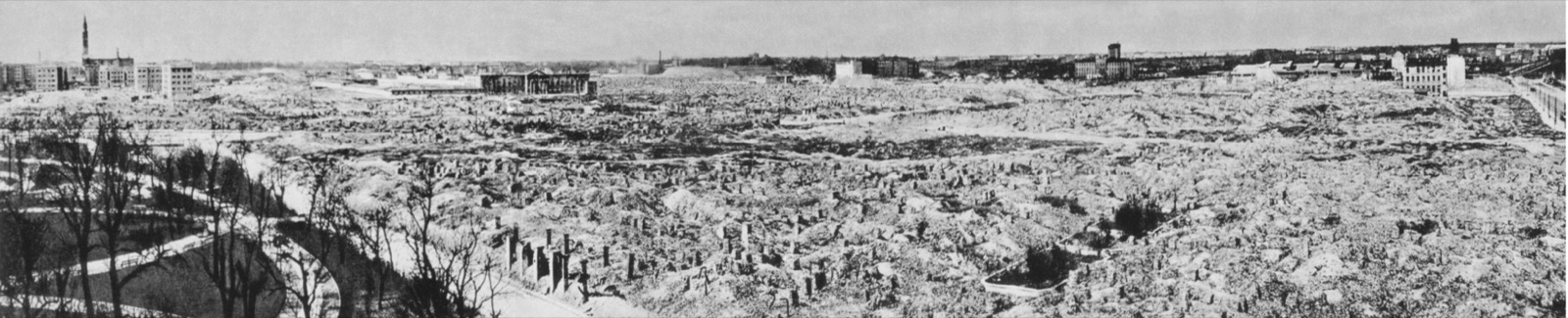
The razed Warsaw ghetto district, circa 1950. Photo: Zbyszko Siemaszko, Centralna Agencja Fotograficzna; published in Warszawa 1945-1970 (Warsaw, 1970), pp. 76-77. Public domain (Polish pre-1994 photographs rule), via Wikimedia Commons. Swietojerska Street runs along the left of the frame, and the third cache of the archive went into the ground near number 34 on the eve of the uprising. It has never been found.
Photographed after the war Zbyszko Siemaszko, photographer of the Central Photographic Agency (CAF), Warsaw · circa 1950 · Wikimedia Commons Public domain View the record: The razed Warsaw ghetto district, circa 1950. Photo: Zbyszko
I sat down among the ruins, somewhere, I don't know for how long... I didn't know what to do and I thought that I must be the last Jew alive in the Warsaw ghetto or maybe even in all of Warsaw.
Simha 'Kazik' Rotem. Yad Vashem, 'Conversations with Simha (Kazik) Rotem, Survivor Who Took Part in the Warsaw Ghetto Uprising' Read it at Yad Vashem: Simha 'Kazik' Rotem
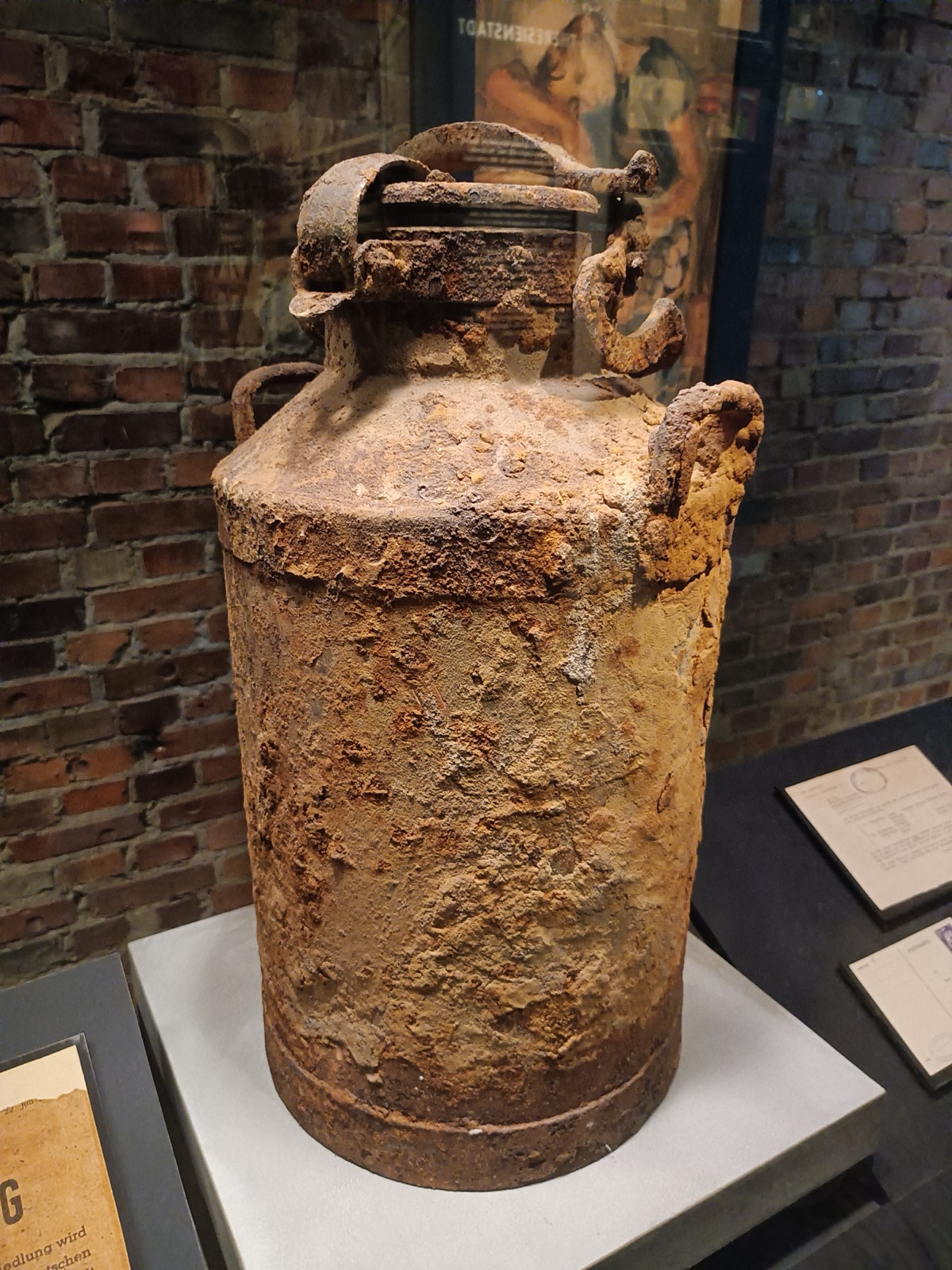
Photo: Brigade Piron / Wikimedia Commons, CC BY 3.0. Milk churn from the Ringelblum Archive (Jewish Historical Institute, Warsaw), photographed on display at the United States Holocaust Memorial Museum. The second cache went into the ground in two of these in February 1943 and came up by chance in December 1950, when a construction crew dug at the same address.
Photograph of a surviving object Brigade Piron (Wikimedia contributor) · 17 September 2023 · Wikimedia Commons CC BY 3.0: licence for Photo: Brigade Piron / Wikimedia Commons, CC BY 3.0. Milk churn from View the record: Photo: Brigade Piron / Wikimedia Commons, CC BY 3.0. Milk churn from
Emanuel Ringelblum, who had run the archive since 1939, was hiding on the other side of the wall in a bunker under a greenhouse on Grojecka Street, with his wife Judyta, their son Uri and other Jews, about forty people in all. Two Poles, Mieczyslaw Wolski and Janusz Wysocki, kept them there. The Gestapo came on March 7, 1944. Everyone in the bunker was taken to Pawiak prison and shot in the ruins of the ghetto. Wolski and Wysocki were also killed. There was a plan to bring Ringelblum out alone. He would not leave his wife and son.
Two of the three caches came back out of the ground. The first was found in September 1946. He had been dead two and a half years.
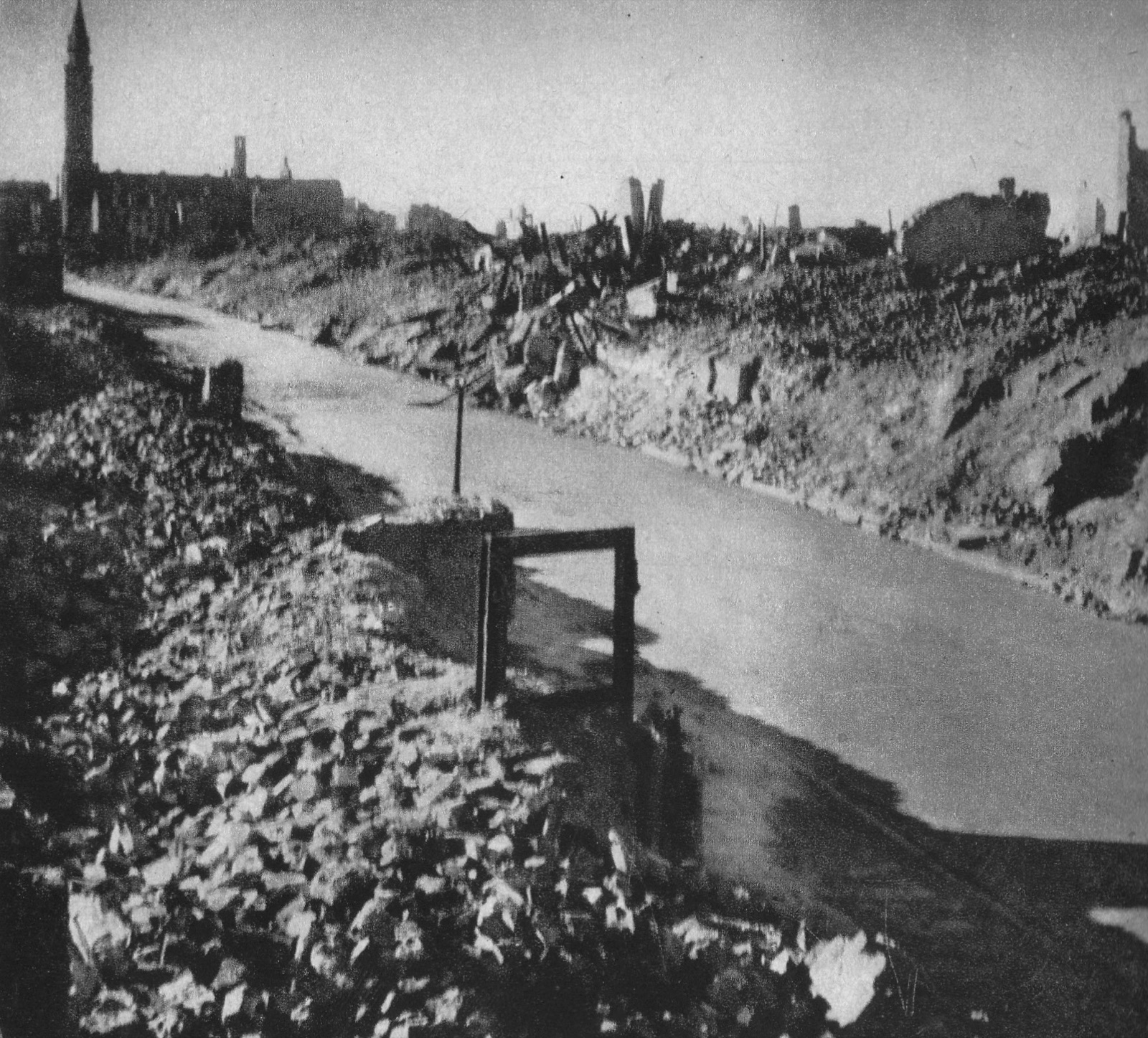
Nowolipki Street in the ruined Warsaw ghetto district, 1945. Photo: Jan Bulhak; published in Ciborowski and Jankowski, Warszawa odbudowana (Warsaw, 1963), p. 82. Public domain, via Wikimedia Commons. The ten tin boxes of the first cache were under the cellar of the school at number 68, and were dug out of rubble like this in September 1946.
Photographed after the war Jan Bułhak · 1945 · Wikimedia Commons Public domain View the record: Nowolipki Street in the ruined Warsaw ghetto district, 1945. Photo:
The ghettos, in dates
Twenty-four dates, from the order that created the Jewish councils to the year both records of the Warsaw ghetto reached the same UNESCO register. Five years of building, three of emptying, decades of digging things up.
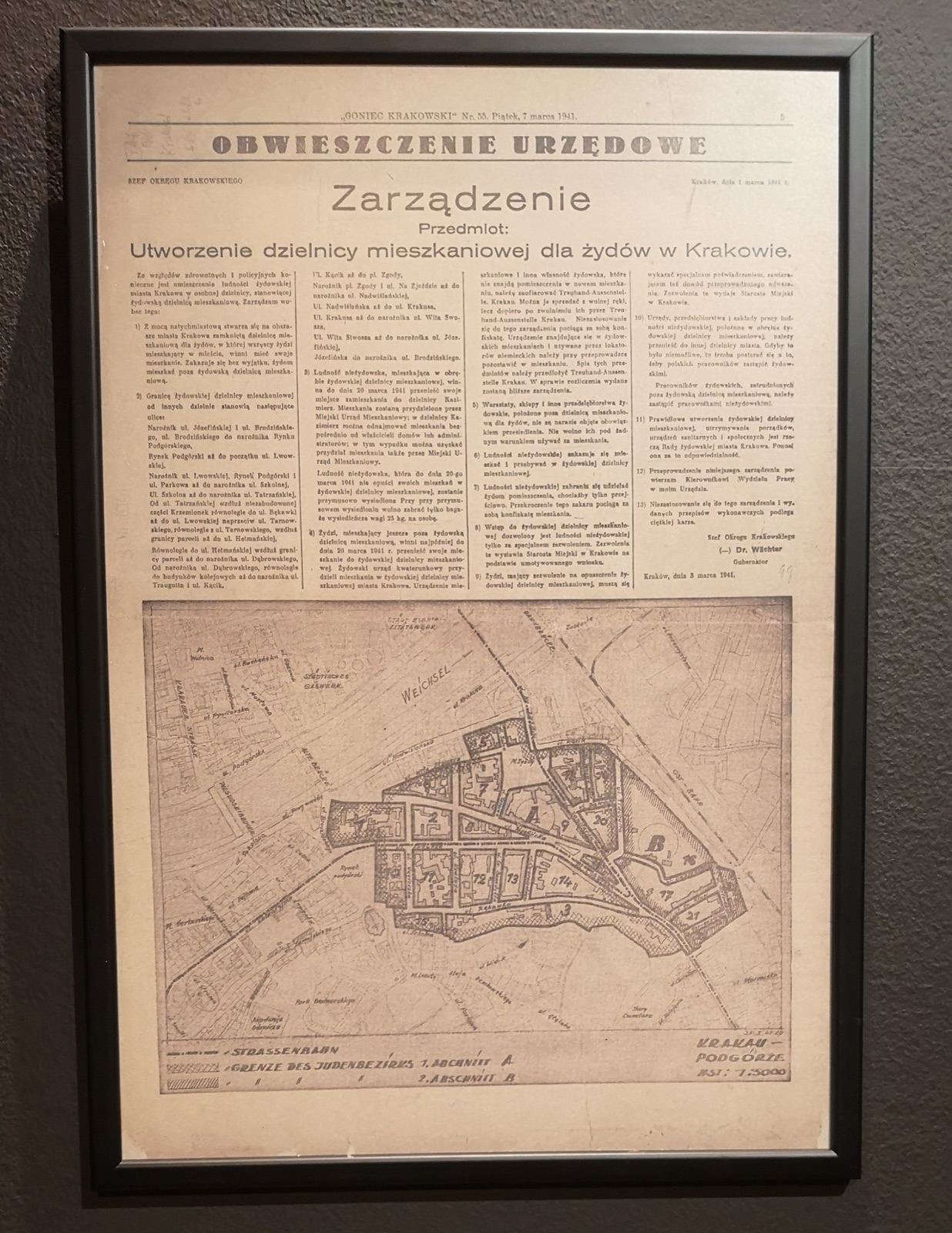
Photograph by Silar, Wikimedia Commons. CC BY-SA 4.0. The regulation of the Governor of the Krakow District establishing a Jewish residential quarter, printed in Goniec Krakowski in 1941. The Krakow ghetto was ordered in early March 1941, and this is the form the order took for the people it applied to.
Postwar memorial photograph Photograph by Wikimedia user Silar of the printed newspaper page · 1941 (regulation); 2022 (photograph) · Wikimedia Commons CC BY-SA 4.0: licence for Photograph by Silar, Wikimedia Commons. CC BY-SA 4.0. The regulation View the record: Photograph by Silar, Wikimedia Commons. CC BY-SA 4.0. The regulation
September 21, 1939
Heydrich orders the concentration of Jews and the creation of Jewish councils
Three weeks into the invasion of Poland, Reinhard Heydrich sends an express letter to the commanders of the mobile killing units. Jews in small towns and villages are to be moved into larger cities, and a Jewish council is to be set up in each place to carry out German orders. The councils are ordered into existence before almost any ghetto exists.
November 16, 1940
The Warsaw ghetto is closed
The order had been signed on October 2 and announced through street loudspeakers on October 12, which was Yom Kippur. About 400,000 people are shut into 1,483 houses behind a wall the Jewish council was ordered to build at its own expense, with twenty-two guarded gates.
November 1940
Ringelblum turns a private chronicle into an underground archive
He had been keeping notes since October 1939. Working under the cover of a Jewish welfare organization, several dozen people now begin collecting everything they can: diaries, reports, ration cards, tram tickets, theater posters, postcards from towns about to be emptied.
October 28 and 29, 1941
The great selection in Kovno
The roughly 26,000 people who survived the earlier massacres are ordered onto Demokratu Square. From morning to evening the Germans pick out more than 9,200 of them and shoot them the following day. Nearly 4,300 of the dead are children.
July 22, 1942
The Great Deportation begins in Warsaw
SS-Sturmbannfuehrer Hermann Hoefle informs Adam Czerniakow that all Jews, regardless of sex or age but with certain exceptions, are to be deported east, and that 6,000 must be delivered by four o'clock that afternoon. That, at the minimum, is to be the daily quota.
April 19, 1943
The uprising begins
German forces enter at six in the morning on the eve of Passover and are driven back out. Their commander is replaced at eight. On the eve of the uprising the third part of the archive had gone into the ground near 34 Swietojerska Street. It has never been found.
August 1944
Lodz, the last major ghetto, is emptied
About 67,000 people are sent to Auschwitz-Birkenau. Between 1,000 and 1,500 are kept back to clear the ruins. The ghetto had lasted four years and four months.
September 1946
The first cache comes up
Rachel Auerbach and Hersh Wasser lead members of the Jewish Historical Commission through the rubble at 68 Nowolipki Street and the ten tin boxes are found. The two milk cans buried in February 1943 turn up by chance under the same address during construction work in December 1950.
Show the other 16 dates
October 1939
The first ghetto opens at Piotrkow Trybunalski
It is in occupied Poland, and so are most of the ghettos that follow. More than 1,300 will be created in all by the Germans and their allies.
April 30, 1940
The Lodz ghetto is sealed
About 160,000 Jews are shut into the northeastern district of the city. Roughly 210,000 people pass through it before it is destroyed. More than one in five die there of hunger and disease.
January to March 1941
Typhus in Warsaw
The Germans force 66,000 refugees from the surrounding towns into the sealed ghetto and the epidemic becomes unstoppable. It kills through the year and then collapses in late October, months before the winter peak, after the ghetto's own doctors ran sanitary courses, hundreds of public lectures, home isolation and an underground medical school.
Early September 1941
Two ghettos in Vilna
The Germans establish both at the start of the month. Ghetto 2 is destroyed within weeks. The killing is done at Ponary, eight miles outside the city, where about 40,000 Jews are shot by the end of the year.
November 30 and December 8 and 9, 1941
Rumbula
At least 25,000 Jews from the Riga ghetto are shot in the Rumbula Forest on those days. The emptied ghetto is then refilled with Jews deported from Germany, Austria and the Protectorate and divided into a German section and a Latvian one.
December 31, 1941
Abba Kovner reads the manifesto in Vilna
He tells a meeting of about 150 members of the Zionist youth movements that Hitler means to kill every Jew in Europe and that the Jews of Lithuania are first in line. The proclamation is dated January 1, 1942. Yad Vashem calls it a turning point in how the ghetto understood what was happening.
March 17, 1942
Lublin to Belzec
The deportations out of the Lublin ghetto begin on the day mass killing begins at Belzec.
July 23, 1942
Czerniakow kills himself
His last diary entry records that 4,000 are ready and the order is for 9,000 by four o'clock. He takes cyanide rather than prepare the lists. Marek Edelman wrote in 1945 that the underground thought at the time he had no right to do it.
August 3, 1942
The first cache of the archive goes into the ground
Ten tin boxes are buried in the cellar of the school at 68 Nowolipki Street while the deportations are running. Dawid Graber, nineteen, writes as he works: 'What we were unable to shout out to the world, we have buried in the ground.'
September 4 to 12, 1942
The Gehsperre in Lodz
Rumkowski tells the ghetto that the Germans have demanded its children and its elderly. Over the following week more than 15,000 people are taken, roughly 6,000 of them children, and murdered at Chelmno. More than 500 are killed during the roundup itself.
September 21, 1942
The Great Deportation ends
In nine weeks about 265,000 people have gone from the Umschlagplatz to Treblinka and about 35,000 have been killed inside the ghetto. As many as 60,000 remain in the ghetto.
January 18, 1943
The first armed resistance in the ghetto
ZOB fighters carrying pistols break out of a column being marched to the Umschlagplatz and fight their escorts in the street at Mila and Zamenhofa. Most of them are killed. The Germans call the operation off on January 21, and the ghetto reads the halt as proof that fighting works.
May 16, 1943
Stroop ends the operation
He blows up the Great Synagogue on Tlomackie Street at 2015 hours and teletypes Krakow that the Jewish quarter of Warsaw no longer exists. His own running total is 56,065 people caught. He was hanged in Warsaw in 1952, and his report was the evidence against him.
March 7, 1944
The Gestapo finds the bunker on Grojecka Street
Emanuel Ringelblum, his wife Judyta, their son Uri and the other Jews hiding with them, 34 to 40 people in all, are taken to Pawiak prison and shot, probably on March 10, in the ruins of the ghetto. The two Poles who hid them, Mieczyslaw Wolski and Janusz Wysocki, are also killed.
May 1945
Theresienstadt, the last ghetto standing, is liberated
It was established in the Protectorate of Bohemia and Moravia in November 1941 and about 140,000 Jews passed through it. It is covered on the camps page.
2017
Both records of the Warsaw ghetto are on the same register
UNESCO inscribed the archive that Jews buried in 1999 and the album a German general made for Himmler in 2017. The report is held by the Institute of National Remembrance in Warsaw, which describes it as evidence of a crime.
For educators
Free, and made for a classroom
Project Witness is a nonprofit Holocaust education organization in New York. Tell us what you teach and we will send you what fits your classroom.
How we know
The record of the ghettos survives in two forms. There is what the Germans made: Stroop's album for Himmler, the propaganda film shot in Warsaw in May 1942, the Bundesarchiv photograph of Jews being moved into the Lodz ghetto under a caption calling it a house move. Those survive because a state kept its paperwork and expected to be admired for it.
Then there is what Jews made and hid. The 35,000 documents of the Ringelblum Archive went into tin boxes and milk cans under a school on Nowolipki Street. Henryk Ross buried about 6,000 negatives at Lodz in 1944 and dug up somewhat more than half after the war. George Kadish photographed Kovno through a buttonhole in his overcoat and hid the negatives with Yehuda Zupowitz of the ghetto's Jewish police, who was tortured and killed in March 1944 and never said where they were. That half exists because people decided it should.
Both halves are on the same UNESCO register: the Ringelblum Archive in 1999, the Stroop Report in 2017. The report is held by the Institute of National Remembrance in Warsaw, which calls it evidence of a crime rather than a record of an achievement.
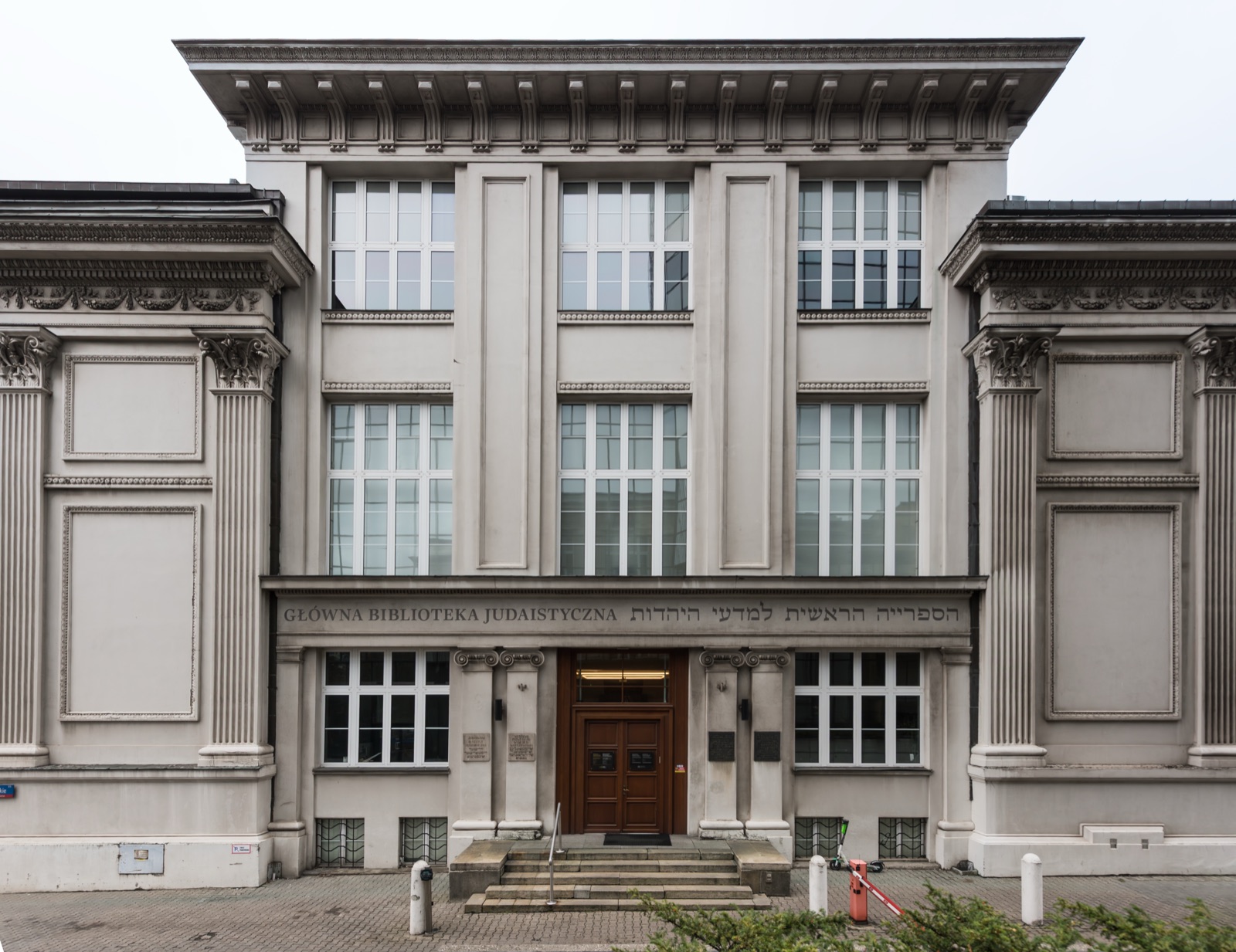
Photo: Adrian Grycuk / Wikimedia Commons, CC BY 3.0 PL. The Emanuel Ringelblum Jewish Historical Institute, Tlomackie Street, Warsaw. It was the Main Judaic Library, Ringelblum and his colleagues worked in it, and the recovered archive is kept there now. It stands beside the site of the Great Synagogue, which Stroop blew up to end the operation.
Postwar memorial photograph Adrian Grycuk · 19 October 2025 · Wikimedia Commons CC BY 3.0 pl: licence for Photo: Adrian Grycuk / Wikimedia Commons, CC BY 3.0 PL. The Emanuel View the record: Photo: Adrian Grycuk / Wikimedia Commons, CC BY 3.0 PL. The Emanuel
Every fact here comes from a named institution. Most of the images are public domain or carry a free license, and where the license asks for attribution the credit runs with the image.
- Majdanek For the State Museum at Majdanek
- National Archives For the Nuremberg trial copy of the Stroop Report, USA Exhibit 275
- Terezin For the Terezin Initiative Institute's article on the Warsaw ghetto
- United States Holocaust Memorial Museum For the Holocaust Encyclopedia, the Encyclopedia of Camps and Ghettos, the oral history collection and the photograph archive
- Yad Vashem For the Shoah Resource Center and its articles on the ghettos
Every image credit on this page
Workers building the Warsaw ghetto wall, 1940-1941. State Archive of the Capital City of Warsaw, collection of Second World War photographs 1939-1945, sig. IX-4/8, via Archiwum Główne Akt Dawnych and Wikimedia Commons. Public domain. Map of the Warsaw ghetto, October 15, 1940. Author unknown; via Wikimedia Commons. Public domain (anonymous work, EU 70-year term). Adam Czerniaków in his office at the Warsaw Judenrat, 1940-1942. Photographer unknown; published in Wroński and Zwolakowa, Polacy Żydzi 1939-1945 (Warsaw, 1971), p. 92. Public domain, via Wikimedia Commons. Pages from Adam Czerniaków's Warsaw ghetto diary, July 1942. Reproduced in Kirshenblatt-Gimblett and Polonsky (eds.), Polin. 1000 lat historii Żydów polskich (POLIN Museum, 2014), p. 301. Public domain, via Wikimedia Commons. Jews being loaded onto deportation trains at the Umschlagplatz, Warsaw, 1942-1943. Photographer unknown. United States Holocaust Memorial Museum, courtesy of the Jewish Historical Institute, Warsaw. Public domain, via Wikimedia Commons. United States Holocaust Memorial Museum, courtesy of Muzeum Sztuki w Lodzi. Public domain. United States Holocaust Memorial Museum. Public domain. Vilna Gaon State Jewish Museum, via LIMIS. CC BY 4.0. Photograph by Mendel Grossman. Ghetto Fighters' House Archive. Public domain (author died 1945). Cover page of Jürgen Stroop's report to Heinrich Himmler on the destruction of the Warsaw ghetto, May 1943, bearing Nuremberg Tribunal evidence stamps. National Archives and Records Administration, USA Exhibit 275, RG 238 (Nuremberg document 1061-PS). Public domain, via Wikimedia Commons. From Jürgen Stroop's report to Heinrich Himmler on the destruction of the Warsaw ghetto, April-May 1943; German album caption 'So sieht es im ehemaligen jüdischen Wohnbezirk nach der Vernichtung aus'. Institute of National Remembrance, Warsaw copy; Nuremberg document 1061-PS. Public domain, via Wikimedia Commons. Three of the ten metal boxes and two milk cans in which the Ringelblum Archive was buried. Photographer unknown; published in Męczeństwo, walka, zagłada Żydów w Polsce 1939-1945 (Warsaw, 1960), photo 150. Public domain, via Wikimedia Commons. Photo: Adrian Grycuk / Wikimedia Commons, CC BY-SA 3.0 PL. Permanent exhibition 'What we were unable to shout out to the world', Emanuel Ringelblum Jewish Historical Institute, Warsaw. Self-portrait by Mendel Grossman. Public domain (author died 1945). Mordechai Anielewicz, commander of the Jewish Combat Organization (ŻOB). Photographer unknown; via Wikimedia Commons, sourced to Yad Vashem. Public domain (Polish pre-1994 photographs rule). The Warsaw ghetto burning, late April 1943, photographed from outside the walls. Photographer unknown; published in Władysław Bartoszewski, Warszawski pierścień śmierci 1939-1944 (Warsaw: Interpress, 1970). Public domain, via Wikimedia Commons. The Great Synagogue on Tłomackie Street, Warsaw, before 1898. Photographer unknown; reproduced in Kirshenblatt-Gimblett and Polonsky, Polin. 1000 lat historii Żydów polskich (POLIN Museum, 2014), p. 195. Public domain, via Wikimedia Commons. Map by Renata3, Wikimedia Commons. CC BY-SA 4.0. Photograph by George Kadish (Zvi Kadushin). United States Holocaust Memorial Museum, courtesy of Association for the Lithuanian Jews in Israel. Public domain. National Archives in Krakow. CC0 1.0 (public domain dedication). United States Holocaust Memorial Museum, courtesy of Belarusian State Museum of the History of the Great Patriotic War. Public domain. Diary of Yitskhok Rudashevski, Vilna ghetto, 1943. Public domain (author died 1943). Emanuel Ringelblum. Photographer unknown; reproduced from Kronika getta warszawskiego (Warsaw: Czytelnik, 1983). Public domain, via Wikimedia Commons. Page from Emanuel Ringelblum's chronicle of the Warsaw ghetto, 1940-1943. Original in the Ringelblum Archive, Emanuel Ringelblum Jewish Historical Institute, Warsaw. Public domain, via Wikimedia Commons. Photo: Adrian Grycuk / Wikimedia Commons, CC BY 3.0 PL. Umschlagplatz Monument (Hanna Szmalenberg and Władysław Klamerus, 1988), Stawki Street, Warsaw. The razed Warsaw ghetto district, circa 1950. Photo: Zbyszko Siemaszko, Centralna Agencja Fotograficzna; published in Warszawa 1945-1970 (Warsaw, 1970), pp. 76-77. Public domain (Polish pre-1994 photographs rule), via Wikimedia Commons. Photo: Brigade Piron / Wikimedia Commons, CC BY 3.0. Milk churn from the Ringelblum Archive, on display at the United States Holocaust Memorial Museum. Nowolipki Street in the ruined Warsaw ghetto district, 1945. Photo: Jan Bułhak; published in Ciborowski and Jankowski, Warszawa odbudowana (Warsaw, 1963), p. 82. Public domain, via Wikimedia Commons. Photograph by Silar, Wikimedia Commons. CC BY-SA 4.0. Photo: Adrian Grycuk / Wikimedia Commons, CC BY 3.0 PL. The Emanuel Ringelblum Jewish Historical Institute, Tłomackie Street, Warsaw.
No Holocaust denial publication was consulted or cited. Sites that mirror encyclopedia text outside the publishing institution's control were excluded.
Questions people ask
How many people were in the Warsaw ghetto?
About 400,000 when it was sealed, rising toward 450,000 at its peak after the Germans forced 66,000 refugees in from surrounding towns between January and March 1941. That was almost 30 percent of Warsaw's population confined to 2.4 percent of the city's area.
What did people eat in the ghettos?
The official German ration for Jews in Warsaw was 181 calories a day, 8 percent of the German ration and 25 percent of the Polish one. What people actually consumed in 1941 averaged about 1,125 calories, ranging from roughly 800 for the poorest to about 1,665 for council employees. Much of the gap between the ration and the intake was smuggled in.
What was the Warsaw ghetto?
A sealed district in German-occupied Warsaw where the city's Jews were confined. The order was signed on October 2, 1940 and announced through street loudspeakers on October 12, which was Yom Kippur. The ghetto was closed on November 16, 1940. More than 400,000 people were held in about 1.3 square miles, an average of 7.2 to a room, behind a wall more than ten feet high that the Jewish council was ordered to pay for.
Why did the ghettos exist?
On September 21, 1939, three weeks into the invasion of Poland, Reinhard Heydrich ordered Jews in small towns moved into larger cities and a Jewish council created in each place to carry out German orders. The first ghetto opened at Piotrkow Trybunalski that October. Ghettos held Jews where they could be counted, controlled and worked, and from 1942 they were the places the deportation trains were loaded from.
How many ghettos were there?
The answer depends on the scope, and the scope has to be named. The United States Holocaust Memorial Museum counts more than 1,300 ghettos established by the Germans and their allies, about 1,100 of them German-created, and documents more than 1,150 sites in German-occupied eastern Europe in its Encyclopedia of Camps and Ghettos. Yad Vashem counts more than 1,000 in eastern Europe plus a few in central and southern Europe.
When was the Warsaw ghetto uprising?
April 19 to May 16, 1943, twenty-seven days. It began on the eve of Passover, when German forces entered to empty what was left of the ghetto and were driven back outside the wall. About 700 young Jewish fighters took part. It is not the Warsaw Uprising, which was a revolt by the Polish Home Army in August 1944, some fifteen months later.
Is the Warsaw ghetto uprising the same as the Warsaw Uprising?
No. The Warsaw ghetto uprising ran from April 19 to May 16, 1943 and was fought by roughly 700 Jewish fighters inside the ghetto, most of whom were killed. The Warsaw Uprising began in August 1944 and was fought by the Polish Home Army across the city. A different force, a different year, some fifteen months apart, though surviving ghetto fighters joined the 1944 rising as a Jewish platoon.
How many people died in the Warsaw ghetto?
At least 83,000 died of starvation and disease between 1940 and mid-1942, and epidemiologists who reexamined the ghetto's records in 2020 argue that registered deaths substantially understate the toll. About 265,000 more were deported to Treblinka and murdered between July 22 and September 21, 1942, and about 35,000 were killed inside the ghetto during that operation. At least 7,000 died in the uprising.
What was life like in the ghettos?
Hunger first. The official German ration for Jews in Warsaw was 181 calories a day, while the average person actually ate about 1,125 calories in 1941, much of it smuggled in. What you ate depended on your position: council workers averaged about 1,665 calories, the poorest about 800. Typhus ran through Warsaw for most of 1941. Inside all of it people ran schools, libraries, clinics, soup kitchens, an orchestra and an underground university.
What was the Judenrat?
A Jewish council appointed by the Germans. Heydrich ordered the councils created on September 21, 1939, before most ghettos existed. They ran hospitals, kitchens, schools and workshops, and they were also required to carry out German orders, including drawing up deportation lists. Historians have argued about them since 1961, moving from the judgments of Raul Hilberg and Hannah Arendt toward Isaiah Trunk, Yehuda Bauer and Dan Michman, who describe councils with almost no room to act.
Who was Mordechai Anielewicz?
The commander of the Jewish Combat Organization, the ZOB, from November 1942. He led the January 1943 fighting and commanded the April uprising, and he was twenty-three or twenty-four years old. He died at the ZOB command bunker at 18 Mila Street on May 8, 1943, along with about 120 others, after the Germans put gas into it. A 2017 reassessment by the historian Havi Dreifuss raises fundamental questions about his role and authority inside the ZOB.
What was the Ringelblum Archive?
The underground archive of the Warsaw ghetto, run by the historian Emanuel Ringelblum and a group that called itself Oyneg Shabes. Several dozen people collected some 35,000 documents: diaries, reports, underground newspapers, drawings, ration cards, tram tickets, theater posters, postcards from Jews about to be deported. It was buried in three caches. Two came up, in September 1946 and December 1950. The third has never been found.
What happened to the people in the ghettos?
Most were murdered. Warsaw's Jews were sent to Treblinka, Lodz's to Chelmno and then Auschwitz-Birkenau, Lublin's to Belzec. In the occupied Soviet territories and the Baltic states people were often shot near the city instead: Vilna's at Ponary, Riga's at Rumbula, Kovno's on the forts around the town. The Hungarian transit ghettos of 1944 fed Auschwitz-Birkenau in eight weeks. Small numbers survived in hiding, with partisans, or in the last ghettos to be liberated in 1945.
Who took the photographs of the Warsaw ghetto?
Mostly Germans. The best-known come from the Stroop Report, the album a German general had made for Himmler. There is also a German propaganda film of May 1942, and witnesses described how its scenes were staged. Jews photographed too: Henryk Ross and Mendel Grossman in Lodz, George Kadish through a buttonhole in Kovno, and the photographs that survived in the Ringelblum Archive, 76 of them from the first cache.