Turning Points · September 15, 1935
The Nuremberg Laws decided who was a Jew by counting grandparents.
Hitler was never elected chancellor. He was appointed on January 30, 1933, and it took two and a half years of decrees to turn that appointment into a law that counted a person's grandparents to decide whether they were a citizen.
Project Witness records and preserves Holocaust survivor testimony. This page is free to use, in classrooms and out of them.
Written for readers 14 and up. This page quotes Nazi laws and shows a Nazi teaching chart, read part by part.
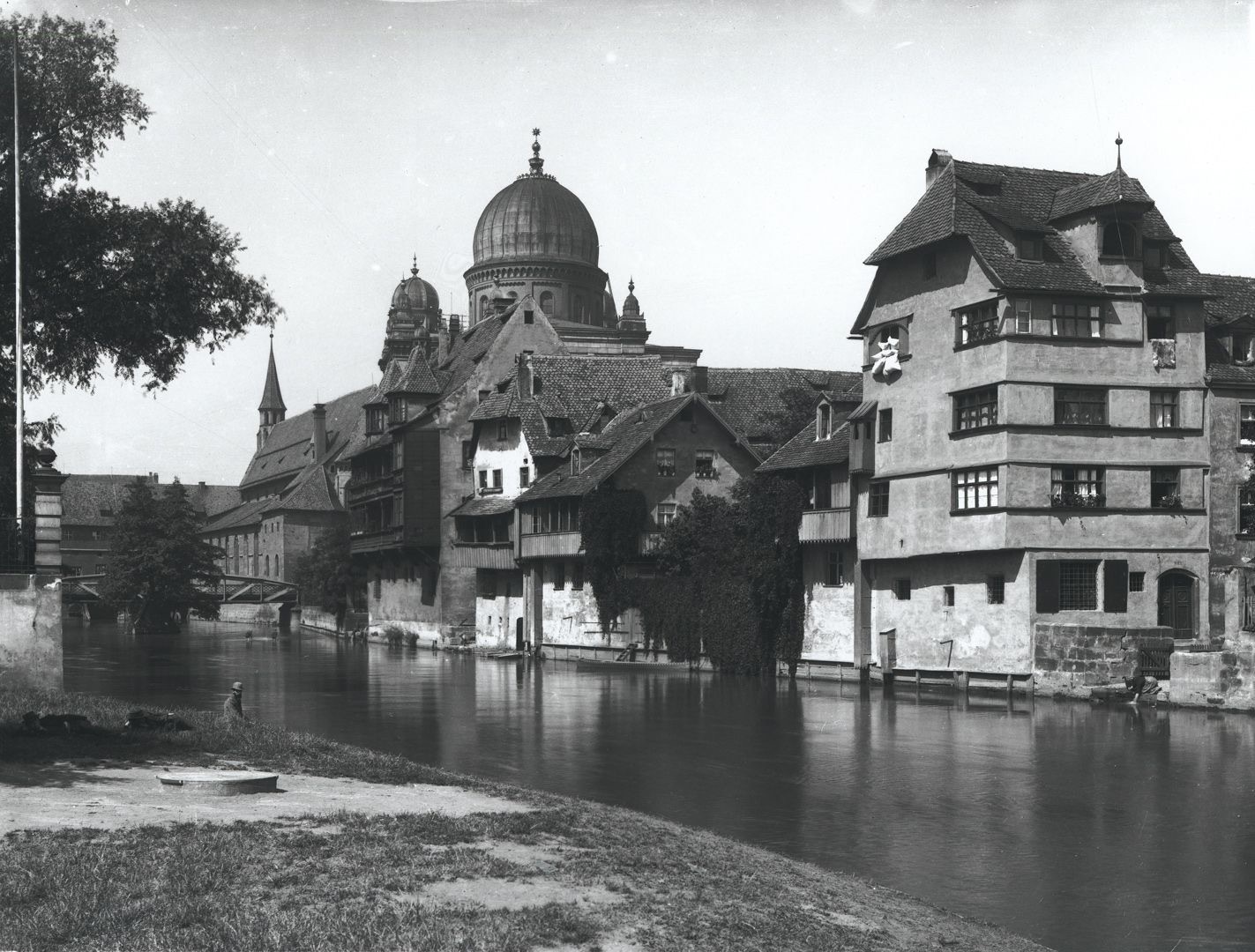
The synagogue of Nuremberg on the bank of the Pegnitz, about 1900. It was consecrated in 1874, and in 1933, 9,000 Jews lived in the city. On August 10, 1938, the synagogue and the community center were demolished. Photograph by Ferdinand Schmidt, Stadtarchiv Nürnberg. Public domain.
The short answers
- What were the Nuremberg Laws?
- Two laws announced on September 15, 1935. The Reich Citizenship Law made Jews subjects of the state rather than citizens. The Law for the Protection of German Blood and German Honor banned marriage and sexual relations between Jews and people the regime called of German or related blood.
- How did they decide who was a Jew?
- Not in the laws themselves. A decree of November 14, 1935 did it by counting grandparents: three or four Jewish grandparents made a person a Jew, and a grandparent counted as Jewish if they had belonged to the Jewish religious community.
- What was a Mischling?
- Someone with one or two Jewish grandparents, classed as neither German nor Jewish. Whether a person with two Jewish grandparents counted as a Jew could depend on their own religious community or whom they had married.
- Were these the first anti-Jewish laws?
- No. The first major one was the Law for the Restoration of the Professional Civil Service of April 7, 1933, which threw Jews out of state employment. In the first six years of the dictatorship there were more than 400 decrees and regulations.
- Did Hitler seize power?
- He was appointed. President Hindenburg made him chancellor on January 30, 1933. The Nazis never won a majority in a free election; their best result was 37 percent, in July 1932.
Before you read on: true or false?
Six statements about the Nuremberg Laws. Choose true or false, then see what the sources say.
Hitler's party won a majority in a free election before he became chancellor.
Show the answer
It is false.
Its best result in a free election was 37 percent, in July 1932. President Hindenburg appointed Hitler chancellor on January 30, 1933.
Source: United States Holocaust Memorial Museum, The Nazi Rise to PowerThe two Nuremberg Laws of September 1935 spelled out who counted as a Jew.
Show the answer
It is false.
They did not. A supplementary decree published on November 14, 1935 defined who was and was not a Jew.
Source: United States Holocaust Memorial Museum, Nuremberg LawsThe regime used physical or racial tests to decide who was a Jew.
Show the answer
It is false.
It had no such test. A grandparent counted as Jewish if they had belonged to the Jewish religious community, and the proof came from baptism records, Jewish community records and gravestones.
Source: United States Holocaust Memorial Museum, The Nuremberg Race LawsA person who had been baptized a Christian could still be classed as a Jew.
Show the answer
It is true.
The decree counted grandparents, not the person's own faith. The definition covered converts to Christianity and the children and grandchildren of converts.
Source: United States Holocaust Memorial Museum, Nuremberg LawsWhether a person with two Jewish grandparents counted as a Jew could depend on whom they married.
Show the answer
It is true.
Under the decree, a person with two Jewish grandparents counted as a Jew if they belonged to the Jewish religious community or were married to a Jew. Otherwise they were a Mischling of the first degree.
Source: Reichsgesetzblatt I 1935, the first decree to the Reich Citizenship Law, § 5 (in German)Most of Germany's Jews were still in the country when the war began in 1939.
Show the answer
It is false.
Of some 522,000 Jews in Germany in January 1933, about 304,000 emigrated in the first six years of the dictatorship, leaving about 214,000 on the eve of the war.
Source: United States Holocaust Memorial Museum, German Jews during the Holocaust
The two laws, September 15, 1935
They were announced at the Nazi Party rally in Nuremberg on September 15, 1935, and took the city's name. There were two.
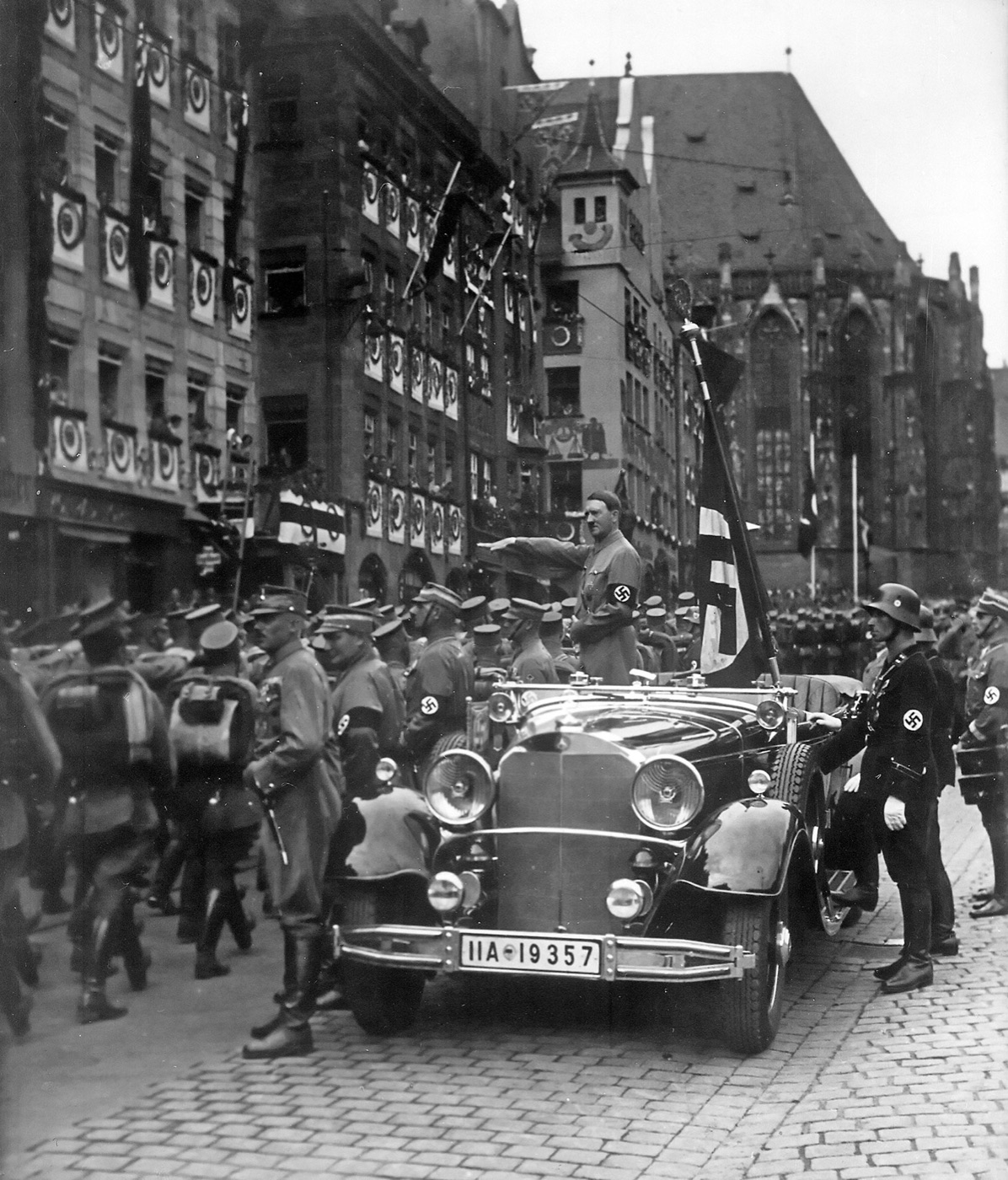
The Nazi Party rally at Nuremberg in September 1935, where the laws were read out.
Staged for propaganda Photographer unknown · September 1935 · Charles Russell Collection, NARA Public domain View the record: The Nazi Party rally at Nuremberg in September 1935, where the laws
The Reich Citizenship Law defined a citizen as a person of German or related blood. Jews were not that, so under the law they were no longer citizens but subjects of the state, with no political rights.
The Law for the Protection of German Blood and German Honor banned marriages and sexual relations between Jews and people of German or related blood, and punished the relations with prison. It also forbade Jews to employ women of German or related blood under 45 in their households. A private life became a criminal matter.
Neither law said who was a Jew. That came two months later.
Counting grandparents
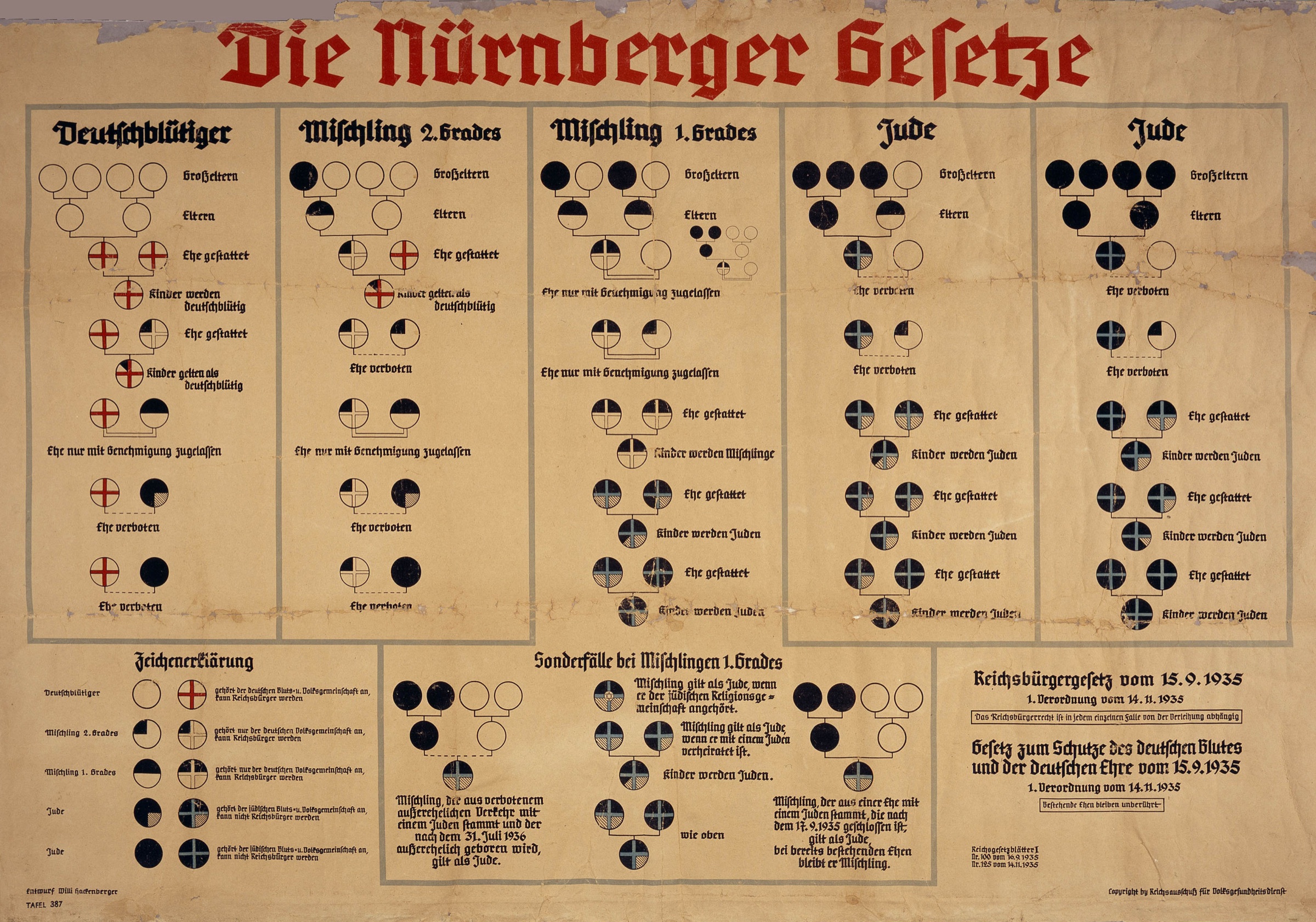
The laws could not work until somebody decided who they applied to. A decree of November 14, 1935 did, and the rule was soon drawn as wall charts like this one. The Holocaust needed clerks as much as it needed ideologues.
Read the chart
A teaching chart from 1935, plate 387 of the Reich Committee for Public Health Service. Choose a number to read that part of it, with a translation.
-
The title
Die Nürnberger Gesetze
The Nuremberg Laws
A teaching chart from 1935, numbered plate 387. Its imprint, at the foot of the sheet, names the designer, Willi Hackenberger, and the copyright holder, the Reichsausschuß für Volksgesundheitsdienst, the Reich Committee for Public Health Service.
-
Of German blood: no Jewish grandparent
Deutschblütiger
Großeltern
Eltern
gehört der deutschen Bluts- u. Volksgemeinschaft an, kann Reichsbürger werden
Of German blood
Grandparents
Parents
belongs to the German community of blood and people, can become a Reich citizen
Each column is one class of person, drawn as a family tree: the four grandparents in the top row, then the parents. White circles are grandparents the law counted as German, black circles grandparents it counted as Jewish. This class and the two Mischling classes could become Reich citizens.
-
Mischling of the second degree: one Jewish grandparent
Mischling 2. Grades
gehört nur der deutschen Volksgemeinschaft an, kann Reichsbürger werden
Mischling of the second degree
belongs only to the German people, can become a Reich citizen
One black circle among the four grandparents. The key admits this class to the German people but not to its community of blood. Mischling, mixed person, was the law's own word.
-
Mischling of the first degree: two Jewish grandparents
Mischling 1. Grades
Ehe nur mit Genehmigung zugelassen
Mischling of the first degree
marriage allowed only with permission
Two black circles. A person in this column needed official permission to marry someone of German blood. The small tree beside the parents shows the same class arising from one Jewish parent and one parent of German blood.
-
Jew: three or four Jewish grandparents
Jude
gehört der jüdischen Bluts- u. Volksgemeinschaft an, kann nicht Reichsbürger werden
Jew
belongs to the Jewish community of blood and people, cannot become a Reich citizen
Three black circles or four. Whatever the person's own faith, three Jewish grandparents made them a Jew under the decree, unable to become a citizen. Marriage to anyone of German blood was forbidden.
-
Who may marry whom
Ehe gestattet
Kinder werden deutschblütig
Ehe nur mit Genehmigung zugelassen
Ehe verboten
marriage permitted
children become of German blood
marriage allowed only with permission
marriage forbidden
Down every column the chart pairs a person with each class in turn and rules on the marriage. The Blood Law forbade marriages and relations between Jews and people of German blood, and punished the relations with prison. Here it becomes a table.
-
The special cases, where the race law gives itself away
Sonderfälle bei Mischlingen 1. Grades
Mischling gilt als Jude, wenn er der jüdischen Religionsgemeinschaft angehört.
Mischling gilt als Jude, wenn er mit einem Juden verheiratet ist.
Special cases among first-degree Mischlinge
A Mischling counts as a Jew if he belongs to the Jewish religious community.
A Mischling counts as a Jew if he is married to a Jew.
Two people with the same two Jewish grandparents could land on opposite sides of the line. One counted as a Jew because he belonged to the Jewish community or had married a Jew; the other stayed a Mischling. The chart draws a Star of David inside the first circle. The decree of November 14, 1935 sets out these cases and two more about children born after it. None of them is about blood. They are about religion and marriage.
-
The laws behind the chart
Reichsbürgergesetz vom 15.9.1935, 1. Verordnung vom 14.11.1935
Das Reichsbürgerrecht ist in jedem einzelnen Falle von der Verleihung abhängig
Gesetz zum Schutze des deutschen Blutes und der deutschen Ehre vom 15.9.1935, 1. Verordnung vom 14.11.1935
Bestehende Ehen bleiben unberührt
Reich Citizenship Law of September 15, 1935, first decree of November 14, 1935
Reich citizenship depends in each case on its being granted
Law for the Protection of German Blood and German Honor of September 15, 1935, first decree of November 14, 1935
Existing marriages are not affected
The chart cites both laws and, beside each, the decree of November 14, 1935. That decree, not the laws read out at Nuremberg, is where the definition of a Jew was written.
-
Who made it
Entwurf Willi Hackenberger
Tafel 387
Design: Willi Hackenberger
Plate 387
A published teaching aid, signed and numbered. Behind every circle was a person whose citizenship and marriage this classification decided.
Die Nürnberger Gesetze, the Nuremberg Laws, 1935. A teaching chart designed by Willi Hackenberger for the Reichsausschuß für Volksgesundheitsdienst. The translations in the notes are ours.
Period document Willi Hackenberger (design), for the Reichsausschuß für Volksgesundheitsdienst · 1935 · United States Holocaust Memorial Museum collection Public domain View the record: Die Nürnberger Gesetze, the Nuremberg Laws, 1935. A teaching chart
Look at what the chart is counting. A grandparent was Jewish if they had belonged to the Jewish religious community. The Holocaust Encyclopedia puts it plainly: the Nazis defined Jews by their religion, not by the supposed racial traits that Nazism attributed to Jews. The proof came from baptism records, Jewish community records and gravestones.
The person being counted had no say. The definition covered tens of thousands of people who did not think of themselves as Jews: converts to Christianity, and the children and grandchildren of converts.
How the law got there, 1933 to 1935
Hitler did not take power. He was given it. President Paul von Hindenburg appointed him chancellor on January 30, 1933, and the men who arranged it were confident they could control him and limit what he could do.
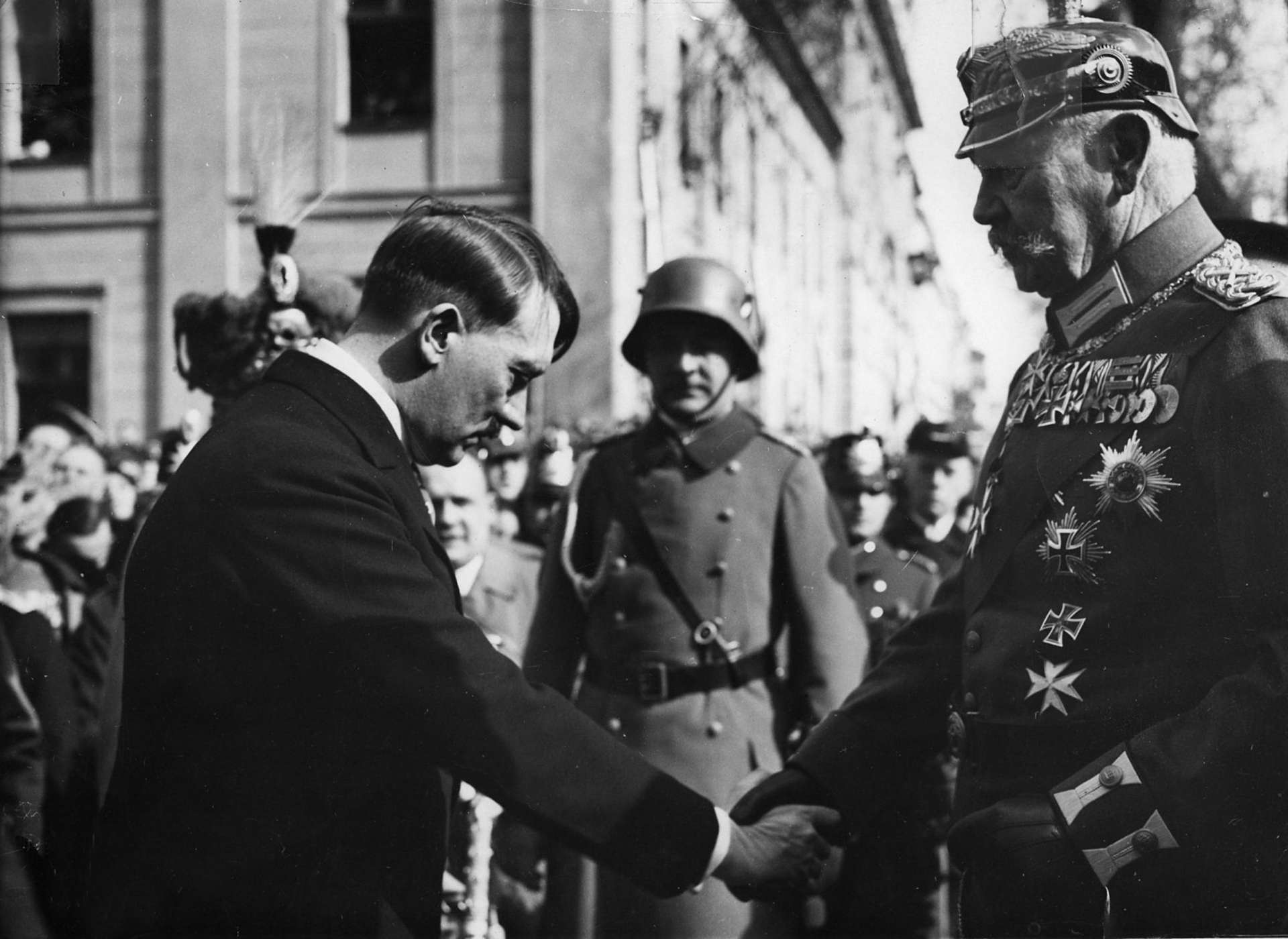
Hitler bowing to Hindenburg on the Day of Potsdam, March 21, 1933, when the first Reichstag of the Nazi era was opened with a staged ceremony. In Germany it was taken at once as a union of the old Germany and the new, and this photograph became its symbol.
Staged for propaganda Theo Eisenhart · March 21, 1933 · Bundesarchiv, Bild 183-S38324 CC BY-SA 3.0 de: license for Hitler bowing to Hindenburg on the Day of Potsdam, March 21, 1933, View the record: Hitler bowing to Hindenburg on the Day of Potsdam, March 21, 1933,
The Nazis never won a majority in a free election. Their best result was 37 percent, in July 1932. What followed the appointment was fast. The Reichstag burned in late February 1933, and a decree suspended civil liberties and due process indefinitely. The election that March was held amid Nazi intimidation and terror, and even then the party won almost 44 percent. The Enabling Act of March 23 let the chancellor make law without parliament. By July the Nazi Party was the only legal party in Germany.
Six months, from a legal appointment to a one-party state.
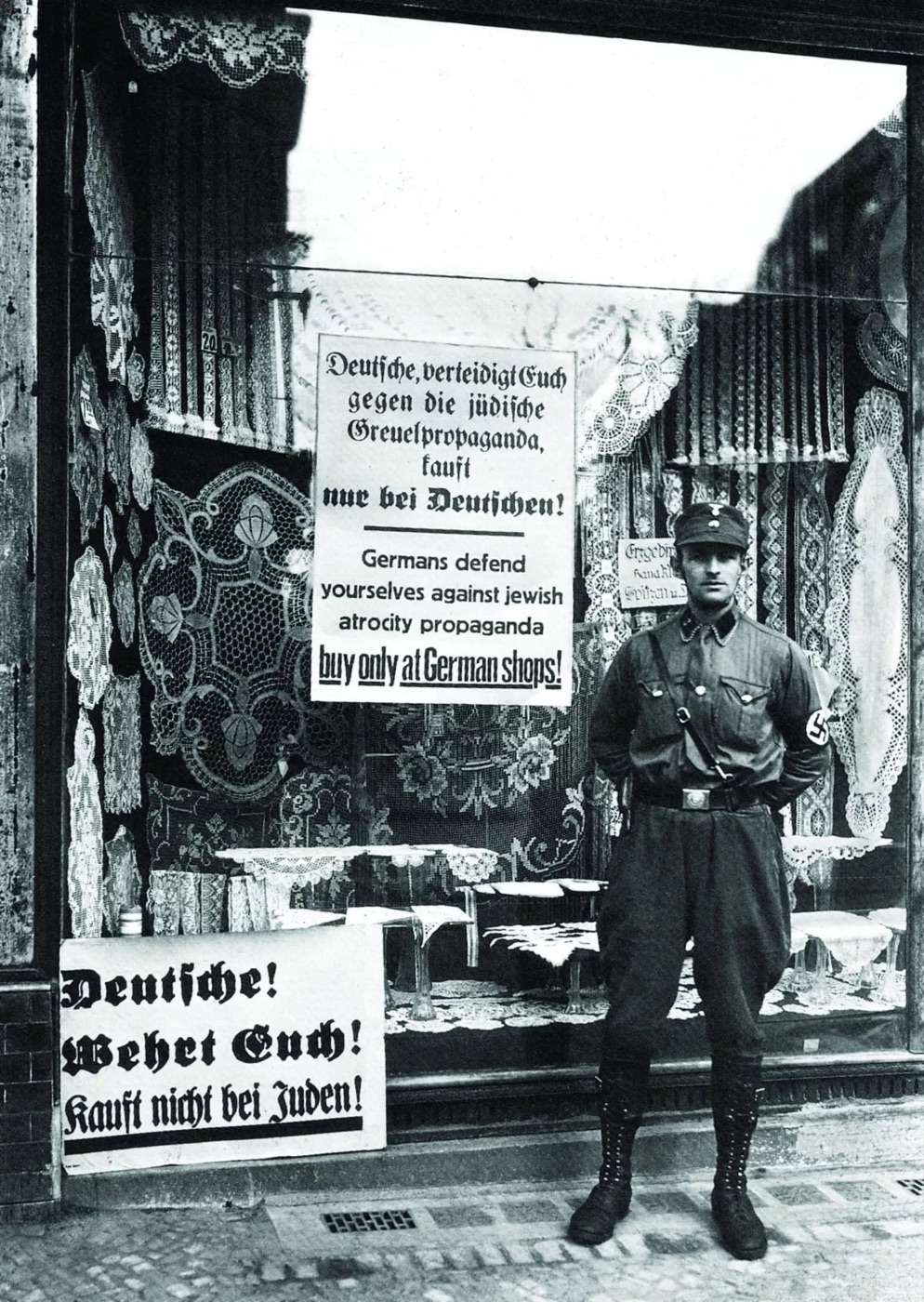
The boycott of April 1, 1933. A sign in a shop window in Berlin reads Kauft nicht bei Juden, do not buy from Jews. It was organized by local Nazi party chiefs and it lasted one day.
Photographed by a German participant or onlooker Photographer Georg Pahl according to German Federal Archives · April 1, 1933 · Wikimedia Commons CC BY-SA 4.0: license for The boycott of April 1, 1933. A sign in a shop window in Berlin reads View the record: The boycott of April 1, 1933. A sign in a shop window in Berlin reads
Many Germans ignored it and went on shopping where they always had, though there was violence against Jews and Jewish property that day.
The law arrived six days later. The Law for the Restoration of the Professional Civil Service of April 7, 1933 excluded Jews and the politically unreliable from state employment. It was the first major law to curtail the rights of Jewish citizens. The same month, another law restricted the number of Jewish students at German schools and universities.
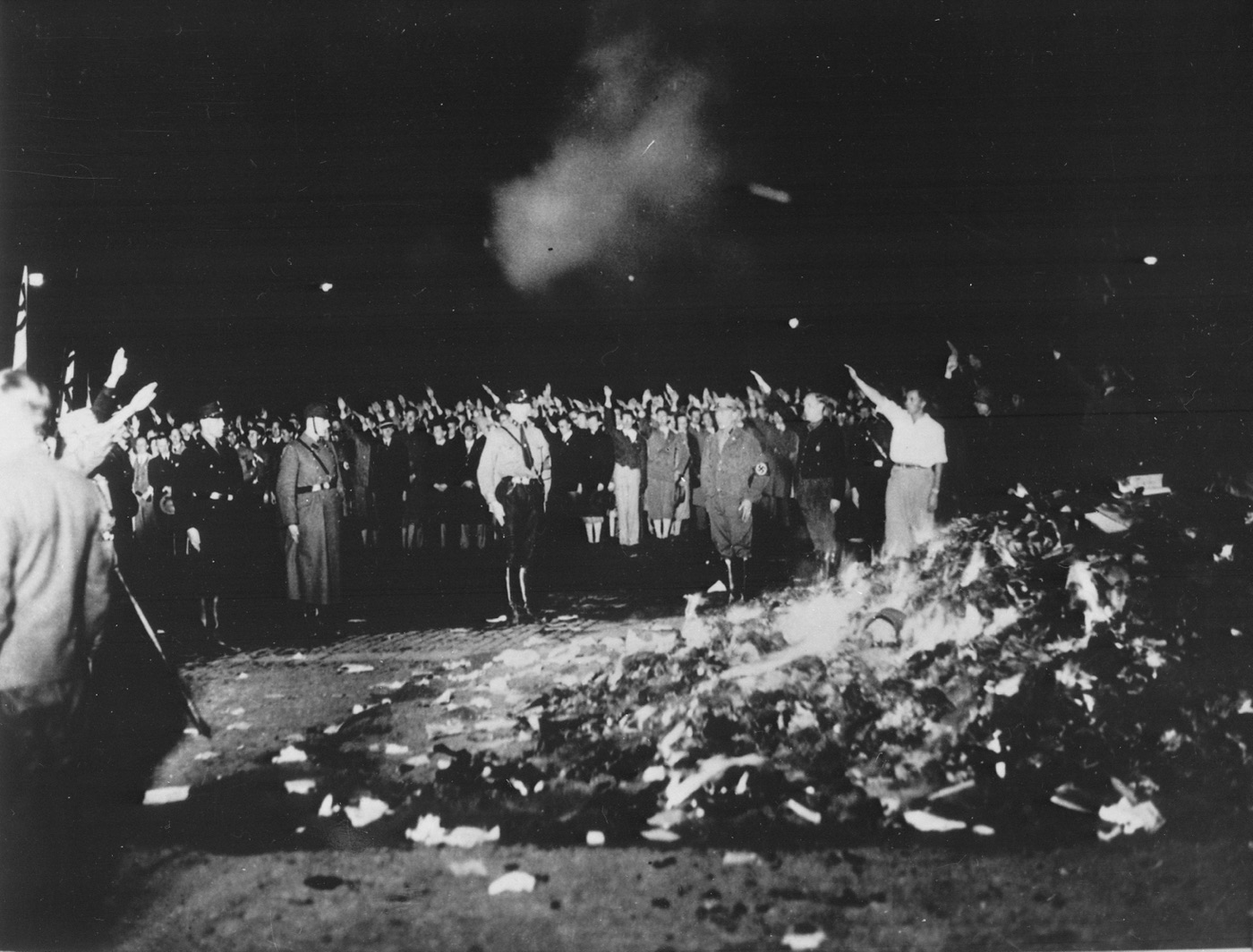
Books burning on the Opernplatz in Berlin, May 1933. Pro-Nazi students organized the book burnings. The largest, in Berlin on May 10, drew some 40,000 people, and about 20,000 volumes were burned.
Photographed by a German participant or onlooker Pahl, Georg · May 11, 1933 · Bundesarchiv, Bild 102-14597 CC BY-SA 3.0 de: license for Books burning on the Opernplatz in Berlin, May 1933. Pro-Nazi View the record: Books burning on the Opernplatz in Berlin, May 1933. Pro-Nazi
The public was not a bystander to all of this. As Jewish businesses were pushed out of the economy, non-Jewish Germans bought them, and owners who were desperate to emigrate or selling a failing business took twenty or thirty percent of what the business was actually worth. Between April 1933 and April 1938 the number of Jewish-owned businesses in Germany fell by about two thirds. After Kristallnacht the transfer of every remaining Jewish business to non-Jews was made compulsory.
Of course, during the time, I don't have to tell you, the persecution of Jews was very difficult, was very hard. Parnassah [livelihood] was very hard. My pa- parents had a, had a business selling furniture, antique furniture, modern and, and other furniture. And the business went completely down the drain. We were left practically penniless, and my parents tried to get us out of Germany.
Jakob Gutmann, who grew up in Berlin and was twelve in 1935. In 1939 he left for England on a Kindertransport. Project Witness testimony. Watch the full testimony. This passage begins at 4:49: Jakob Gutmann, Project Witness
Germans also informed on one another. The Gestapo had too few officers for widespread surveillance, which is why denunciations mattered so much: a neighbor, an acquaintance, a colleague, a friend or a relative telling the police that someone was breaking the rules, often out of ideology, politics or personal gain.
The people it was written about
In January 1933 some 522,000 Jews lived in Germany. Nuremberg, the city that gave the laws their name, had 9,000 of them, the second-largest Jewish community in Bavaria. Its synagogue had been consecrated in 1874. Its Orthodox members had their own community, Adass Israel, founded in 1875, with its own synagogue from 1902 and its own primary school from 1921.
I was born in Würzburg, Germany, on March 10th, 1929, and we lived in a small village outside of Würzburg called Hessdorf, which my ancestors lived for probably in that same area, as far as I know, about 300 years. ... My family were mostly shochtim, and as many generations back that I'm aware of, which is at least four or five generations, my ancestors had a slaughterhouse in Hessdorf, Germany.
David Weichselbaum, who grew up in Heßdorf, a village in Lower Franconia, and was six in 1935. Shochtim are ritual slaughterers. Project Witness testimony. Watch the full testimony. This passage begins at 1:10: David Weichselbaum, Project Witness
German Jews did not simply absorb the decrees. They tried to cope with them through their own institutions. In the early war years the Reich Association of Jews in Germany, led by the theologian Leo Baeck but subject to the demands of the Nazi authorities, worked to organize further emigration, to support Jewish schools and self-help organizations, and to help the community contend with what the Holocaust Encyclopedia calls an ever-growing mass of discriminatory legislation.
From then on, life for the Jews became very uncomfortable. Month after month, year after year, there were new laws and new decrees depriving Jews of citizenship and of possessions and of opportunities and education. Perhaps the only positive aspect of that was that a lot of semi-assimilated Jews who would be sending their children to the public schools because they didn't want them to get too much of a Jewish education now had no choice but to send their children to Jewish schools and give them a better background of Jewish education. Also, a lot of people who previously felt that they didn't need any religion, they were so comfortable, so secure, so suddenly they felt that in a time of danger, they came to shul [synagogue] and they came to the Beis HaRav [the rabbi's house, here his father's] to ask for aid, for guidance, for, for help, how, how do you manage all that?
Naftali Carlebach, as Project Witness lists him, a son of the rabbi of Altona, beside Hamburg, on the years after 1933. Project Witness testimony. Watch the full testimony. This passage begins at 5:06: Naftali Carlebach, Project Witness
Many left: about 304,000 in the first six years of the dictatorship, leaving about 214,000 in Germany on the eve of the war.
In Nuremberg the synagogue and the community center were demolished on August 10, 1938. Three months later, on Kristallnacht, the city's two remaining synagogues were burned. By 1939 only 2,611 Jews were left in the city.
What followed
In the first six years of the dictatorship, Jews felt the effects of more than 400 decrees and regulations on all aspects of their lives. There was no single law that did it.
In May 1938 the Nuremberg Laws were decreed to apply in annexed Austria. By then the measures had reached names, papers and movement. Jewish men and women with first names of non-Jewish origin had to add Israel or Sara to them from January 1, 1939. All Jews had to carry identity cards showing their Jewish heritage, and from the fall of 1938 every Jewish passport was stamped with a J.
The professions went the same way. In late September 1938 the regime revoked the medical licenses of all Jewish doctors in Germany. The few allowed to keep working had to call themselves Krankenbehandler, treaters of the sick, and could treat only Jews.
The Jewish doctors were no longer allowed to call themselves doctors. They had to call themselves Judenbehandler, which means treaters of Jews. They were not allowed to call themselves doctor anymore. That was a tough time.
Henry Lowenthal, whose father was a urologist at the Jewish hospital in Frankfurt. The word he remembers differs from the official one, Krankenbehandler. Project Witness testimony. Watch the full testimony. This passage begins at 6:36: Henry Lowenthal, Project Witness
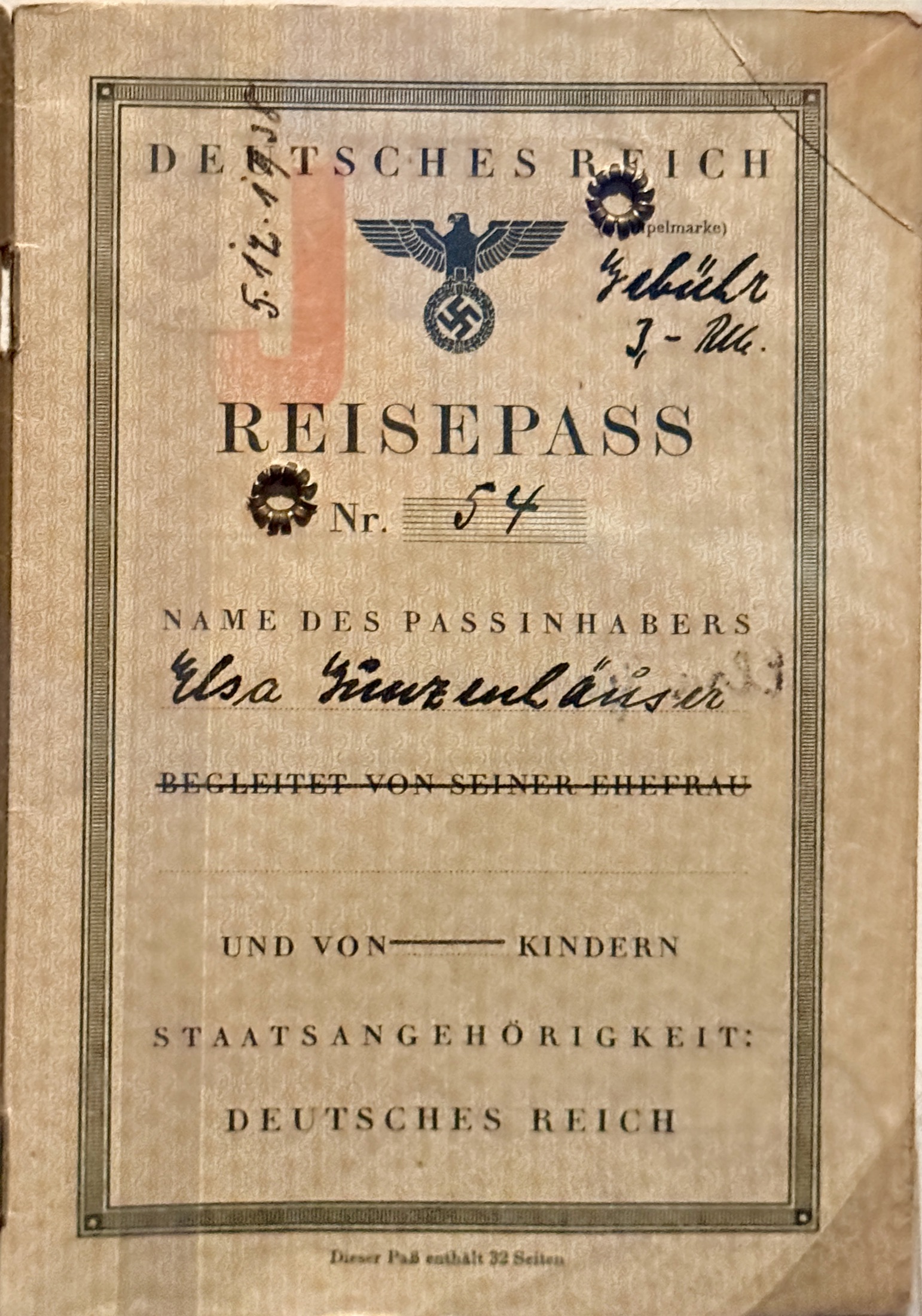
A passport stamped with the J. Any official who opened it, including at a border, could see at once that its holder was a Jew.
Oleg Yunakov · September 11, 2025 · Wikimedia Commons CC BY-SA 4.0: license for A passport stamped with the J. Any official who opened it, including View the record: A passport stamped with the J. Any official who opened it, including
They would do it right in the train and the people would stay on the train. And then when they came to us, to my family, it seems we were the only Jews on the train. And how did they know about, that we were Jews? Because by that time we had a big J on our passport.
Thea Reuben, whose family left Vienna for Belgium in 1939. At Aachen, the last German city on the line, German officials checked every passenger's papers on the train. Project Witness testimony. Watch the full testimony. This passage begins at 1:01:35: Thea Reuben, Project Witness
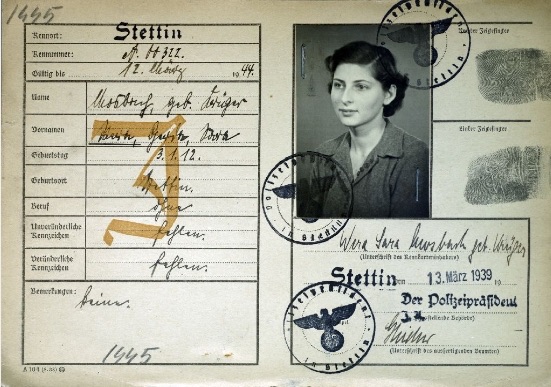
An identity card. A named person, a photograph, a fingerprint, and a classification arrived at by counting her grandparents.
Deutsches Reich · March 13, 1939 · Wikimedia Commons Public domain View the record: An identity card. A named person, a photograph, a fingerprint, and a
The next turning point in this series is the Anschluss, when exclusion that had been built up on paper in Germany was carried out in the streets of Vienna within days.
The dates
Read the gaps as well as the entries. This took years, and it was meant to.
January 30, 1933
Hindenburg appoints Hitler chancellor.
Late February 1933
The Reichstag burns. A decree suspends civil liberties and due process indefinitely.
March 23, 1933
The Enabling Act lets the chancellor make law without parliament.
April 1, 1933
The national boycott of Jewish businesses. It lasts one day.
April 7, 1933
The Law for the Restoration of the Professional Civil Service excludes Jews from state employment.
July 1933
The Nazi Party becomes the only legal party in Germany.
September 15, 1935
The Nuremberg Laws are announced at the Nazi Party rally.
November 14, 1935
A decree defines Jew and Mischling by counting grandparents.
August 10, 1938
Nuremberg's synagogue and community center are demolished.
Fall 1938
Jewish passports are stamped with a J.
January 1, 1939
Jews with non-Jewish first names must add Israel or Sara.
Show the other 3 dates
March 1933
The last multi-party election, held amid Nazi intimidation and terror.
May 10, 1933
Book burnings. In Berlin about 20,000 volumes burn on the Opernplatz.
May 15, 1938
The Nuremberg Laws are applied in annexed Austria.
Questions people ask
When were the Nuremberg Laws passed?
They were announced on September 15, 1935, at the Nazi Party rally in Nuremberg. The decree that defined who counted as a Jew followed on November 14.
What did the Nuremberg Laws actually do?
The Reich Citizenship Law defined a citizen as a person of German or related blood, which made Jews subjects of the state rather than citizens, with no political rights. The Law for the Protection of German Blood and German Honor banned future marriages and sexual relations between Jews and other Germans.
How did the Nazis define a Jew?
By grandparents, in a decree of November 14, 1935. Three or four Jewish grandparents made a person a Jew. One or two made them a Mischling, a category that was neither German nor Jewish. A grandparent counted as Jewish if they had belonged to the Jewish religious community.
Isn't it strange that a racial law used religious records?
That is the point. The regime had no test for race, so the decree fell back on membership of the Jewish religious community, and the proof came from baptism records, Jewish community records and gravestones. The Holocaust Encyclopedia says the Nazis defined Jews by their religion, not by any racial trait.
Did Hitler win an election?
Not in the sense people usually mean. His party came first in the Reichstag election of July 1932 with 37 percent, the most it ever won in a free election, and he lost the 1932 presidential election to Hindenburg. He became chancellor because Hindenburg appointed him on January 30, 1933.
How many anti-Jewish laws were there?
More than 400 decrees and regulations in the first six years of the dictatorship, affecting every part of life. The Nuremberg Laws are the famous ones, but they sit inside a much longer accumulation.
What was the J stamp?
From the fall of 1938 every Jewish passport was stamped with an identifying letter J, and all Jews had to carry identity cards that showed their Jewish heritage.
Were the laws enforced immediately?
Yes. The Holocaust Encyclopedia says the laws brought about immediate and concrete segregation. Around the 1936 Olympics the regime toned down its public anti-Jewish rhetoric and even removed some of the signs reading Jews Unwelcome from public places, but the laws stayed in force.
What happened to Mischlinge?
At first they kept the same rights as other Germans, but those rights were curtailed again and again by later legislation. A Mischling with two Jewish grandparents could be counted as a Jew outright, through their own religious community or their marriage.
Why does this page start with the laws and then go back to 1933?
Because the laws are what people search for, and they make sense only with what came before. They formalized an exclusion that had been running for two and a half years, and reading them as a beginning gets the whole shape of it wrong.
For educators
Free, and made for a classroom
Project Witness is a nonprofit Holocaust education organization in New York. Tell us what you teach and we will send you what fits your classroom.
How we know
Where the page shows a Nazi document, it says so and gives the words as printed, in German, with our translation.
The survivors quoted on this page speak in Project Witness's own recorded testimonies. Each passage was checked against the audio of the recording, and the link under it says where in the testimony it begins.
Every source this page rests on.
- The Nuremberg Race Laws United States Holocaust Memorial Museum, Holocaust Encyclopedia
- Nuremberg Laws United States Holocaust Memorial Museum, Holocaust Encyclopedia
- Erste Verordnung zum Reichsbürgergesetz, November 14, 1935 (in German) Reichsgesetzblatt I 1935, pages 1333 and 1334, as transcribed on German Wikisource The German text of the decree. The Avalon Project's English translation mistakes grandparents for parents in § 5.
- Die Nürnberger Gesetze, Tafel 387: the chart on this page United States Holocaust Memorial Museum collection, via Wikimedia Commons The German on the chart is quoted as printed; the translations on the page are ours.
- Chart illustrating the Nuremberg laws United States Holocaust Memorial Museum, credit Stadtarchiv und Landesgeschichtliche Bibliothek Bielefeld
- The Nazi Rise to Power United States Holocaust Memorial Museum, Holocaust Encyclopedia
- Der Tag von Potsdam (in German) Deutsches Historisches Museum, Lebendiges Museum Online
- Anti-Jewish Legislation in Prewar Germany United States Holocaust Memorial Museum, Holocaust Encyclopedia
- Boycott of Jewish Businesses United States Holocaust Memorial Museum, Holocaust Encyclopedia
- Nazi Book Burnings United States Holocaust Memorial Museum, Holocaust Encyclopedia
- Aryanization United States Holocaust Memorial Museum, Holocaust Encyclopedia
- The Gestapo: Overview United States Holocaust Memorial Museum, Holocaust Encyclopedia
- Nuremberg Encyclopaedia Judaica (2007), via the Jewish Virtual Library
- German Jews during the Holocaust United States Holocaust Memorial Museum, Holocaust Encyclopedia
- 1938 Key Dates United States Holocaust Memorial Museum, Holocaust Encyclopedia
- Certificate issued to Sigmar Karplus confirming his service during the First World War Jewish Museum Berlin
- Talmud, Kiddushin 68b Sefaria, William Davidson Edition, in English
- Talmud, Yevamot 22a Sefaria, William Davidson Edition, in English
- Robert Gellately, Backing Hitler: Consent and Coercion in Nazi Germany Oxford University Press, 2001 Further reading on denunciation and public consent. Not quoted on this page.
- Frank Bajohr, 'Aryanisation' in Hamburg Berghahn Books, 2002 Further reading on who ended up with the property. Not quoted on this page.
Words used on this page
Show the 2 terms
- Mischling
- The Nuremberg Laws' category for a person with one or two Jewish grandparents, counted as neither German nor Jewish. A grandparent was counted as Jewish if they had belonged to the Jewish religious community. Source: USHMM Holocaust Encyclopedia, The Nuremberg Race Laws, for Mischling
- Anschluss
- Germany's annexation of Austria on March 11 to 13, 1938. The regime called it reunification, which the Holocaust Encyclopedia calls a misnomer, because Austria had never been part of the German Empire. Source: USHMM Holocaust Encyclopedia, Nazi Territorial Aggression: The Anschluss, for Anschluss