
The Nuremberg trials, and the men who were never tried.
Twenty-one men sat in the dock at Nuremberg. Hundreds of thousands took part in the killing. This is what the trials proved, how the murder of a continent was written into memoranda first, and what happened to almost everyone who carried it out.
Jump to the trialsThe Nuremberg trials: the short answers
Each of these has a fuller answer below.
- What they were
- The trial of the surviving leadership of Nazi Germany by an international court, held in the Palace of Justice at Nuremberg.
- When
- November 20, 1945 to October 1, 1946. Twelve further trials ran at Nuremberg until 1949.
- Who ran it
- The United States, the United Kingdom, the Soviet Union and France, under the London Charter of August 8, 1945.
- The charges
- Conspiracy, crimes against peace, war crimes, and crimes against humanity. The last of those was a new criminal charge.
- Who was tried
- Twenty-four men were indicted. Twenty-one sat in the dock.
- The verdicts
- Twelve death sentences, three life terms, four fixed terms, three acquittals.
- How many were punished in the end
- Far fewer than took part. Thousands never faced a court, and in West Germany most of those who did were acquitted or given light sentences. That is the part of this story that is usually left out, and it is the last section on this page.
Who were the men who did this?
Lawyers, physicians, career civil servants and the men who ran the ministries. The machinery moved on paper, and the paper was signed.
Twenty-four men were indicted at Nuremberg. Robert Ley, head of the German Labor Front, hanged himself in his cell on October 25, 1945, twenty-six days before the trial opened. The industrialist Gustav Krupp von Bohlen und Halbach was ruled unfit to stand trial on medical evidence of senile brain softening. Martin Bormann could not be found and was tried in his absence. Twenty-one men physically sat in the dock.
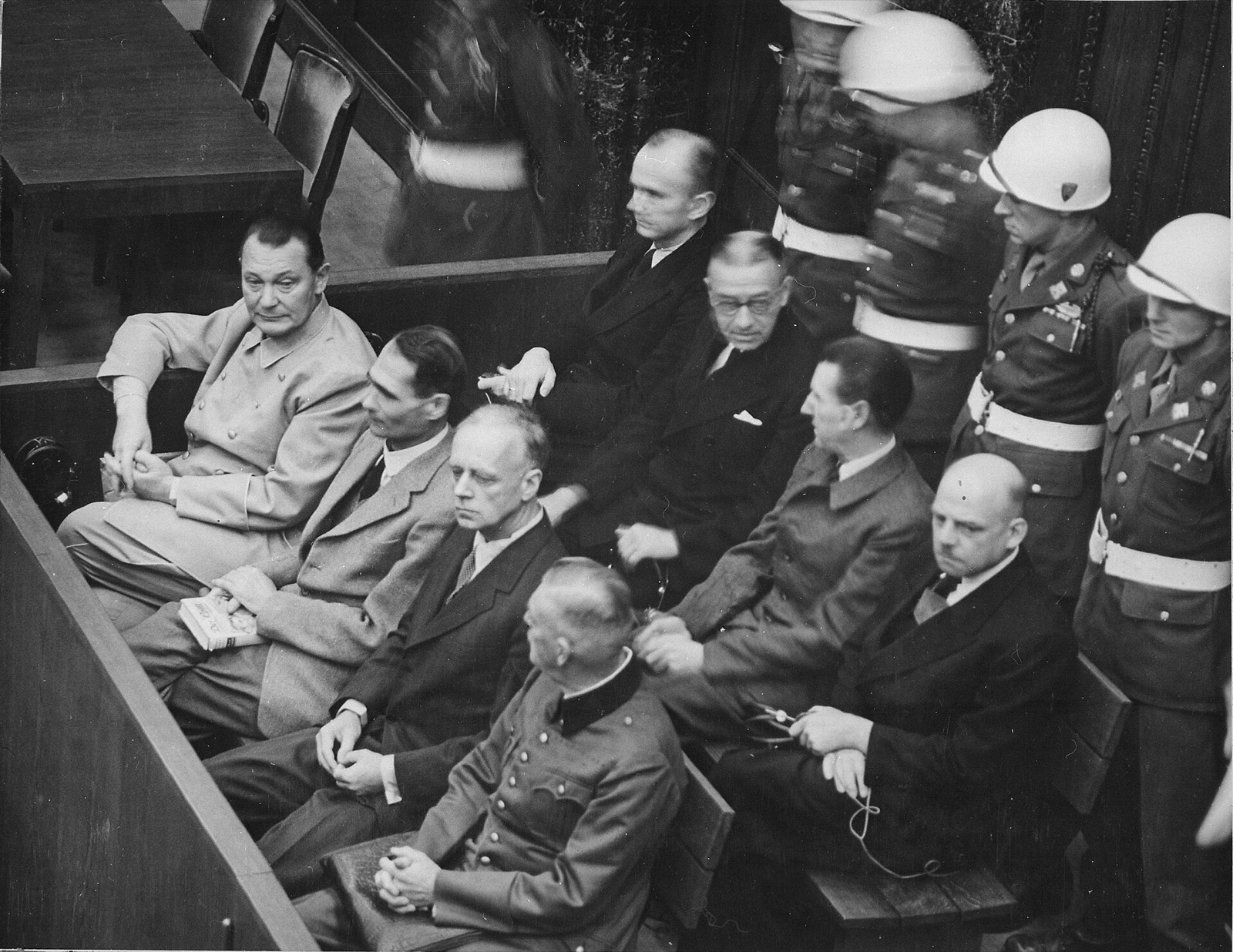
The twelve American trials that followed sorted the rest by profession. The Doctors' Trial opened on December 9, 1946 against 23 German physicians and administrators. The Judges' Trial opened on March 5, 1947 against 16 men: nine officials of the Reich Ministry of Justice and seven judges and prosecutors of the People's and Special Courts.
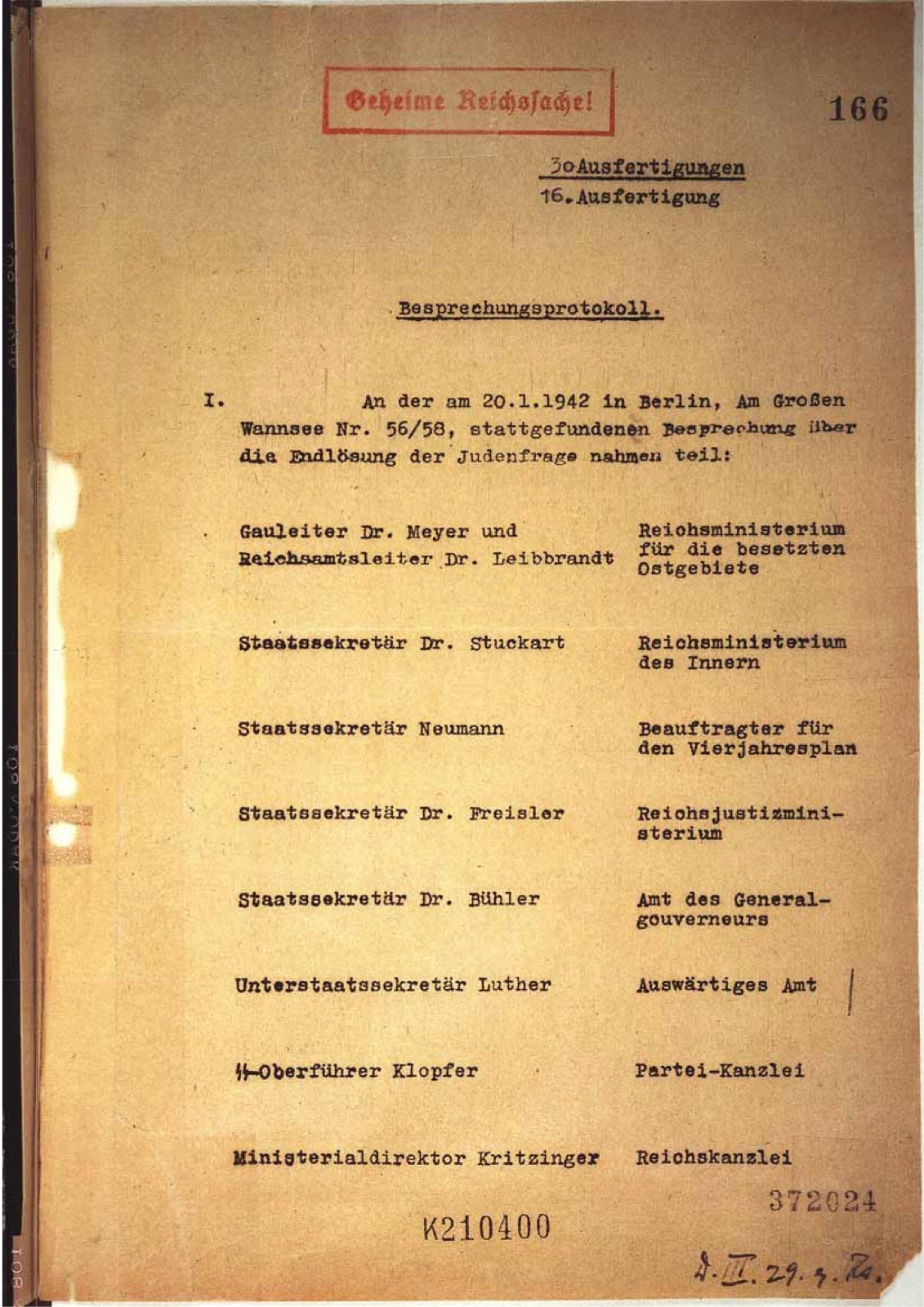
Fifteen officials sat around a table at the villa in Wannsee on January 20, 1942. Ten had been to university, eight had studied law, and eight held doctorates, though Hans-Christian Jasch and Christoph Kreutzmüller, who counted them, note that a doctorate in law or philosophy was easier to get in the 1920s than it is now. They came from the Interior Ministry, the Justice Ministry, the Foreign Office, the Ministry for the Occupied Eastern Territories, the Reich Chancellery, the Party Chancellery, the office of the Governor General in occupied Poland and the Four Year Plan, and from the SS and police.
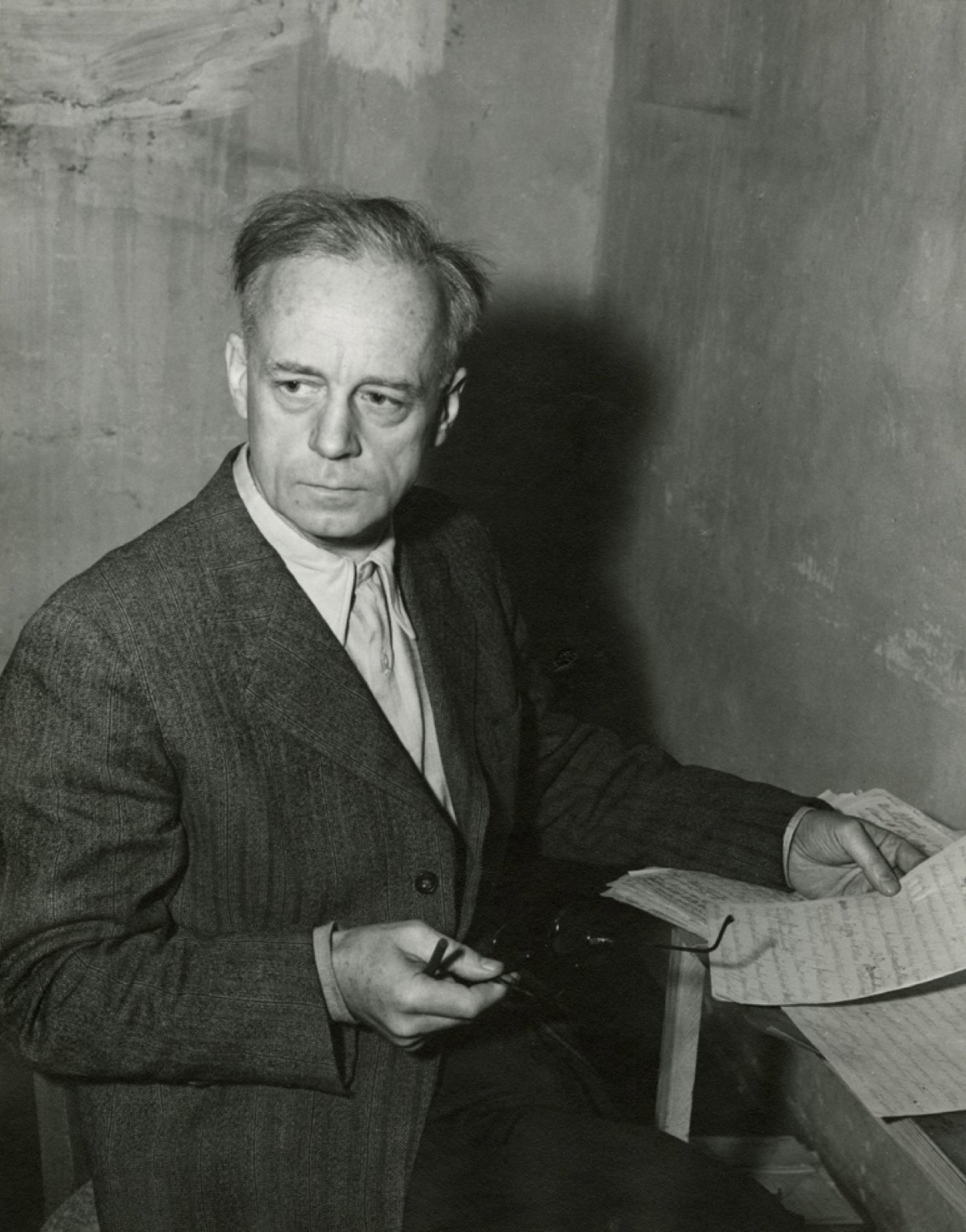
What follows runs in the order it happened. Men working inside a constitutional republic took it apart in eighteen months using its own statute book. The killing was already under way before the Wannsee Conference. Then a courtroom in a bombed city, where a few of them were handed back the files they had signed. Then what came after, in the words of the United States Holocaust Memorial Museum: thousands of Nazi officials and perpetrators never faced trial, and many returned to the professions they had practiced under the Third Reich.
How did Hitler come to power?
He was appointed, not elected, and the Nazi vote was falling when it happened.
He was appointed. On January 30, 1933, President Paul von Hindenburg named Adolf Hitler chancellor of Germany. Under the constitution of 1919 the chancellor was chosen by the president, not the electorate. There was no national vote for the office. Hindenburg signed. That was the mechanism.
Weimar was built to be representative and turned out to be ungovernable. Seats went out proportionally, so a party with 0.8 percent of the vote took four of them. Article 48 let the president suspend named civil liberties and legislate without parliament, and Hindenburg was using it routinely from July 1930. Government without a parliamentary majority was normal in Germany before a Nazi held office in it. The far right had its grievance ready: territory lost at Versailles, an army capped at 100,000 men, and a lost war that Germany's own retired generals blamed on subversion at home.
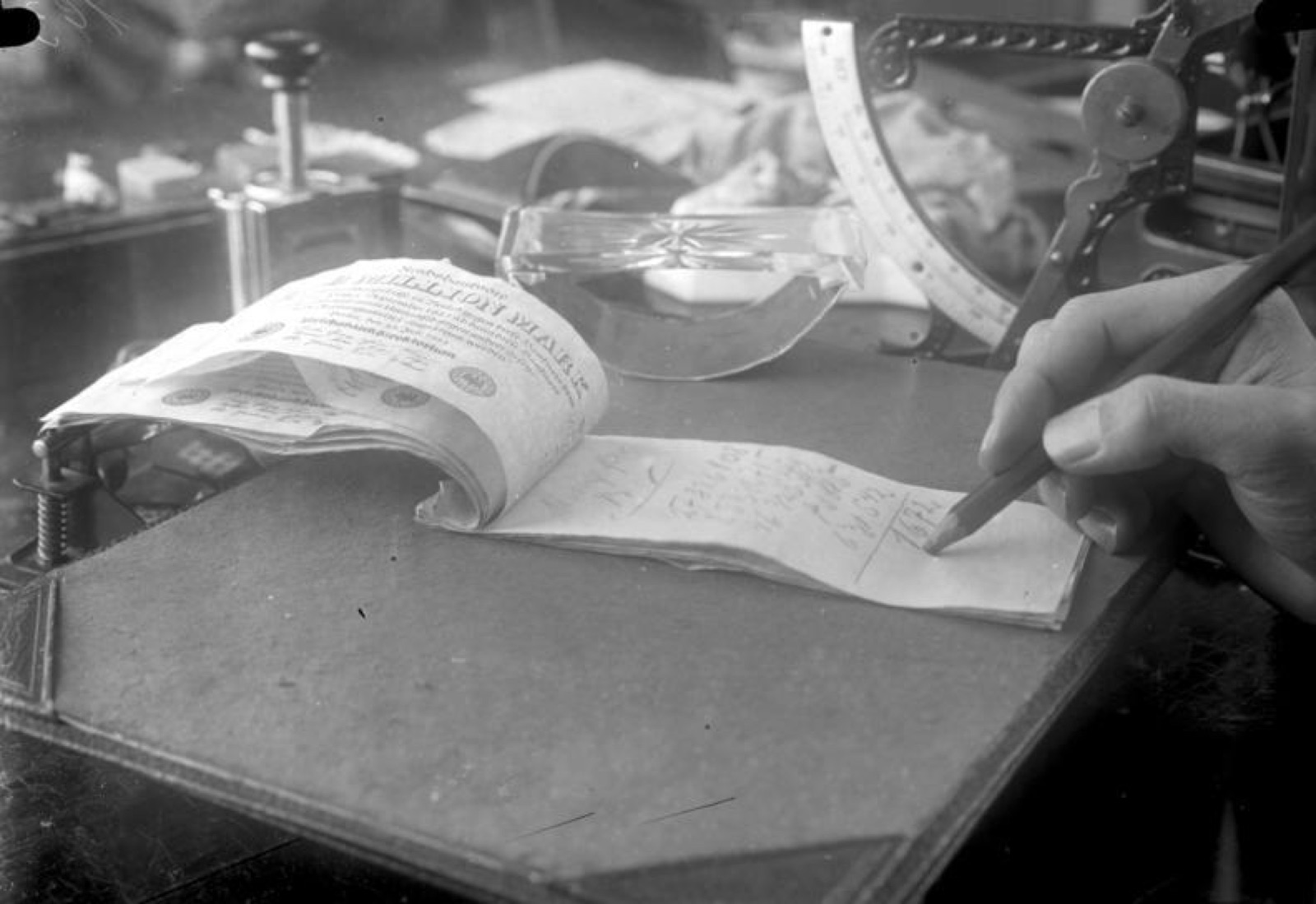
In January 1920 the mark stood at 64.8 to the U.S. dollar. By November 1923 it stood at 4,200,000,000,000 to one. That same month Hitler and the Nazi Party tried to seize the Bavarian state government and march on Berlin. Munich police stopped the column in the city center on November 9.
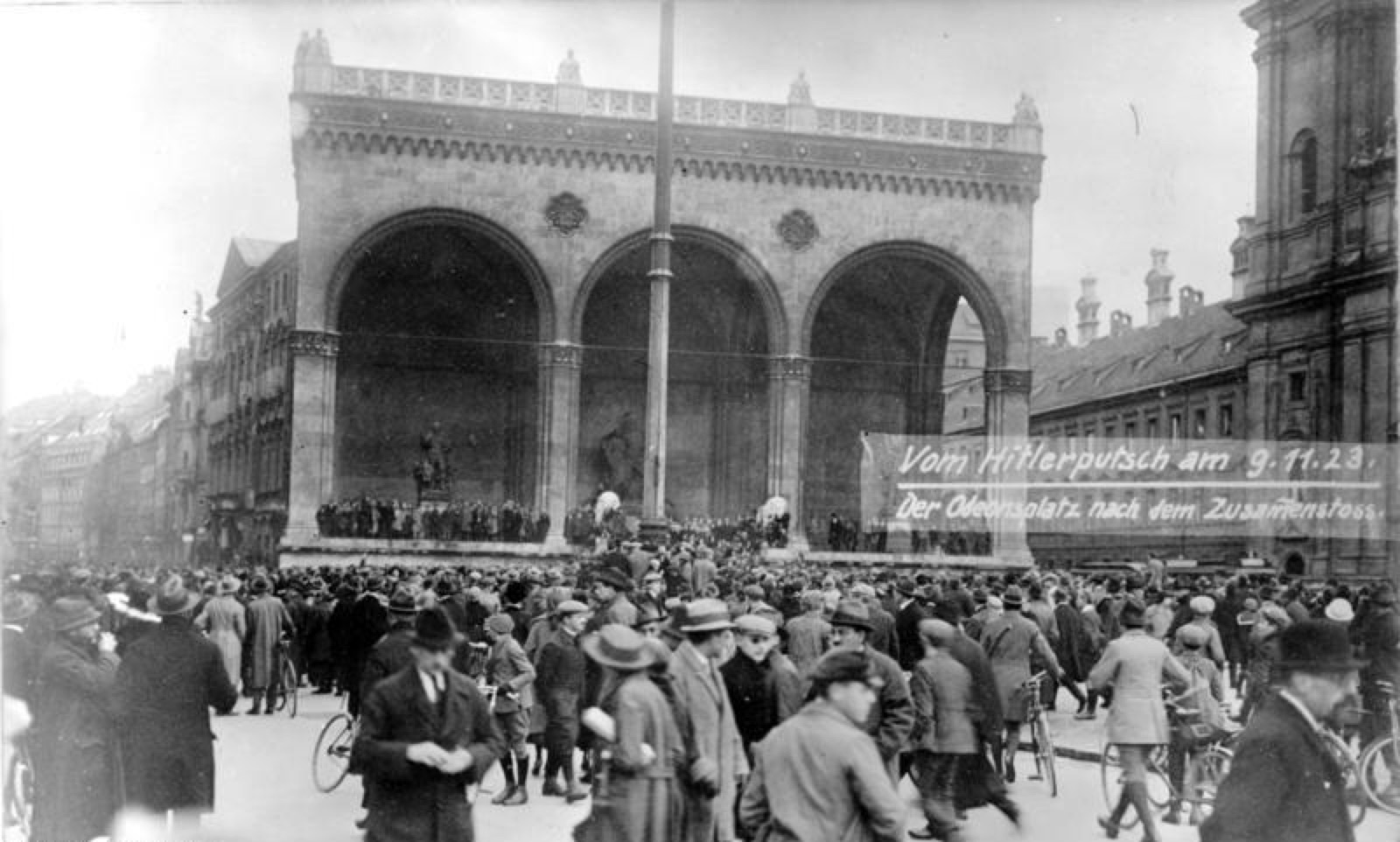
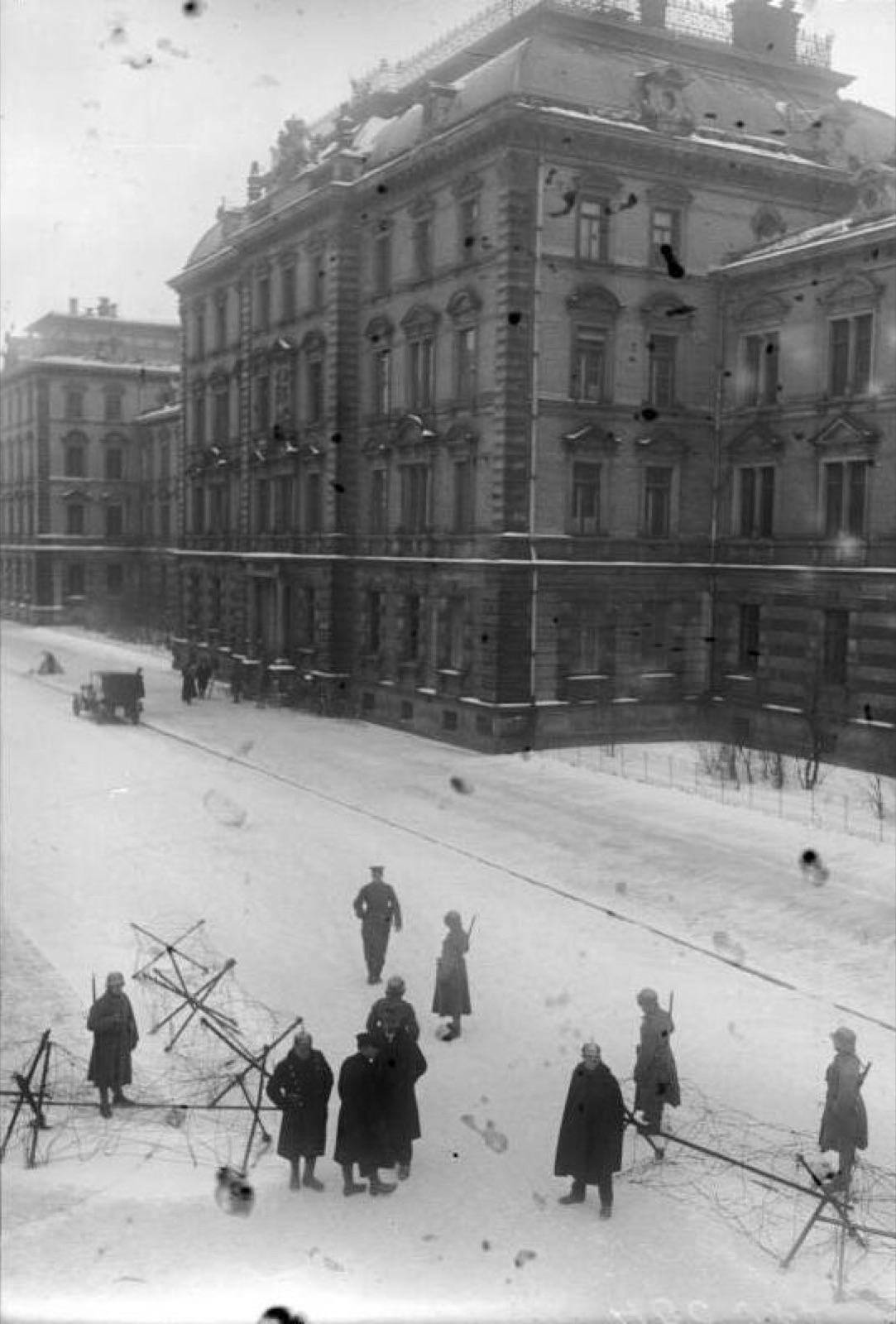
Hitler was tried for high treason before the Munich People's Court from February 26 to April 1, 1924, and convicted. He got five years of Festungshaft, fortress confinement without hard labor, and a 200 gold mark fine. Five years was the statutory minimum, with probation held out after six further months. He was an Austrian citizen, and the law required deporting foreign nationals convicted of high treason. The court expressly declined. He walked out on December 20, 1924, having served about nine months, with the manuscript of a book.
Franz Eher Verlag published the first volume of Mein Kampf in 1925 and the second in 1926. The antisemitism and the plan to take living space in eastern Europe are in it, stated openly. Fewer than 230,000 copies sold by the end of 1932; more than 850,000 sold in 1933 alone. The intentions were on the record for eight years and nobody who could have acted treated them as disqualifying.
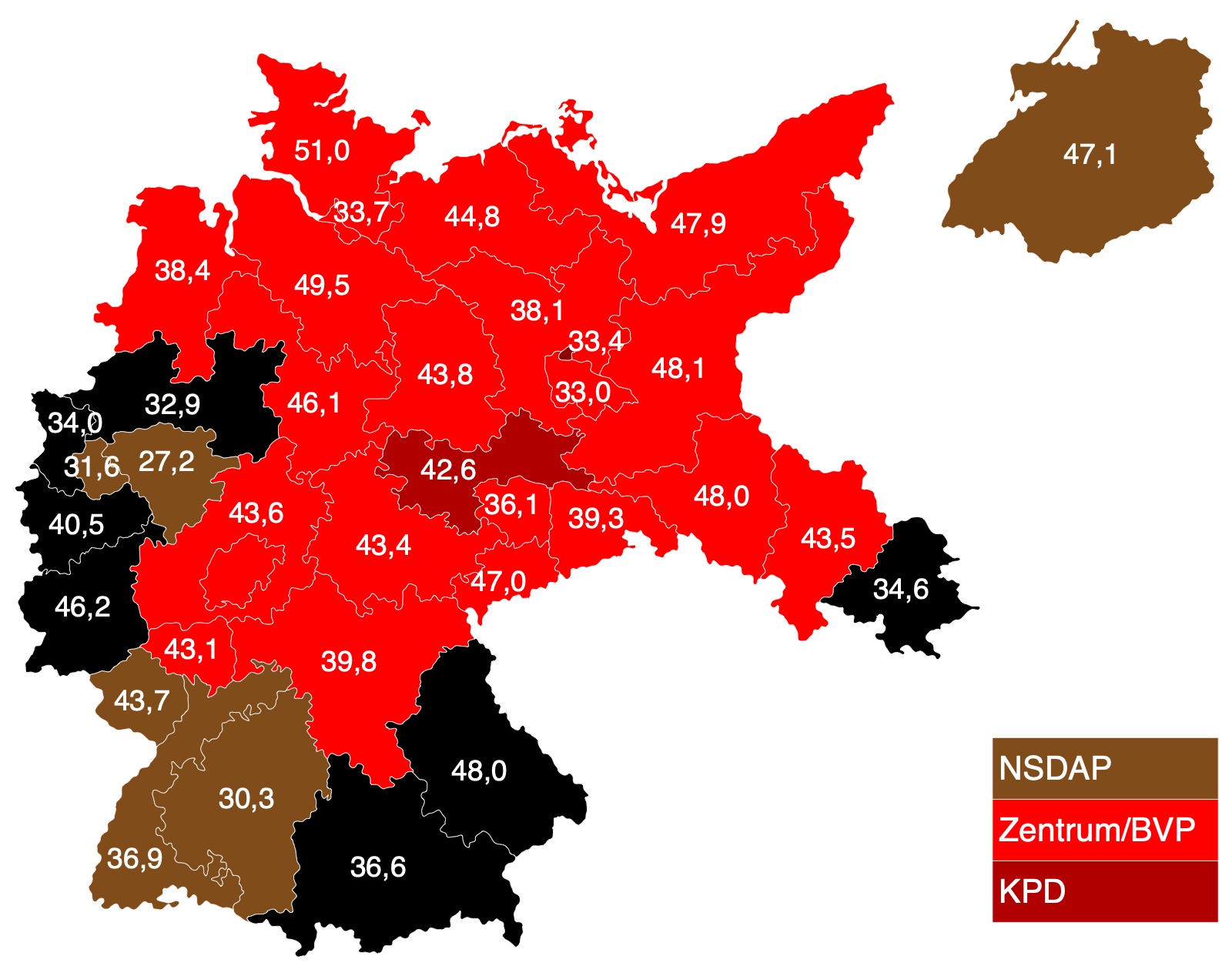
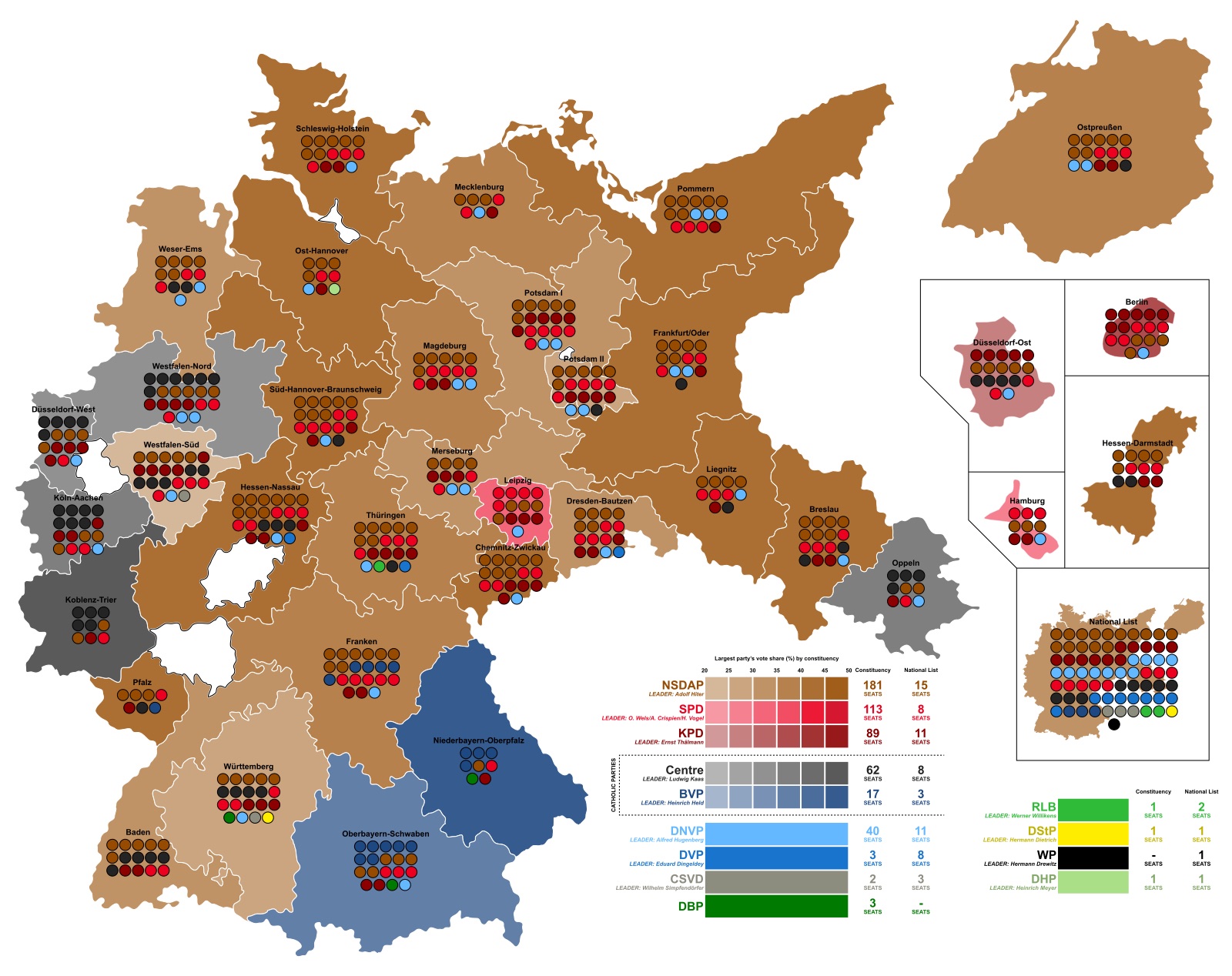
Registered unemployment rose from about 1.9 million in 1929 to about 5.6 million in 1932, peaking at 6,128,429 that February. The Nazi vote climbed with the collapse, then stopped while the collapse went on. Unemployment was still above five million in November 1932 and the vote fell 4.3 points, costing the party 34 seats and roughly two million votes. Hitler was appointed chancellor 85 days after that defeat.
It was arranged in private. Kurt von Schleicher resigned as chancellor on January 28, 1933, after Hindenburg refused to let him govern by decree. Franz von Papen brokered the deal and said that within two months they would have Hitler pushed so far into the corner that he would squeak. Alfred Hugenberg brought in the German National People's Party and later called it the greatest stupidity of his life. The cabinet sworn in on January 30 held two Nazis besides Hitler: Wilhelm Frick at the Interior Ministry, and Hermann Göring as minister without portfolio and acting Prussian Interior Minister, which handed the largest police force in Germany to the party. Everyone else was a conservative. Two days later Hitler had Hindenburg dissolve the Reichstag.
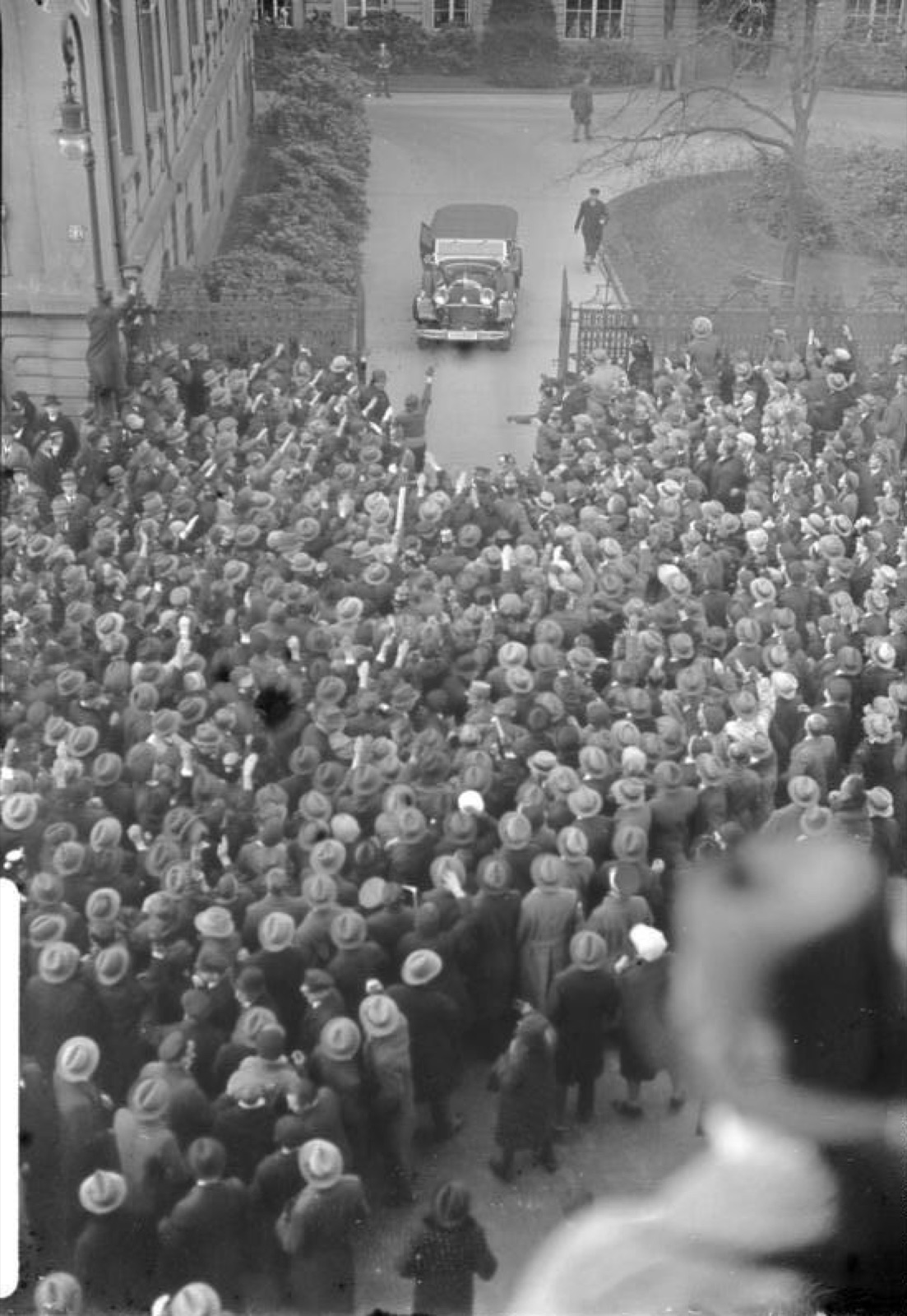
The seventeen months that ended a democracy
February 27, 1933 to August 2, 1934. Almost all of it was done by decree and statute.
There were torches on the Wilhelmstrasse by the evening of January 30, 1933. What came after was not a coup. It was legislation.
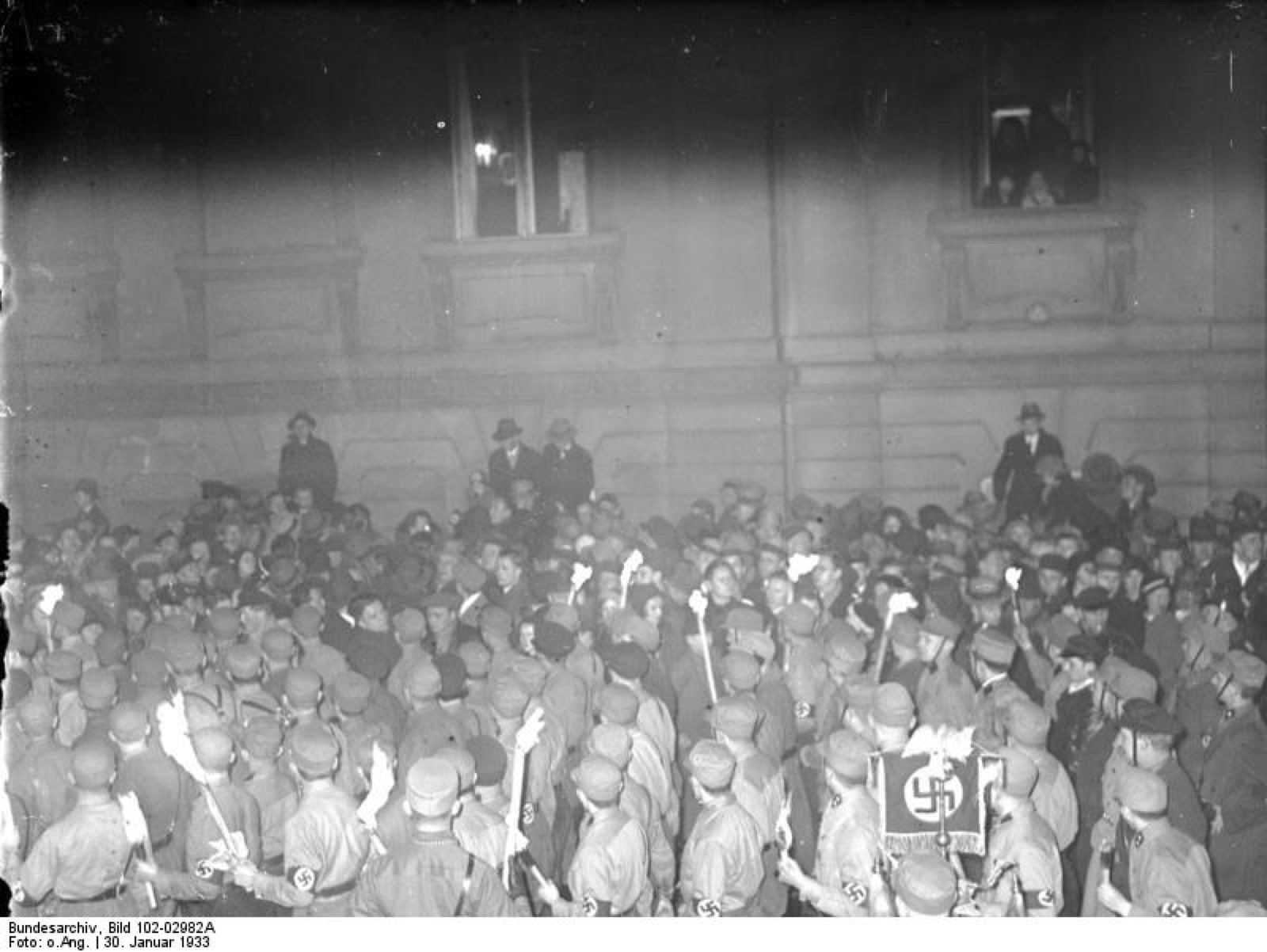
The Reichstag burned on the night of February 27, 1933. Marinus van der Lubbe, an unemployed Dutch construction worker and left anarchist, was arrested inside and said he had acted alone. Who lit it is still argued over. The German Supreme Court convicted van der Lubbe and acquitted his four Communist co-defendants. Most historians accept that account, a view Richard J. Evans restated in 2014 and in 2020; Benjamin Carter Hett argued for a team of SA men in Burning the Reichstag the same year. The question is open.
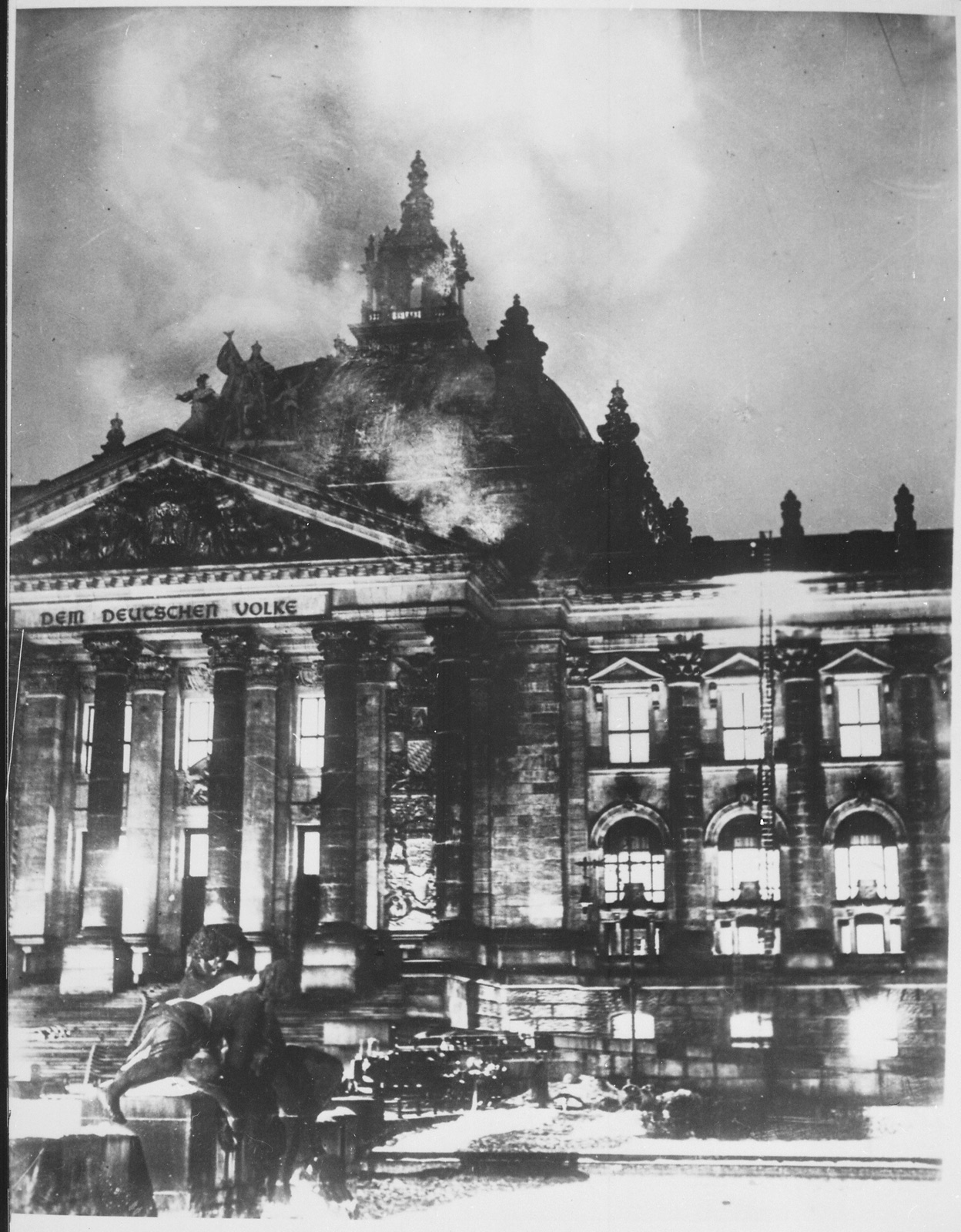
The next day is not in dispute. On February 28 Hindenburg signed the Decree for the Protection of the People and State, suspending seven articles of the constitution: personal liberty, free expression and a free press, assembly, association, the privacy of post and telephone, protection against search and seizure, and property rights. An estimated 40,000 to 50,000 political opponents were taken into protective custody over the next two months. It was never repealed. It stood for twelve years, and it is the legal basis of the camps.
On March 23 the Reichstag met at the Kroll Opera House and passed the Law to Remedy the Distress of the People and the Reich. The cabinet could now make law without parliament, without the president, and against the constitution. The 81 Communist mandates had been annulled. Twenty-six of the 120 Social Democrats were in custody or in hiding. SA and SS men ringed the opera house and stood inside the chamber. The Center Party was bought with promises, given by word of mouth; the written confirmation it was told to expect never arrived, and most of the promises were never honored. The vote was 444 to 94. The 94 were the Social Democrats, alone. The German Bundestag's own account adds the sentence nobody wants: the two-thirds majority was there without the exclusions.
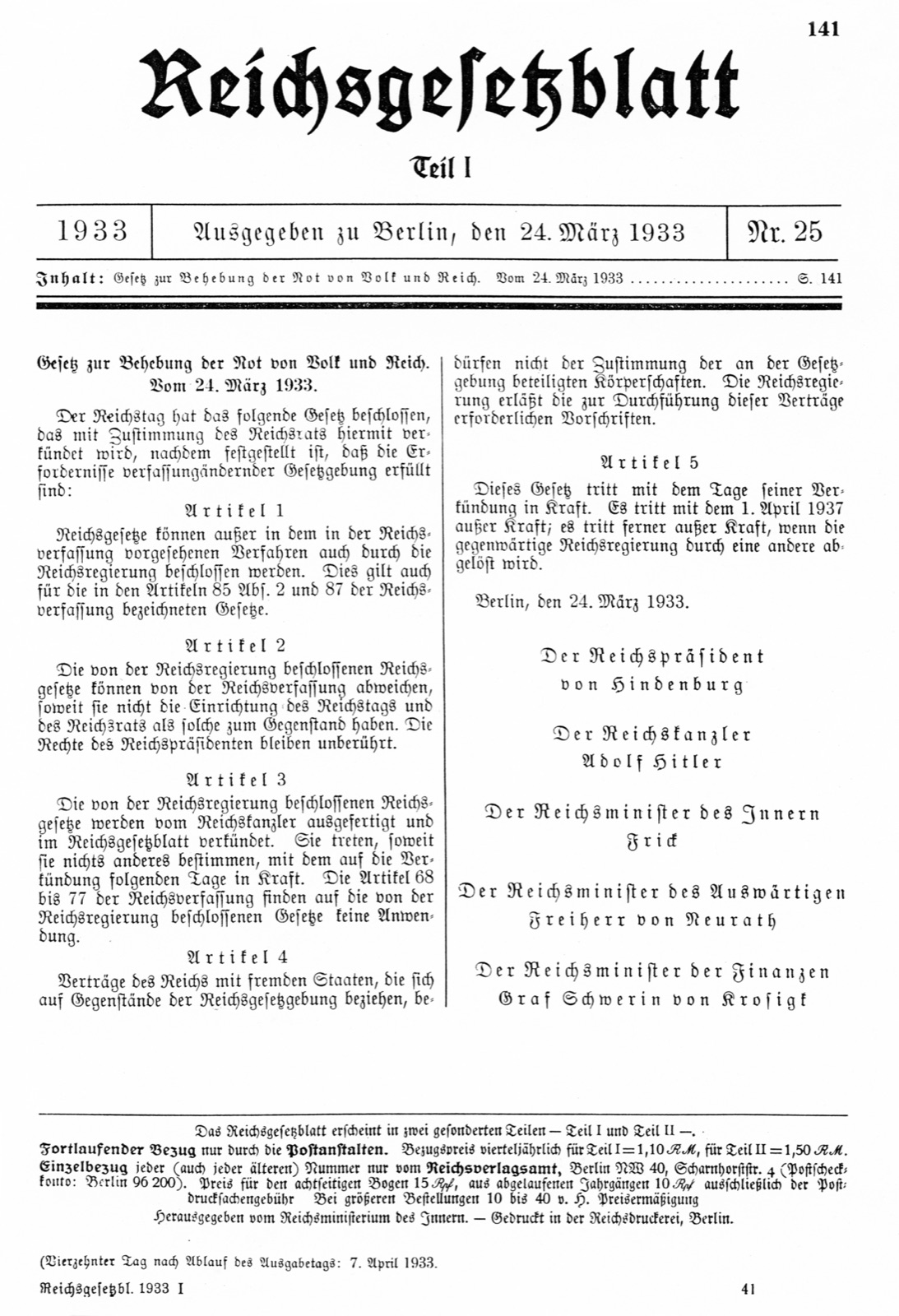
The national laws enacted by the Reich Cabinet may deviate from the Constitution as long as they do not affect the institution of the Reichstag and the Reichsrat.
German History in Documents and Images, translating Reichsgesetzblatt I 1933, p. 141.
Otto Wels, the party chairman, made the speech against it. It is regarded as the last free speech in the Reichstag, and a recording survives.
What Wels said
The recording runs 7 minutes 13 seconds. Three passages are set out below in the German he spoke and in English. The rest of the speech is at the source named at the end.
Aus einem Gewaltfrieden kommt kein Segen; im Innern erst recht nicht. Eine wirkliche Volksgemeinschaft läßt sich auf ihn nicht gründen. Ihre erste Voraussetzung ist gleiches Recht. Mag sich die Regierung gegen rohe Ausschreitungen der Polemik schützen, mag sie Aufforderungen zu Gewalttaten und Gewalttaten selbst mit Strenge verhindern. Das mag geschehen, wenn es nach allen Seiten gleichmäßig und unparteiisch geschieht, und wenn man es unterläßt, besiegte Gegner zu behandeln, als seien sie vogelfrei. Freiheit und Leben kann man uns nehmen, die Ehre nicht.
An enforced peace is followed by few blessings, least of all at home. It cannot be the basis of a real national community, whose first prerequisite is equal justice. The government may protect itself against raw excesses of polemics; it may rigorously prevent incitements to acts of violence and acts of violence in and of themselves. This may happen if it happens toward all sides evenly and impartially, and if defeated opponents are not treated as if they are outlaws. Freedom and life can be taken from us, but not our honor.
Nach den Verfolgungen, die die Sozialdemokratische Partei in der letzten Zeit erfahren hat, wird billigerweise niemand von ihr verlangen oder erwarten können, daß sie für das hier eingebrachte Ermächtigungsgesetz stimmt. [...] Kritik ist heilsam und notwendig. Noch niemals, seit es einen Deutschen Reichstag gibt, ist die Kontrolle der öffentlichen Angelegenheiten durch die gewählten Vertreter des Volkes in solchem Maße ausgeschaltet worden, wie es jetzt geschieht, und wie es durch das neue Ermächtigungsgesetz noch mehr geschehen soll.
After the persecutions that the Social Democratic Party has suffered recently, no one will reasonably demand or expect that it should vote for the Enabling Act proposed here. [...] Criticism is salutary and necessary. Never before, since there has been a German Reichstag, has the control of public affairs by the elected representatives of the people been disabled to such an extent as is happening now, and as will happen even more through the new Enabling Act.
Die Verfassung von Weimar ist keine sozialistische Verfassung. Aber wir stehen zu den Grundsätzen des Rechtsstaates, der Gleichberechtigung, des sozialen Rechtes, die in ihr festgelegt sind. Wir deutschen Sozialdemokraten bekennen uns in dieser geschichtlichen Stunde feierlich zu den Grundsätzen der Menschlichkeit und der Gerechtigkeit, der Freiheit und des Sozialismus. Kein Ermächtigungsgesetz gibt Ihnen die Macht, Ideen, die ewig und unzerstörbar sind, zu vernichten. [...] Wir grüßen die Verfolgten und Bedrängten. Wir grüßen unsere Freunde im Reich. Ihre Standhaftigkeit und Treue verdienen Bewunderung. Ihr Bekennermut, ihre ungebrochene Zuversicht verbürgen eine hellere Zukunft.
The Weimar Constitution is not a socialist constitution. But we stand by the principles enshrined in it, the principles of a state based on the rule of law, of equal rights, of social justice. In this historic hour, we German Social Democrats solemnly pledge ourselves to the principles of humanity and justice, of freedom and socialism. No Enabling Act gives you the power to destroy ideas that are eternal and indestructible. [...] We greet the persecuted and the oppressed. We greet our friends in the Reich. Your steadfastness and loyalty deserve admiration. The courage of your convictions and your unbroken optimism guarantee a brighter future.
Source: German History in Documents and Images; German text from Dokumente der deutschen Politik, vol. 1 (1935); English translation by Thomas Dunlap.
Dachau took its first prisoners on March 22, 1933, the day before the vote. Heinrich Himmler, then police president of Munich, had announced it as the first concentration camp for political prisoners, and the people in it were German Communists, Social Democrats and trade unionists. April 1 brought a one-day boycott of Jewish-owned businesses. On April 7 the Law for the Restoration of the Professional Civil Service threw Jews and political opponents out of government employment. It carried the first Aryan Paragraph in German law, the clause that made a civil servant produce a certificate of Aryan descent to keep the job. It became the model for the rest of the professions. The unions went on May 2, the Social Democrats were banned on June 22, and a law of July 14 made the Nazi Party, the NSDAP, the only legal party in Germany. Every step of it a decree or a statute.
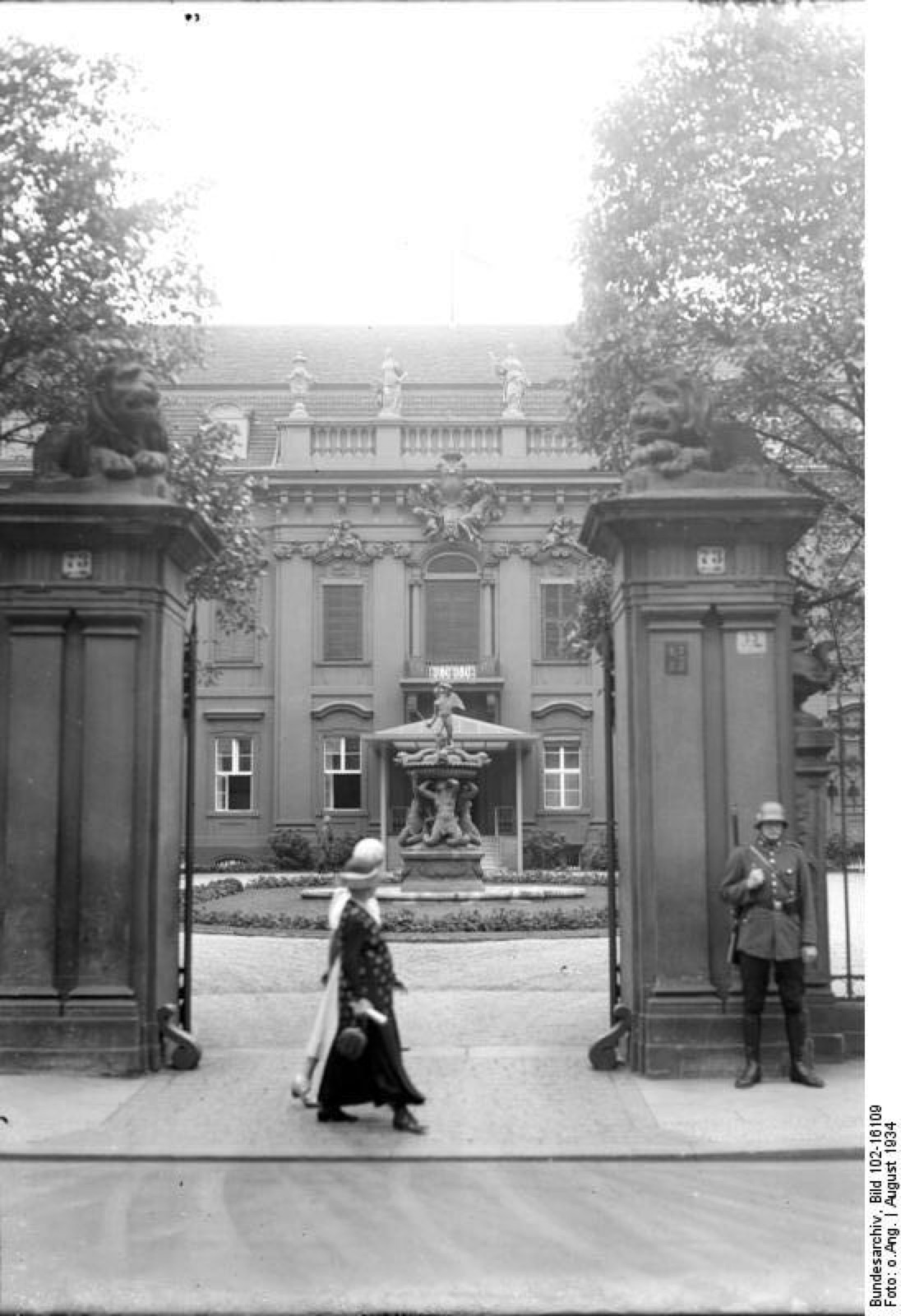
Between June 30 and July 2, 1934, the SS killed the SA leadership and a list of other enemies. Ernst Röhm was shot in his cell on July 1, on Hitler's order, by Theodor Eicke, who ran Dachau. Kurt von Schleicher, whose fall had cleared the way seventeen months earlier, was murdered. Ninety of the dead have been identified by name; the real total is put at about 100. On July 3 the cabinet declared the killings lawful retroactively. Hindenburg died at nine in the morning on August 2, 1934. A law issued the day before merged the presidency into the chancellorship and took effect the moment he died. That same day the German armed forces swore unconditional obedience to Adolf Hitler by name, replacing the oath to the constitution. The generals wrote that oath themselves.
What was the Final Solution?
The phrase arrived first. What it named changed underneath it.
Endlösung der Judenfrage. Final Solution to the Jewish Question. It was the German government's own name for what it was doing, and what it was doing was the deliberate, systematic murder of the Jews of Europe.
The Nazis did not invent the phrase. It comes out of nineteenth-century writing on the 'Jewish question', where a solution already covered everything from emigration to expulsion to biological elimination. The antisemite Eugen Dühring used it in 1881. In 1897 the Protestant theologian Johann Friedrich Heman, following Herzl's lead, used it for a book arguing for a Jewish state: The Path to a Definitive Solution to the Jewish Question. Johann Chapoutot, who traces that lineage, attaches a warning to it: the vocabulary was 60 years old and had not produced Treblinka.
In documented Nazi use before mid-1941 the phrase meant a territorial solution. Move the Jews somewhere. Then it stopped meaning that.
For eight years the policy was to get Jews out. Yad Vashem describes the aim of those first years as removal from German soil, and the method was to make life in Germany unbearable enough that Jews would leave. In late 1939 Eichmann and Franz Stahlecker proposed pushing Jews into the Lublin district of occupied Poland, with a transit camp at Nisko. The first transport took 901 people out of Bohemia and Moravia on October 18, 1939. The camp closed in April 1940. Madagascar came next. That one was not a German idea; British, Dutch and Polish antisemites had been floating it since the First World War. It needed control of the sea, and Germany lost the Battle of Britain. In October 1941 emigration was banned for every Jew in German-controlled territory. Nisko was Eichmann's. Two years later Stahlecker commanded Einsatzgruppe A.
Six million Jewish men, women and children were murdered. The United States Holocaust Memorial Museum states it in those words. The figure is not copied out of a German ledger, because no single Nazi document accounts for every death. It is built from hundreds of thousands of pages of German records set against prewar and postwar demographic data.
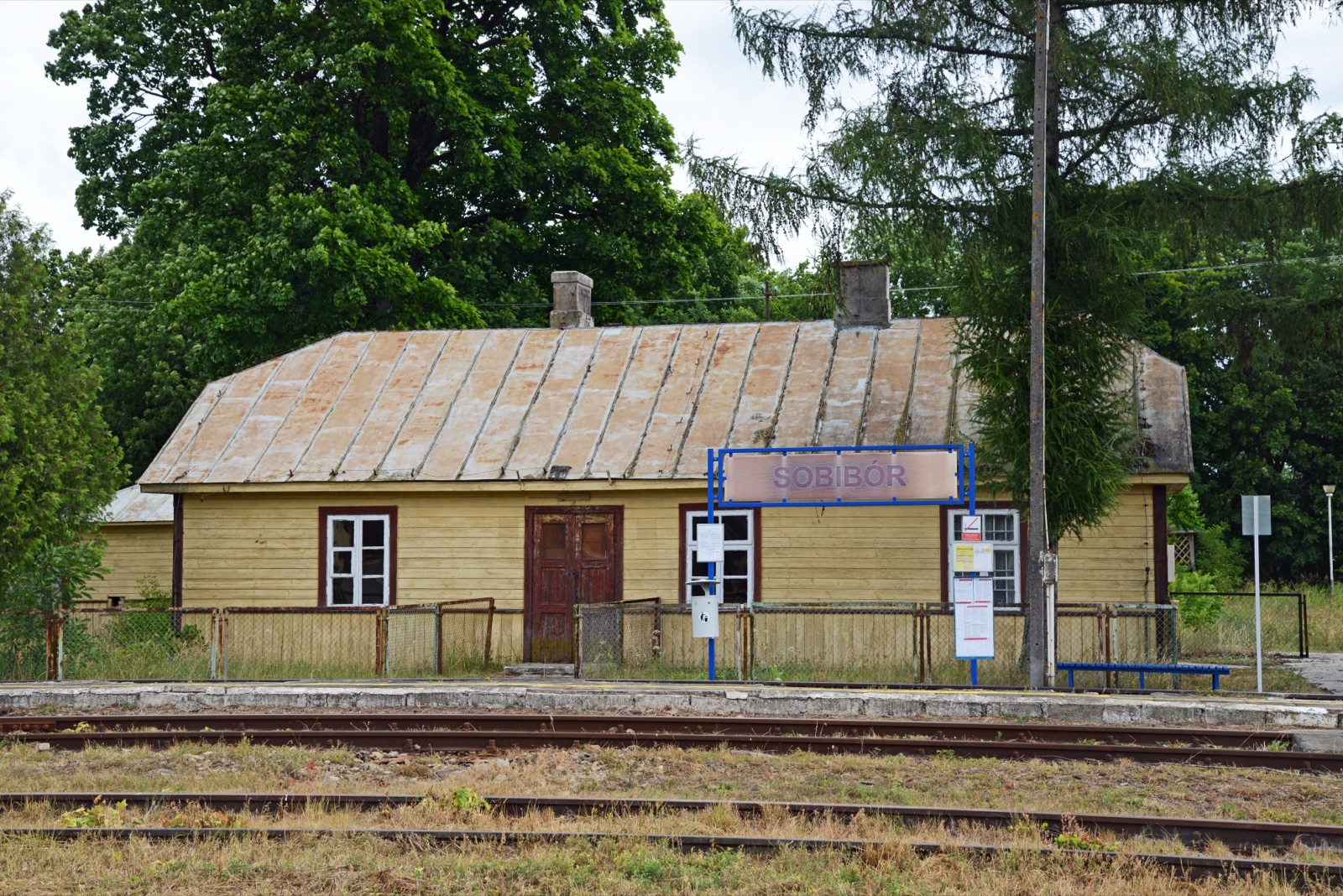
Nazi Germany operated five killing centers: Chelmno, Belzec, Sobibor, Treblinka and Auschwitz-Birkenau. People were killed there with poison gas, in sealed chambers or in vans. The Museum places approximately 2.7 million of the Jewish dead in the killing centers, about 2 million in mass shootings, between 800,000 and 1,000,000 in ghettos and camps, and at least 250,000 in other acts of violence.
Independent calculations land between five and six million, and the spread is a question of where the accounting stops, not of whether the murders happened. Yad Vashem says so without softening it: "There is no precise figure for the number of Jews killed in the Shoah," and "Most research confirms that the number of victims was between five and six million." Raul Hilberg's Destruction of the European Jews, first published in 1961, came to 5.1 million, the lowest of the early calculations Yad Vashem lists. The demographer Jacob Leschinsky had already put the toll at nearly six million in 1946. Israel Gutman and Robert Rozett, in Yad Vashem's Encyclopedia of the Holocaust, give 5.59 to 5.86 million against a prewar Jewish population of 9,797,000 in the countries affected, and their table leaves some territories out. A study headed by Wolfgang Benz gives 5.29 million to 6 million.
The figures rest on prewar censuses compared with postwar censuses and population estimates, read against the German records made at the time: the daily reports of the killing units, the deportation lists. Borders moved before, during and after the war, and Yad Vashem notes that this alone makes the victims hard to enumerate country by country. Move the boundary and the total moves with it.
Yad Vashem also records where the number in ordinary use came from. "The figure commonly used is six million quoted by Adolf Eichmann, a senior SS official." Eichmann ran the deportations. Six million is the number he gave.
There is a fourth line of evidence, and it is a list of names. Yad Vashem has spent seven decades recovering them one at a time, about 2.8 million from Pages of Testimony. As of November 11, 2025 the count stood at five million. An estimated one million names are still unknown, and many will never be recovered. Five million of the six million have a name.
The Final Solution meant the Jews. Yad Vashem keeps that category separate because only the Jews were marked for annihilation in their entirety. The Germans killed other people in enormous numbers under other headings, each with its own reason and its own figure.
Historians estimate that the Germans and their allies killed at least 250,000 European Roma, and some put the full toll near 500,000. Yad Vashem gives 200,000 to over 500,000. The range is that wide because nobody knows how many Roma lived in Europe before the war and because the killings were recorded late. About 23,000 Roma and Sinti were deported to Auschwitz and about 21,000 died there, many of them from typhus, smallpox and dysentery. When the SS liquidated the compound on August 2, 1944, it gassed between 4,200 and 4,300 people.
Some 5.7 million Soviet soldiers fell into German hands. By the end of the war 3.3 million of them, about 57 percent, were dead from starvation, exposure, disease and shooting. From the middle of July 1941 those prisoners were screened for "politically and racially intolerable elements," a category that took in every Jew among them. A decree of September 8, 1941 declared that the use of arms against Soviet prisoners was as a rule to be regarded as legal.
The Germans killed between 1.8 and 1.9 million non-Jewish Polish civilians. In the spring of 1940 the AB-Aktion went after the Poles the occupiers classed as a leadership class, shooting thousands of teachers, priests and other intellectuals. Croatia's Ustaša regime, Germany's ally, murdered more than 310,000 Serb civilians.
The gassing started with disabled people. T4's own accounting recorded 70,273 institutionalized disabled patients killed at six gassing facilities between January 1940 and August 1941, and the Museum puts the program's toll in all its phases at 250,000 to 300,000. Most of the German staff at Belzec, Sobibor and Treblinka came out of that program.
Jehovah's Witnesses were persecuted for what they refused to do, which was swear allegiance to the state or carry a weapon for it. At least 3,000 were sent to concentration camps, about 1,000 German Witnesses died in camps and prisons along with 400 from other countries, and at least 273 were sentenced to death by military courts and executed for refusing to serve. Under Paragraph 175 the police made roughly 100,000 arrests of men for homosexuality, about 53,400 of which ended in conviction, and between 5,000 and 15,000 men were sent to concentration camps as homosexual offenders.
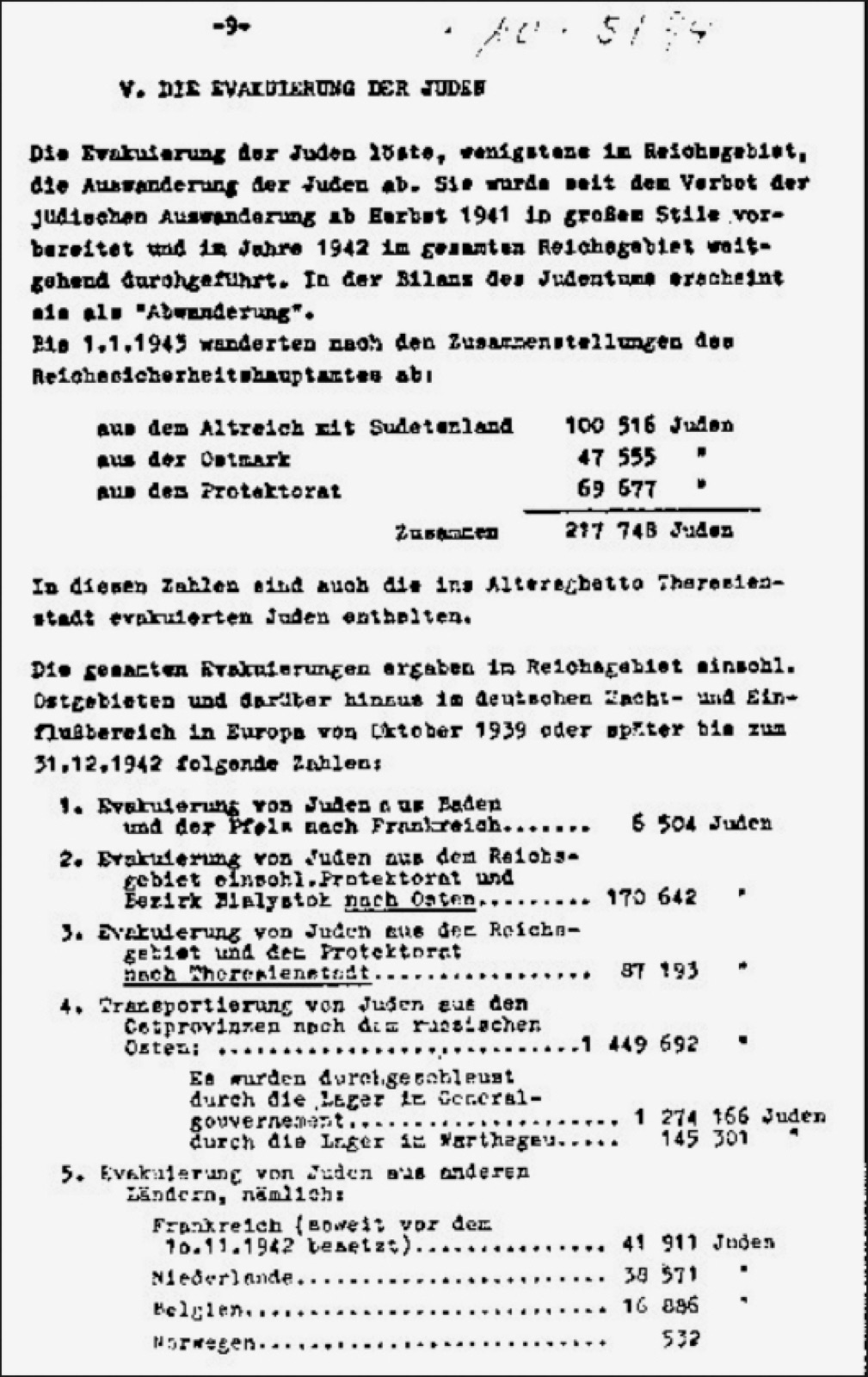
No document has been found in which Hitler orders the murder of the Jews of Europe, and historians do not agree on when the decision was taken. Richard Breitman argues for a fundamental decision in early 1941. Philippe Burrin and Christopher Browning put the turn in the second half of that year, Browning in late October; Christian Gerlach puts it in December, after the United States entered the war. Peter Longerich holds that the process was not concluded until the spring or summer of 1942, that hunting for one decision is the wrong exercise, and that Nisko and Madagascar were never an alternative to mass death but a slower form of it. That last is a minority reading. The Museum's encyclopedia says instead that those schemes were simply too hard to carry out. It declines to name a decision date at all.
The disagreement took its present shape in the 1990s, when regional archives in the former Soviet Union, Poland and East Germany opened and produced a flood of local evidence and no smoking gun.
The record is thin because it was made thin. The perpetrators destroyed most of it on purpose, and the pages that survived were written in camouflage. The Wannsee protocol of January 20, 1942 records that evacuation of the Jews to the East has now taken the place of emigration. Evacuation to the East meant Belzec, Sobibor, Treblinka and Auschwitz.
Where the killing actually began
Not in a camp and not with gas. In fields and ravines behind the German army as it moved east.
Germany invaded the Soviet Union on June 22, 1941. From the beginning of operational planning, German military and police authorities intended a war of annihilation against the Soviet state and its citizens, and particularly against Jews.
On June 6, 16 days before the invasion, the Armed Forces High Command issued the Guidelines for the Treatment of Political Commissars. Captured Soviet political officers were to be separated out and shot on principle. It was rescinded in May 1942, once field commanders reported it was stiffening Soviet resistance.
Four battalion-sized units, lettered A through D, followed the army in. A crossed Lithuania, Latvia and Estonia toward Leningrad. B went east from Warsaw through Belorussia toward Smolensk. C started near Krakow and crossed Ukraine toward Kyiv. D worked the south. All four reported to the Reich Security Main Office in Berlin, and together they numbered about 3,000 men. Order Police battalions, Waffen-SS units, Wehrmacht units and local auxiliaries carried out massacres too.
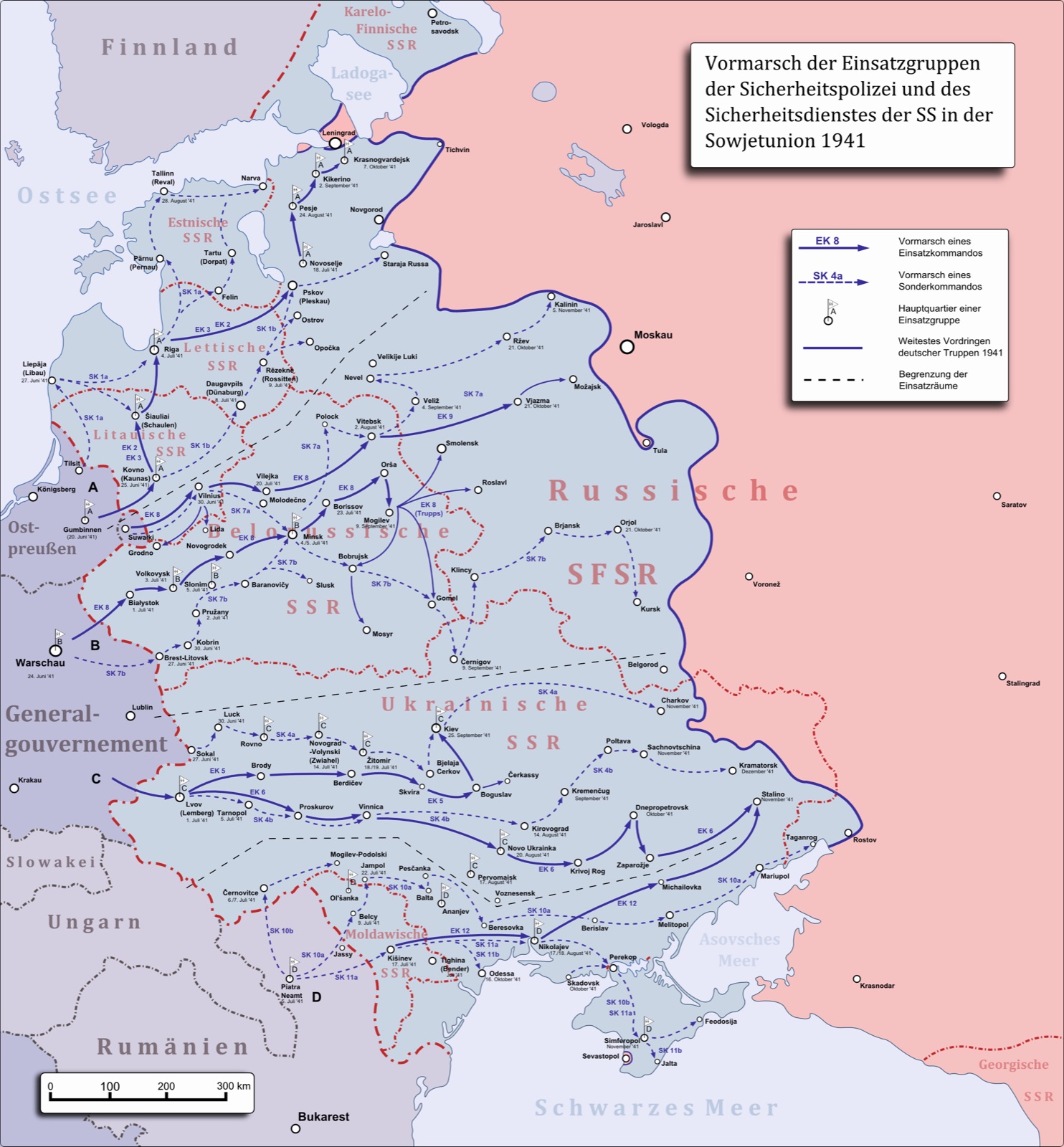
No master plan for killing all Jews existed before the invasion. The first Lithuanian killings were begun by local German SS and police officers; Stahlecker, Heydrich and Himmler were told afterward and agreed afterward. At first the units shot Jewish men of military age. By August 1941 they were killing whole communities regardless of age or sex, first on a mass scale in Lithuania.
On September 29 and 30, 1941, on the eve of Yom Kippur, Sonderkommando 4a of Einsatzgruppe C, under SS-Standartenführer Paul Blobel, with German police units and local auxiliaries, shot the Jews of Kyiv in small groups at a ravine called Babyn Yar. The count is 33,771. It is that precise because the killers counted, and reported the count to Einsatzgruppen headquarters in Berlin. The number exists because the men who did it wanted Berlin to know how much they had done.
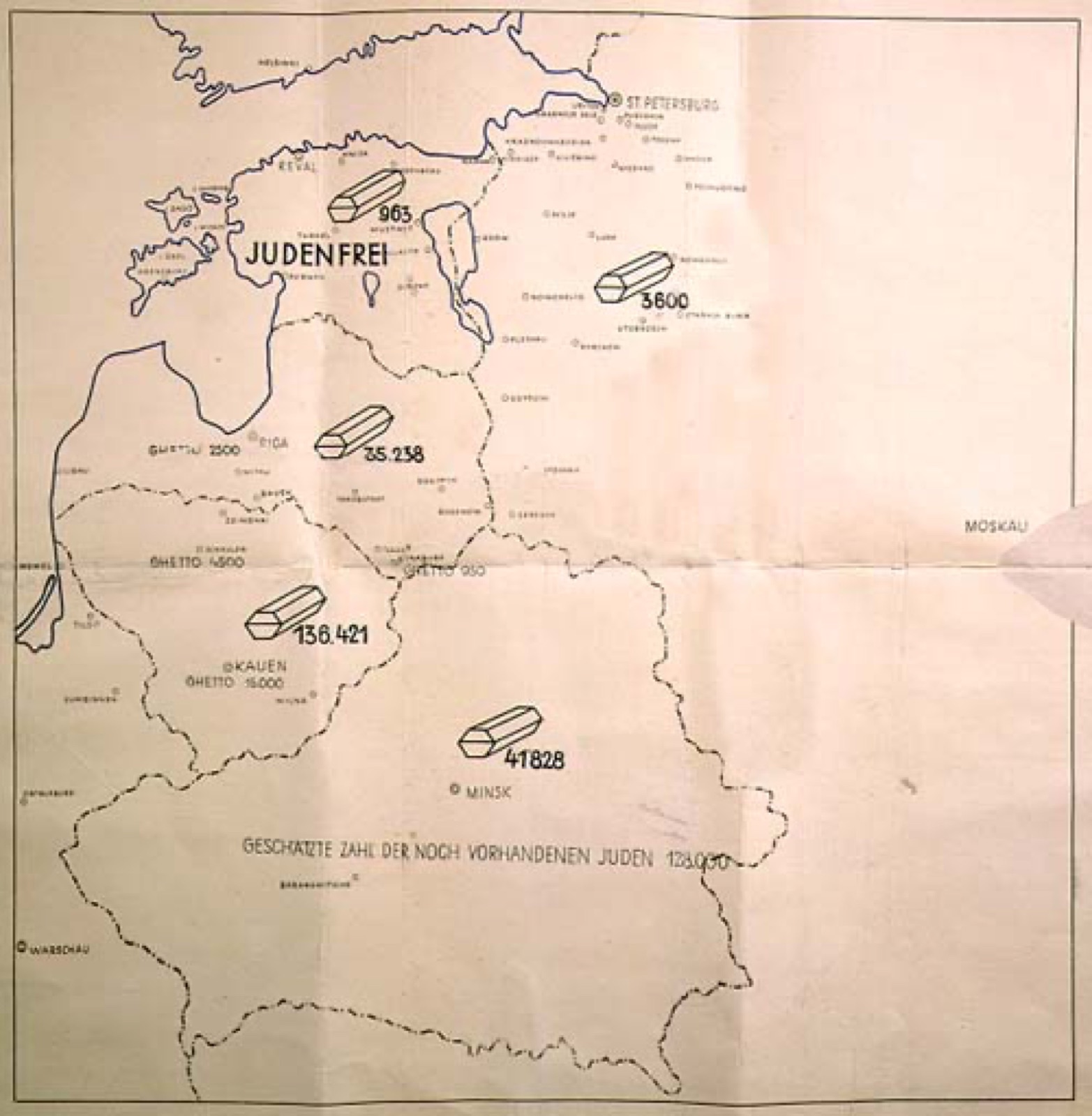
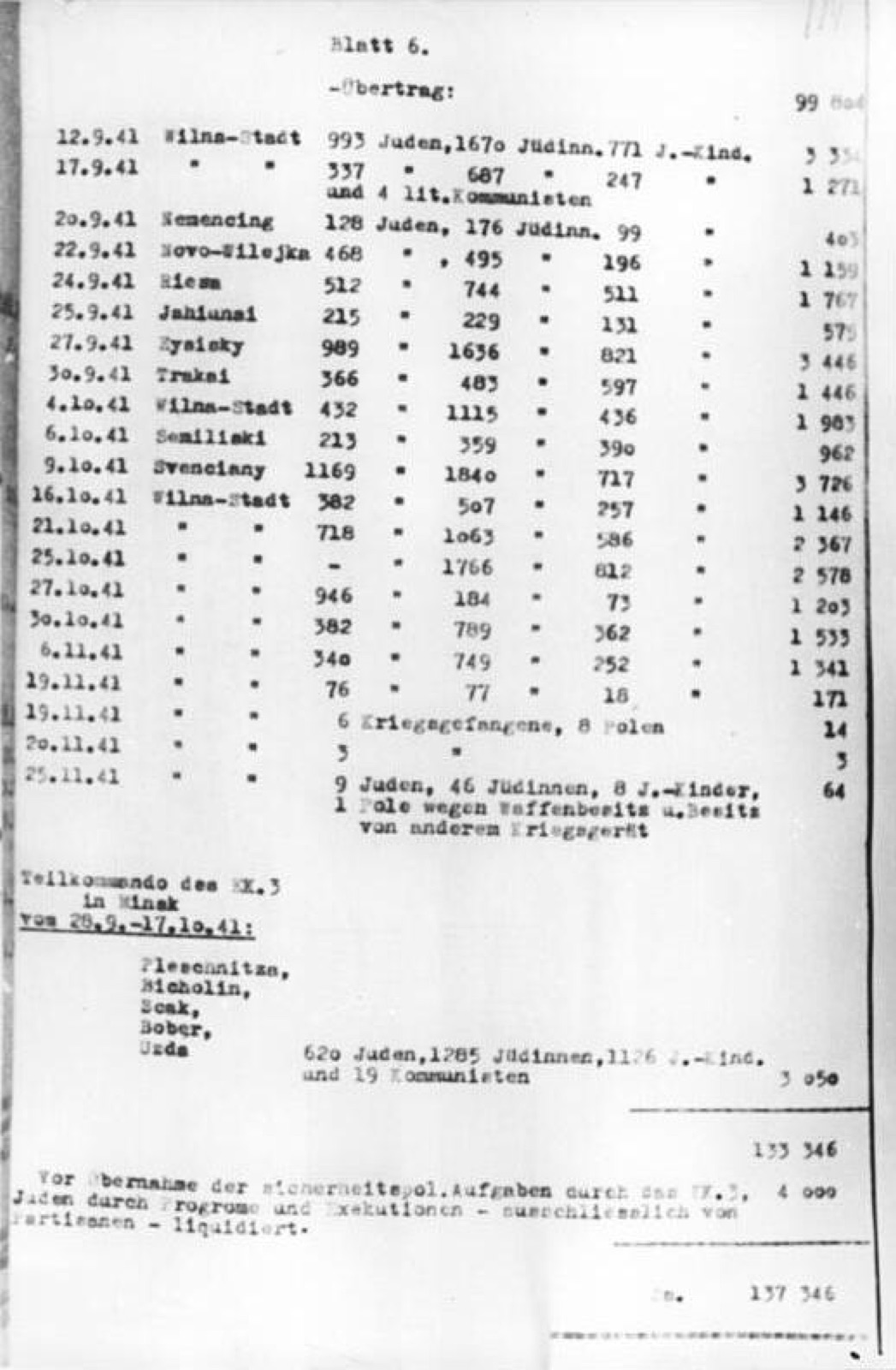
SS-Standartenführer Karl Jäger commanded Einsatzkommando 3, which covered most of Lithuania. On December 1, 1941 he wrote up what his men had done: place by place, date by date, more than a hundred massacres in five months, men, women and children counted in separate columns. "I can confirm today," he wrote, "that Einsatzkommando 3 has achieved the goal of solving the Jewish problem in Lithuania." He called mass execution "an organizational question."
The grand total at the foot of the report, 137,346, does not survive checking. Antonia Tejeda Barros recounted the line items and published the result in Historiografias in 2025: they come to 137,448, of whom 135,392 were Jews. Jürgen Matthäus, writing for the Holocaust Memorial Museum in 2005 and counting through February 1942, gives 138,272 executed. Roughly 137,000 killings in five months in one country.
A month after Jäger typed his report, about 150 young people crowded into a kitchen at 2 Strashun Street in the Vilna ghetto and heard a page read aloud in Hebrew and Yiddish. Abba Kovner had written it. He was 23, and an art student until the German invasion stopped his studies.
Hitler is scheming to annihilate all of European Jewry. The Jews of Lithuania were tasked to be first in line. Let us not go like sheep to the slaughter!Abba Kovner, proclamation to the Jewish youth movements of the Vilna ghetto, January 1, 1942. Read aloud in Hebrew and Yiddish. Yad Vashem's translation.
Couriers carried its message out of Vilna to the ghettos of Poland, Lithuania and Belorussia. Most of them were women.
One third of all Jewish victims of the Holocaust were killed by shooting. What ended the shooting phase where it ended was not conscience. The German sources record complaints that shooting was inefficient, hard to keep secret and wasteful of ammunition needed at the front, and that it was affecting the shooters. Gassing, Nazi authorities argued, was more humane for the perpetrators. The victims are not in that sentence.
Gas vans were paneled trucks with the exhaust piped into a sealed rear compartment, in use by autumn 1941. In December the SS opened Chelmno, the first camp to which Jews were brought in order to be gassed. The first transport arrived on December 7, 1941. Everyone on it was murdered the next day. The shooting never stopped.
The shooting was mostly done by policemen
Not fanatics and not soldiers. Middle-aged reservists out of Hamburg, and local men hired where the killing was.
The four Einsatzgruppen had about 3,000 men. As many as two million Jews were shot. Three thousand men did not do that. Most of the shooting was done by policemen.
In September 1939 the German Order Police had barely more than 130,000 men. By mid-1940 it had nearly 250,000. Five days into the invasion of the Soviet Union, Police Battalion 309 killed 2,000 to 3,000 Jews in Bialystok, hundreds of them burned alive in the Great Synagogue.
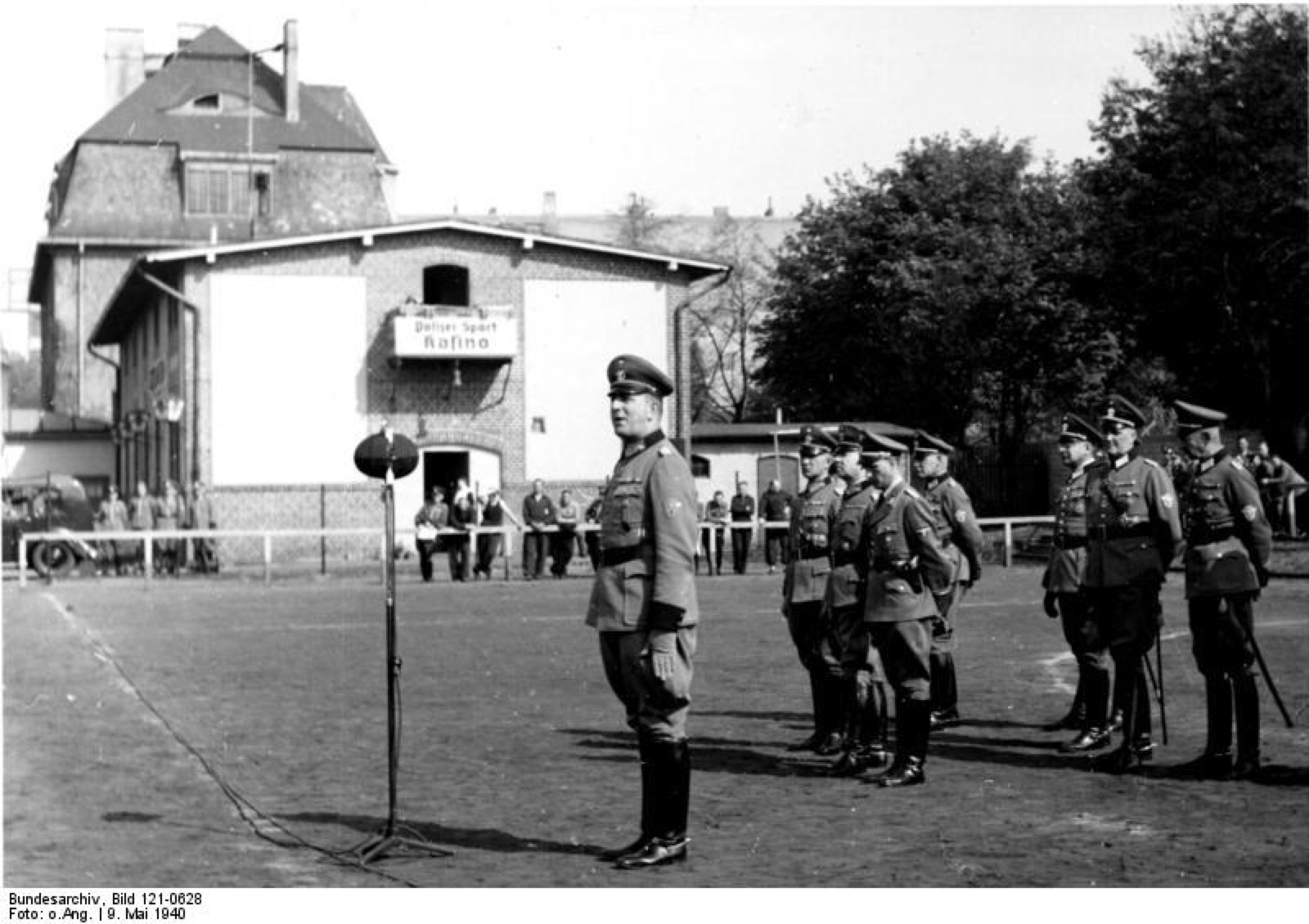
Reserve Police Battalion 101 was about 500 men, nearly all from Hamburg. Average age 39. Truck drivers, dock workers, salesmen, a quarter of them in the Nazi Party. They were policemen because they were too old for the army.
On July 13, 1942 they surrounded the village of Jozefow. Major Wilhelm Trapp gave the order: the Jewish men of working age to a labor camp, the rest, some 1,500 women, children and elderly people, to be shot. Then he added something. Any of the older men who did not feel up to it could step out.
Twelve stepped out.
The others took their victims into the woods in groups, paired one policeman to one person, and shot them in the back of the neck. Over the next sixteen months the same battalion shot at least 38,000 people and put 45,000 more on trains to Treblinka. Eighty-three thousand dead, from a unit of fewer than 500 men.
Nothing happened to the twelve. Daniel Goldhagen said it at the Holocaust Memorial Museum in 1996: no German was ever killed, sent to a concentration camp, jailed, or seriously punished for refusing to kill Jews. Israel Gutman said the same in Yad Vashem Studies. These men could be released from the killing with impunity, and only a few chose it.
West German prosecutors interrogated 210 of them in the 1960s. What the men described was a different fear. Not a court-martial. Looking cowardly, weak or judgmental in front of the men they lived with.
Underneath the Germans was a second layer. At Trawniki near Lublin the SS trained about 5,000 auxiliary guards between 1941 and 1944, the first 2,500 almost all Soviet prisoners of war taken out of camps where they were starving. Trawniki men guarded Belzec, Sobibor and Treblinka and cleared the ghettos at Warsaw three times and Bialystok twice.
Tens of thousands of non-German auxiliary police served across the occupied Soviet territories as guards and killers. The subunit Karl Jaeger sent through the Lithuanian countryside, under Joachim Hamann, was fewer than ten Germans and about fifty Lithuanian policemen. The squad that shot people at Ponary was the Ypatingasis burys, out of Vilnius, and not all of it was Lithuanian: one of its men, arrested in Poland in 1972, was a Pole who played first trombone at the Warsaw Opera. In Riga the unit was the Arajs Kommando. At Rumbula, German SS and police with Latvian auxiliaries shot at least 25,000 people out of the ghetto. These are names of units, not names of countries.
Christopher Browning published the Jozefow interrogations in 1992 as Ordinary Men. Daniel Goldhagen worked much of the same material and published Hitler's Willing Executioners in 1996, arguing they killed because they were Germans and wanted to. Eberhard Jäckel and Raul Hilberg dismissed it as 'simply a bad book' and 'worthless', and Browning's reading held: true believers, a smaller group who got onto guard duty and never fired, and most of the battalion in between.
The men in the dock at Nuremberg signed the orders. These men stood close enough to see the faces of the people they shot. Twelve of five hundred stepped out.
What was the Wannsee Conference?
January 20, 1942. Fifteen men, about ninety minutes, and a decision that had already been taken somewhere else.
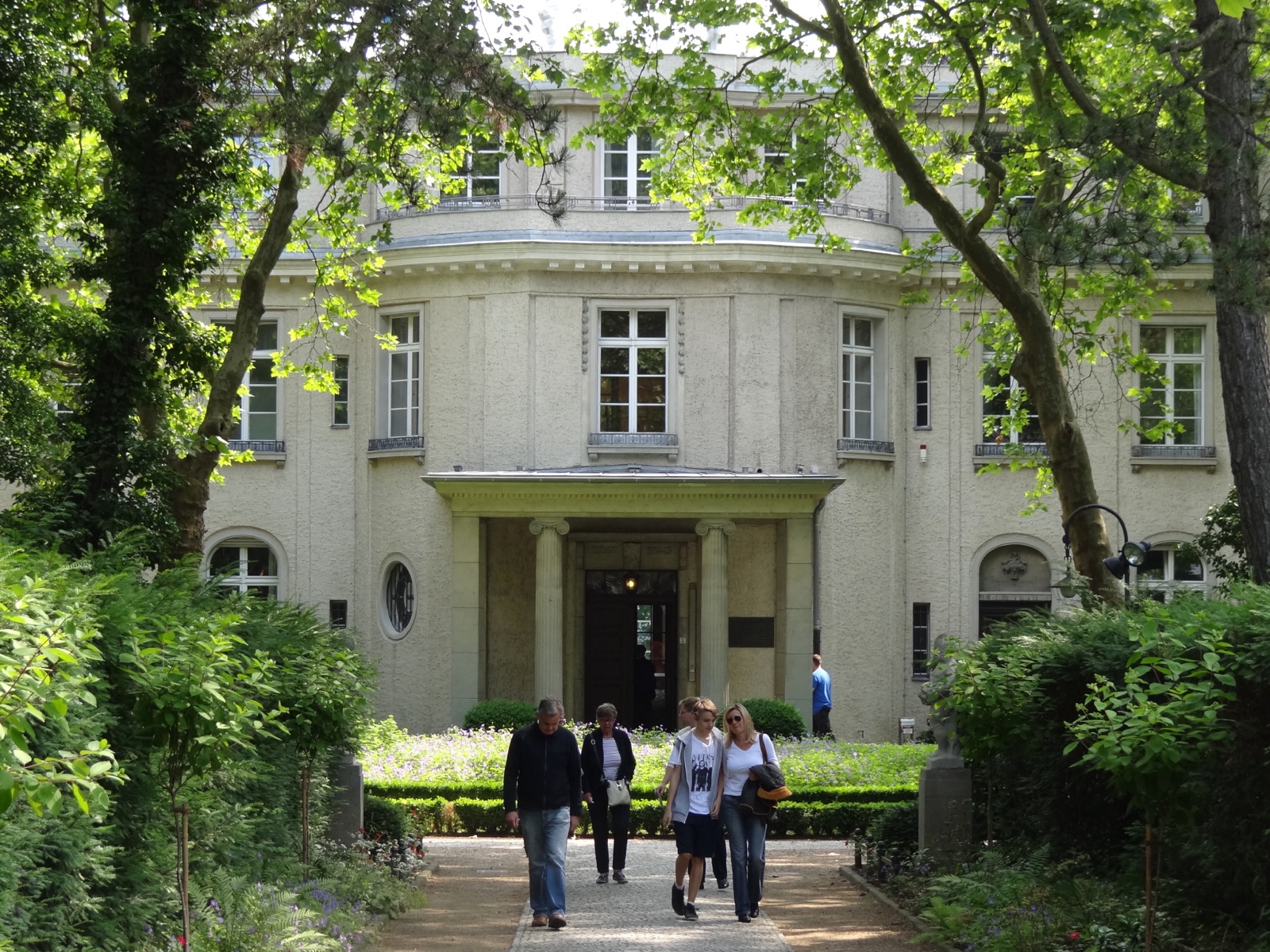
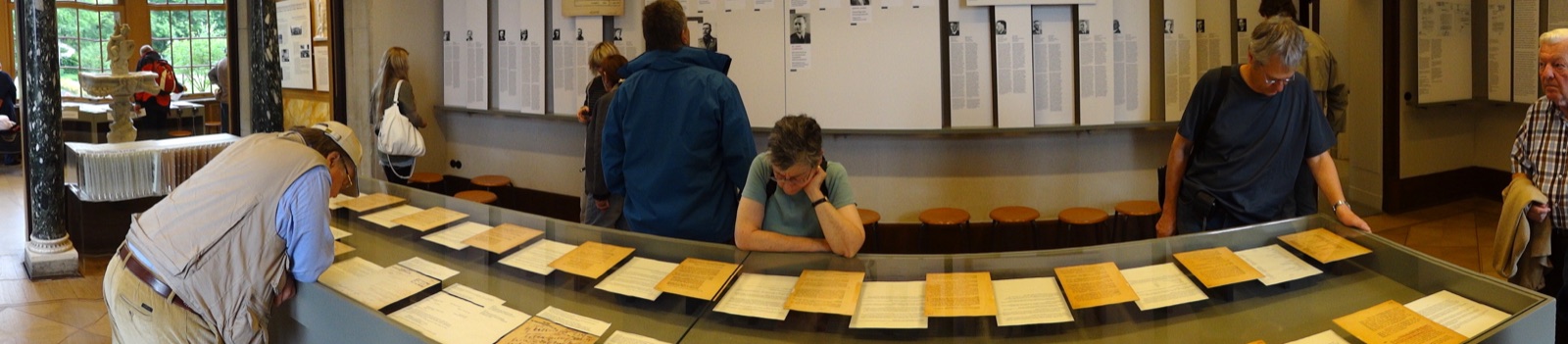
The conference is usually described as the meeting where the murder of the Jews of Europe was decided. It was not. The memorial that occupies the villa today puts the correction in its own words: "The State Secretaries implemented what had already been decided at a higher political level. It would therefore be incorrect to say that the murder of European Jews was decided at the Wannsee Conference."
Seven months of shooting had come first. The Einsatzgruppen had been killing Jews in the occupied Soviet Union since June 1941, and USHMM puts the toll at more than half a million people, most of them Jews, across the first nine months of that war. Chelmno had been gassing since December 8, 1941. Belzec was under construction. Emigration was closed in October. Fifteen men arrived at a lakeside villa at noon and were briefed on a program already running.
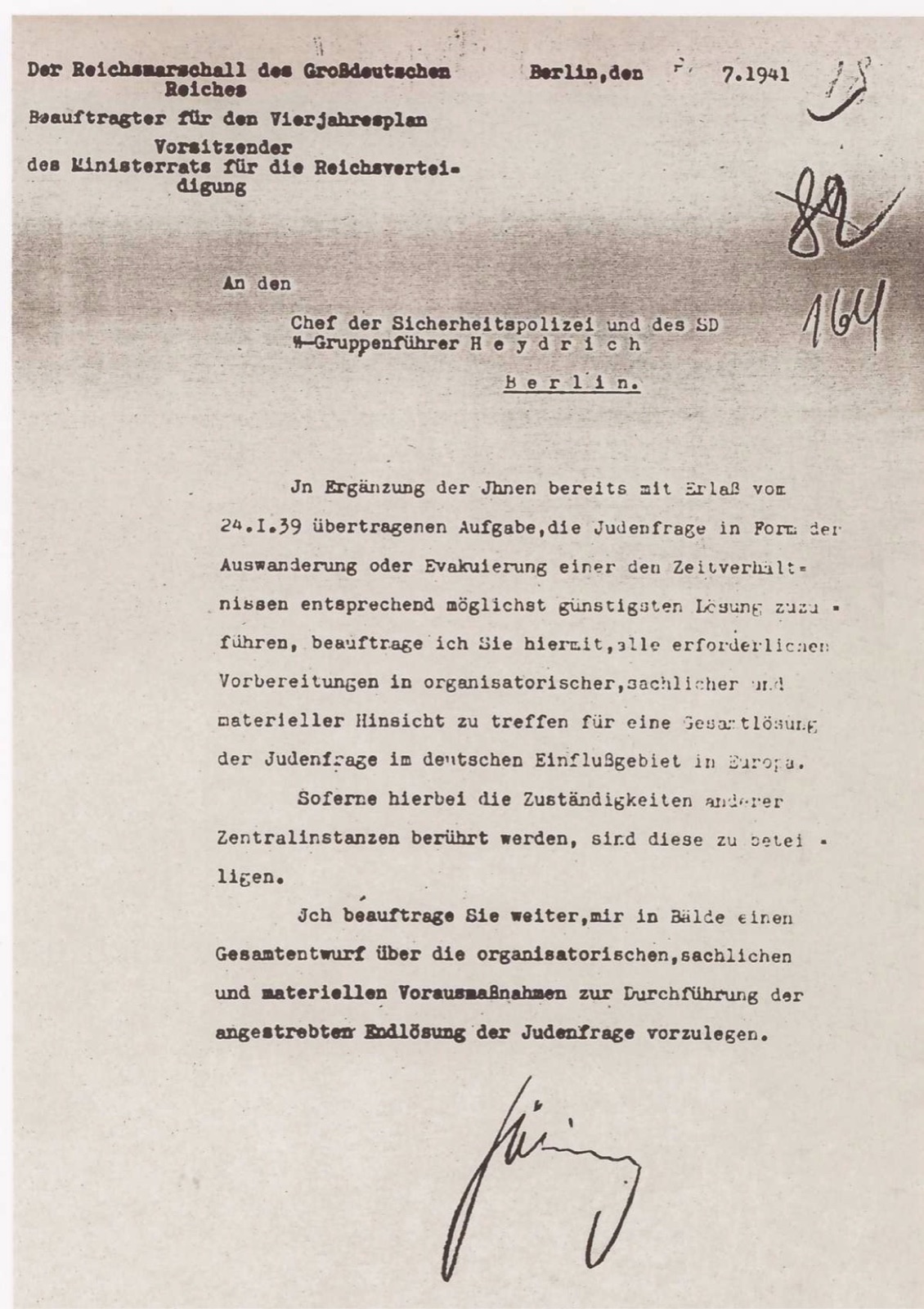
Heydrich's authority came from a single page. On July 31, 1941, Hermann Göring commissioned Reinhard Heydrich, chief of the Security Police and the SD, to prepare a Gesamtlösung, a total solution, of the Jewish question in the German sphere of influence, and to submit an overall plan for the intended Endlösung, the final solution. The letter authorizes preparations and a plan. It orders nobody killed, and the shooting was already five weeks old when Göring signed it.
Those two German words are not the same word, and English translations have collapsed them in both directions ever since. Cross-examined by Justice Robert H. Jackson at Nuremberg on March 20, 1946, Göring stopped on the point: "Now comes the decisive word which has been mistranslated: 'for a total solution,' not 'for a final solution.'" He was defending himself and it failed. He was right about the German.
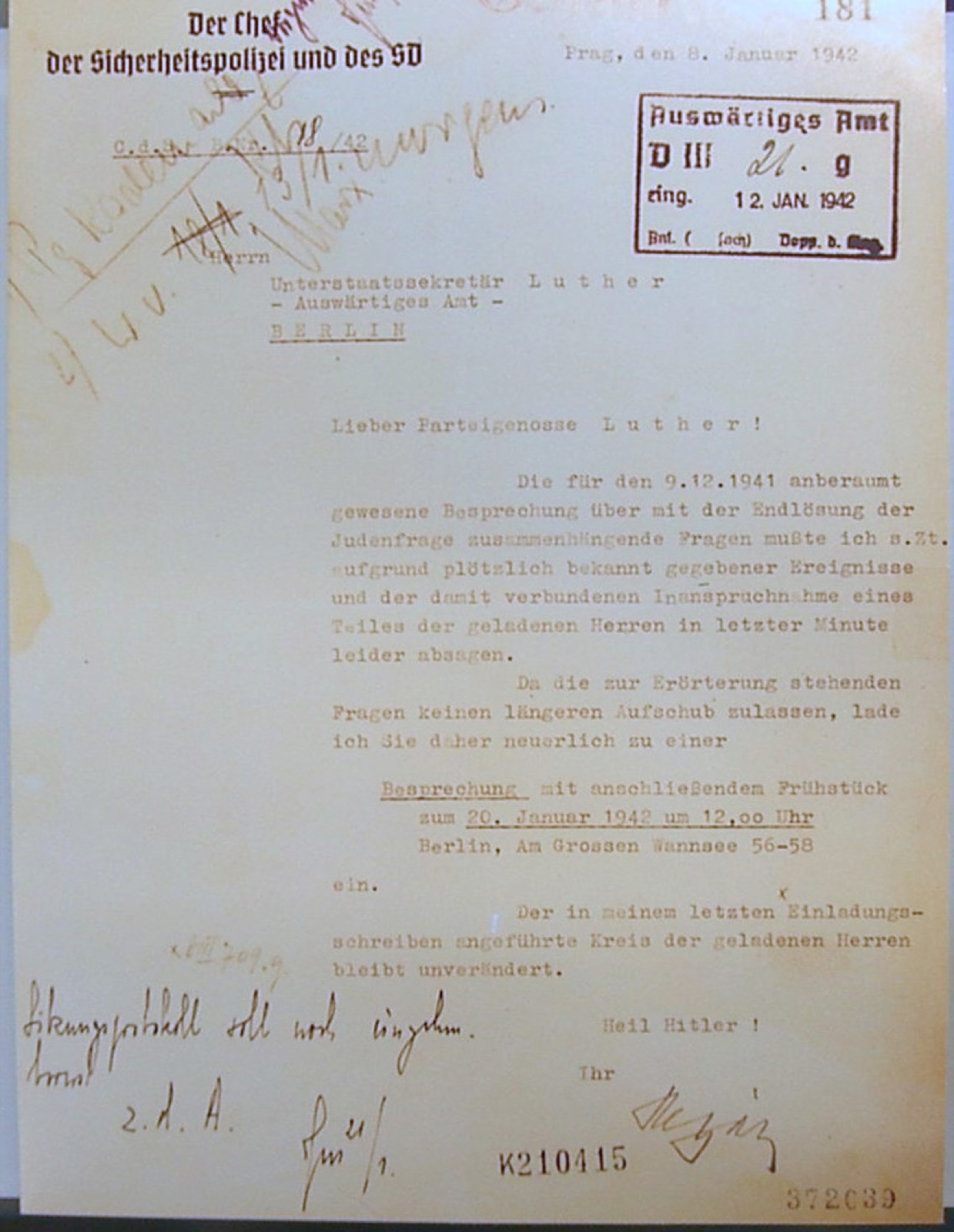
The meeting was first called for December 9, 1941, then pushed six weeks after Japan attacked Pearl Harbor and Germany declared war on the United States on December 11. Christian Gerlach argues that inside those six weeks, on December 12, Hitler told the assembled Reichsleiter and Gauleiter in Berlin that he had decided in principle to exterminate the Jews of Europe.
Fifteen participants, and about ninety minutes by the memorial's estimate; the minutes record no start or end time. Hans-Christian Jasch and Christoph Kreutzmüller, the memorial's own historians, counted ten university men among the fifteen, eight of them holding doctorates and eight trained in law. They attached their own deflation: a doctorate in law or philosophy in the 1920s was considerably easier to come by than one is today.
Adolf Eichmann, a lieutenant colonel running the Reich Security Main Office's Jewish affairs desk, compiled the Protocol but did not take the notes. A secretary from his office took the stenographic notes, and she is not among the fifteen participants the document lists. Eichmann worked her notes up into the Protocol, cutting what he later called the vulgarisms, and Heydrich approved the text. What came out is not a transcript, and no German verb for killing appears anywhere in it. At his trial in Jerusalem in 1961 he described a different room: "during the conversation, they minced no words about it at all. They spoke about methods of killing, about liquidation, about extermination."
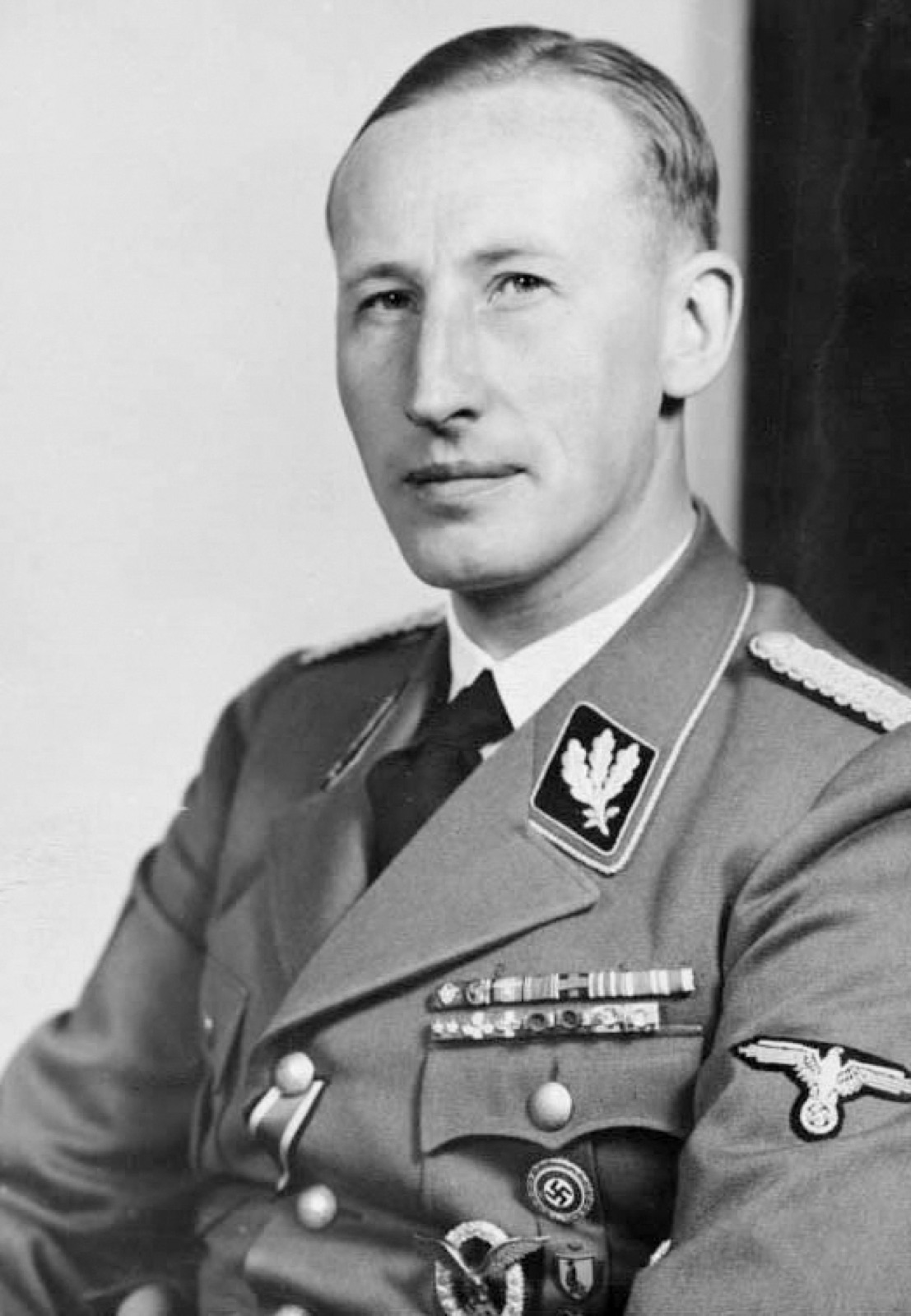
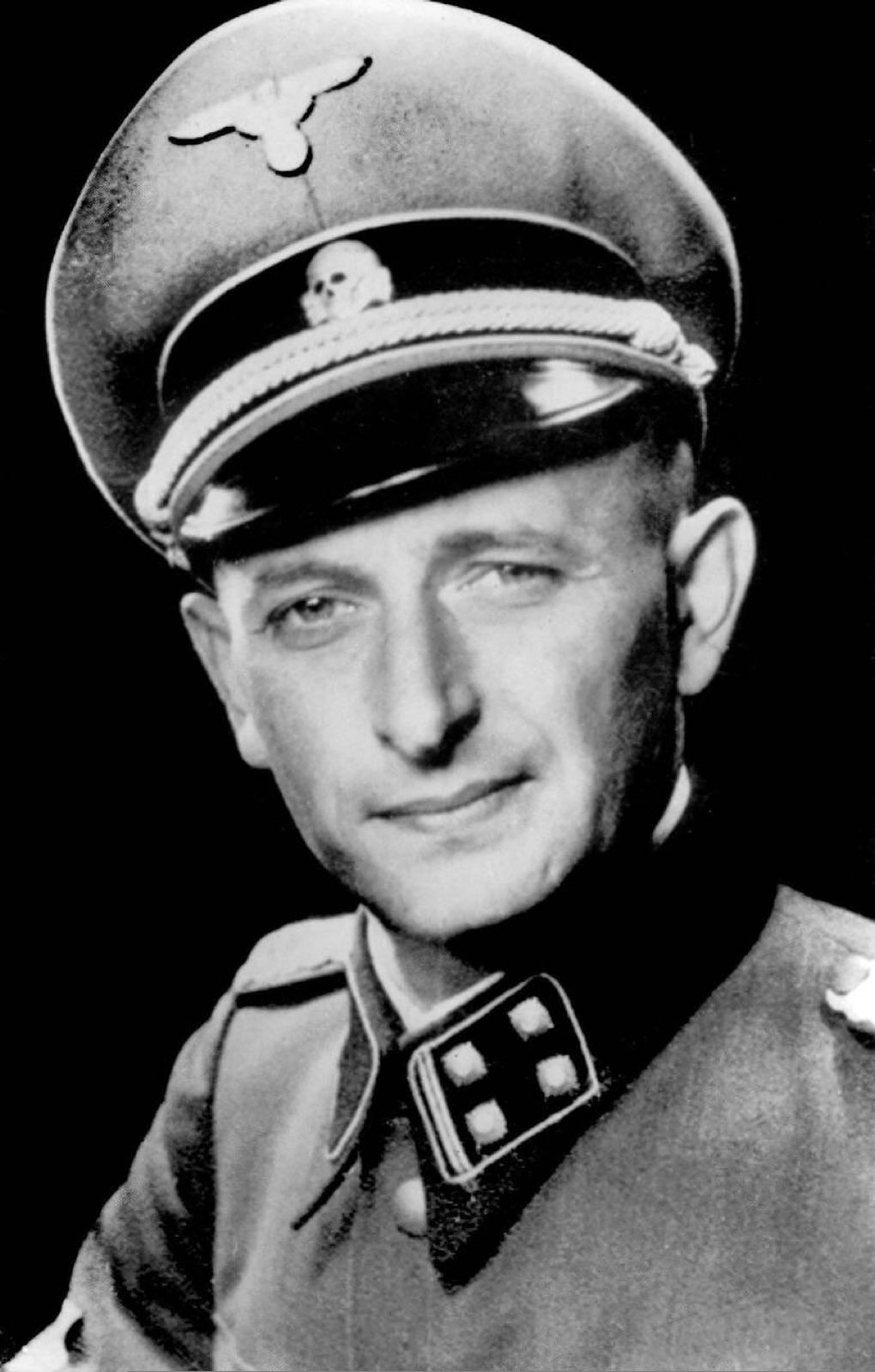
More of the Protocol is given over to Mischlinge, people of mixed Jewish and "German" descent, and to Jews in mixed marriages, than to anything else in it. First-degree Mischlinge were to be treated as Jews. Those exempted from evacuation were to be sterilized, and the document calls that sterilization voluntary in the same breath as making it the price of staying. Wilhelm Stuckart of the Interior Ministry pressed for compulsory sterilization and a law dissolving mixed marriages, because Heydrich's case-by-case scheme meant endless administrative work. His objection was to the paperwork.
Nobody objected to the policy. Objections were recorded and every one was jurisdictional: Josef Bühler wanted the killing to begin in the General Government he administered, Erich Neumann wanted Jews in war industries left alone until replacements were found. Heydrich closed by asking the participants for their support, and he had what he came for. The ministries were inside the program and the authority over it was his.
Where historians still disagree
The negative claim is settled. What replaces the old story is not. Christopher Browning dates the crossing of the line to September and October 1941, when deportations began and emigration was banned. Gerlach dates it to December 12, 1941. Peter Longerich dates it to April and May 1942 and argues that hunting for a single decision is the wrong exercise; he reads Heydrich's inclusion of Jews in Britain, Spain and Turkey as evidence the RSHA still expected to finish after the war. Mark Roseman concluded that Wannsee "was not the moment of decision" but "cleared the way for genocide." They disagree about when. None of them thinks it happened at that table.
Eleven million people, counted by country
Page 6 of the Protocol, read line by line against the German original.
Page 6 of the Protocol is a table. A country on the left, a number of Jews on the right, and beneath the last line the words Zusammen: über 11.000.000. Together: over 11,000,000. Heydrich had opened by telling the room that authority over the final solution rested with Himmler "regardless of geographical boundaries." The table is what that phrase meant in practice.
... kommen rund 11 Millionen Juden in Betracht, die sich wie folgt auf die einzelnen Länder verteilen
Approximately 11 million Jews will be involved in the final solution of the European Jewish question, distributed as follows among the individual countries.
The Avalon Project, Yale Law School.
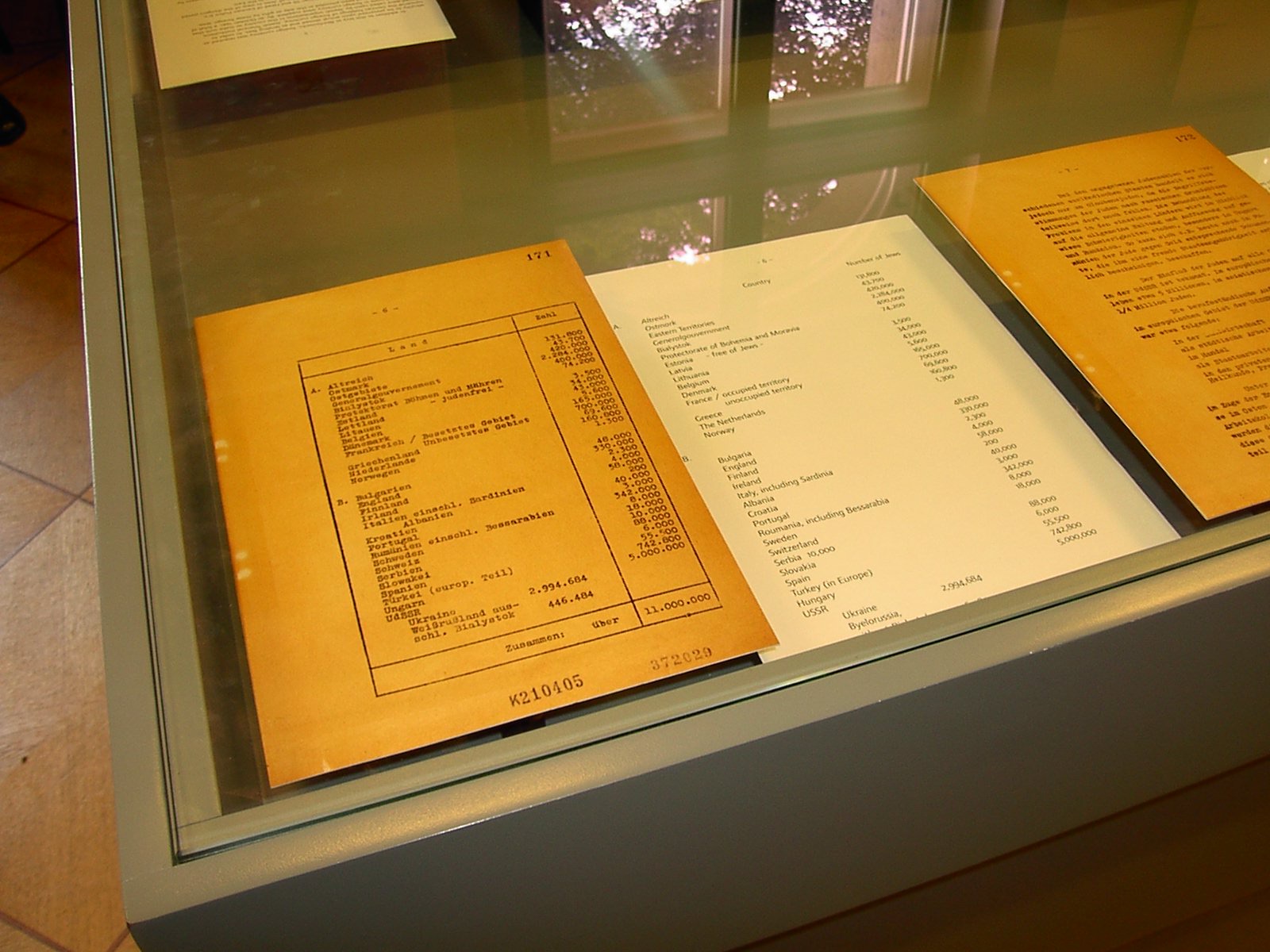
The figures as printed
| Group | Country | Figure |
|---|---|---|
| A | Germany proper (Altreich) | 131,800 |
| A | Austria (Ostmark) | 43,700 |
| A | Eastern territories | 420,000 |
| A | General Government | 2,284,000 |
| A | Bialystok | 400,000 |
| A | Protectorate of Bohemia and Moravia | 74,200 |
| A | Estonia | judenfrei, free of Jews |
| A | Latvia | 3,500 |
| A | Lithuania | 34,000 |
| A | Belgium | 43,000 |
| A | Denmark | 5,600 |
| A | France, occupied territory | 165,000 |
| A | France, unoccupied territory | 700,000 |
| A | Greece | 69,600 |
| A | Netherlands | 160,800 |
| A | Norway | 1,300 |
| B | Bulgaria | 48,000 |
| B | England | 330,000 |
| B | Finland | 2,300 |
| B | Ireland | 4,000 |
| B | Italy including Sardinia | 58,000 |
| B | Albania | 200 |
| B | Croatia | 40,000 |
| B | Portugal | 3,000 |
| B | Romania including Bessarabia | 342,000 |
| B | Sweden | 8,000 |
| B | Switzerland | 18,000 |
| B | Serbia | 10,000 |
| B | Slovakia | 88,000 |
| B | Spain | 6,000 |
| B | Turkey, European portion | 55,500 |
| B | Hungary | 742,800 |
| B | USSR | 5,000,000 |
| B | Ukraine | 2,994,684 |
| B | White Russia excluding Bialystok | 446,484 |
| Total | Zusammen | over 11,000,000 |
Group B is where the table stops being an inventory. England, 330,000. Ireland, 4,000. Sweden, 8,000. Switzerland, 18,000. Spain, 6,000. Turkey, European portion, 55,500. In January 1942 the Reich held none of those countries and was at war with one of them. Two lines in Group B are given to the single digit while every other entry is rounded off: Ukraine 2,994,684 and White Russia excluding Bialystok 446,484. The Estonia line is not a number at all. It reads judenfrei, free of Jews, entered as a status already achieved.
The document then concedes that its own count is short. "The number of Jews given here for foreign countries includes, however, only those Jews who still adhere to the Jewish faith, since some countries still do not have a definition of the term 'Jew' according to racial principles." Eleven million was a floor. It was what the drafters could reach using somebody else's definition of who counted as a Jew.
The words they used
The Protocol never uses a German word for killing. Three phrases carry the whole operation, quoted here from the official English translation the memorial published in 2020.
Deportation is "evacuation of the Jews to the East," which replaced emigration as stated policy "with appropriate prior authorisation from the Führer." The older Avalon Project translation makes that approval conditional and still to come; the German supports the memorial's reading, which bears on whether Hitler had authorized the program before January 20. The Avalon text also gives Martin Luther of the Foreign Office the title 'Dr.', which the German original does not.
Death by forced labor is a road-building project. "In large labour columns, separated by sex, the Jews capable of working will be dispatched to these regions to build roads. In the process, a large portion will undoubtedly drop out through natural reduction."
And for anyone still alive at the end of that: "Those who ultimately should possibly get by will have to be given suitable treatment," on the reasoning that survivors of such a process are a natural selection and, if released, would become the seed of a Jewish revival.
Men organizing road construction do not need a euphemism for what happens to the workers.
... wobei zweifellos ein Großteil durch natürliche Verminderung ausfallen wird.
In the process, a large portion will undoubtedly drop out through natural reduction.
Memorial and Educational Site House of the Wannsee Conference, official English translation, 2020. The Avalon Project renders the same clause as "a large portion will be eliminated by natural causes," which loses the accounting register of the German.
Operation Reinhard
Belzec, Sobibor and Treblinka, 1942 to 1943, and the telegram that counted them.
Operation Reinhard was the German plan to murder the Jews of the General Government, the part of occupied Poland that was governed rather than annexed. Odilo Globocnik, the SS and Police Leader in Lublin, directed it from the autumn of 1941 to the late summer of 1943. Christian Wirth was inspector of the killing centers. Hermann Höfle, an SS major, arranged the personnel and the trains. The operation was later named after Heydrich.
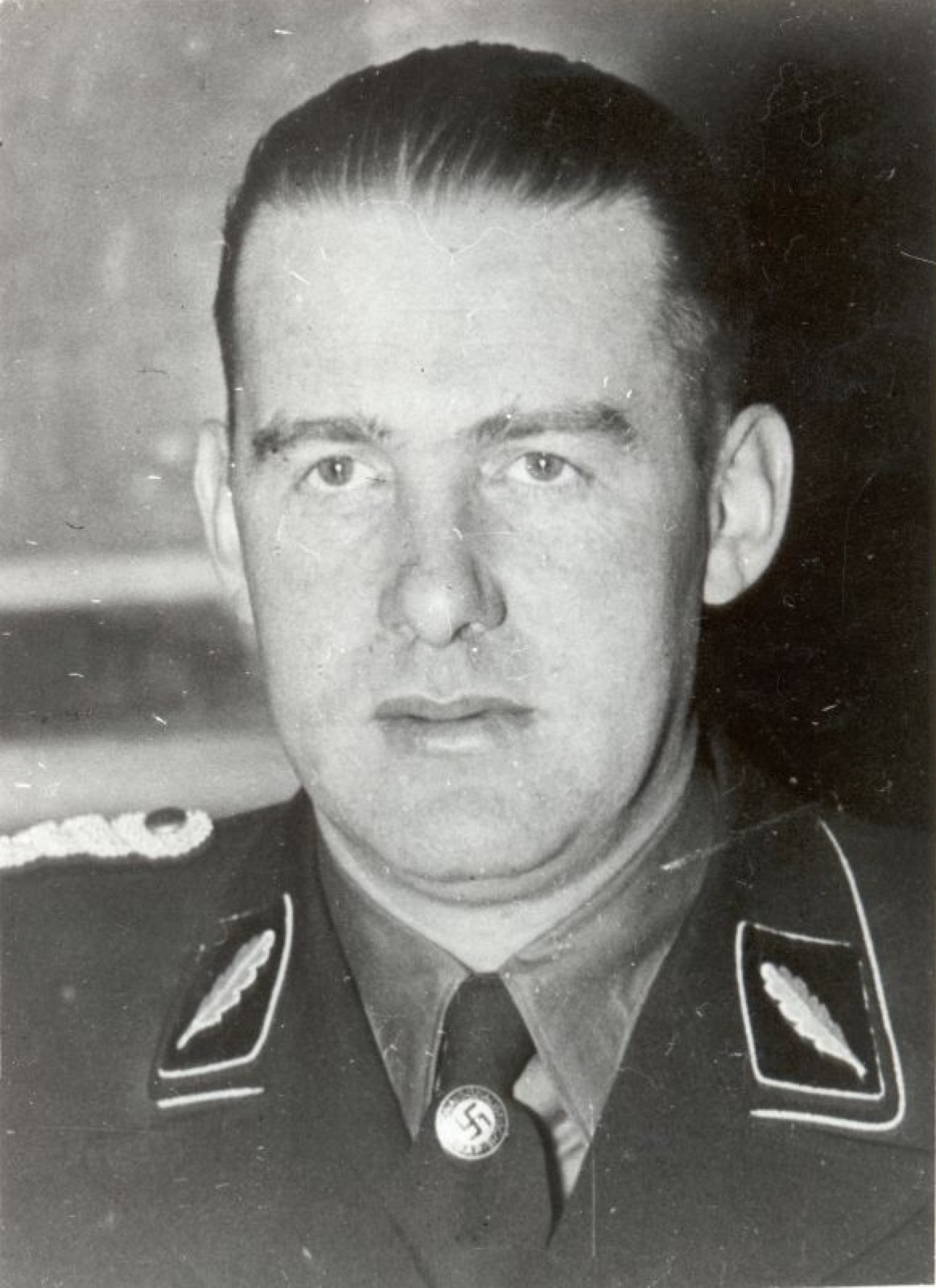
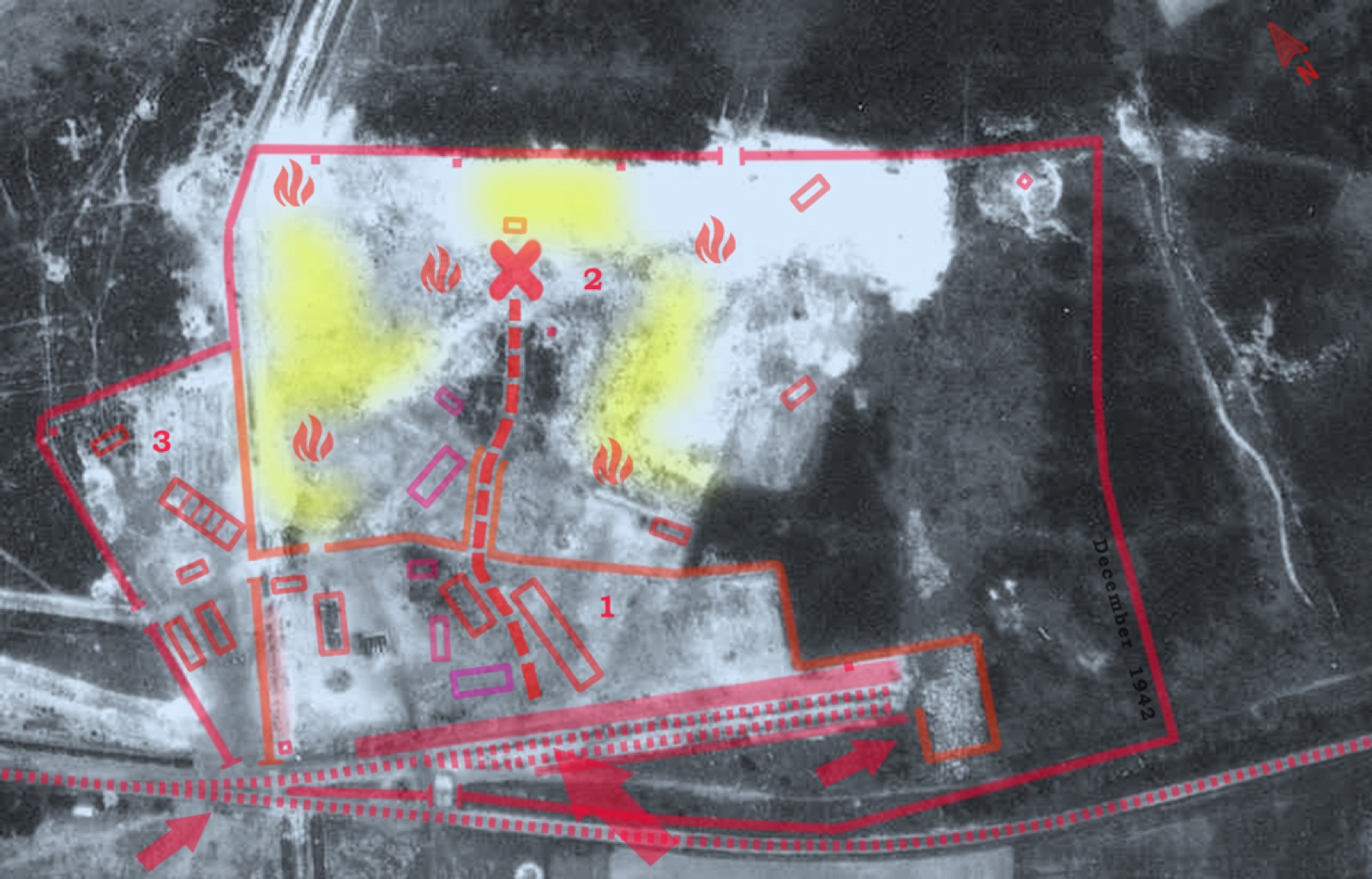
Three sites, built in sequence. Belzec, under construction from November 1941, killing on a mass scale from March 17, 1942. Sobibor, gassing regularly from early May 1942. Treblinka II, completed in July 1942 and killing from the end of that month. The overwhelming majority of the German staff came out of T4, the program that had gassed disabled patients in German asylums, and they arrived with carbon monoxide and cremation already in hand as a working method.
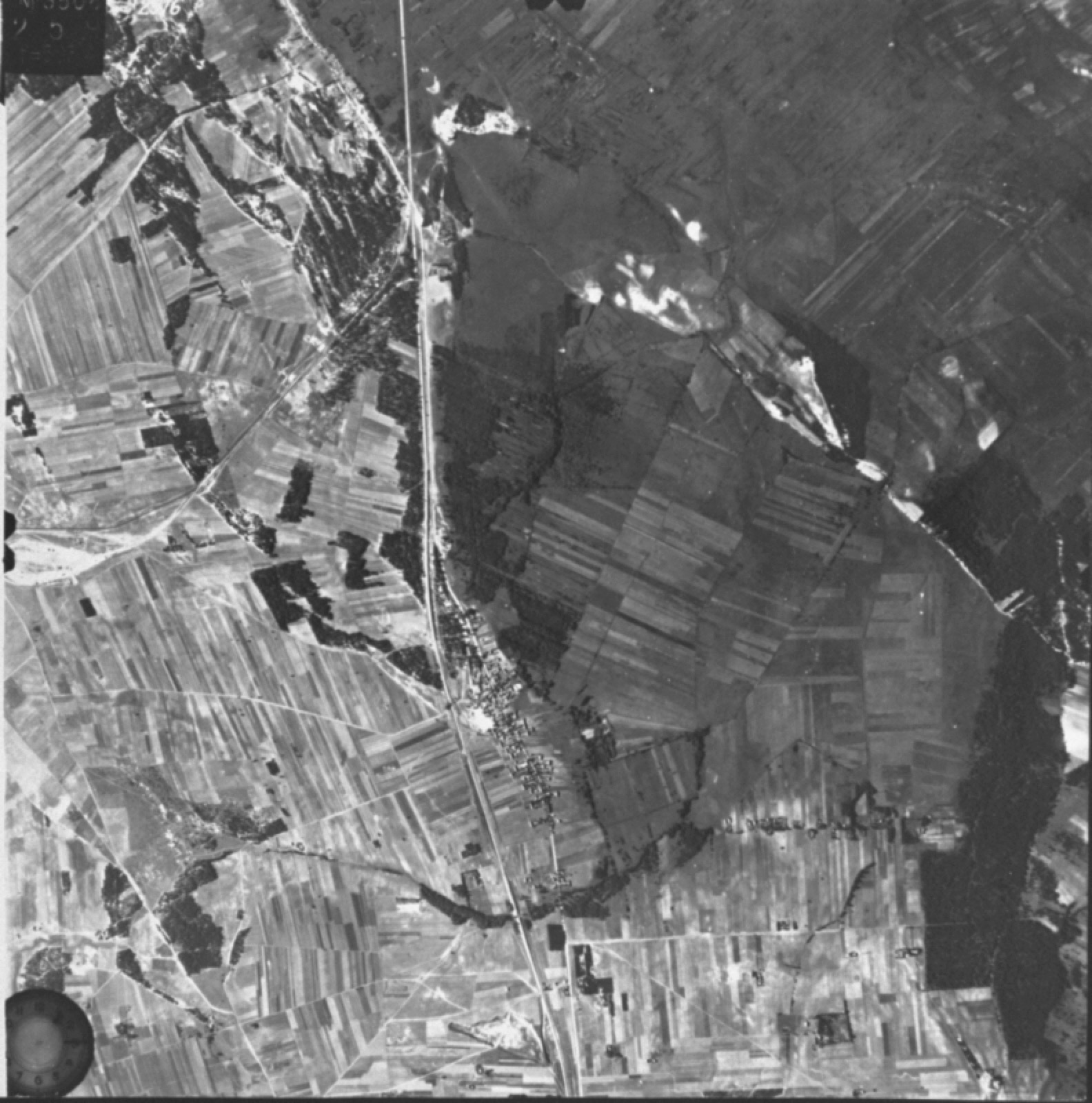
Auschwitz did two jobs at once. It held registered prisoners as a concentration camp and it killed as a killing center, with selections on arrival, and the agent there was hydrogen cyanide from Zyklon B rather than engine exhaust. Belzec, Sobibor and Treblinka did one job. Almost everyone sent to them was killed on arrival; very small numbers were kept alive to work. USHMM gives Belzec at least 434,508 dead, Sobibor at least 167,000, Treblinka approximately 925,000, and roughly 1.7 million for the operation as a whole.
The Höfle Telegram
On January 11, 1943, Höfle sent a radio message in cipher reporting arrivals at four sites through December 31, 1942. Lublin 24,733. Belzec 434,508. Sobibor 101,370. Treblinka 713,555. Total 1,274,166.
Where that number comes from is why it cannot be argued with. British codebreakers intercepted the transmission and decrypted it at the time, and then it sat in a file. It surfaced in 2000 among newly declassified British wartime signals intelligence at the Public Record Office in Kew, and Peter Witte and Stephen Tyas published it in Holocaust and Genocide Studies the following year. This is the perpetrators' own arithmetic, sent by the officer running the transports to his own side and read by an enemy who kept the reading secret. No postwar testimony could have shaped it. Richard Korherr, Himmler's statistician, quotes the identical total in his report of March 1943. USHMM's figure for Belzec, at least 434,508, is Höfle's number to the digit.
Most of the documentation of the killing was destroyed on purpose, and what survives is written in euphemism. That is why a decrypt filed by the wrong side carries the weight it does.
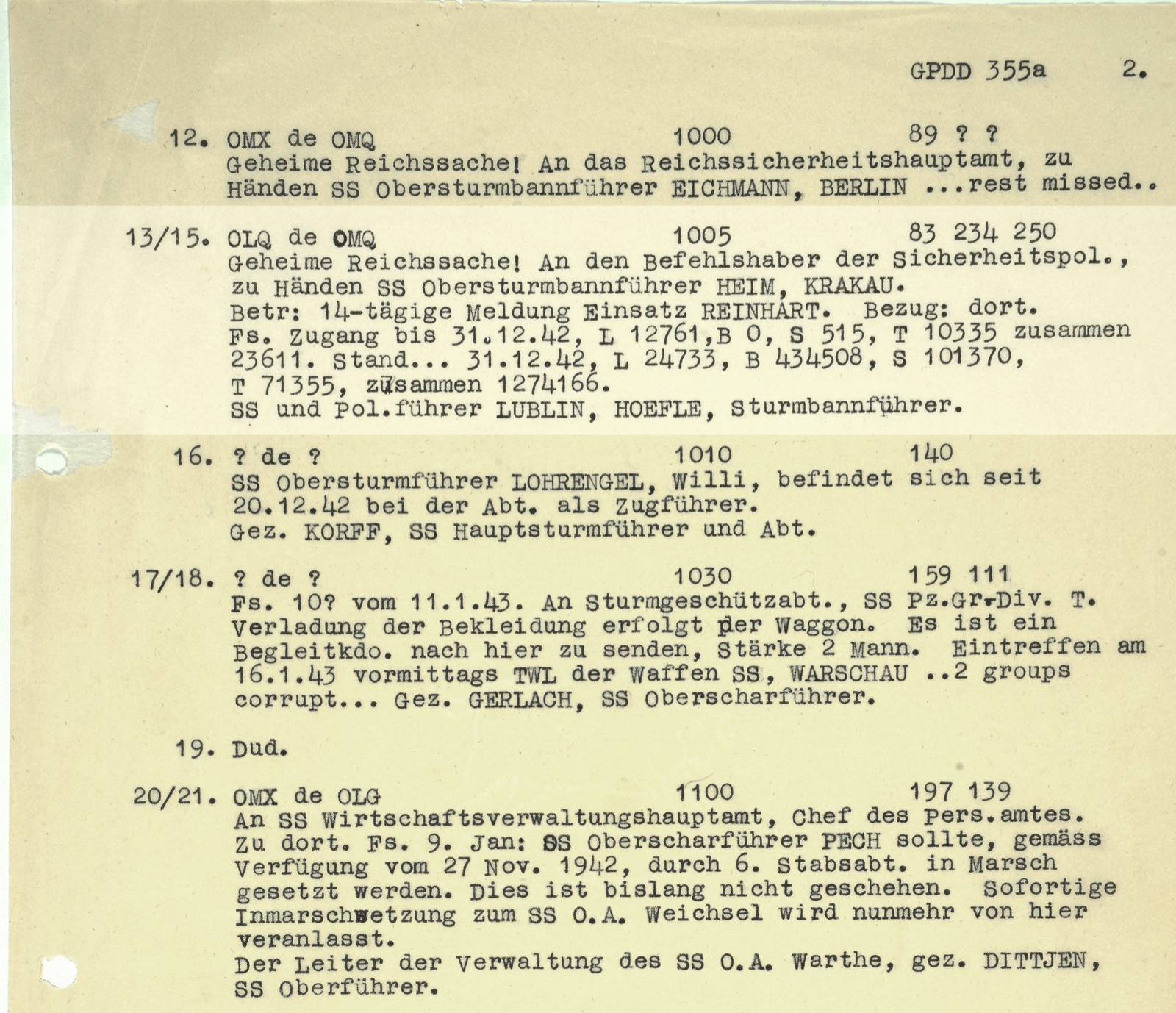
The telegram counts arrivals through the end of 1942 and no further, which is why its Treblinka figure sits below the camp's full toll: the deportations ran on into 1943. Lublin in the telegram means Majdanek, which USHMM classifies as a concentration camp rather than a killing center, a difference of function rather than a dispute about what happened there. On November 3 and 4, 1943 came the action the Germans code-named Harvest Festival: some 42,000 Jews shot in the labor camps of the Lublin district over two days.
What were the Nuremberg trials?
The London Agreement, the four counts, and the 24 names on the indictment
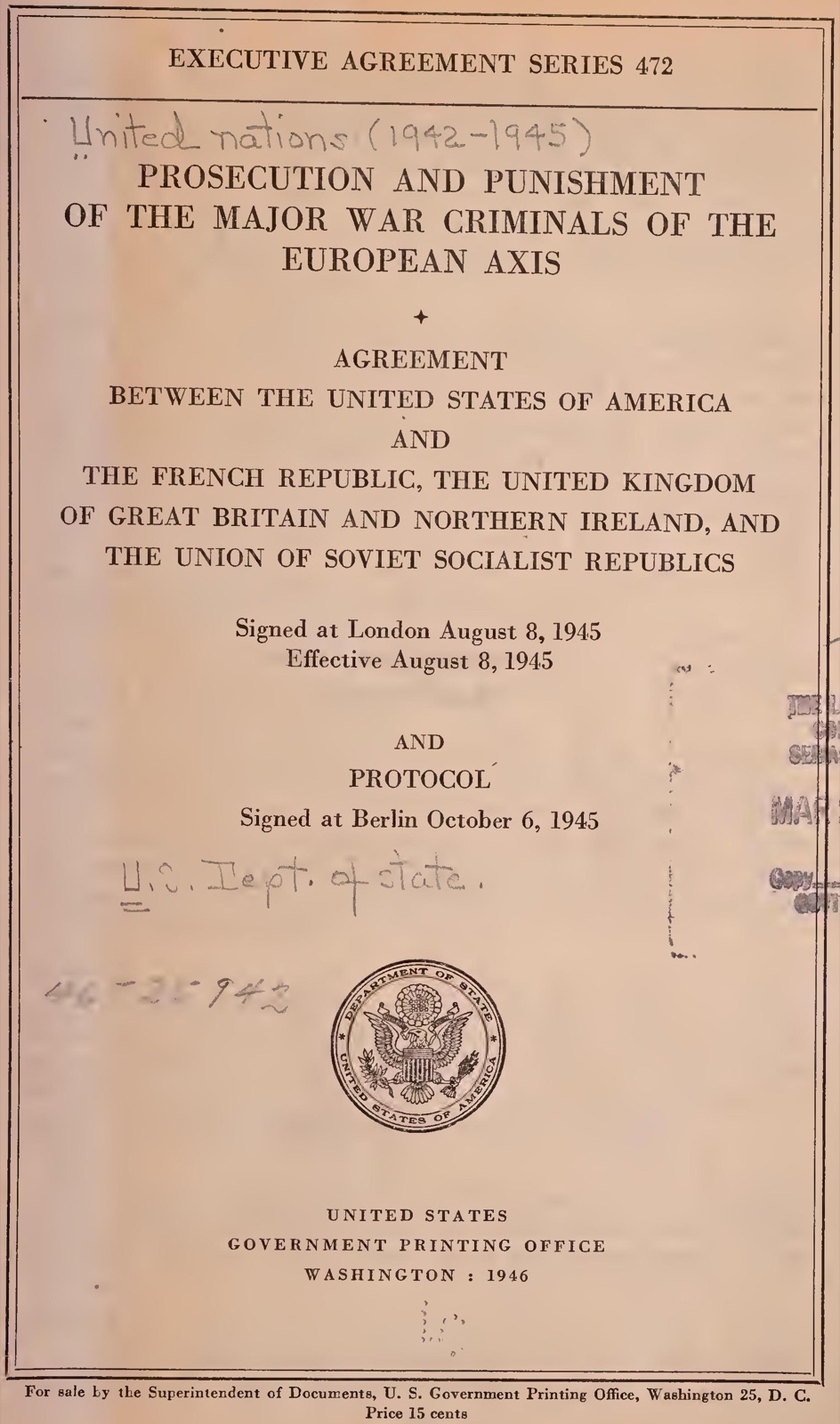
Four governments signed an agreement in London on August 8, 1945: the United States, the Provisional Government of the French Republic, the United Kingdom, and the Soviet Union. It established an International Military Tribunal to try the major war criminals of the European Axis, and the Charter annexed to it is where the law was written. The Tribunal's permanent seat was Berlin. The Charter named Nuremberg for the first trial only, and that first trial was the only one the four powers ever held together.
The city was chosen for a practical reason. The Palace of Justice had survived the bombing largely intact, the only facility left standing extensive enough for a proceeding this size, with 20 courtrooms and a prison for 1,200 attached to the building. That Nuremberg was also where the party had held its rallies and where the race laws were proclaimed in 1935 was not the deciding factor, though it gave the choice a symbolic weight.
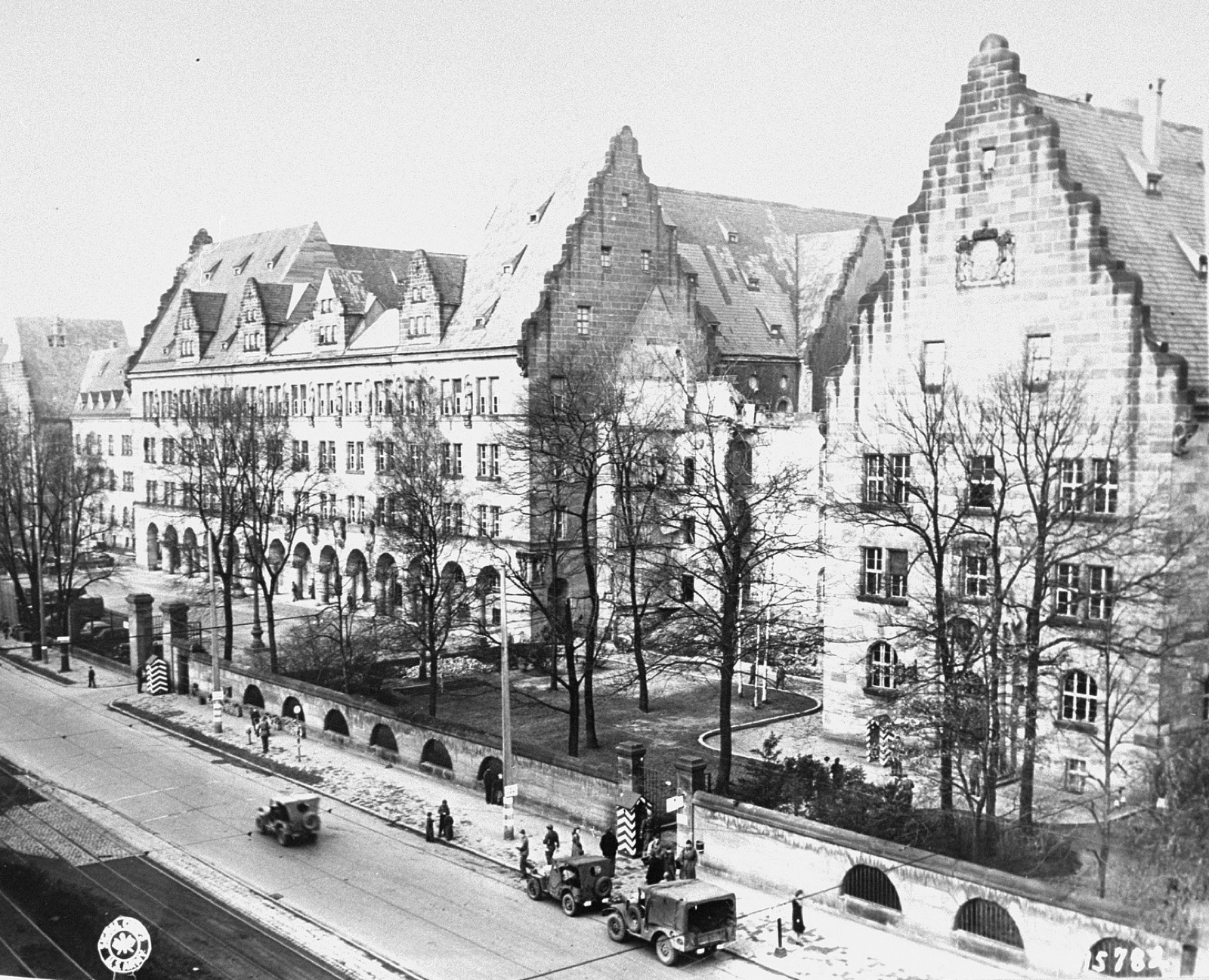
The indictment ran to four counts. Conspiracy. Crimes against peace. War crimes. Crimes against humanity. Prosecutors lodged it in Berlin on October 18, 1945, against 24 men and six organizations. Robert H. Jackson signed for the United States, Francois de Menthon for France, Hartley Shawcross for Britain, R. A. Rudenko for the Soviet Union.
War crimes were old law. The Hague Convention of 1907 and the Geneva Convention of 1929 already covered them, and that individuals could be punished for breaking them was, in the Tribunal's words, "too well settled to admit of argument." Counts Two and Four were the new ones. The phrase crimes against humanity had been used before, by the Allies in 1915, about the massacres of Armenians. It had never been something a court could convict on. Article 6(c) of the Charter made it one.
Defense counsel attacked exactly there. Nullum crimen sine lege, nulla poena sine lege: no punishment of crime without a pre-existing law. No sovereign power had made aggressive war a crime when the acts were committed, they argued, no statute had defined it, no penalty had been fixed for it and no court had existed to try it. It was a serious objection.
The Tribunal answered in two moves. It held that it did not strictly need to reach the question at all, since "the law of the Charter is decisive, and binding upon the Tribunal." Then it answered anyway. The maxim, the judgment says, "is not a limitation of sovereignty, but is in general a principle of justice," and an attacker who defies treaties knows he is doing wrong. The Kellogg-Briand Pact of 1928 had already bound 63 nations, Germany among them, to renounce war. Bound by the Charter first, defending it second.
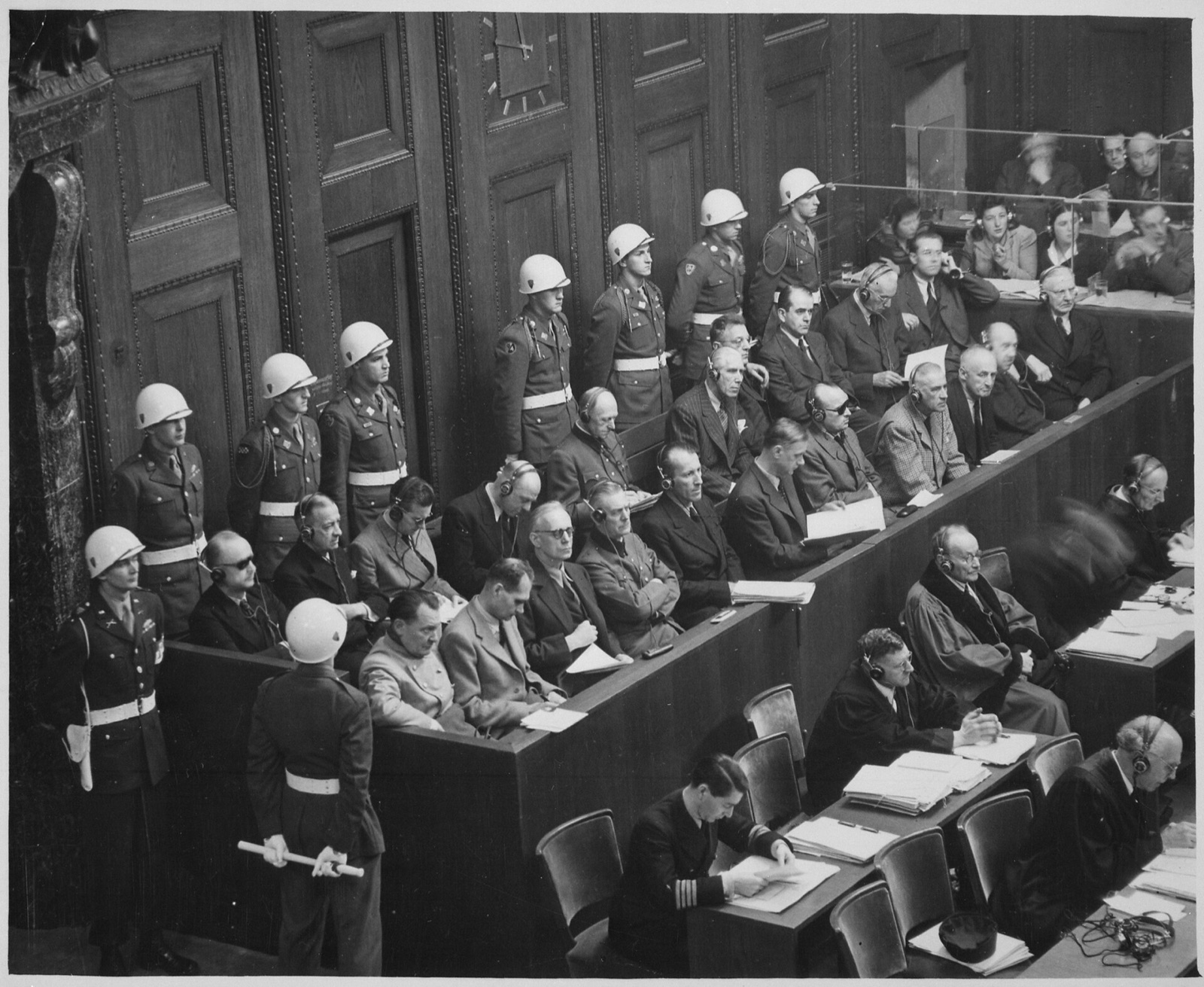
Only 21 of the 24 men named in the indictment ever sat in the dock. Robert Ley, head of the German Labor Front, hanged himself in his cell on October 25, 1945, 26 days before the trial opened, not on its eve. On November 15 the Tribunal severed the arms manufacturer Gustav Krupp von Bohlen und Halbach on medical evidence of senile softening of the brain. On November 17 it ordered Martin Bormann tried in his absence under Article 12, because he could not be found. That left 22 men tried and 21 in the room. The trial ran 216 days across 403 open sessions, by Jackson's own count.
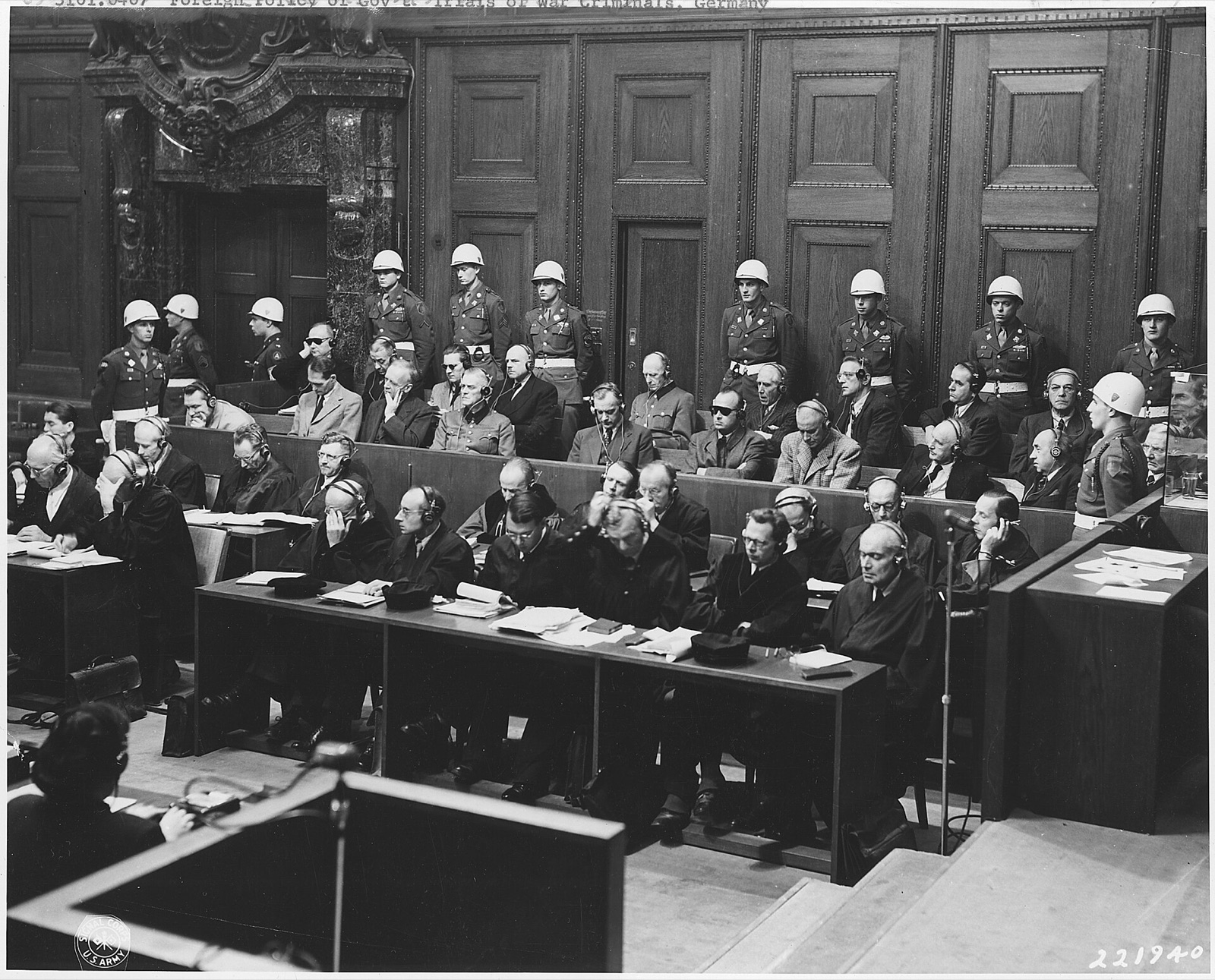
Inside Courtroom 600
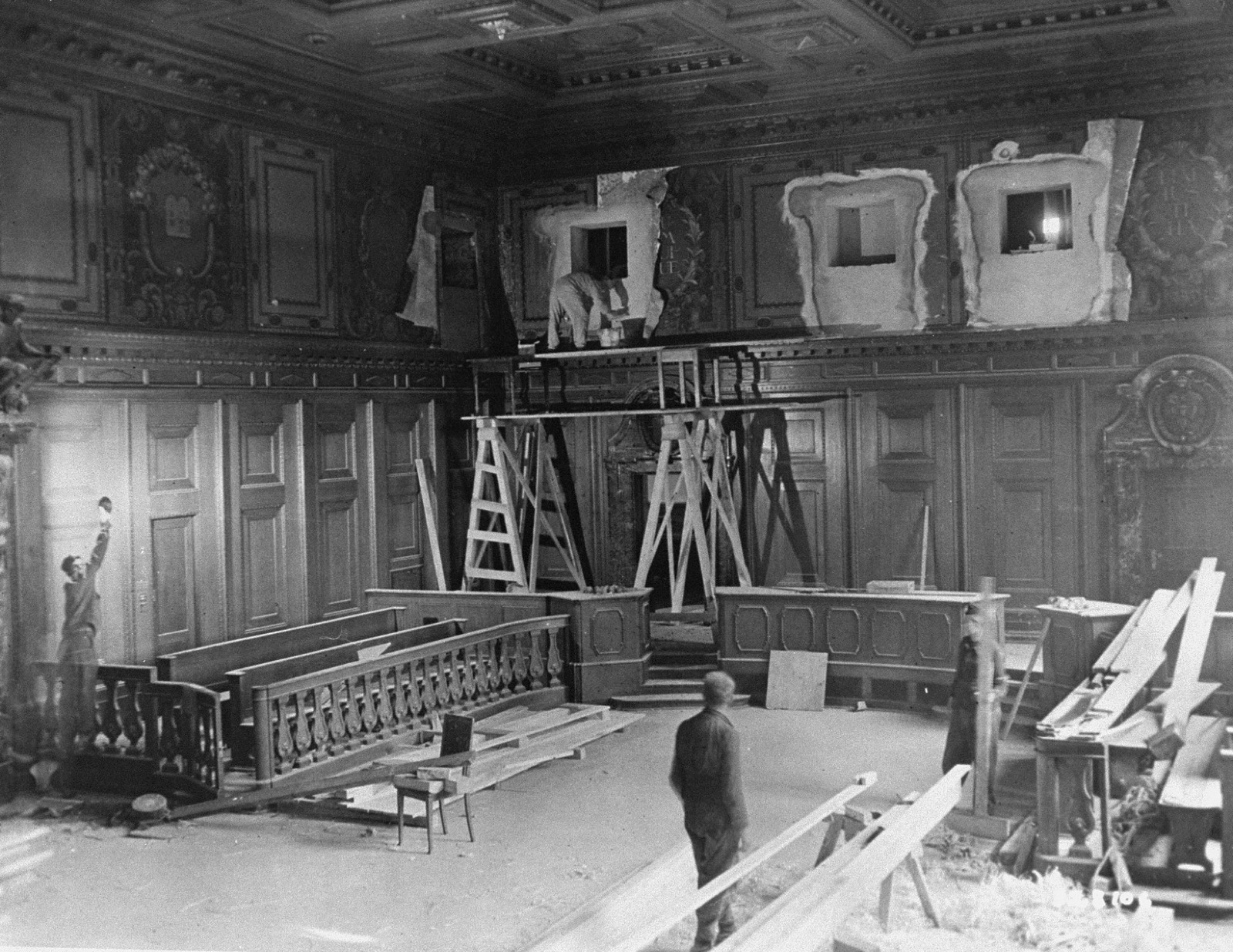
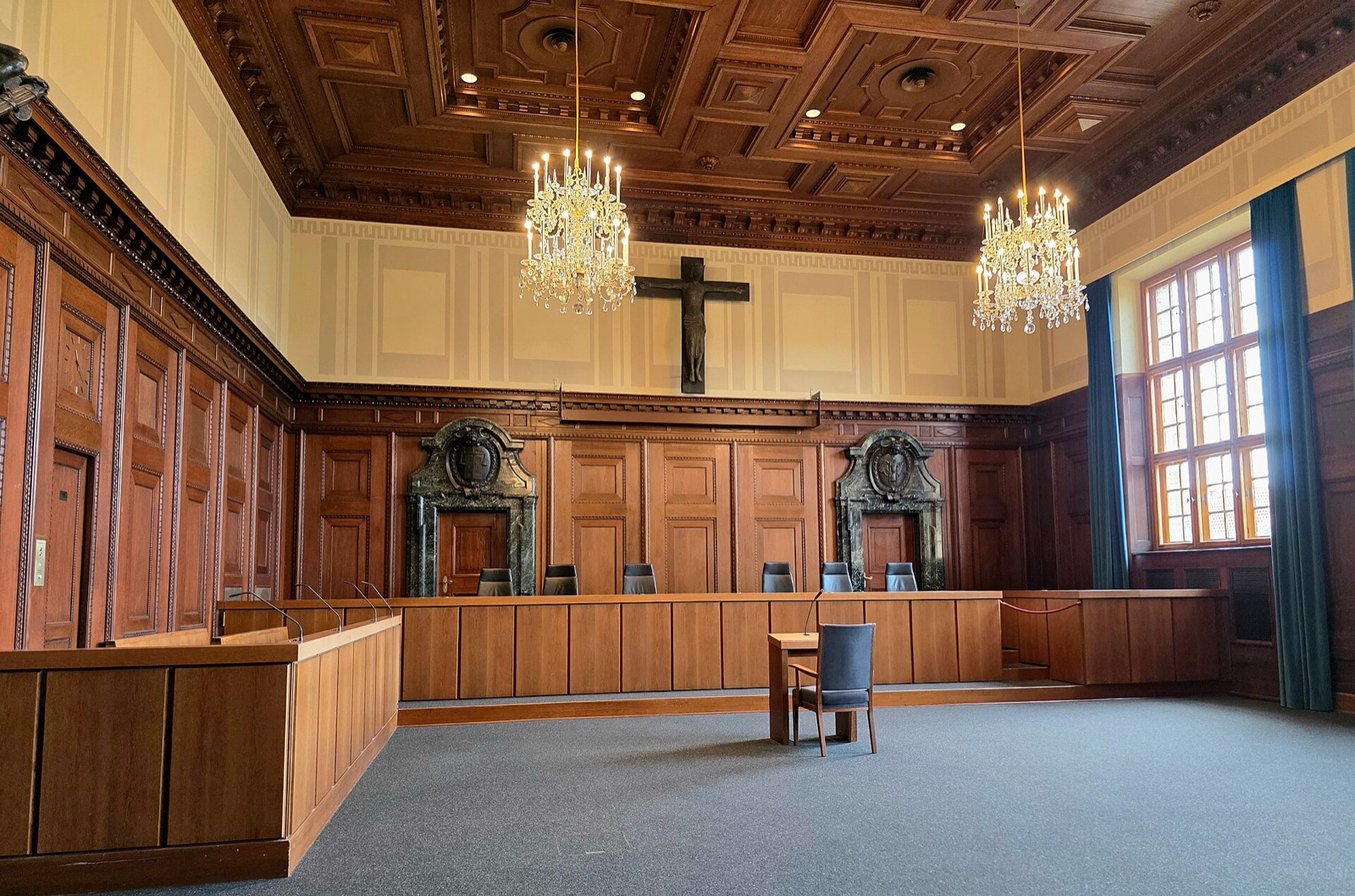
The room was rebuilt for the trial, and it is still there
The trial needed a courtroom and the courtroom was the wrong shape. Room 600 was an ordinary working German criminal court, and through the autumn of 1945 American engineers took it apart. A wall came down. The ceiling was raised. A gallery went in for 250 members of the international press, along with the wiring and cabling for a simultaneous translation system, because four signatory powers meant four working languages and there was no way around it.
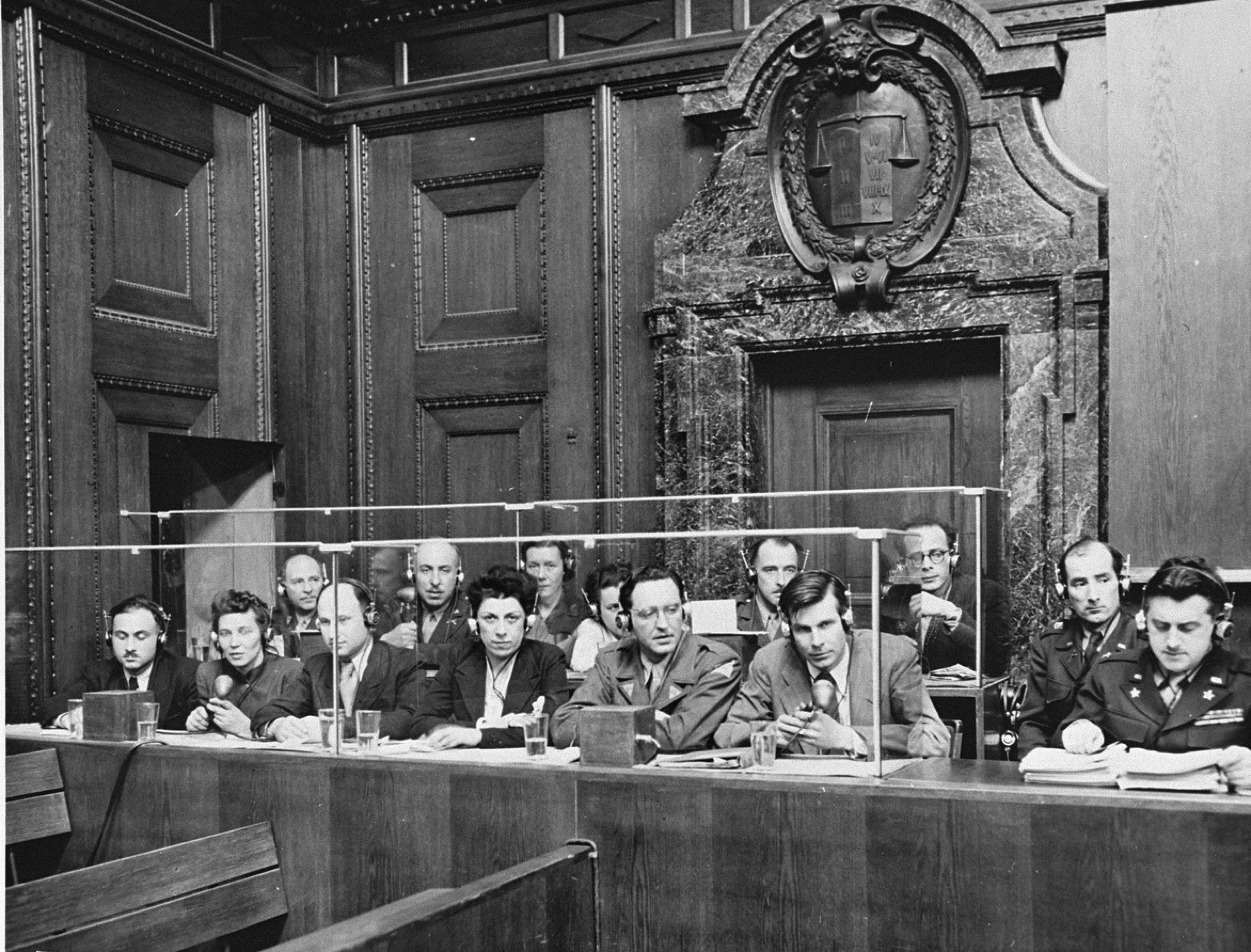
English, Russian, French and German ran at the same time, every session, for 216 days of trial time. The interpreters worked in a glass-fronted section beside the dock, under Leon Dostert, who headed the translation division, and everything said in the room was sound-recorded in the language it was actually spoken in. The English transcript alone came to more than 17,000 pages. About 4,000 captured documents had to be rendered into all four languages before they could be used as exhibits. Every word arrived four times.
Four flags hung on the front of the Palace of Justice, one for each of the powers that had signed in London. Inside, eight men sat at the bench, a judge and an alternate from each: Alexander Volchkov and Iona Nikitchenko for the Soviet Union, Norman Birkett and Geoffrey Lawrence for Great Britain, Francis Biddle and John Parker for the United States, Henri Donnedieu de Vabres and Robert Falco for France. Lawrence presided. Signal Corps cameras filmed the proceedings, which is why the trial can still be watched and not only read.
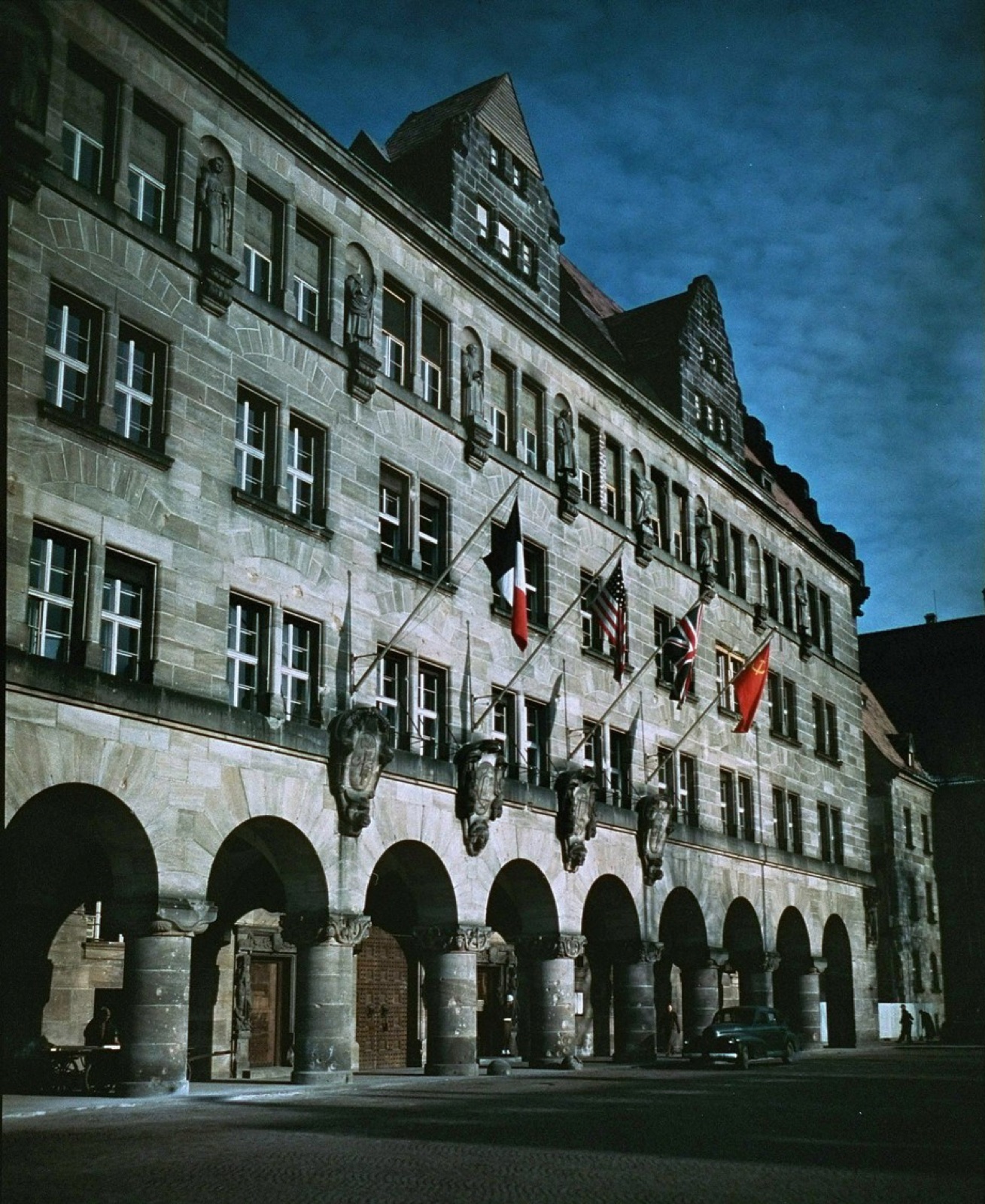
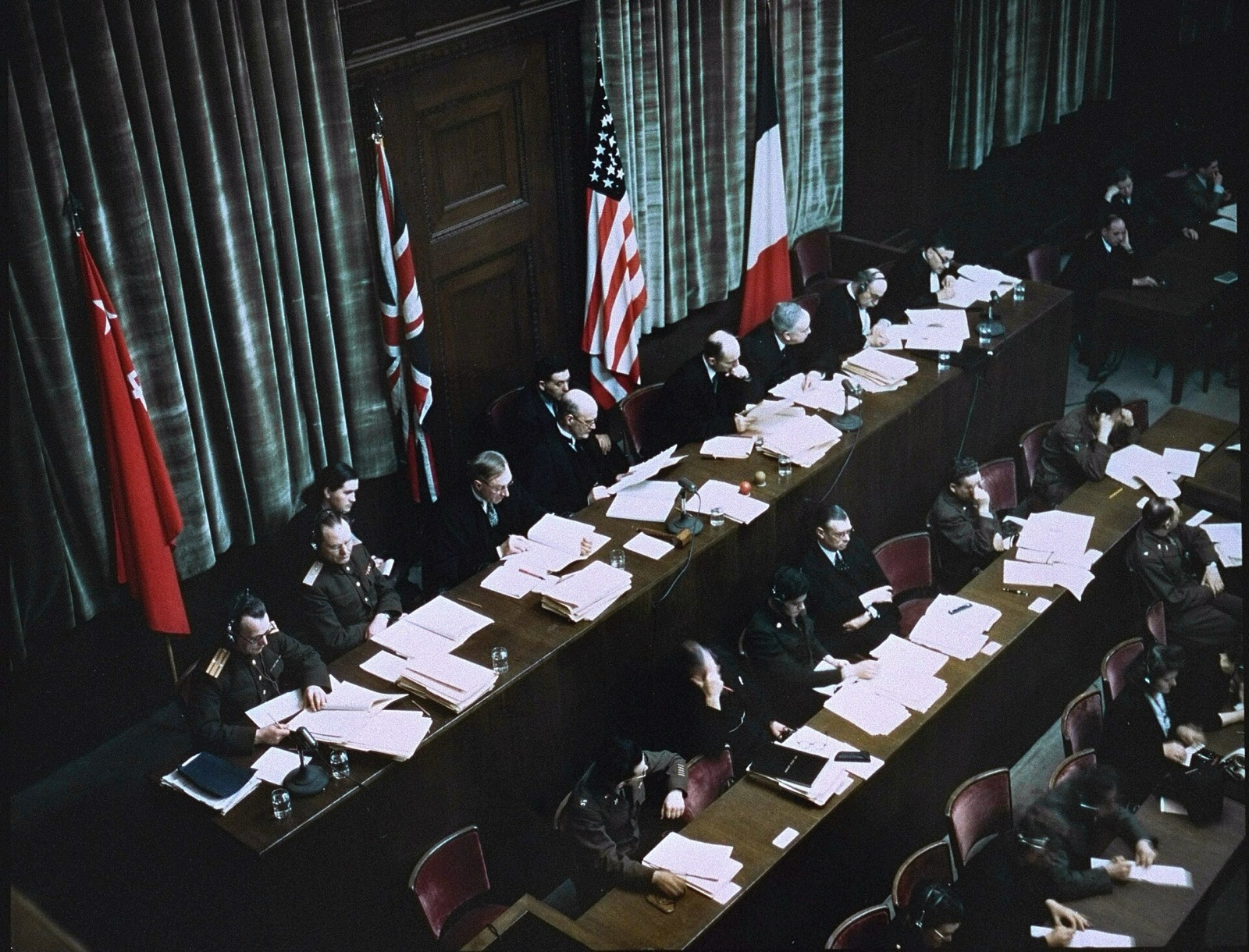
Room 600 is still there, in the same building, open to visitors as part of the Memorium Nuremberg Trials.
They were convicted on their own paperwork
Robert H. Jackson built the case out of German memoranda, on purpose
Jackson made his choice before the trial opened. He would not build the case on the testimony of the defendants' enemies. He would build it on what the Germans had written down about themselves, and he told the Tribunal why on November 21, 1945, the trial's second day. "We will not ask you to convict these men on the testimony of their foes. There is no count in the Indictment that cannot be proved by books and records." They had a habit of putting everything on paper, he said, and enough vanity to be photographed doing it. "We will show you their own films. You will see their own conduct and hear their own voices." The reason was credibility. A conviction resting on the defendants' own memoranda cannot be waved away later as something the winners invented.
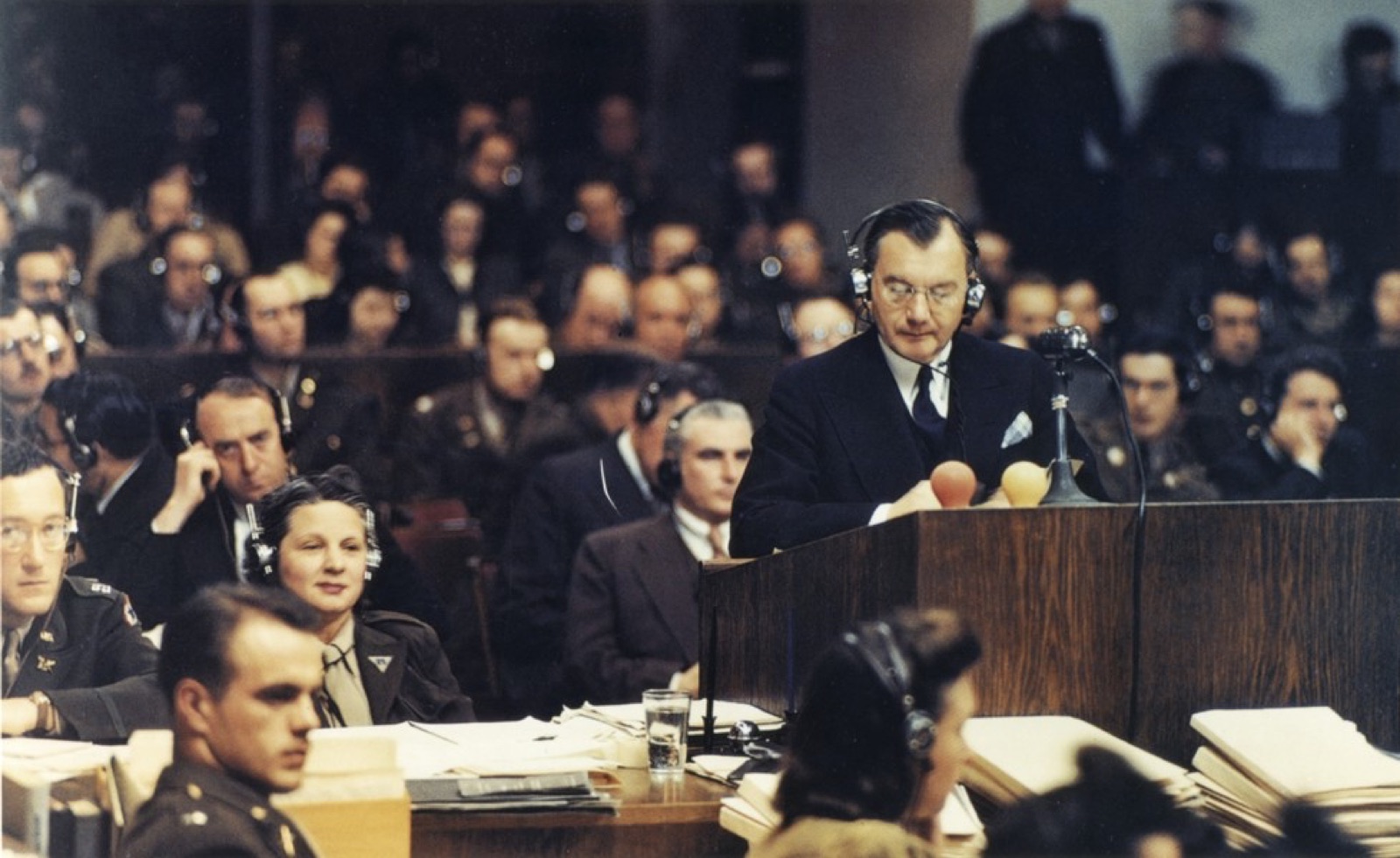
The privilege of opening the first trial in history for crimes against the peace of the world imposes a grave responsibility. The wrongs which we seek to condemn and punish have been so calculated, so malignant, and so devastating, that civilization cannot tolerate their being ignored, because it cannot survive their being repeated. That four great nations, flushed with victory and stung with injury stay the hand of vengeance and voluntarily submit their captive enemies to the judgment of the law is one of the most significant tributes that Power has ever paid to reason.Robert H. Jackson, chief prosecutor for the United States, opening statement, November 21, 1945. Nuremberg Trial Proceedings, volume 2.
Making good on that took a screening operation. More than 100,000 captured German documents were screened.
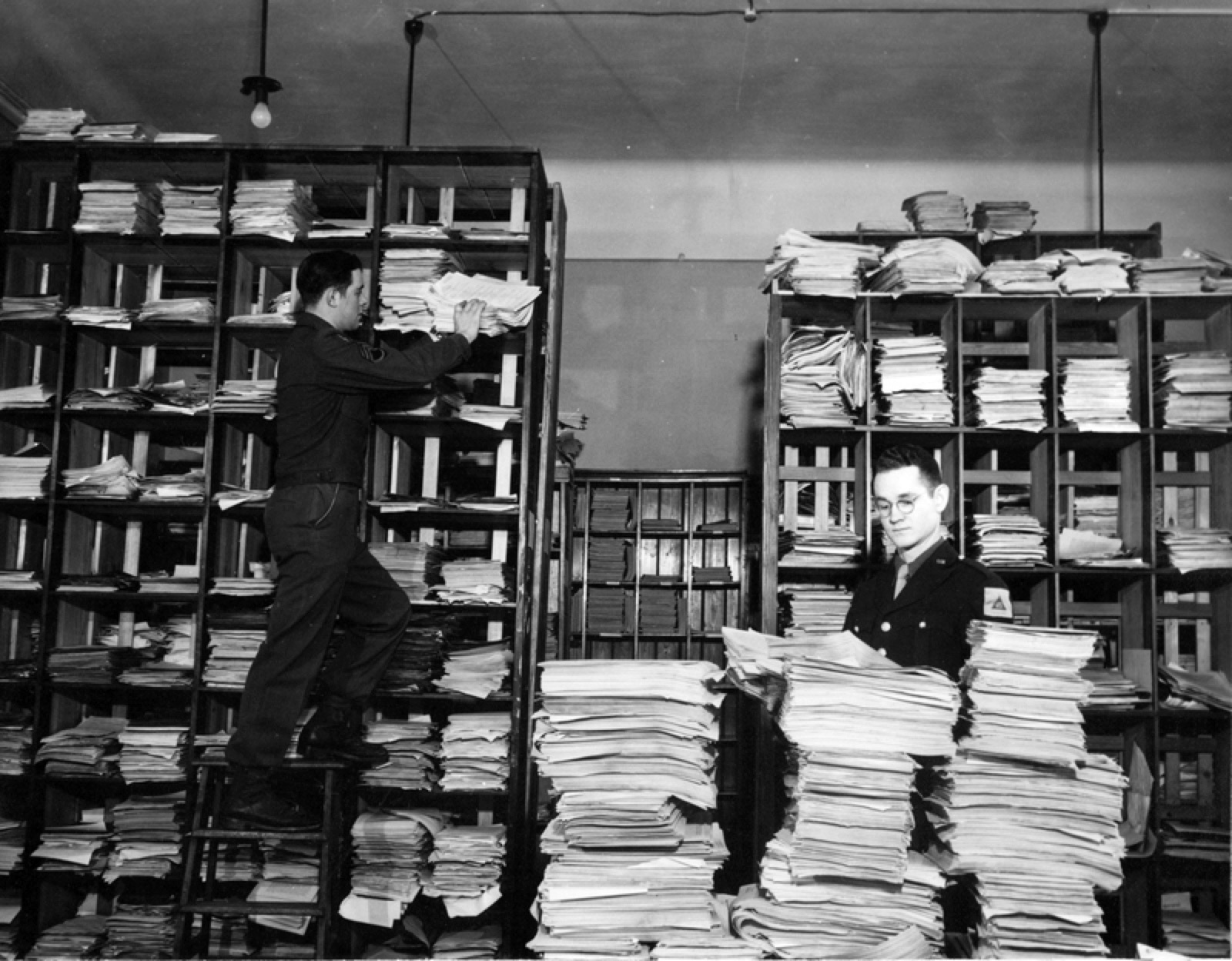
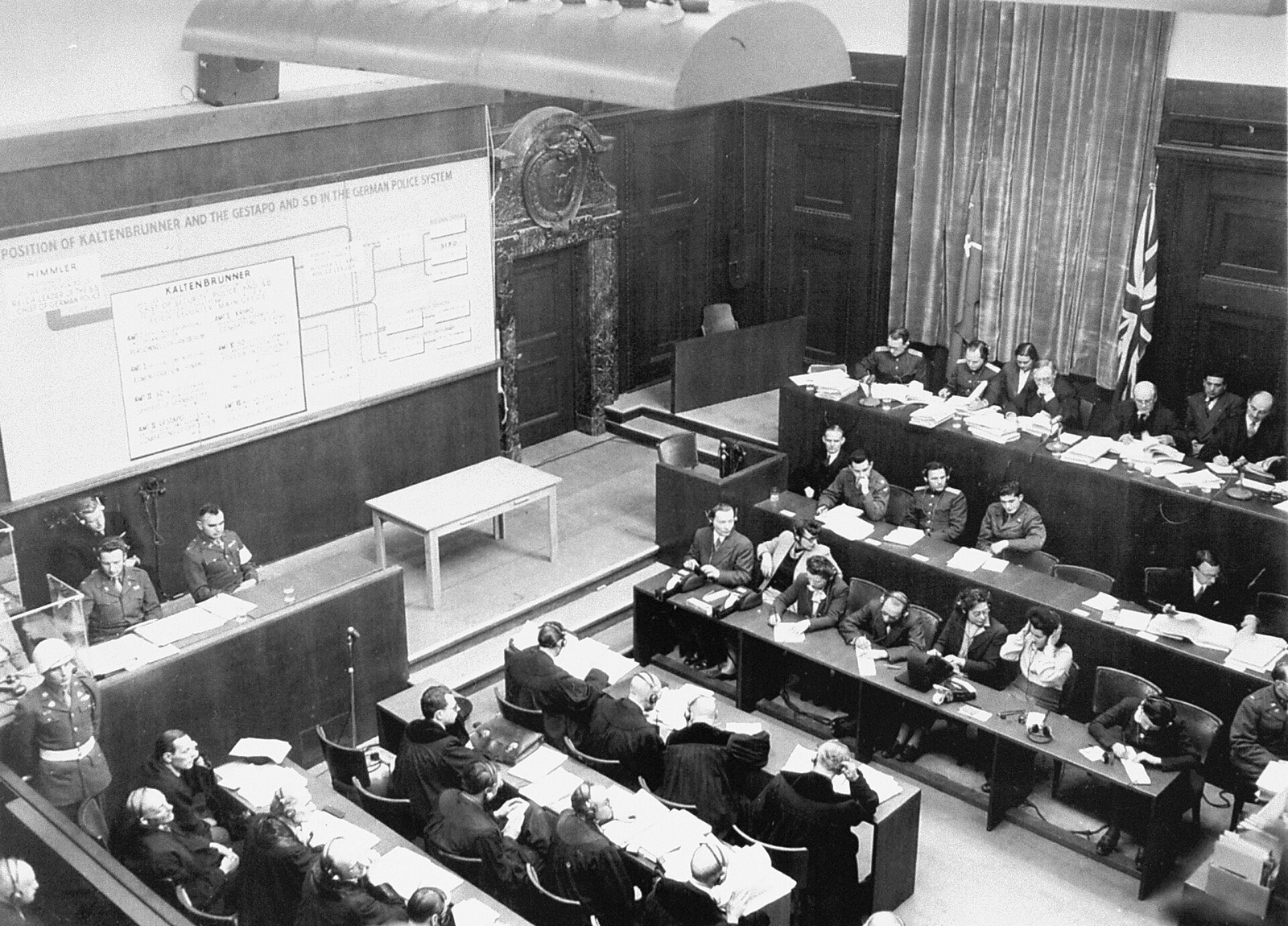
In its judgment the Tribunal endorsed the method in one sentence: the case against the defendants rested "in a large measure on documents of their own making, the authenticity of which has not been challenged except in one or two cases." A week after the verdict Jackson wrote to President Truman and said what he thought the record was for. The aggressions, persecutions and atrocities had been documented from German sources "with such authenticity and in such detail that there can be no responsible denial of these crimes in the future."
On the afternoon of November 29, 1945 the lights went down. Thomas Dodd, prosecuting for the United States, offered a film called "Nazi Concentration Camps," and Commander James B. Donovan entered it as Document 2430-PS, Exhibit USA-79. Dodd told the Tribunal it was not the whole proof of anything, only a film that showed "in a brief and unforgettable form an explanation of what the words 'concentration camp' imply." Defense counsel had been offered a private screening two evenings earlier. Eight of them came. Dr. Dix said he would not come unless he was forced to.
The transcript records no reaction. After "[The film was then shown.]" the only words are Colonel Storey's, "That concludes the presentation," and then the court adjourned. Most of the details people repeat about that hour, Schacht turning away, Frank in tears, Hess saying he did not believe it, come from the prison psychologist Gustave Gilbert's notes and from press reports, and Signal Corps film caught some of the defendants' reactions after the lights came up. USHMM puts it more carefully: when the lights came up in the Palace of Justice, all assembled sat in silence.
Documents were not the whole case. The prosecution called 33 witnesses to give evidence orally against individual defendants, and some of them had been inside the thing being described. The poet Abraham Sutzkever testified on the morning of February 27, 1946, having spent two years in a ghetto before joining the partisans in Lithuania. That afternoon Samuel Rajzman was sworn in by Geoffrey Lawrence and began speaking in Russian. He had been an accountant in an export firm, then a prisoner at Treblinka, and he had taken part in the revolt there.
When I had been in the camp 2 days, my mother, my sister, and two brothers were brought to the camp from the town of Vinegrova. I had to watch them being led away to the gas chambers. Several days later, when I was loading clothes on the freight cars, my comrades found my wife's documents and a photograph of my wife and child. That is all I have left of my family, only a photograph.Samuel Rajzman, survivor of Treblinka, testifying for the prosecution at the International Military Tribunal, Nuremberg, February 27, 1946. He answered in Russian. English from the published trial record.
A Spanish prisoner named Francisco Boix took the stand on January 28 and 29, 1946. Boix had worked in the identification service at Mauthausen, the office where the SS photographed its own work. He developed the negatives, he kept them, and with other prisoners in the camp underground he got them out. At Nuremberg he testified about Mauthausen and Gusen and about the photographs, and he identified Albert Speer in 36 of them. Pictures the SS took to record what it was doing were used against the men who ordered them taken.
The verdicts, and who received what
September 30 and October 1, 1946. Twelve death sentences, three life terms, four fixed terms, three acquittals.
The reading of the judgment began on September 30, 1946 and finished the next day. On October 1, after the last verdict was read, the Tribunal recessed, came back at ten minutes to three, and pronounced sentence under Article 27 of its Charter. Before the recess it told the men in the dock that any application for clemency to the Control Council had to be lodged within four days.
Twelve were sentenced to death by hanging. Three got life. Four got fixed terms. Three were acquitted.
The twenty-two men tried, and what the Tribunal did with each of them
| Defendant | Role | Counts | Sentence |
|---|---|---|---|
| Hermann Goering | Reichsmarschall; commander in chief of the Luftwaffe; head of the Four Year Plan | 1, 2, 3, 4 | Death by hanging |
| Rudolf Hess | Deputy to the Fuehrer until May 1941 | 1, 2 | Life imprisonment |
| Joachim von Ribbentrop | Reich foreign minister | 1, 2, 3, 4 | Death by hanging |
| Wilhelm Keitel | Chief of the High Command of the Armed Forces | 1, 2, 3, 4 | Death by hanging |
| Ernst Kaltenbrunner | Chief of the Reich Security Main Office | 3, 4 | Death by hanging |
| Alfred Rosenberg | Reich minister for the occupied Eastern territories | 1, 2, 3, 4 | Death by hanging |
| Hans Frank | Governor general of occupied Poland | 3, 4 | Death by hanging |
| Wilhelm Frick | Reich minister of the interior; Reich protector of Bohemia and Moravia | 2, 3, 4 | Death by hanging |
| Julius Streicher | Gauleiter of Franconia; publisher of Der Stuermer | 4 | Death by hanging |
| Walther Funk | Reich minister of economics; president of the Reichsbank | 2, 3, 4 | Life imprisonment |
| Hjalmar Schacht | President of the Reichsbank; Reich minister of economics | None | Acquitted |
| Karl Doenitz | Grand admiral; commander in chief of the navy from 1943; head of state after Hitler | 2, 3 | 10 years |
| Erich Raeder | Grand admiral; commander in chief of the navy to 1943 | 1, 2, 3 | Life imprisonment |
| Baldur von Schirach | Reich youth leader; Gauleiter of Vienna | 4 | 20 years |
| Fritz Sauckel | Plenipotentiary general for labor deployment | 3, 4 | Death by hanging |
| Alfred Jodl | Chief of the operations staff of the armed forces high command | 1, 2, 3, 4 | Death by hanging |
| Franz von Papen | Vice chancellor in 1933; ambassador in Vienna and Ankara | None | Acquitted |
| Arthur Seyss-Inquart | Reich commissioner for the occupied Netherlands | 2, 3, 4 | Death by hanging |
| Albert Speer | Reich minister for armaments and war production | 3, 4 | 20 years |
| Konstantin von Neurath | Reich foreign minister to 1938; Reich protector of Bohemia and Moravia | 1, 2, 3, 4 | 15 years |
| Hans Fritzsche | Head of the radio division, Reich propaganda ministry | None | Acquitted |
| Martin Bormann | Head of the Party Chancellery; Hitler's private secretary | 3, 4 | Death by hanging, in absentia |
The Tribunal also declared criminal the Leadership Corps of the Nazi Party, the Gestapo and SD, and the SS. It refused to do the same for the SA, the Reich Cabinet, and the General Staff and High Command.
Three men were acquitted. Hjalmar Schacht had run the Reichsbank and the economics ministry. Franz von Papen had been vice chancellor and then ambassador in Vienna and Ankara. Hans Fritzsche ran the radio division of Goebbels's propaganda ministry. All three walked out of the Palace of Justice. A court that releases three of the twenty-two men in front of it is a harder thing to write off as a formality.
The bench was not unanimous about it. Iona Nikitchenko, the Soviet member, put a dissent on the record: he held that Schacht, von Papen and Fritzsche should have been convicted. He dissented as well from the refusal to declare the Reich Cabinet and the General Staff criminal, and from the life sentence given to Rudolf Hess. He wanted Hess hanged.
Hermann Goering did not hang. On the night of October 15, 1946, about two hours before he was due to be taken out, he swallowed a cyanide capsule in his cell.
The other ten were hanged in the early hours of October 16: Joachim von Ribbentrop, Wilhelm Keitel, Ernst Kaltenbrunner, Alfred Rosenberg, Hans Frank, Wilhelm Frick, Julius Streicher, Fritz Sauckel, Alfred Jodl, Arthur Seyss-Inquart. The bodies were driven to Dachau, cremated, and the ashes tipped into the Isar.
So twelve death sentences produced ten hangings. Goering killed himself. Martin Bormann had been convicted and sentenced in absentia because nobody could find him, and he was already dead in Berlin, which was not confirmed until his remains were identified decades later.
The twelve trials after the famous one
The four-power court sat once. The Americans then ran twelve more trials in the same building.
Twenty-two men were tried by the International Military Tribunal, twenty-one of them physically in the room. Over the life of one camp alone, Auschwitz, some 8,000 to 8,200 SS men and about 200 female guards served in its garrison. The arithmetic never worked.
What came next was not a second international trial. Between December 1946 and April 1949 the United States ran twelve more proceedings in the same building, under Allied Control Council Law No. 10, enacted for occupied Germany on December 20, 1945. The judges were American. The prosecutors were American. All thirteen are called the Nuremberg trials. The four-power court met once.
Brigadier General Telford Taylor, chief of counsel for war crimes, ran them. The United States indicted 185 people and 177 of them stood trial. The tribunals imposed 24 death sentences, 20 life sentences and 98 other prison terms, and acquitted 35.
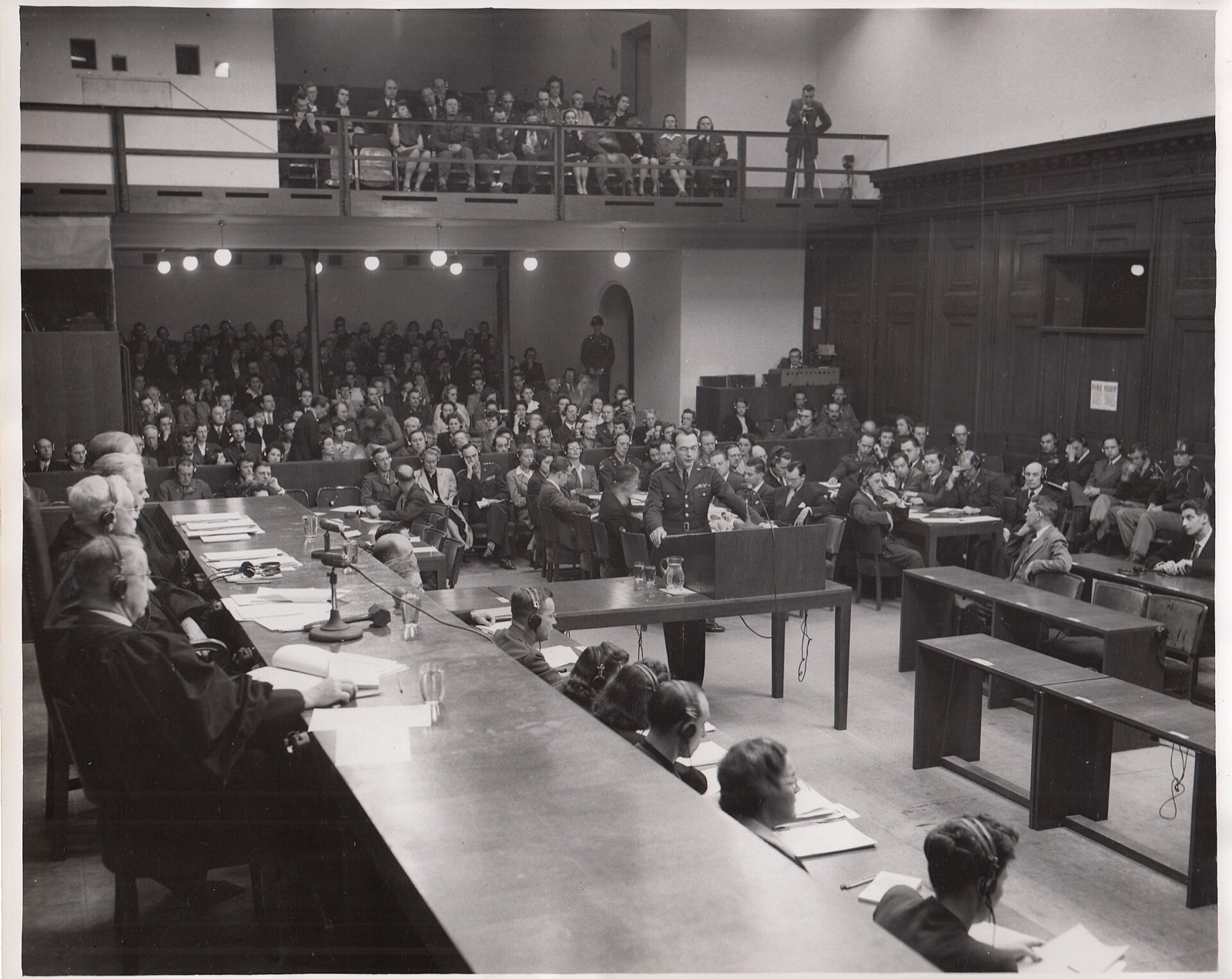
The cases were built around professions. Case 1 was the doctors. It opened on December 9, 1946 against 23 physicians and medical administrators, ran almost 140 days, heard 85 witnesses and took in nearly 1,500 documents. Sixteen were convicted. Seven were sentenced to death and executed on June 2, 1948.
The judgment carried a section headed Permissible Medical Experiments, ten numbered principles handed down in August 1947. The first of them opens: "The voluntary consent of the human subject is absolutely essential." That section is the Nuremberg Code, and it remains a landmark of medical ethics. Its legal force was never well established. It is a court's statement of principle rather than a treaty.
Case 3 was the judges. It opened on March 5, 1947 against 16 men from the Reich justice ministry and from the People's and Special Courts. The charge was judicial murder: destroying law in Germany, then using the emptied forms of legal process for persecution, enslavement and extermination. Ten were convicted, four acquitted. Four got life; six got five to ten years.
Case 6 was IG Farben, the chemical combine that owned 42.5 percent of Degesch, the firm that marketed Zyklon B, and used slave labor at its Auschwitz-Monowitz plant. Of the 23 executives tried, ten were acquitted outright. The thirteen convicted got one and a half to eight years, time already served included. Eight years was the most anyone got.
Case 10 was Krupp. Twelve officials were tried, judgment came on July 31, 1948, one was acquitted, and the other eleven got two to twelve years. In almost every instance those sentences were commuted to time served. Case 11, the Ministries Case, records how that happened: on January 31, 1951 the United States High Commissioner for Germany reduced eight of its sentences to shorter terms or to time already served.
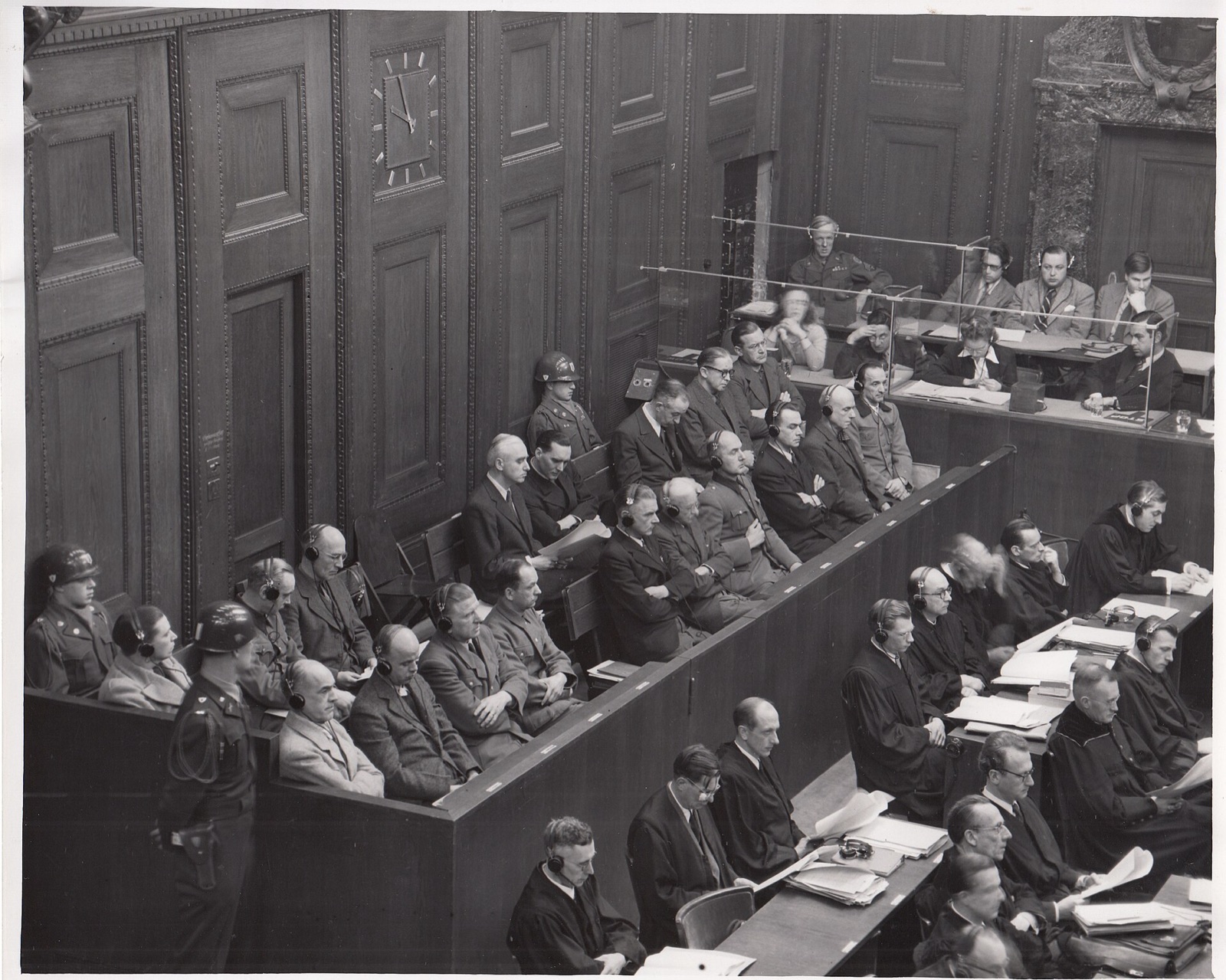
The biggest murder trial in history
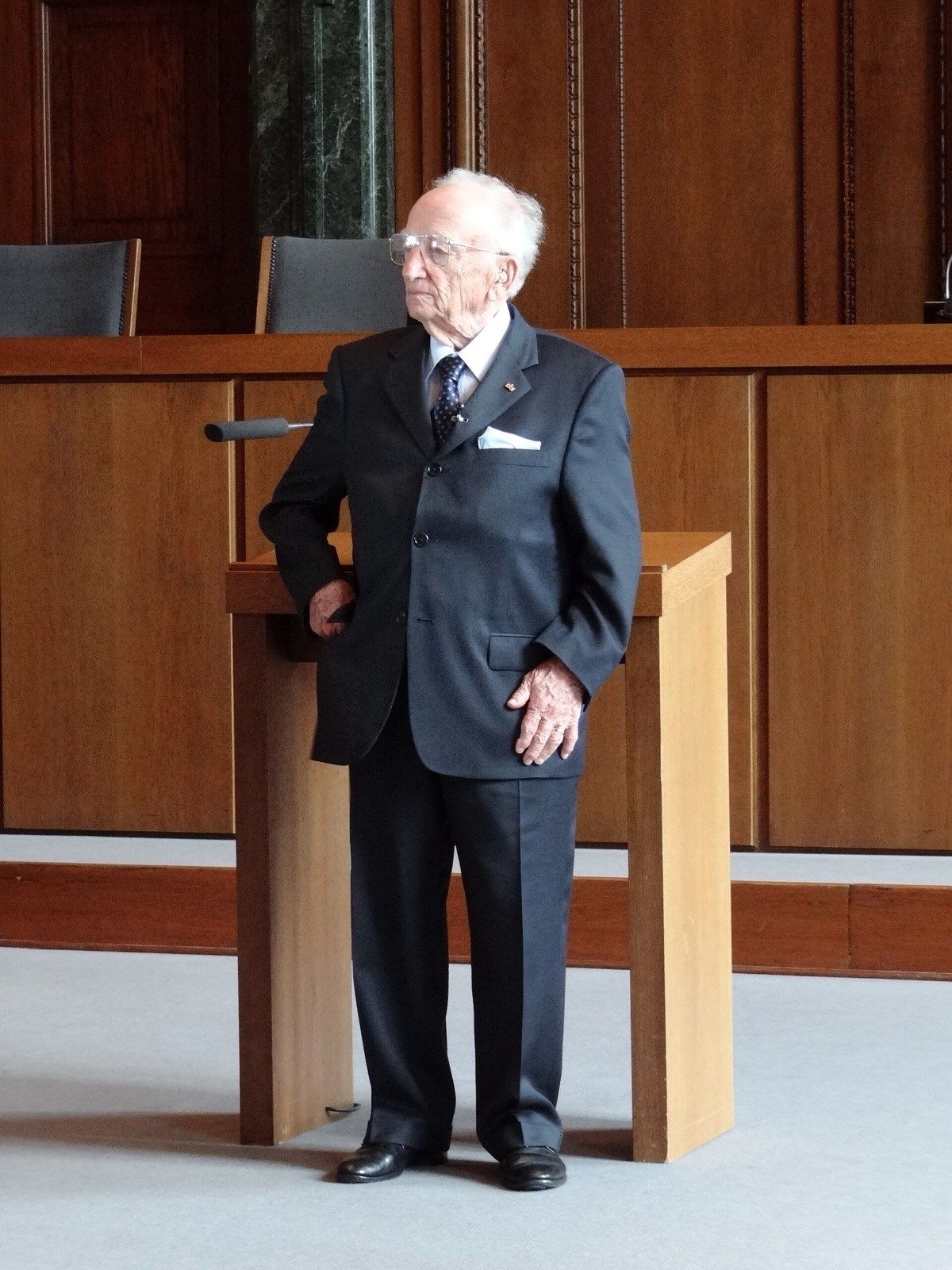
Case 9. The prosecutor was 27 years old and had never tried a case.
Benjamin Ferencz was 27 years old and had never tried a case in his life.
The evidence was already written. The Einsatzgruppen had reported their work back to Berlin as they went, in bulletins that tabulated the shootings by unit, by place, by date and by number. Nobody had to reconstruct anything. The killers had kept the books.
On July 29, 1947 twenty-four men were indicted for their part in murdering between 723,661 and one million people, in the indictment's phrase, "as part of a systematic program of genocide."
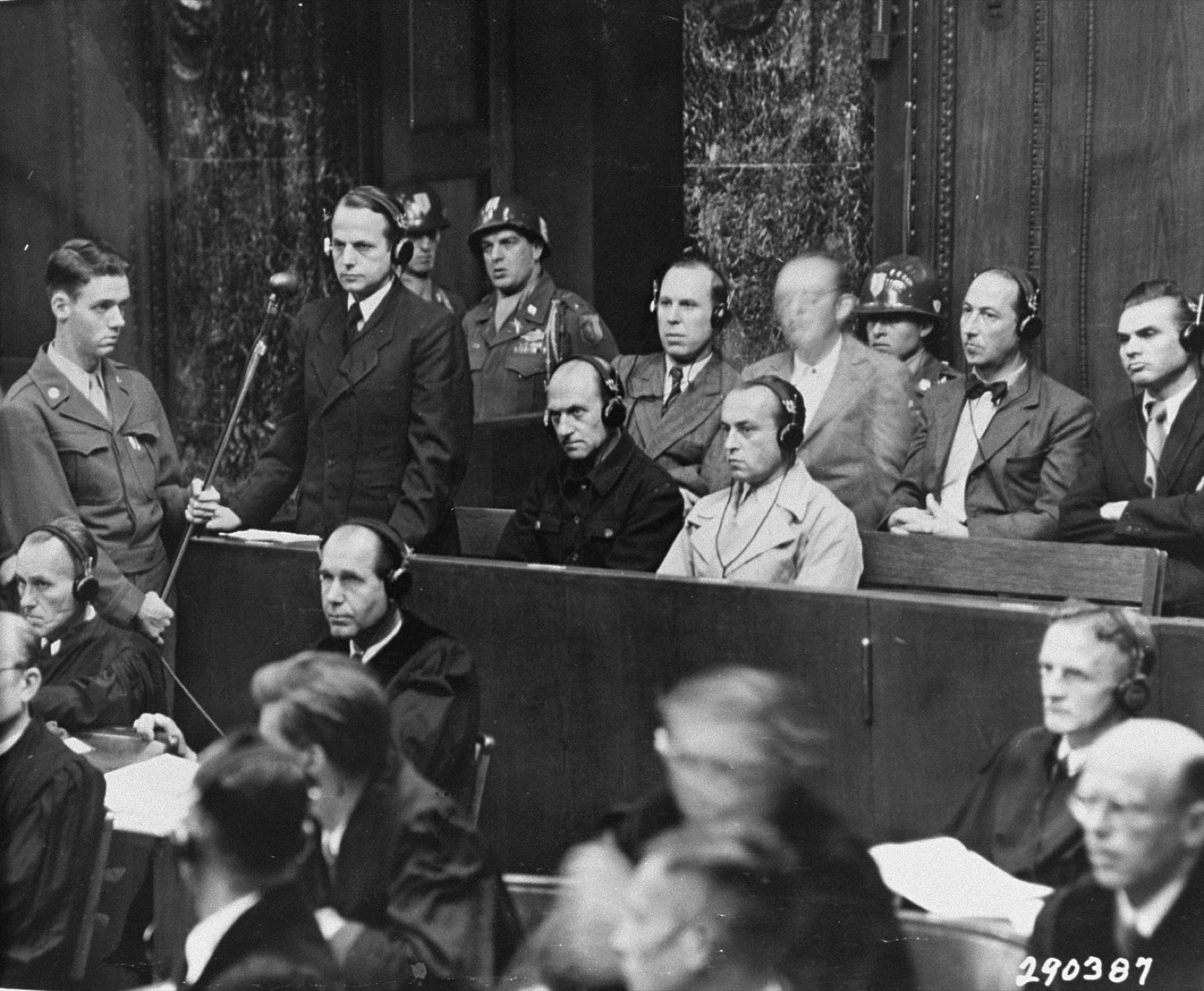
Two of the twenty-four never reached trial. Emil Hausmann killed himself. Otto Rasch was ruled too ill. Twenty-two were tried.
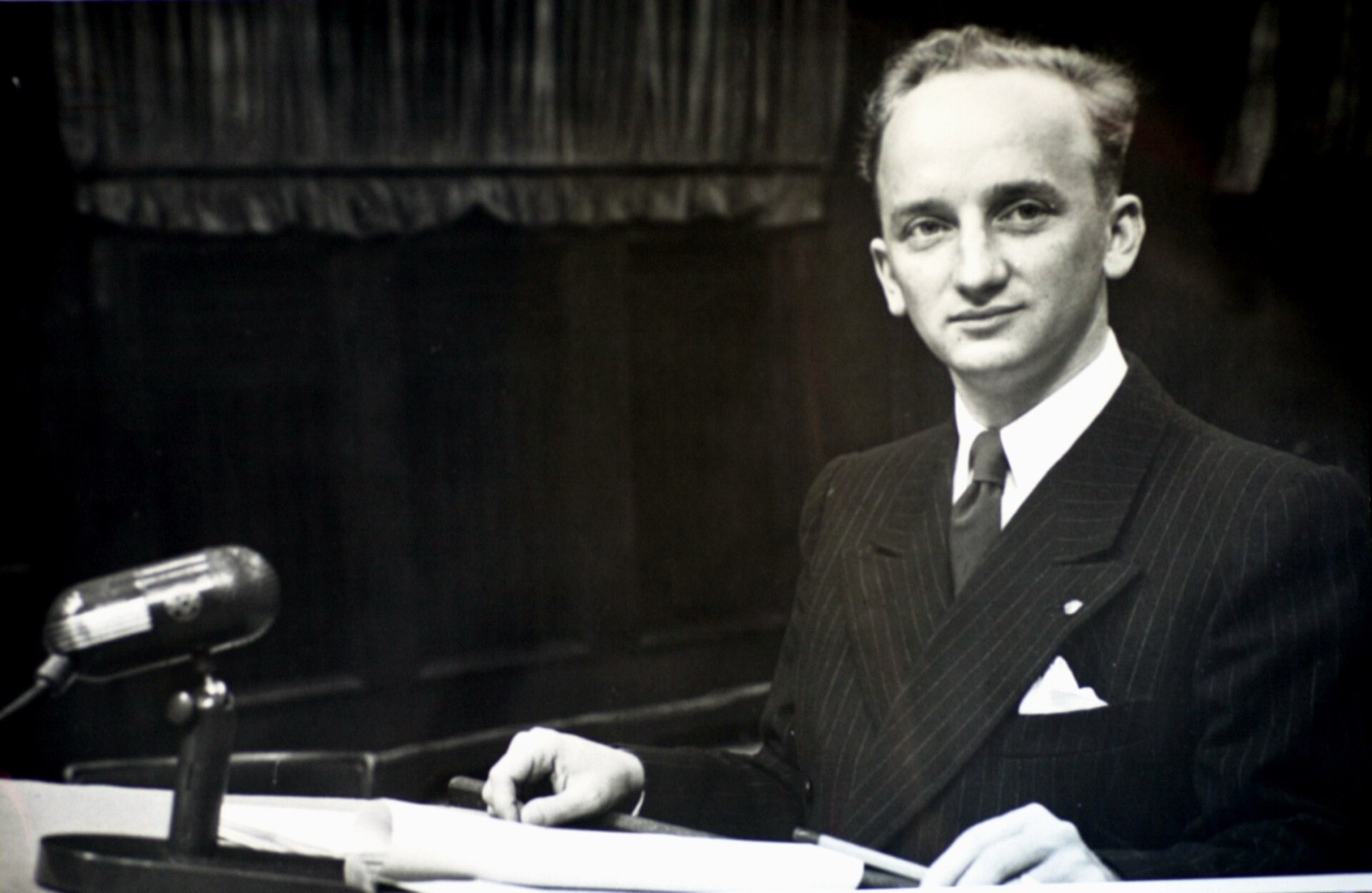
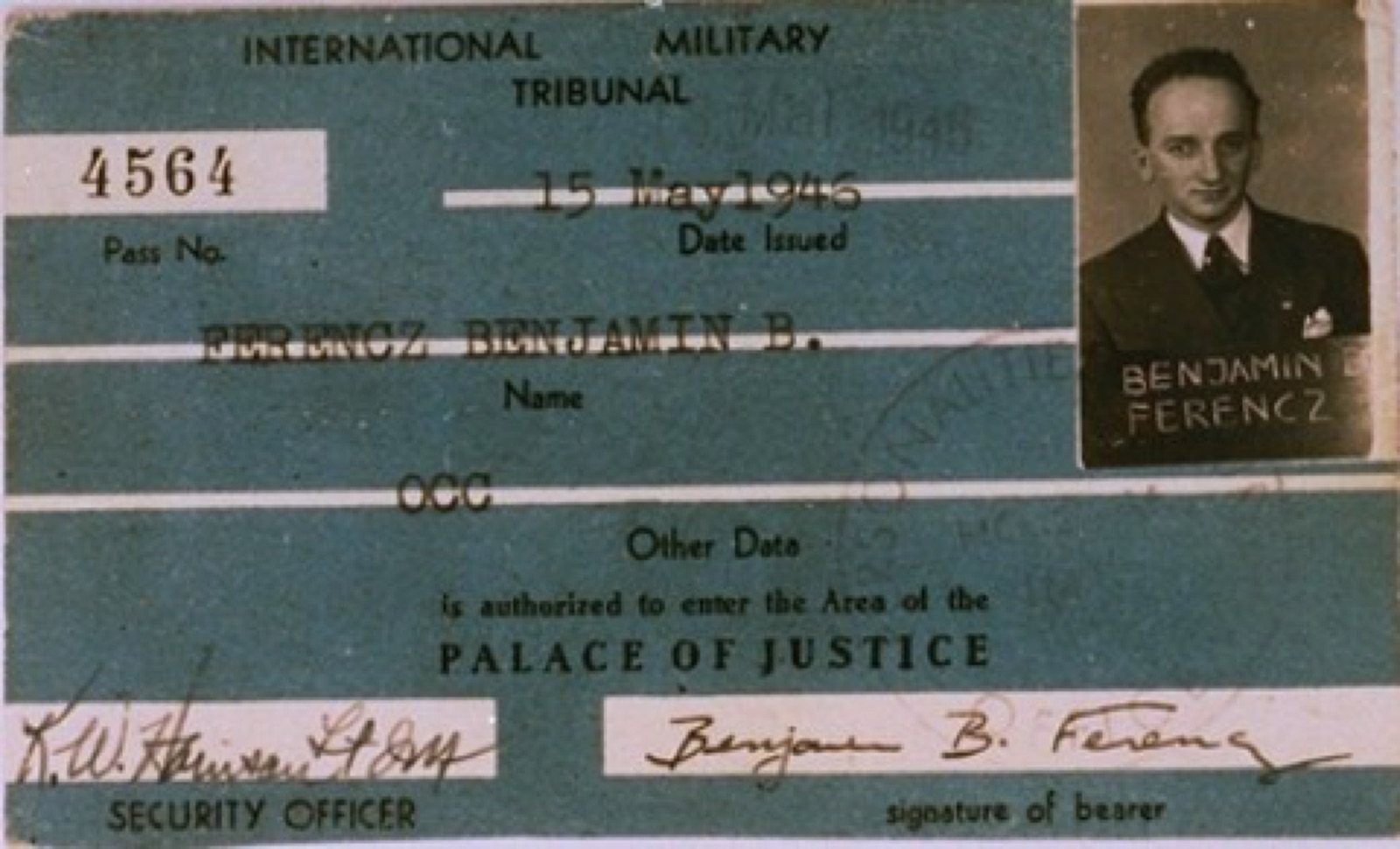
Ferencz called no witnesses. Not one. He put the whole prosecution case in across two court sessions, resting it on the defendants' own filed reports, and sat down. The trial ran more than three months after that, almost all of it the defense. Every man pleaded not guilty. The ones who admitted taking part argued that they had acted legally and under orders from above.
Otto Ohlendorf commanded Einsatzgruppe D. The number of people his unit killed was put at 90,000, a figure he had given himself in a sworn affidavit and before the International Military Tribunal. At his own trial he tried to talk it down, claiming double counting. He pleaded not guilty at his arraignment on September 15, 1947, and his defense was that the killings had been lawful.
It is with sorrow and with hope that we here disclose the deliberate slaughter of more than a million innocent and defenseless men, women, and children. This was the tragic fulfillment of a program of intolerance and arrogance.Benjamin Ferencz, opening statement for the prosecution, the Einsatzgruppen Case, 1947
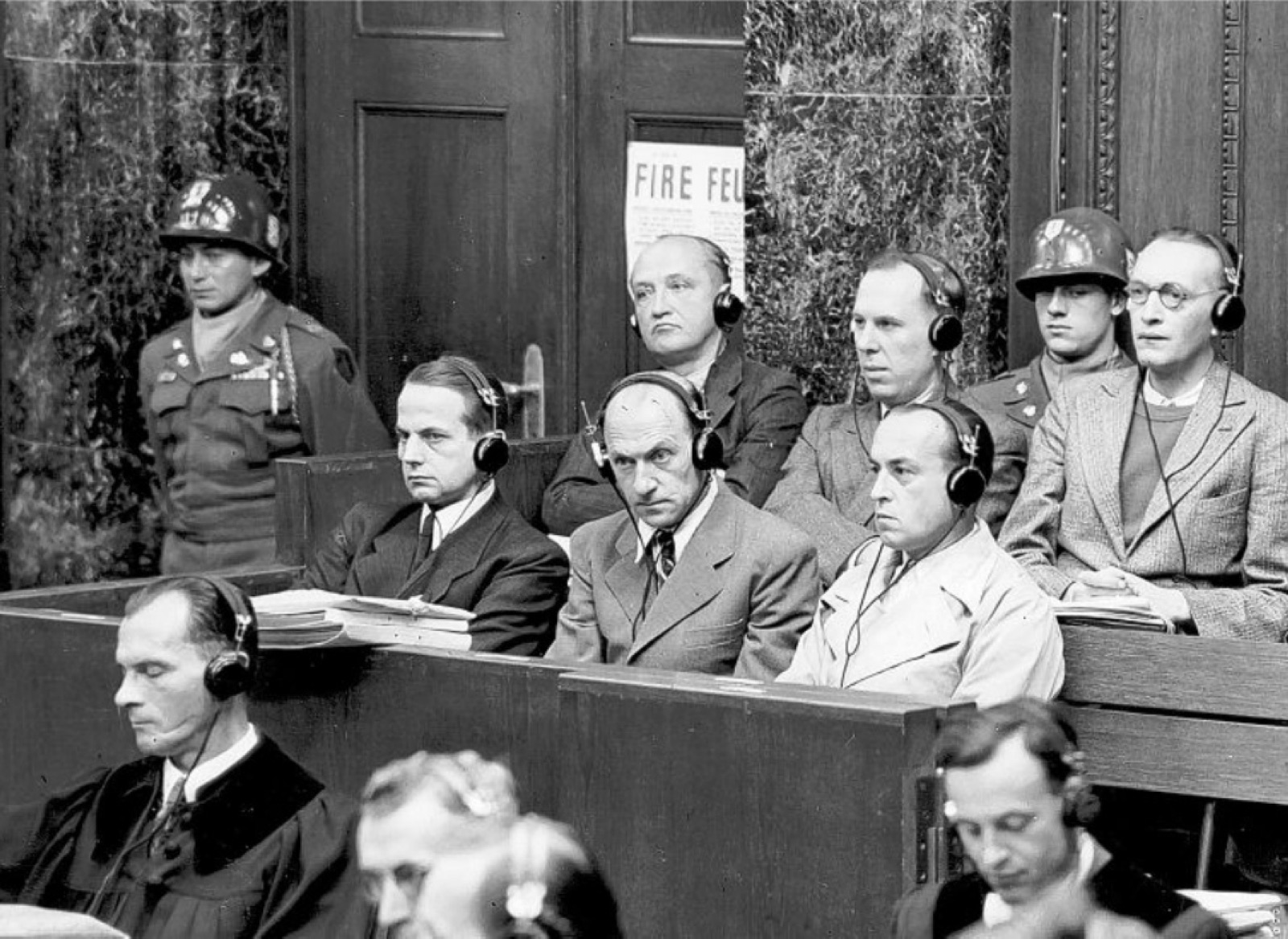
The trial ran from September 29, 1947 to February 12, 1948. Judgment came on April 8 and 9, and all twenty-two were convicted, twenty on all three counts and two on the third alone. Sentences were read on April 10. Fourteen men were sentenced to death, two to life, five to terms of ten to twenty years. Matthias Graf was released on time already served.
That is more death sentences than any other Nuremberg proceeding produced. Four of them were carried out.
Ohlendorf, Erich Naumann, Paul Blobel and Werner Braune were hanged at Landsberg on June 7, 1951, in the same round of executions that took Oswald Pohl, who had run the SS office in charge of the camps. Eduard Strauch, who had commanded Einsatzkommando 2, was extradited to Belgium instead, sentenced to death there as well, and died in Belgian custody.
Every other man convicted in Case 9 had his sentence commuted or was paroled. All of them were out by 1958.
The name attached to that is John J. McCloy. As United States High Commissioner for Germany his authority over the Nuremberg sentences was absolute and could not be reviewed, and he empaneled an advisory board on clemency to go back through them. On January 31, 1951 he announced what he had decided. Of the 142 Germans convicted by the twelve tribunals, 88 men and one woman were still held at Landsberg. Seventy-eight of those 89 got clemency, including the commutation of 10 of the 15 death sentences still outstanding. Twenty-nine walked out within days.
It was not an isolated act of mercy. By 1950 the Cold War had displaced the interest in prosecuting the crimes of the war, trials outside Germany had largely stopped, and most convicted men not already executed were let out during the 1950s.
Which means this. Men who had commanded the shooting of civilians into pits, whose own units had counted and filed the dead, were free within ten years of being sentenced to hang.
The Eichmann trial
Nuremberg was built on documents. Jerusalem was built on survivors, and that choice outlasted the verdict.
Adolf Eichmann was an SS lieutenant colonel who ran a desk. From March 1941 he directed Department IV B 4 of the Reich Security Main Office, the Jewish Affairs desk, and his section organized the deportation of more than 1.5 million Jews to the killing centers. Between late April and early July 1944 he and his staff deported some 440,000 Hungarian Jews.
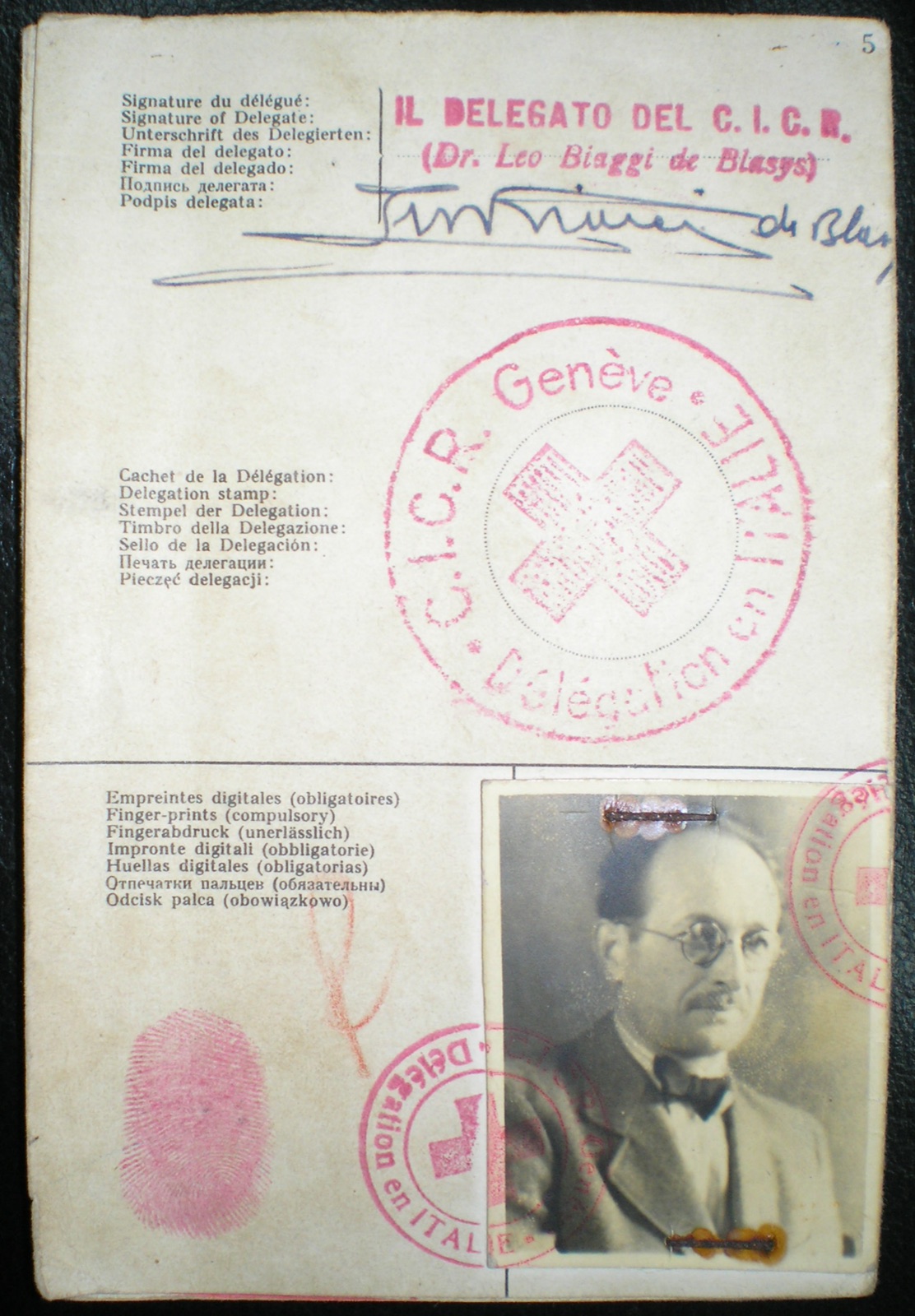
He was in American custody when the war ended and escaped in 1946. On June 1, 1950 he applied at the Red Cross delegation in Genoa and was handed a travel document the same day, his fingerprint on it in red ink. The Argentine visa followed on June 14.
Mossad operatives seized him near his home on Garibaldi Street on May 11, 1960. An El Al Britannia flew him out on the night of May 20 and he reached Israel on May 22. Argentina held a seat on the UN Security Council and used it.
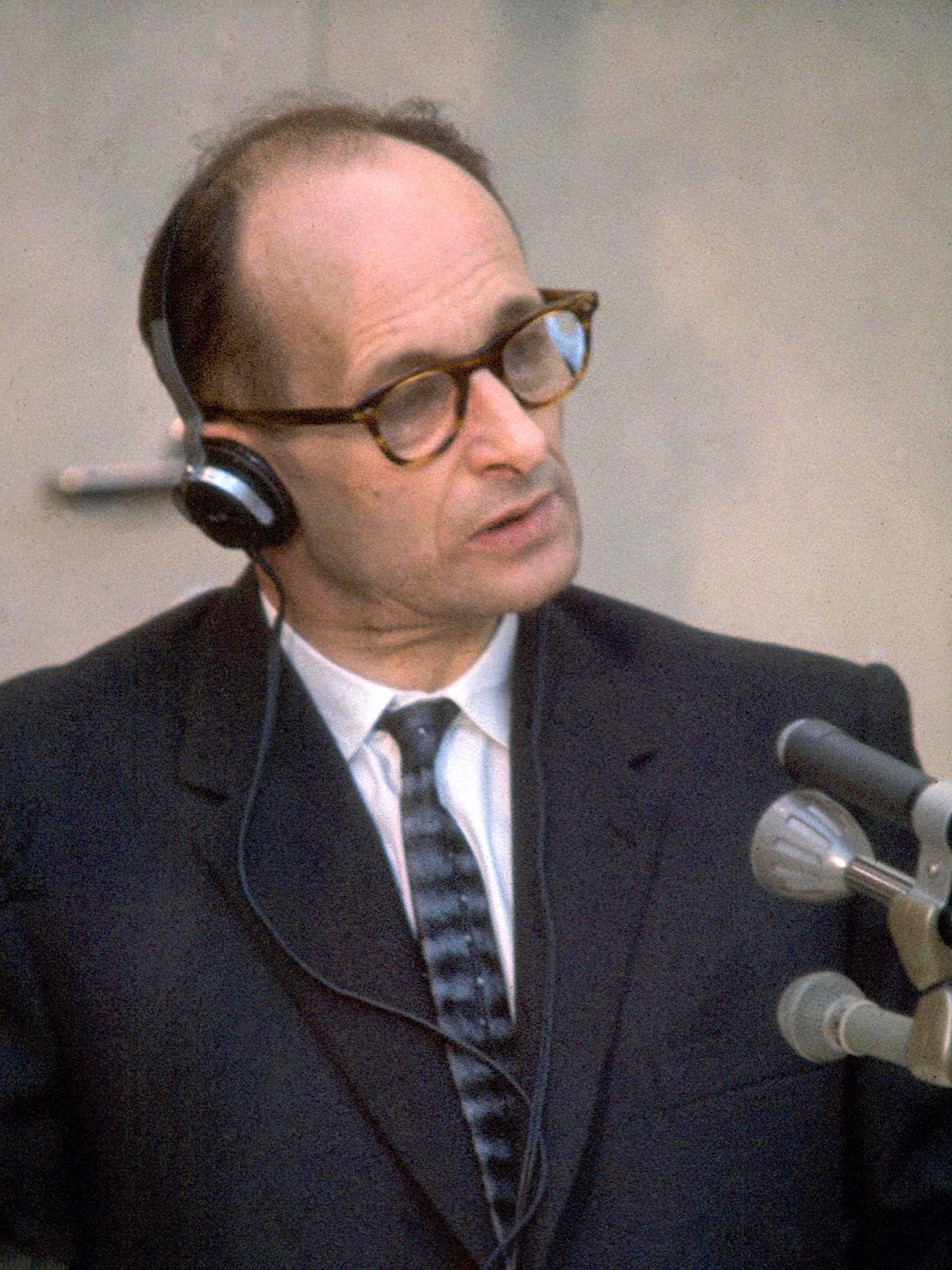
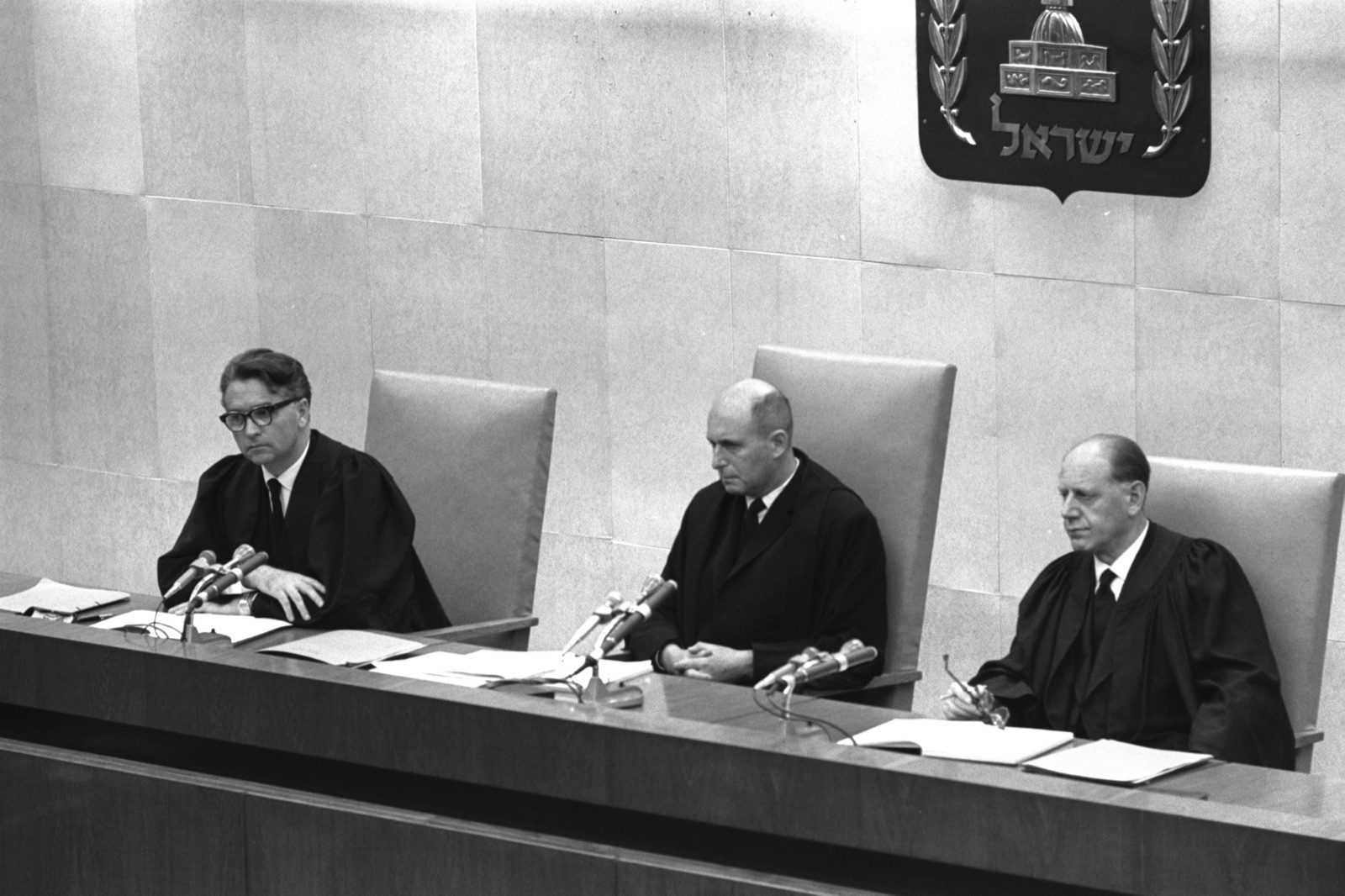
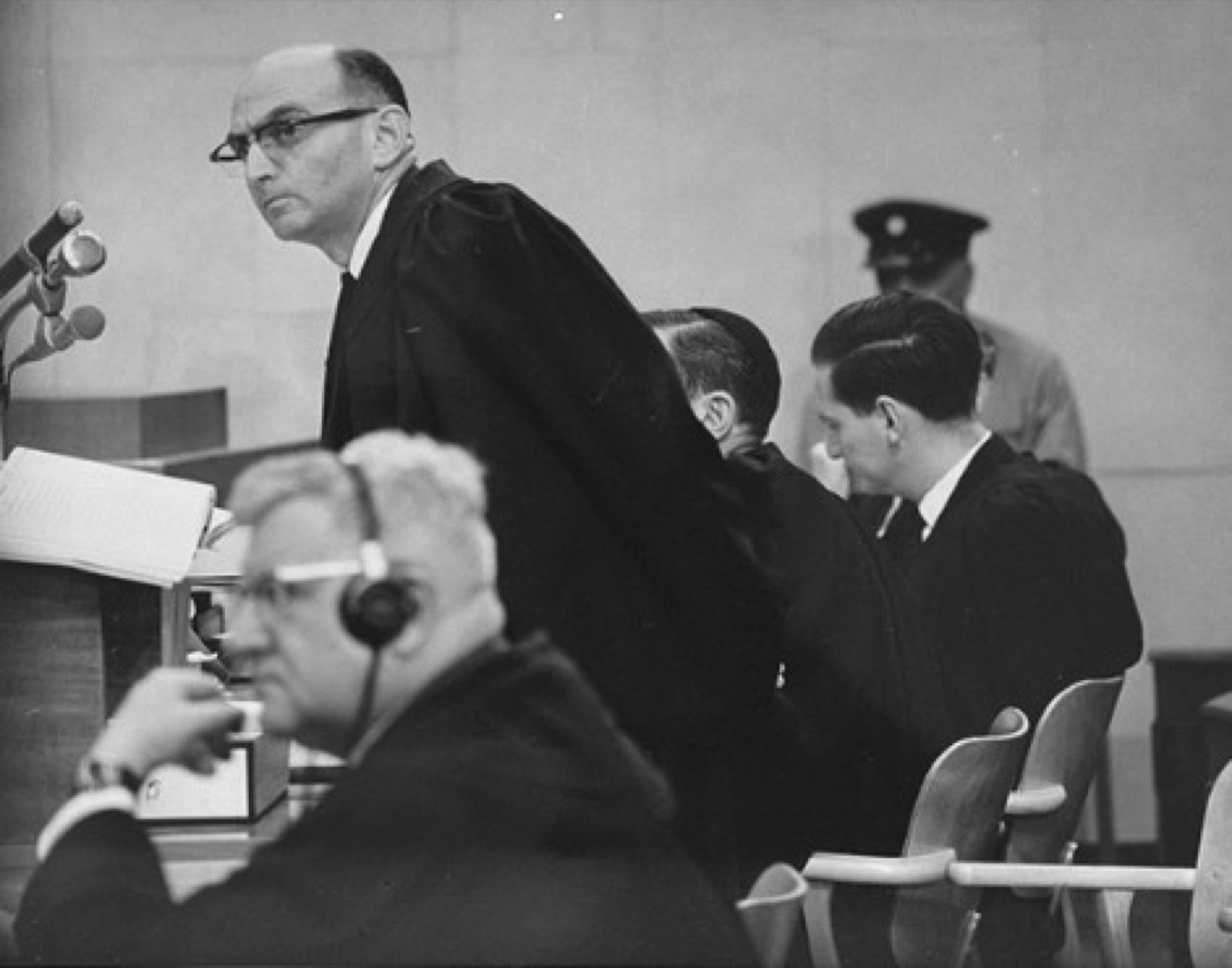
The trial opened on April 11, 1961 at Beit Ha'am, a Jerusalem community center fitted out as a courtroom. Moshe Landau presided, with Benjamin Halevi and Yitzhak Raveh. Attorney General Gideon Hausner indicted him on 15 counts. Robert Servatius, who had worked at Nuremberg, defended him at Israel's expense.
At Nuremberg on November 21, 1945, Robert Jackson had told the tribunal he would not ask it to convict on the testimony of the defendants' foes, because every count could be proved out of German records. Hausner had 1,600 documents, many bearing Eichmann's signature, and said a conviction alone was not enough. Yad Vashem's Hanna Yablonka counts 110 Jewish witnesses for the prosecution.
In order merely to secure a conviction, it was obviously enough to let the archives speak; a fraction of them would have sufficed to get Eichmann sentenced ten times over. But I knew we needed more than a conviction; we needed a living record of a gigantic human and national disaster, though it could never be more than a feeble echo of the real events.Gideon Hausner, attorney general of Israel and chief prosecutor at the Eichmann trial, Justice in Jerusalem (New York: Harper & Row, 1966), p. 291
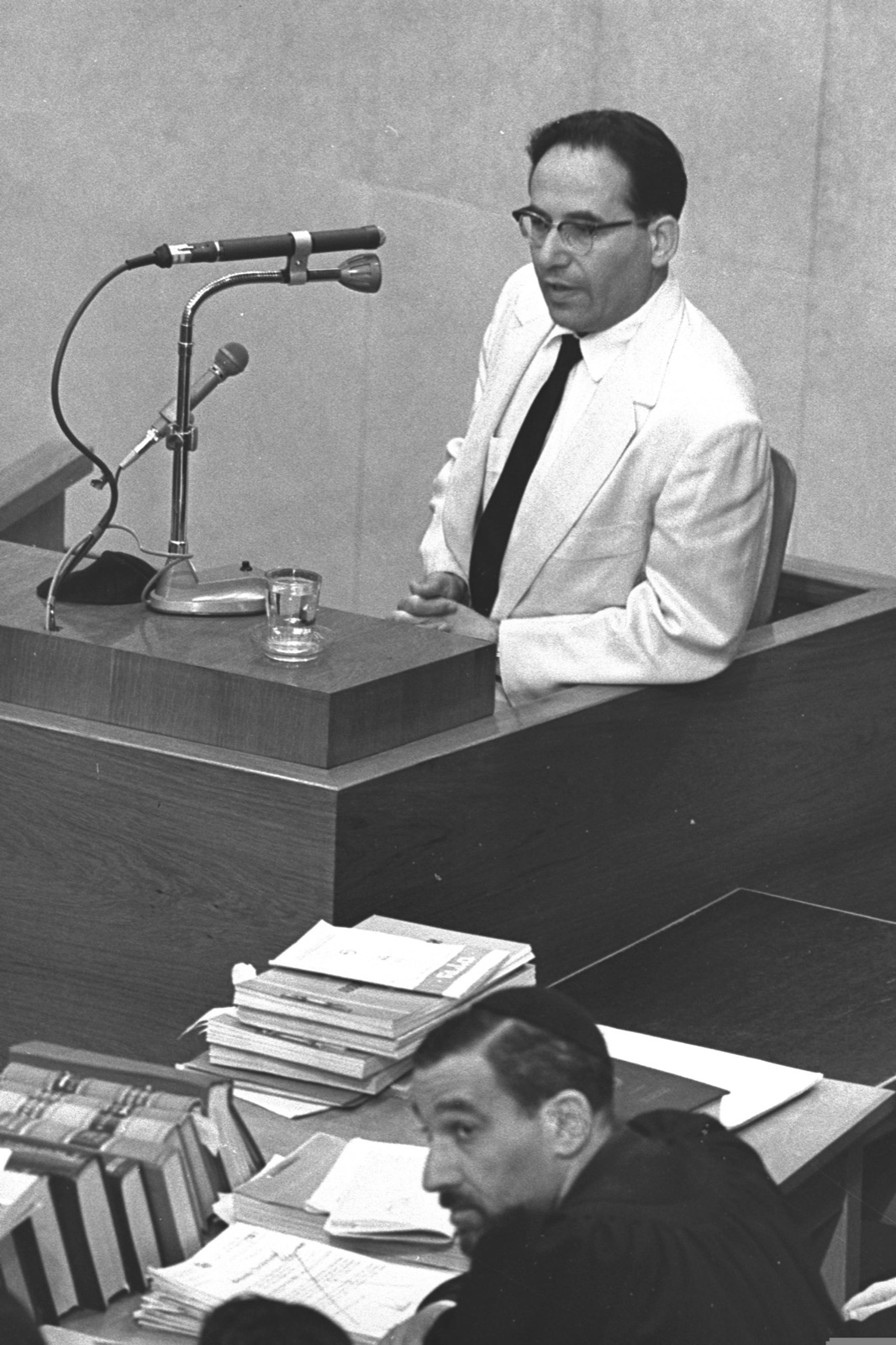
On June 7, 1961, in Session 68, Hausner called the writer Yehiel De-Nur, who had been inside Auschwitz about two years and published his books under the name Ka-Tzetnik rather than his own. Hausner asked him why. He said it was not a pen name.
This is a chronicle of the planet of Auschwitz. I was there for about two years. Time there was not like it is here on earth. Every fraction of a minute there passed on a different scale of time. And the inhabitants of this planet had no names, they had no parents nor did they have children.Yehiel De-Nur, who wrote as Ka-Tzetnik, answering the attorney general's question about his pen name at the Eichmann trial, Session 68, Jerusalem, June 7, 1961. He testified in Hebrew. English from the official Record of Proceedings in the District Court of Jerusalem.
He collapsed before the first prepared question and was carried out of court on a stretcher. It was on television.
Yablonka found the unflattering half too. The witnesses dominated the public record and stayed almost entirely out of the court's reasoning.
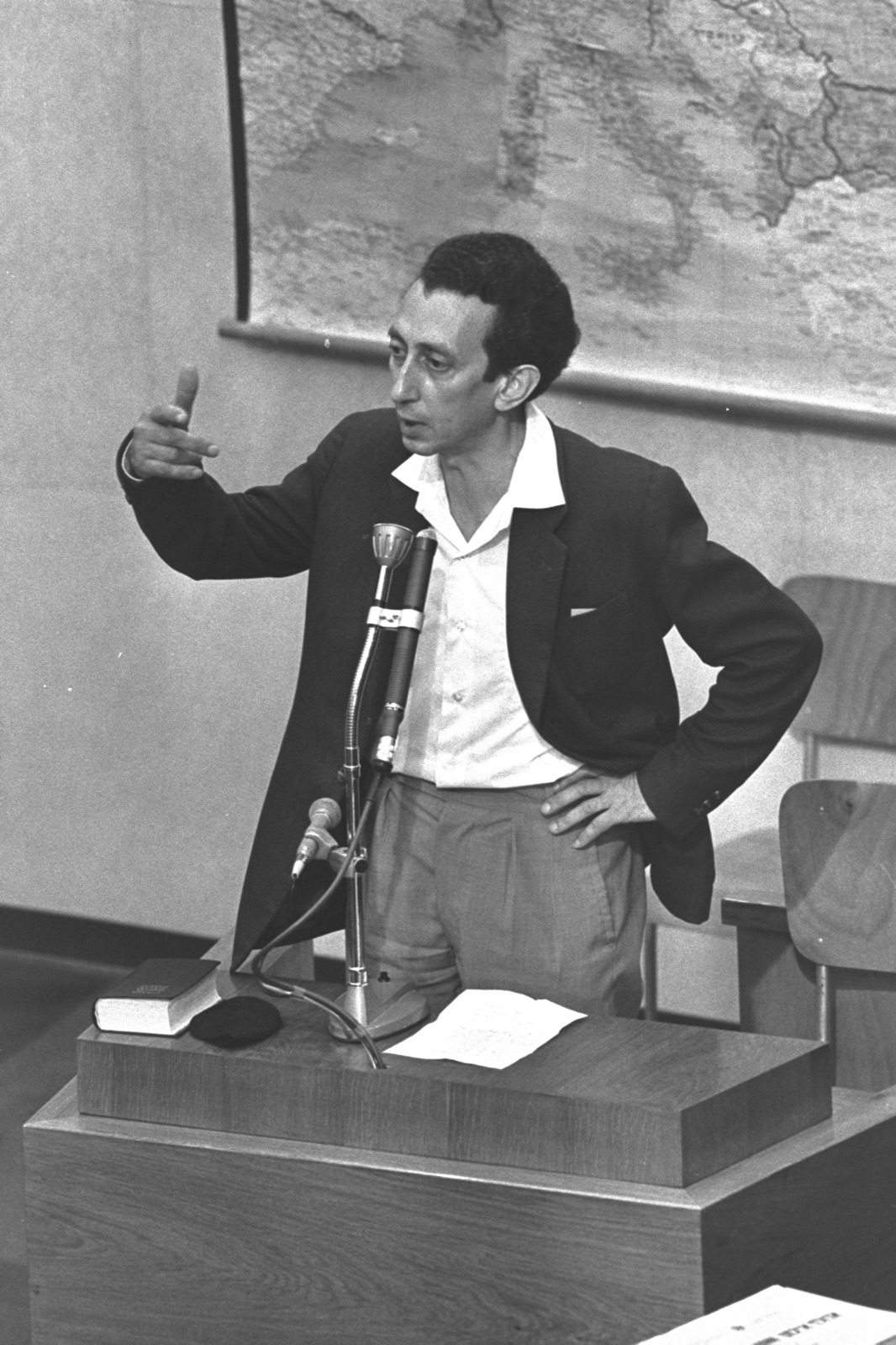
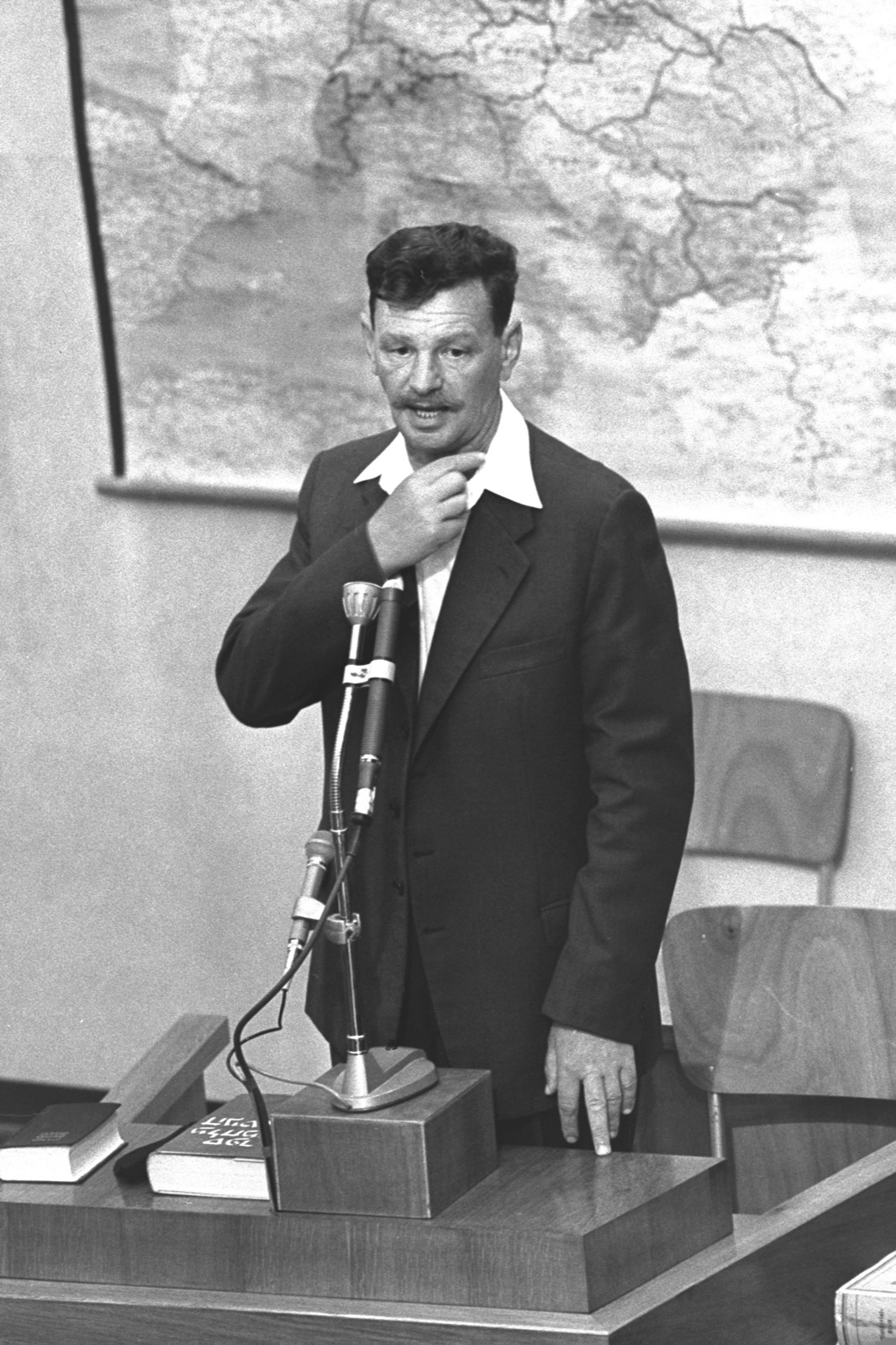
The court convicted him on December 11 and 12, 1961 of crimes against the Jewish people, crimes against humanity, war crimes and membership in a criminal organization, then sentenced him to death on December 15. The Supreme Court affirmed on May 29, 1962 and President Yitzhak Ben-Zvi refused clemency. He was hanged at Ramla prison at midnight between May 31 and June 1, 1962, cremated, his ashes scattered beyond Israeli waters. It is the only execution the State of Israel has ever carried out.
Hannah Arendt covered the trial for The New Yorker in five articles from February 16, 1963, and turned them into Eichmann in Jerusalem: A Report on the Banality of Evil. Her argument was about thoughtlessness, an absence of thinking that let a man do monstrous things. The phrase is now used as a general account of who commits mass murder.
The scholarship went the other way. David Cesarani argued in 2004 for careerist ambition and learned habituation, Deborah Lipstadt in 2011 for a convinced Nazi and antisemite committed to genocide. Bettina Stangneth, working from the tapes Eichmann recorded in Argentina in 1956 and 1957 with the Dutch former SS man Willem Sassen, argued that the mild official in the booth was a performance and that in Buenos Aires he had talked like a believer. The Sassen transcripts were in evidence in Jerusalem.
The Hannah Arendt Center supplies the limit. Transcripts of those tapes existed before the trial and Arendt read many of them. What Stangneth recovered was the audio, not the content. She reached her conclusion with most of that material in front of her.
How many were ever punished?
The number of people who took part, set against the number who were convicted of anything.
The International Military Tribunal tried 22 men and convicted 19. The twelve American proceedings that followed indicted 185, tried 177, and convicted 142. Against that stands Mary Fulbrook's estimate that perhaps 200,000 people, and possibly closer to a million, were at some point actively involved in killing Jewish civilians. USHMM puts the outcome in one sentence: most perpetrators have never been tried or punished.
Since 1949 USHMM counts over 900 proceedings for National Socialist era crimes in the Federal Republic, most of them against low-level functionaries and most ending in acquittal or a light sentence. Fulbrook's tally for 1946 to 2005 gives 6,656 convictions; by her count only 164 people in the Federal Republic were ever sentenced as perpetrators of murder rather than for lesser crimes.
Part of the reason is who was doing the judging. A 2016 study commissioned by the German Federal Ministry of Justice found that from 1949 to 1953 former Nazi party members held well over half of the positions in the ministry, and more than 70 percent in some of its departments.
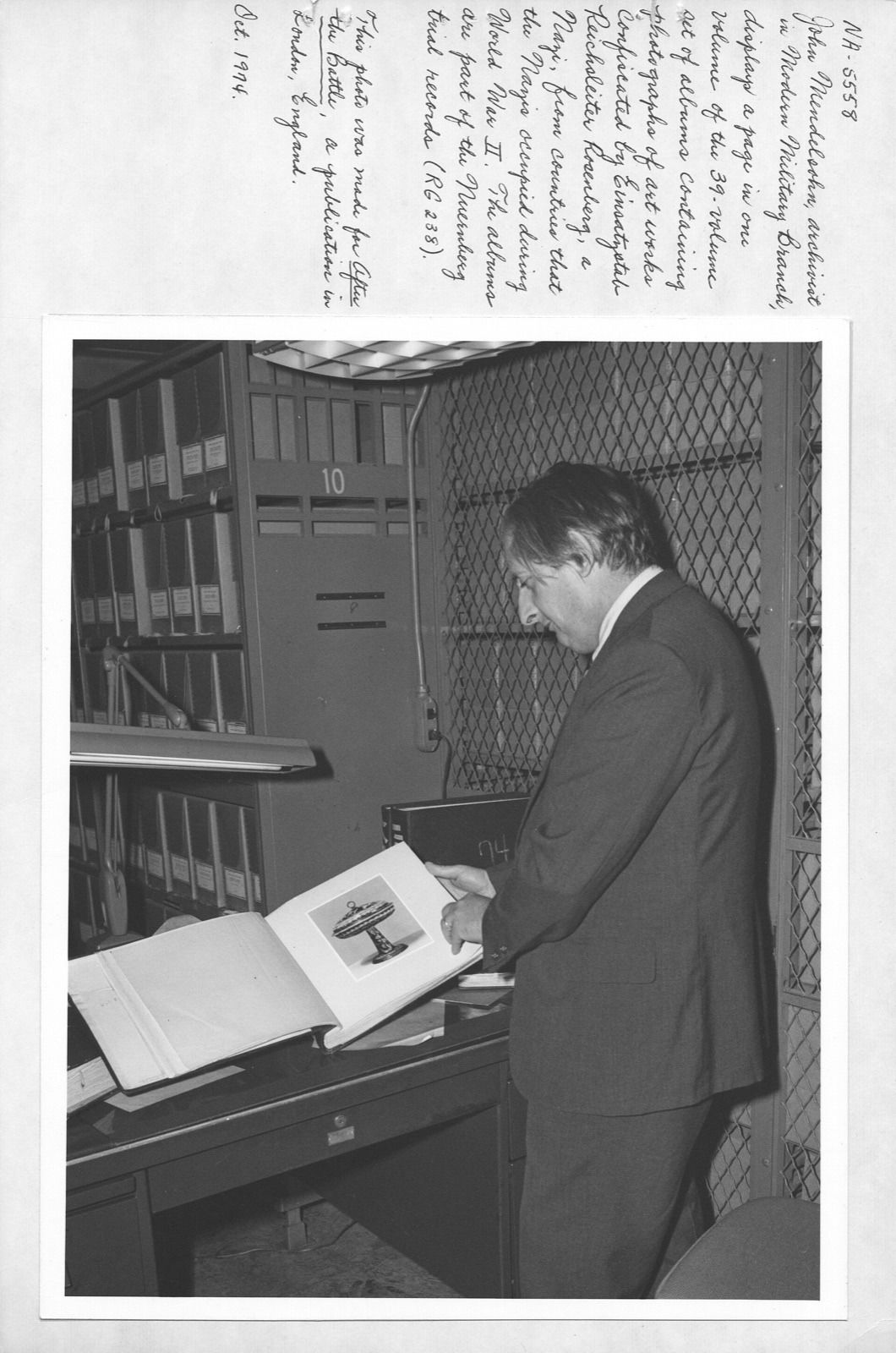
Systematic prosecution started late and by accident. Ten men from Einsatzkommando Tilsit were sentenced at Ulm in August 1958 and the Central Office at Ludwigsburg opened four months later. Before it existed, the office's own account says, investigating Nazi crimes had depended mainly on coincidence. The Frankfurt Auschwitz trial ran from December 1963 to August 1965 against 22 SS men, with about 210 survivors among some 360 witnesses, under Fritz Bauer, himself a camp prisoner in 1933. Yad Vashem counts eighteen convictions; other accounts give seventeen convictions out of the twenty men still on trial at the verdict. Most of the convictions were for aiding and abetting, because West German murder law required proof of individual initiative.
Twice the Bundestag came within months of closing the books by operation of law, in 1965 and again in 1969, and polls at the time showed a West German majority content to let the deadlines run. It abolished the limitation period for murder on July 3, 1979 by 255 votes to 222.
The door reopened in 2011, when a Munich court convicted John Demjanjuk on 28,060 counts of accessory to murder at Sobibor on the theory that serving at a place built only for killing is itself accessory liability. He died in March 2012 with the appeal undecided, so the conviction never became final. Israel had tried him earlier as Ivan the Terrible of Treblinka and sentenced him to death in 1988; its Supreme Court overturned that in 1993 after Soviet archives pointed to a different man. Since 2011 Ludwigsburg has referred 127 cases to prosecutors. Fifteen produced charges. Five produced convictions, from Oskar Gröning in 2015 to Irmgard Furchner in 2022. None of the five spent a day in prison.
On the other side are the ones nobody tried. The National Archives' review of declassified CIA and Army records found that most of the war criminals whose files it studied received light punishment or none, partly because Western intelligence agencies treated them as useful Cold War assets, and that Army counterintelligence protected Klaus Barbie from French prosecution and helped him reach South America. The same archive holds dossiers on more than 1,500 foreign scientists brought in under Operation Paperclip, among them men it names as tied to the Nordhausen rocket factory and to medical experiments on camp prisoners.
Furchner was 99 when the Federal Court of Justice made her conviction final in August 2024. She had typed in the commandant's office at Stutthof. Almost everyone who did more than she did was never charged with anything.
The killers counted to the last digit, and the counting did not stop with them. As of November 11, 2025, Yad Vashem has recovered the names of five million of the six million murdered. About a million are still unknown, and many always will be.
The whole thing, in dates
From the treaty that ended one war to a conviction that became final in 2024.
Questions people ask
What were the Nuremberg trials?
What was the Final Solution?
What happened at the Wannsee Conference?
How did Hitler come to power?
Who was Adolf Eichmann?
How was Adolf Eichmann captured?
What happened at the Eichmann trial?
How many Nazis were punished?
What is a crime against humanity?
Were the Nuremberg trials fair?
What did Hannah Arendt mean by the banality of evil?
Are Nazi war criminals still being prosecuted today?
Free, and made for a classroom
Project Witness is a nonprofit Holocaust education organization in New York. Tell us what you teach and we will send you what fits your classroom.
Where this comes from
Every fact here comes from a named institution. Every image is free to use, and the credit runs with it.
- Avalon Project — the full text of the London Charter, the indictment and the judgment of the International Military Tribunal source
- Bundesarchiv — German Federal Archives photography of the Weimar collapse and the Nazi seizure of power source
- German History in Documents and Images — translated German legal texts, including the Enabling Act source
- Harvard Law School — the Nuremberg Trials Project, its document images and its trial transcripts source
- House of the Wannsee Conference — the German original of the Wannsee Protocol and its 2020 English translation source
- Israel Government Press Office — photography of the Eichmann trial in Jerusalem, 1961 source
- National Archives — US Army Signal Corps photography of the trial, the Nuremberg war crimes records in Record Group 238, and the evidentiary films source
- Project Witness — recorded testimony, including Benjamin Ferencz, and the Holocaust Educators Conference lectures source
- Robert H. Jackson Center — Justice Jackson's opening statement and his final report source
- The National Archives (UK) — the Hoefle Telegram, decrypted by British intelligence in 1943 and identified in 2000 source
- United States Holocaust Memorial Museum — the Holocaust Encyclopedia, the subsequent Nuremberg proceedings, the Einsatzgruppen Case and the photograph archive source
- Yad Vashem — the Shoah Resource Center and the name collection project behind the victim figures source
US Army Signal Corps photograph, U.S. National Archives and Records Administration. Public domain. US Army Signal Corps photograph, courtesy of the Harvard Law School Library, Harvard University. Public domain as a work of the U.S. federal government. Bundesarchiv, Bild 102-00193 / CC-BY-SA 3.0 Bundesarchiv, Bild 119-1426 / CC-BY-SA 3.0 Bundesarchiv, Bild 102-00287 / CC-BY-SA 3.0 Map by Furfur (after Dove), CC BY 3.0, via Wikimedia Commons. Data: Statistisches Jahrbuch für das Deutsche Reich 1932. November 1932 Reichstag election, results by constituency. Map by 沁水湾, CC BY-SA 4.0, via Wikimedia Commons. Bundesarchiv, Bild 102-15347 / CC-BY-SA 3.0 Bundesarchiv, Bild 102-02982A / CC-BY-SA 3.0 Firemen at the burning Reichstag, Berlin, February 1933. U.S. National Archives, National Archives Identifier 535790 (Local Identifier 208-N-39835). Unrestricted use. Reichsgesetzblatt I 1933, p. 141. Public domain. Otto Wels, speech against the Enabling Act, Reichstag, March 23, 1933. Public domain, via Wikimedia Commons. Bundesarchiv, Bild 102-16109 / CC-BY-SA 3.0 Document reproduced in Jenő Lévai, Eichmann in Hungary. Public domain, via Wikimedia Commons. Korherr Report, page 9. Richard Korherr, 1943. U.S. National Archives, RG 238, NO-5194. Public domain via Wikimedia Commons. Project Witness. Map: Memnon335bc / Wikimedia Commons, CC BY-SA 3.0 Map from Franz Walter Stahlecker's report to Reinhard Heydrich, January 31, 1942, 'Jewish Executions Carried Out by Einsatzgruppe A'. United States Holocaust Memorial Museum. Public domain via Wikimedia Commons. Bundesarchiv, Bild 183-B0716-0005-007 / CC-BY-SA 3.0 Bundesarchiv, Bild 121-0628 / CC-BY-SA 3.0 Photo: Adam Jones, Ph.D. / Wikimedia Commons, CC BY-SA 3.0 Hermann Goering's authorization to Reinhard Heydrich, July 31, 1941 (Nuremberg document PS-710, IMT exhibit USA-509). Facsimile via Haus der Wannsee-Konferenz / Wikimedia Commons. Reinhard Heydrich's invitation to Martin Luther, January 1942. Photograph by Adam Carr, 2006. Public domain via Wikimedia Commons. Bundesarchiv, Bild 146-1969-054-16 / Hoffmann, Heinrich / CC-BY-SA 3.0 Adolf Eichmann, RSHA portrait, c. 1941-1942. Photographer unknown. Public domain via Wikimedia Commons. Minutes of the Wannsee Conference, January 20, 1942 (copy 16 of 30). Reichssicherheitshauptamt. Politisches Archiv des Auswaertigen Amtes, Berlin, R 100857, Bl. 166-188. Facsimile via Haus der Wannsee-Konferenz / Wikimedia Commons. Public domain (§ 5 Abs. 1 UrhG). Page 6 of the Wannsee Protocol on display at the House of the Wannsee Conference, Berlin. Photograph by Adam Carr, 2006. Public domain via Wikimedia Commons. Bundesarchiv, Bild 146-2007-0188 / CC-BY-SA 3.0 Belzec extermination camp, aerial photograph, 1944. Luftwaffe / U.S. National Archives and Records Administration. Public domain via Wikimedia Commons. Aerial photograph of the Treblinka area, after November 1943. United States Holocaust Memorial Museum, courtesy of the National Archives and Records Administration, College Park. Public domain. The Hoefle Telegram, January 11, 1943. The National Archives (UK), HW 16/23. Contains public sector information licensed under the Open Government License v3.0. Photo: Dr. med. Detlef Bihn / Wikimedia Commons, CC BY-SA 4.0 US Army Signal Corps photograph, U.S. National Archives and Records Administration, NAID 540127. Public domain. Prosecution and Punishment of the Major War Criminals of the European Axis (1946), via Internet Archive. Public domain. US Army Signal Corps photograph. United States Holocaust Memorial Museum. Public domain. US Army Signal Corps photograph, U.S. National Archives and Records Administration, NAID 292601. Public domain. US Army Signal Corps photograph. United States Holocaust Memorial Museum, courtesy of National Archives and Records Administration, College Park. Public domain. Photo: Ray D'Addario, US Army Signal Corps. United States Holocaust Memorial Museum, courtesy of National Archives and Records Administration. Public domain. Photo: Ray D'Addario, US Army Signal Corps, NARA 111-SC-C-3704. United States Holocaust Memorial Museum, courtesy of National Archives and Records Administration, College Park. Public domain. Photo: JensKunstfreund, CC BY-SA 4.0, via Wikimedia Commons. Photo: Ray D'Addario, US Army Signal Corps. Public domain (work of the U.S. federal government). Photo: Charles Alexander, Office of the U.S. Chief of Counsel for the Prosecution of Axis Criminality. Harry S. Truman Library & Museum, 72-858. Public domain. Photo: Ray D'Addario, US Army Signal Corps. U.S. National Archives and Records Administration. Public domain. 'Nazi Concentration Camps' (1945), produced for the U.S. Counsel for Prosecution of Axis Criminality. U.S. National Archives and Records Administration. Public domain. US Army Signal Corps film. United States Holocaust Memorial Museum, courtesy of National Archives and Records Administration. Public domain. US Army Signal Corps film, U.S. National Archives and Records Administration, NAID 23769. Public domain. Universal Newsreel, October 8, 1946. Released into the public domain by Universal Pictures. OCCWC photograph, U.S. National Archives at College Park, NAID 169156700. No Copyright - United States. OCCWC photograph, U.S. National Archives at College Park, NAID 169155696. No Copyright - United States. US Army photograph on behalf of the Office of Chief of Counsel for War Crimes. United States Holocaust Memorial Museum, Photograph 09917. Public domain. US Army photograph on behalf of the Office of Chief of Counsel for War Crimes. United States Holocaust Memorial Museum, Photograph 09920. Public domain. US Army photograph. United States Holocaust Memorial Museum, Photograph 43043, courtesy of National Archives and Records Administration, College Park. Public domain. Project Witness archive. US Signal Corps photograph. Public domain (work of the U.S. federal government). Photo: Adam Jones, Ph.D., CC BY-SA 3.0, via Wikimedia Commons. Red Cross identity document issued to Adolf Eichmann as "Riccardo Klement," Genoa, June 1, 1950. Fundación Memoria del Holocausto, Argentina. Adolf Eichmann in the glass booth at his trial, Jerusalem, 1961. Israel Government Press Office, National Photo Collection, D482-067. Public domain via Wikimedia Commons. The bench at the Eichmann trial: Benjamin Halevi, Moshe Landau and Yitzhak Raveh, 1961. Israel Government Press Office / Israel National Photo Collection. Public domain in Israel. Defense counsel Robert Servatius and chief prosecutor Gideon Hausner during the Eichmann trial, July 11, 1961. United States Holocaust Memorial Museum, Photograph #65284, courtesy of Israel Government Press Office. Yehiel De-Nur ("Ka-Tzetnik") testifying at the Eichmann trial, Beit Ha'am, Jerusalem, June 7, 1961. Israel Government Press Office, digital ID D409-026. Public domain. Abba Kovner testifying at the Eichmann trial, Jerusalem, May 4, 1961. Israel Government Press Office / National Photo Collection of Israel, digital ID D408-083. Public domain in Israel. Yitzhak Zuckerman testifying at the Eichmann trial, Beit Ha'am, Jerusalem, May 3, 1961. Israel Government Press Office / National Photo Collection of Israel, digital ID D408-073. Public domain in Israel. "Guilty! Eichmann to Hang," Universal-International News, December 1961. Motion Picture Division, U.S. National Archives. Public domain. National Archives and Records Service photograph, U.S. National Archives, NAID 35810564. No Copyright - United States.