Turning Points · June 22, 1941
Almost a third of the Holocaust's victims were shot.
Most people picture the camps. But as many as two million Jews were murdered by shooting, most of them close to their own homes, by men who saw their faces. This is where it grew to that scale.
Project Witness records and preserves Holocaust survivor testimony. This page is free to use, in classrooms and out of them.
Written for readers 14 and up. This page describes, in plain words, how the mass shootings were carried out. It shows no photograph of a killing.
The short answers
- Who were the Einsatzgruppen?
- Mobile killing units of the Security Police and the SD, the SS intelligence service, that followed the German army into occupied territory. For the invasion of the Soviet Union there were four of them, lettered A to D, with about 3,000 men between them.
- What did they do?
- They shot people. In the first nine months of the war against the Soviet Union they organized and helped carry out the shooting of more than half a million people, the vast majority of them Jews.
- When did this start?
- June 22, 1941, the day Germany invaded the Soviet Union. Jews in occupied Poland had already been shot before that. This invasion began the systematic mass shooting that, within weeks, was killing whole communities.
- How many were killed this way?
- As many as two million Jews were murdered in mass shootings and associated massacres. That is almost one third of the six million.
- What was Babyn Yar?
- A ravine outside Kyiv where 33,771 Jews were shot on September 29 and 30, 1941, according to the killers' own report. It is one of the largest mass killings at a single location in the whole war.
- Why do most people picture only the camps?
- Because the camps left buildings, records and survivors who could describe them. The shootings left pits in forests and very few survivors, though they were often carried out in full view of the neighbors. The imbalance is in the evidence, not in the scale.
Before you read on: true or false?
Six statements about the shootings. Choose true or false, then see what the sources say.
Most victims of the shootings were taken far from home to be killed.
Show the answer
It is false.
The usual first step was to round up the Jews of a village, town or city and take them to a place chosen in advance on its outskirts. Ponary, where about 40,000 Jews had been shot by the end of 1941, is a forest eight miles outside Vilna. There were exceptions: most of the Jews shot at Kamianets-Podilskyi had been deported there from Hungary.
Source: United States Holocaust Memorial Museum, Mass Shootings of Jews during the HolocaustLocal people in the occupied countries took part in the killing.
Show the answer
It is true.
Local collaborators helped to identify the victims and helped to kill them, alongside German police, Waffen SS and army units. Many of the killers and the victims knew one another as neighbors and colleagues.
Source: United States Holocaust Memorial Museum, EinsatzgruppenThe mass shooting of Jews began only after the Wannsee Conference of January 1942.
Show the answer
It is false.
The shootings began almost immediately after the invasion of the Soviet Union on June 22, 1941. When Reinhard Heydrich presented his plans at Wannsee on January 20, 1942, they had been going on for almost seven months.
Source: United States Holocaust Memorial Museum, Reinhard Heydrich: In DepthThe killers wrote down how many people they had shot.
Show the answer
It is true.
The figure for Babyn Yar, 33,771 Jews in two days, comes from the report the killers filed. At Kamianets-Podilskyi the SS and police leader Friedrich Jeckeln reported 23,600. They are the best figures we have, and the killers wrote them.
Source: United States Holocaust Memorial Museum, Kamenets-PodolskThe monument the Soviet Union put up at Babyn Yar in 1976 said that the victims were Jews.
Show the answer
It is false.
Its text spoke of some 100,000 victims and did not say that at least a third of them were Jews. A monument to the Jewish victims, in the shape of a menorah, went up only in 1991, on the fiftieth anniversary of the shooting.
Source: United States Holocaust Memorial Museum, Mass Shootings at Babyn Yar (Babi Yar)The Germans tried to destroy the evidence of the shootings.
Show the answer
It is true.
From June 1942, in a secret operation code-named Sonderaktion 1005, prisoners were forced to dig up the mass graves and burn the remains. At Babyn Yar it began in August 1943.
Source: Yad Vashem, Babi Yar and the Jews of Kiev: historical background
What were the Einsatzgruppen?
The Einsatzgruppen were units of the Security Police and the SD, the SS intelligence service, and they followed the German army as it invaded and occupied countries in Europe. Operational group is the literal translation, and task force the usual one. Mobile killing squad is the accurate one.
For the Soviet campaign there were four, lettered A through D, and about three thousand men in all of them together. That number matters, because three thousand men cannot shoot two million people. They did not work alone, and the question of who else did the shooting is the hardest part of this history.
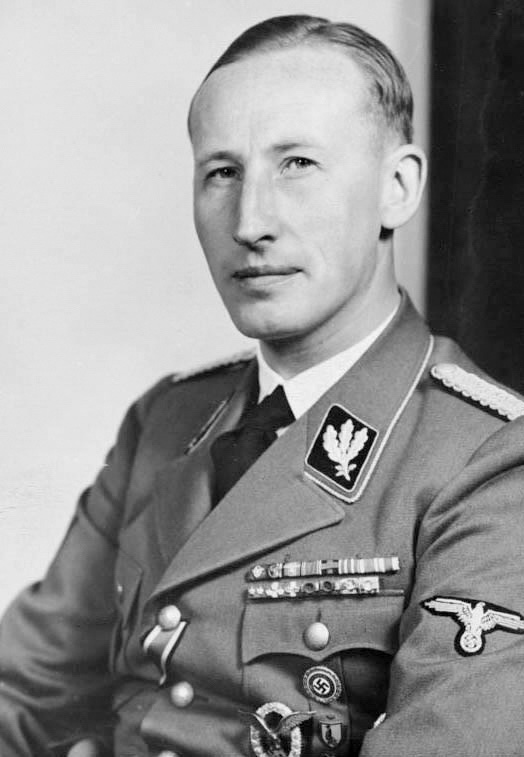
Reinhard Heydrich, around 1940. He created the Einsatzgruppen, and he was chief of the Reich Security Main Office, the SS and police agency most directly concerned with carrying out the plan to murder the Jews of Europe.
Portrait or personal record Heinrich Hoffmann · 1940 · Bundesarchiv, Bild 146-1969-054-16 CC BY-SA 3.0 de: license for Reinhard Heydrich, around 1940. He created the Einsatzgruppen, and he View the record: Reinhard Heydrich, around 1940. He created the Einsatzgruppen, and he
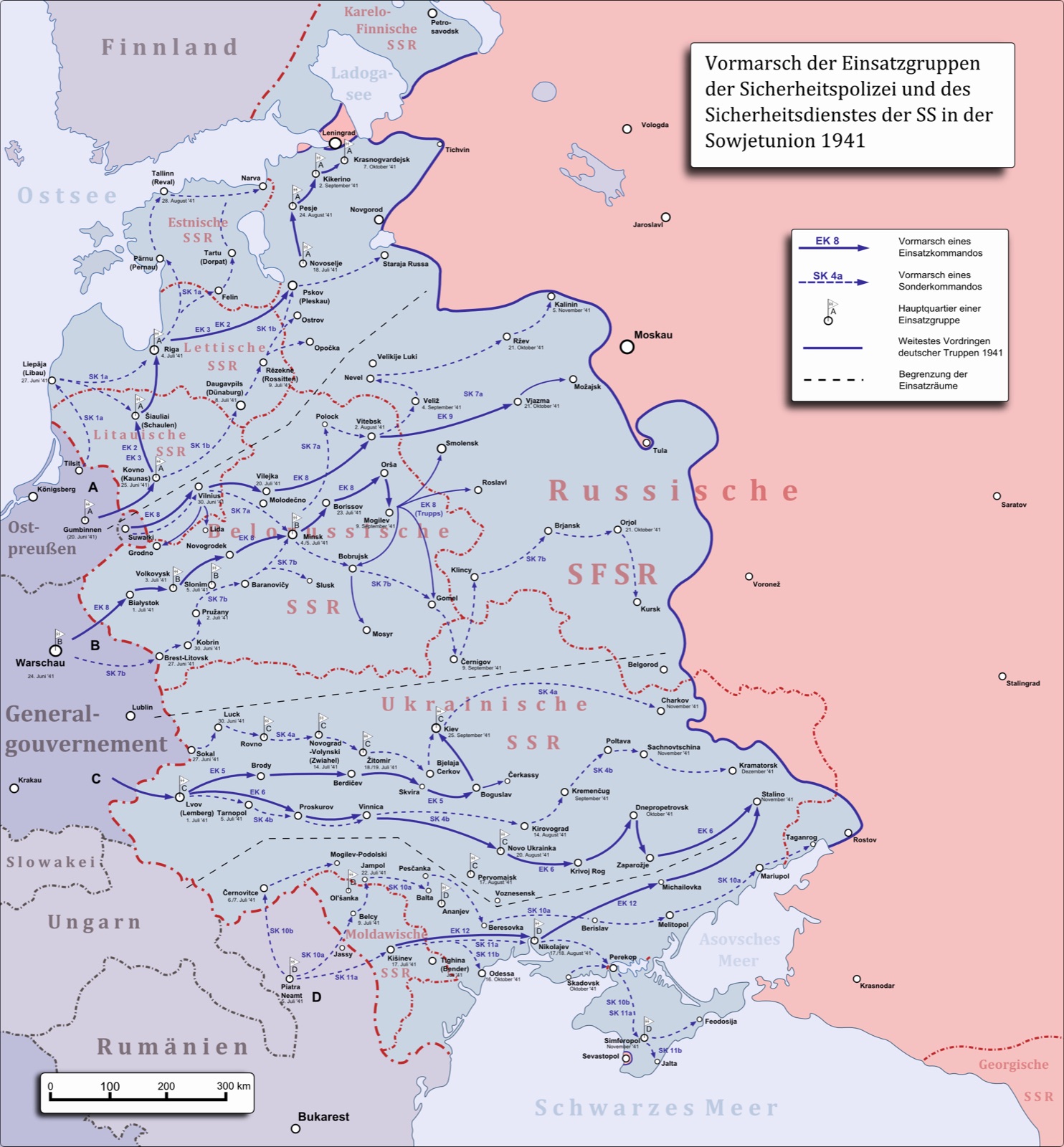
Where the four groups operated. A took the Baltic and the road to Leningrad, B the center toward Moscow, C Ukraine, D the far south and the Crimea.
Map drawn after the events Memnon335bc · January 2010 · Wikimedia Commons CC BY-SA 3.0: license for Where the four groups operated. A took the Baltic and the road to View the record: Where the four groups operated. A took the Baltic and the road to
June 22, 1941: what Operation Barbarossa changed
On June 22, 1941, Germany and its allies attacked the Soviet Union with more than three and a half million troops. It was one of the largest military operations in the history of modern warfare, and the United States Holocaust Memorial Museum calls it a turning point in both the history of the Second World War and the Holocaust.
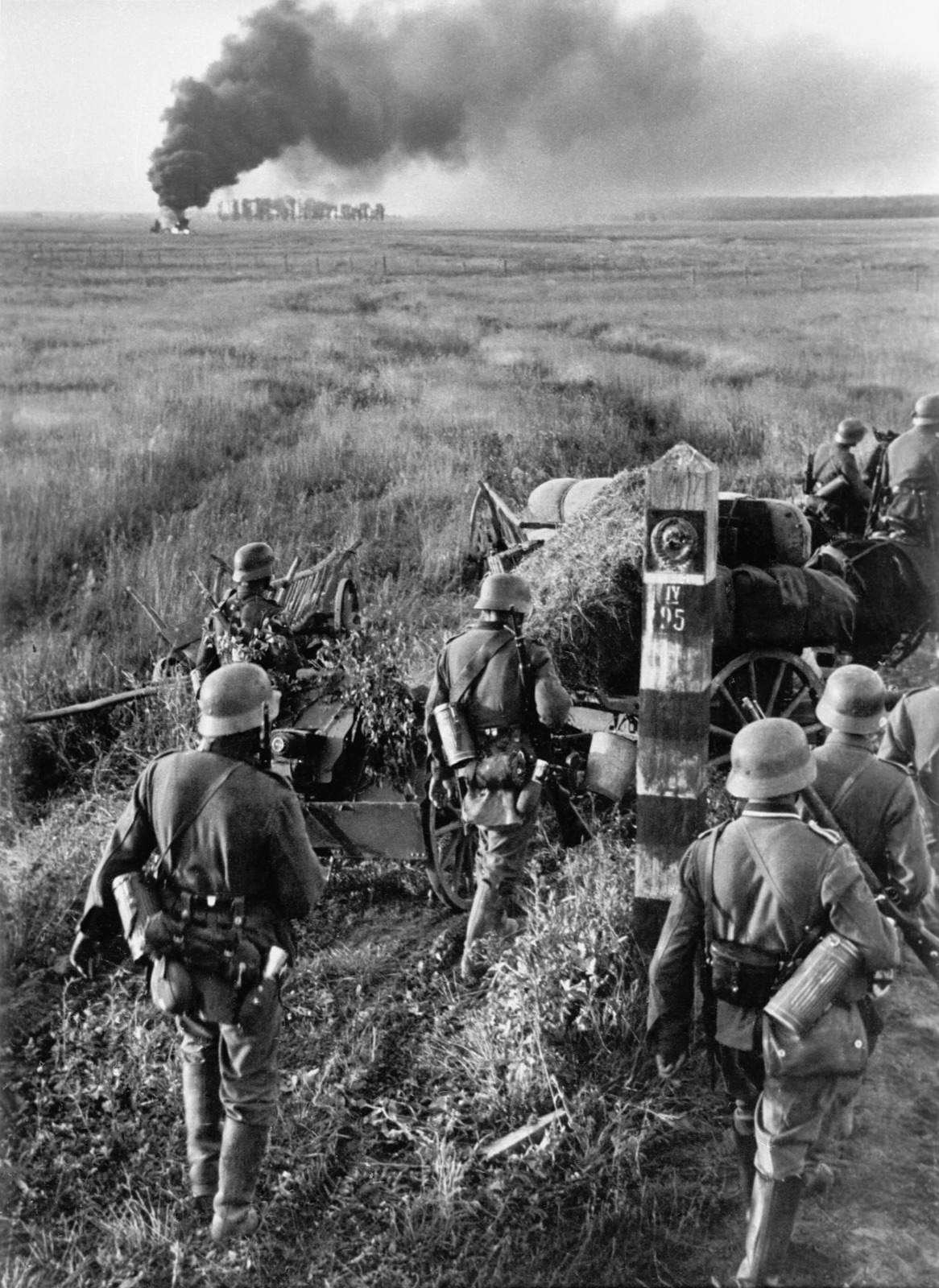
German troops crossing the Soviet frontier at the start of Operation Barbarossa, June 1941.
Photographed by a German participant or onlooker Photographer not confirmed · June 1941 · WW2 Photo Archive Public domain View the record: German troops crossing the Soviet frontier at the start of Operation
What made it different from the war in the west was written down in advance. The German army regarded this as a crusade against communism and not subject to the normal rules of war, and the planning was for a war of annihilation against the Soviet state and its citizens, the Jews above all.
The killing units did not follow the army as an afterthought. Their deployment behind the front was negotiated between the army high command and Heydrich's Reich Security Main Office in the winter and spring of 1941, before the first shot was fired. As the army advanced, the SS and police units followed it, and the Einsatzgruppen were the first to arrive.
Sure enough, two days later, the Germans walk in. So I, we lived in center of town, which is called the Rynek. Rynek is a, is a square marketplace. So the Germans walk in. They ask all the Jews to come out, all. ... Everybody comes out. My father comes out holding me and my sister. All I remember is the boots. They were so clean, not like soldiers are tired and clean, but they were not tired. They didn't fight. Boots, tall, young men, dressed well, handsome, but screaming at us, yelling. And I'm pulling my father, 'Why are they yelling?' He turns to me, he says, 'Quiet!' I never forgot the way he screamed at me, 'Quiet,' because my father never screamed at me.
Toby Eisenstein, who was eight in 1941, on the day the Germans came into Chodorów, her town near Lwów, now in Ukraine. Rynek is the market square. Project Witness testimony. Watch the full testimony. This passage begins at 18:18: Toby Eisenstein, Project Witness
We come upstairs. My father turns to my mom. He says, 'This is not the same Germans that we knew. Nobody's making out of this war alive. Unless we get help from outside, we're as good as dead, all of us.'
Toby Eisenstein, on what her father told her mother when the family came back upstairs that day. Project Witness testimony. Watch the full testimony. This passage begins at 20:40: Toby Eisenstein, Project Witness
How the shootings were carried out
The pattern repeated across hundreds of towns. The Jews of a place were rounded up or ordered to report to a central point, often under the pretext of resettlement. They were marched or driven to a site already chosen outside the town, often a ravine or a forest clearing. They were made to hand over valuables and undress. Then they were shot, in groups, at the edge of a pit.
The German word for one of these operations was Aktion. The whole phenomenon is sometimes called the Holocaust by bullets.
In some places the shooters used a method known, irreverently, as Sardinenpackung, sardine packing. Victims were made to lie down on the bodies already in the pit and were shot in the back of the neck; earth was scattered thinly over the dead before the next people were made to lie on top.
Babyn Yar, September 29 and 30, 1941
In the first week of the German occupation of Kyiv, explosions destroyed the German headquarters and killed a number of soldiers. The mines had been laid by the retreating Soviets. The Germans used the sabotage as the pretext for murdering the Jews still in the city.
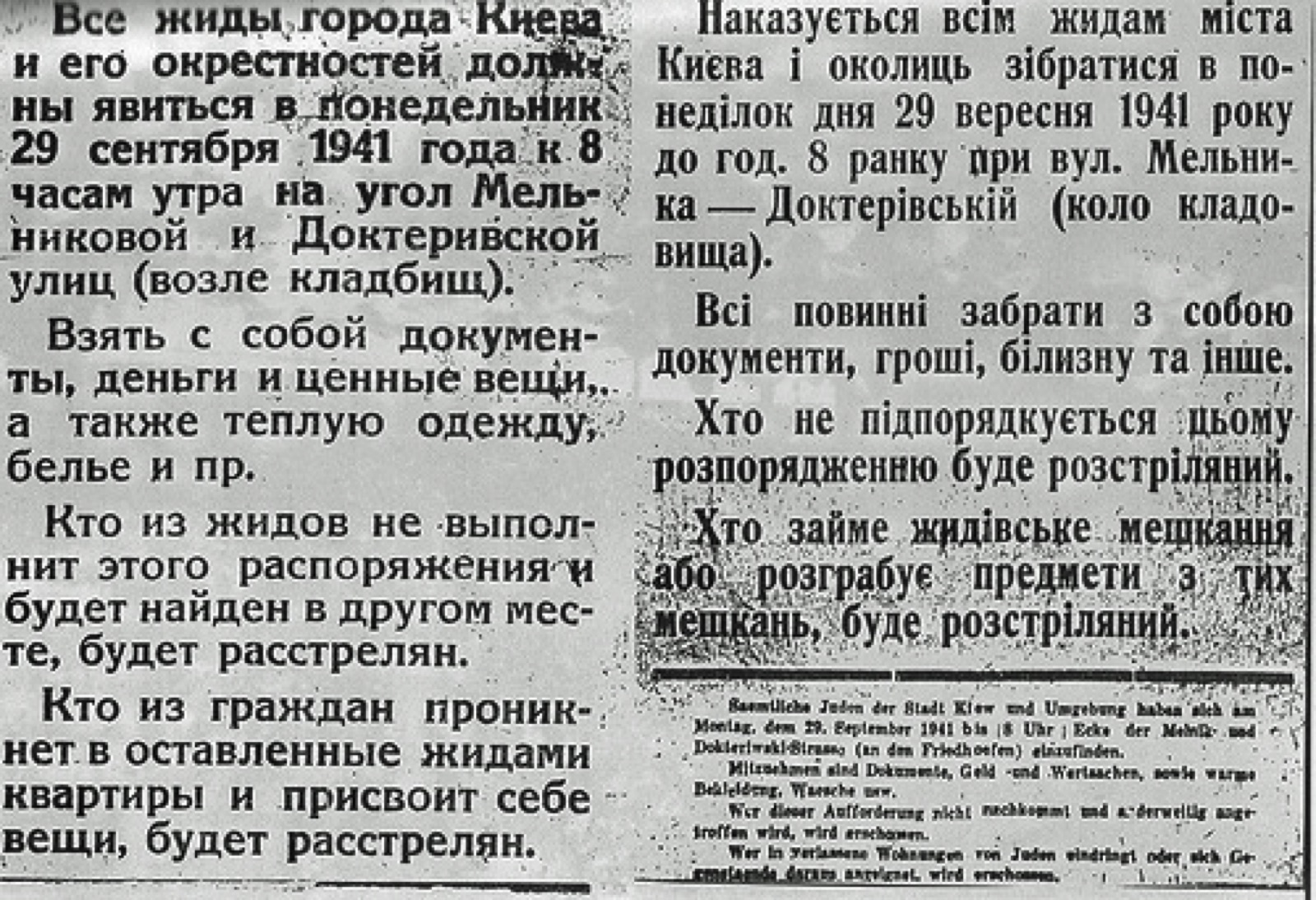
The notice posted around Kyiv on September 28, 1941, in Russian, Ukrainian and German. It ordered all Jews of the city and its surroundings to appear the following Monday morning at the corner of Melnykova and Dokterivska streets, and to bring documents, money, valuables, warm clothing and underwear. Those who did not comply would be shot. The people who read it had no way of knowing where they were being sent.
Printer unknown · 1941 · Wikimedia Commons Public domain View the record: The notice posted around Kyiv on September 28, 1941, in Russian,
They came. They were taken to a ravine on the edge of the city called Babyn Yar, made to undress, and shot in small groups. According to the report the killers themselves filed, 33,771 Jews were murdered over those two days. It is one of the largest mass killings at a single location in the entire war.
The shooting was carried out by Sonderkommando 4a, a detachment of Einsatzgruppe C under Paul Blobel, with the assistance of other German units and local auxiliaries.
Dina Pronicheva was one of the few people taken to the ravine who survived. She testified about the massacre before a Soviet court in January 1946. In one of her written testimonies she described what she saw.
Each time I saw a new group of men and women, elderly people, and children being forced to take off their clothes. All [of them] were being taken to an open pit where submachine-gunners shot them.
Dina Pronicheva, from one of her written postwar testimonies (Yad Vashem; published in Yitzhak Arad, ed., The Destruction of the Jews of the USSR during the German Occupation, 1991)
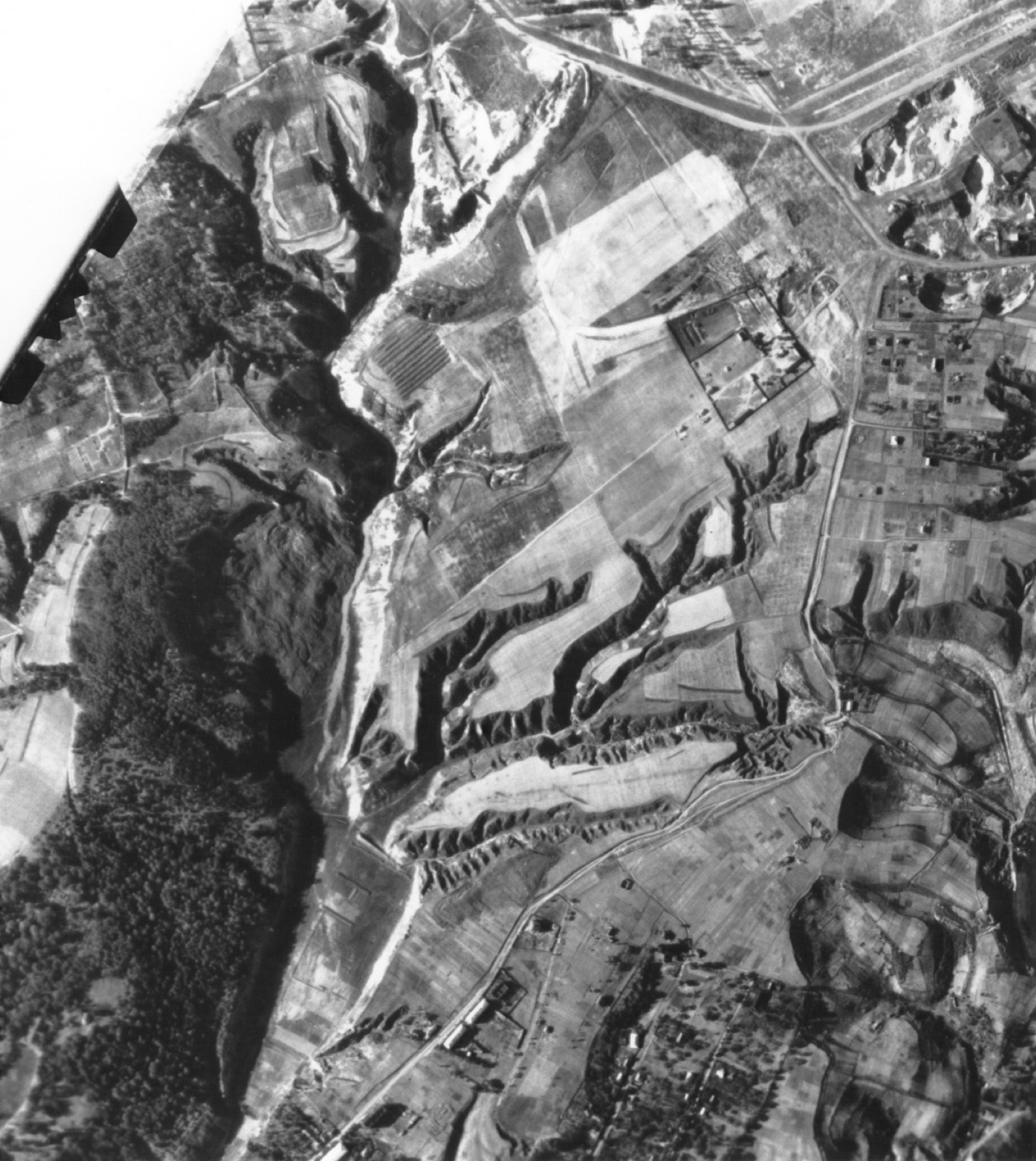
The ravine photographed from the air by the Luftwaffe on September 26, 1943, almost two years after the massacre and while the Germans were destroying the evidence.
Aerial reconnaissance Unknown Luftwaffe aircraft · September 26, 1943 · United States Holocaust Memorial Museum, USHMM pa1097751 Public domain View the record: The ravine photographed from the air by the Luftwaffe on September
In the summer of 1943, with the Soviet army approaching, about three hundred prisoners from the nearby Syrets camp were forced to dig up the graves and burn what was in them. The operation had a code name, Sonderaktion 1005, and it was carried out across the occupied east. The intention was that there should be nothing left to find.
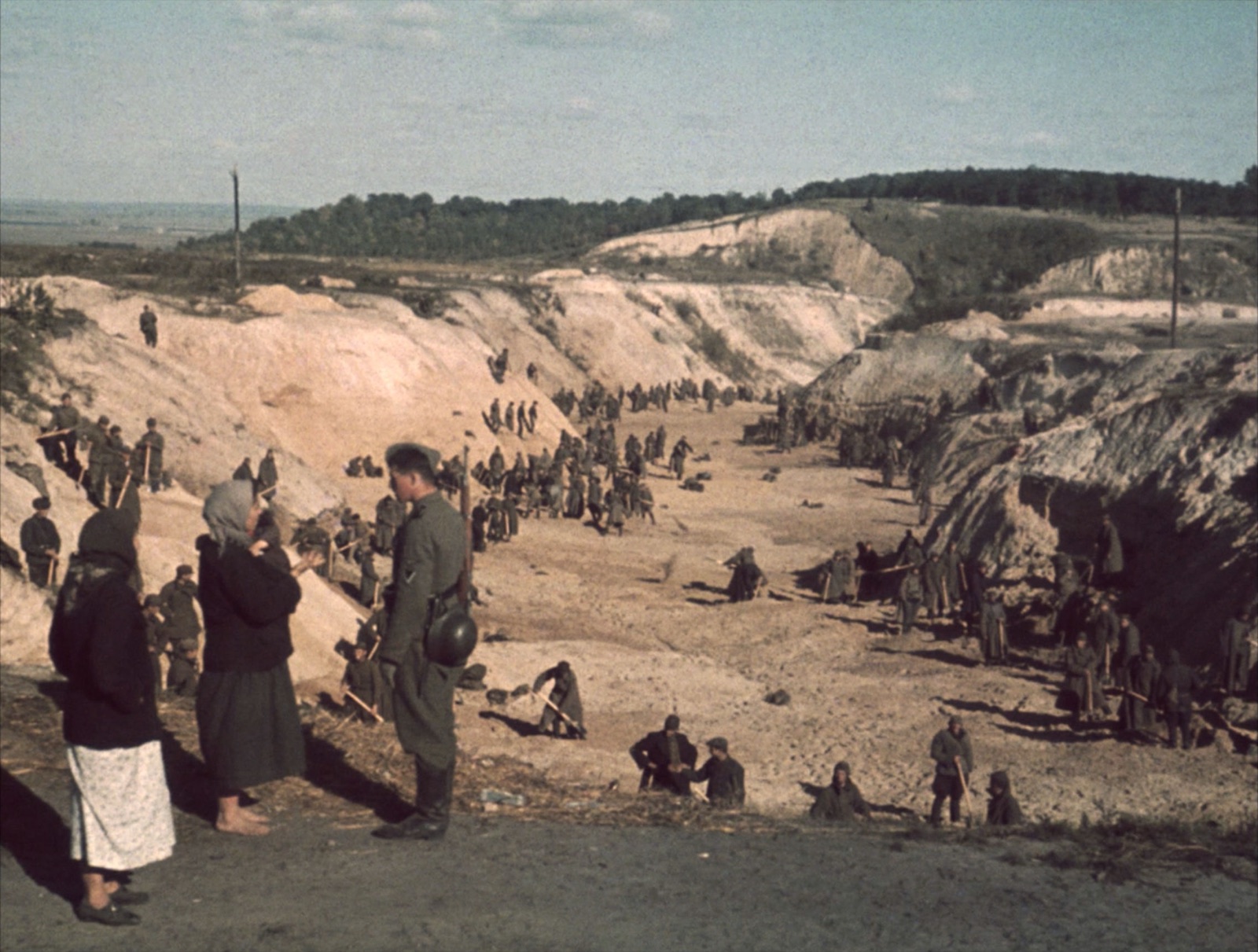
Soviet prisoners of war covering a mass grave at Babyn Yar in the days after the massacre, photographed by Johannes Hähle of a Wehrmacht propaganda company. His photographs later became part of West German war crimes trial records.
Photographed by a German participant or onlooker Johannes Hähle · September or October 1941 · Wikimedia Commons Public domain View the record: Soviet prisoners of war covering a mass grave at Babyn Yar in the
Who actually did the shooting
Three thousand men in four units could not have killed on this scale, and they did not. The Einsatzgruppen were assisted by units of the Waffen SS, by Order Police battalions, by the Wehrmacht, by allied Romanian forces, and by local collaborators in every occupied country they entered.
That last category is the one that is hardest to teach. In town after town, the men who guarded the column on its way to the pit were neighbors. The killing units leaned on them. In many places local auxiliaries identified the victims, guarded the columns and did some of the shooting, alongside the Order Police, Waffen SS and Wehrmacht units whose manpower, the Holocaust Encyclopedia says, was essential.
They marched into us in the summer of 1941. After school was over and the tests were over, it was a beautiful summer, but it was marked with Germans' occupation. But there weren't a lot of Germans in my town. A lot of the local became police, and they, one day, they came, and they took out the Sifrei Torahs [Torah scrolls] from the shul [synagogue], and they put them like logs, and, and, and, and they burned them. It was a big smoke, a big fire, and we were hiding. They shouldn't put us on top of the Mizbeach [the altar], on top of, on top of the Sifrei Torahs. At night when the fire stopped and it finished, my mother ran out ... and she took a piece of parchment from the Sifrei Torah to, to, to keep it, to have it. It was awful. A few Jewish people were shot.
Rachel Hochhauser, who was about 13 in the summer of 1941, in Krzywicze, a small town now in Belarus. Project Witness testimony. Watch the full testimony. This passage begins at 18:26: Rachel Hochhauser, Project Witness
The places, and what is there now
The shootings happened at named places that are still there. Kamianets-Podilskyi. Babyn Yar outside Kyiv. Ponary outside Vilna. The Rumbula forest outside Riga. The Ninth Fort at Kovno. Most are woods or ravines on the outskirts of a city.
They were not remote places. Each was beside a Jewish community. In 1939 more than 55,000 Jews lived in Vilna. On the eve of the war Kovno had some 40 synagogues and batei midrash, houses of Torah study, and one of the most prestigious yeshivas in Europe. Kamianets-Podilskyi, for more than two centuries the center of the province of Podolia, had more than 30 synagogues and prayer houses in 1910, Hasidic ones among them. Podolia is where the founder of Hasidism, the Baal Shem Tov, lived: from 1740 until 1760 his home was the town of Medzhybizh, Mezhbizh in Yiddish. In the fall of 1942, after the ghetto there was liquidated, the Jews of Medzhybizh were shot as well.
It was a big yeshiva, Slobodka Yeshiva Knesset Israel ... And there was a kollel [a study hall for married scholars] too, and mostly it was all, I mean, it was a Jewish town, but in my time everybody was shomer Shabbos [kept the Sabbath]. You hardly saw a gentile.
Rivka Dubiansky, born in 1923 in Slobodka, the old Jewish quarter of Kovno, describing the town she grew up in. Project Witness testimony. Watch the full testimony. This passage begins at 2:56: Rivka Dubiansky, Project Witness
- Kamianets-Podilskyi, late August 1941
- Einsatzgruppen detachments and troops under Friedrich Jeckeln, the SS and police leader for the south, shot Jews deported from Hungary and the town's own Jews. Jeckeln reported 23,600 dead.
- Babyn Yar, Kyiv, September 29 and 30, 1941
- Sonderkommando 4a, with other German units and local auxiliaries, shot the Jews of Kyiv in a ravine on the edge of the city. The killers' own report gives 33,771 dead in two days.
- Ponary, outside Vilna, from July 1941
- In July, Einsatzgruppen units aided by Lithuanian auxiliaries killed 5,000 Jewish men in the Ponary forest, eight miles from the city. By the end of 1941, about 40,000 Jews had been killed there.
- The Ninth Fort, Kovno, October 29, 1941
- The day before, the Germans had selected more than 9,200 Jews in the Kovno ghetto for murder, nearly 4,300 of them children. German and Lithuanian police took them to the fort and shot them into pits.
- Rumbula, outside Riga, November 30 and December 8 and 9, 1941
- German SS and police units and Latvian auxiliaries shot at least 25,000 Jews from the Riga ghetto in the Rumbula forest.
And the small ghetto, they put the Latvian Jews in there, only the men. So I wind up going from the big ghetto into the small ghetto. ... On November 30th, they took half of the ghetto out, half of the ghetto out, and took them to Rumbula to be shot.
Jack Ratz, who was 15 and in the Riga ghetto in November 1941. His mother and his brother were among those shot at Rumbula. Project Witness testimony. Watch the full testimony. This passage begins at 1:08:46: Jack Ratz, Project Witness
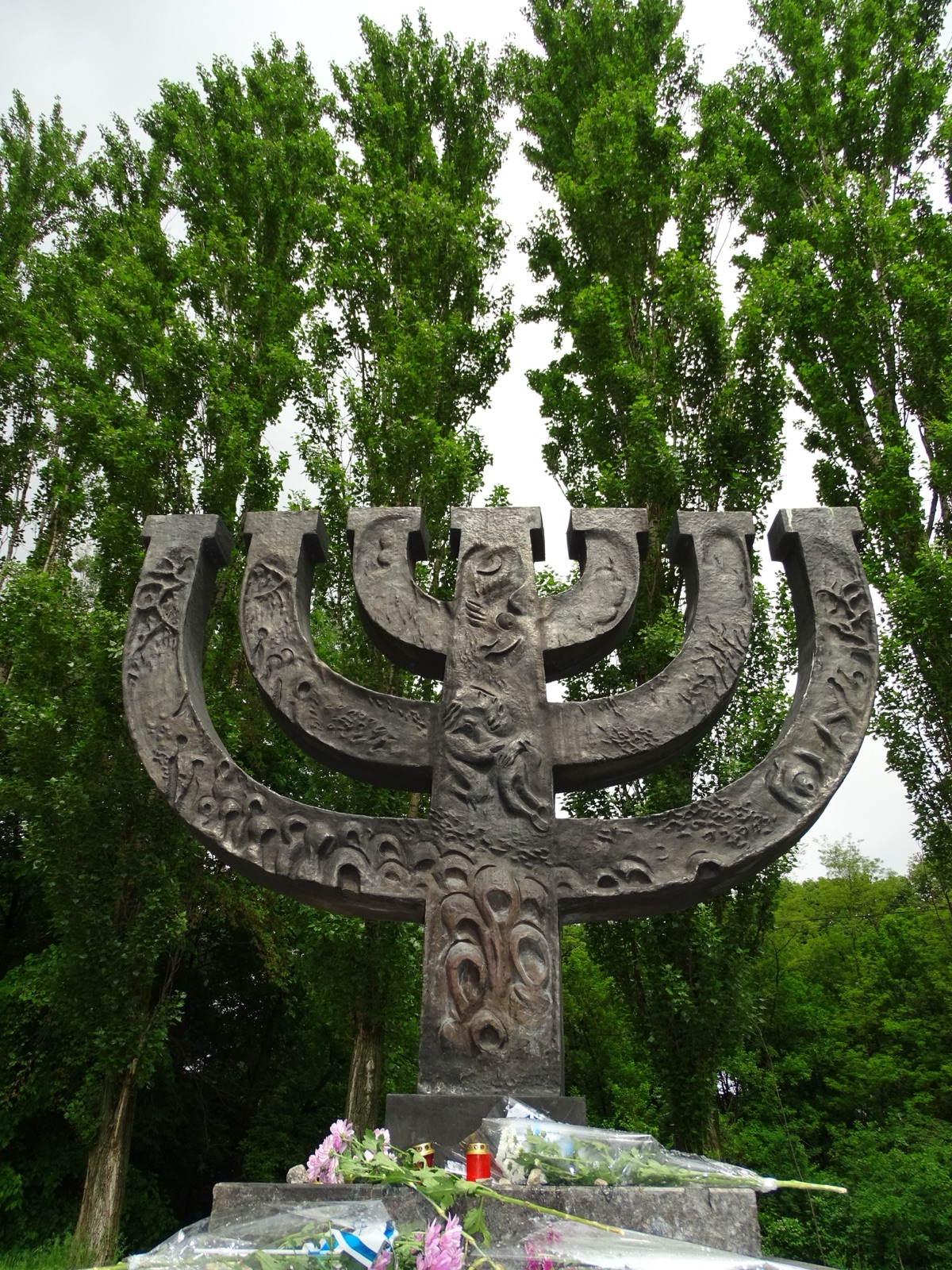
The menorah memorial at Babyn Yar. A monument was put up in 1976 that did not say the victims were Jews. This one was raised only after Ukrainian independence, on the fiftieth anniversary of the massacre.
Postwar memorial photograph Adam Jones from Kelowna, BC, Canada · May 15, 2016 · Wikimedia Commons CC BY-SA 2.0: license for The menorah memorial at Babyn Yar. A monument was put up in 1976 that View the record: The menorah memorial at Babyn Yar. A monument was put up in 1976 that
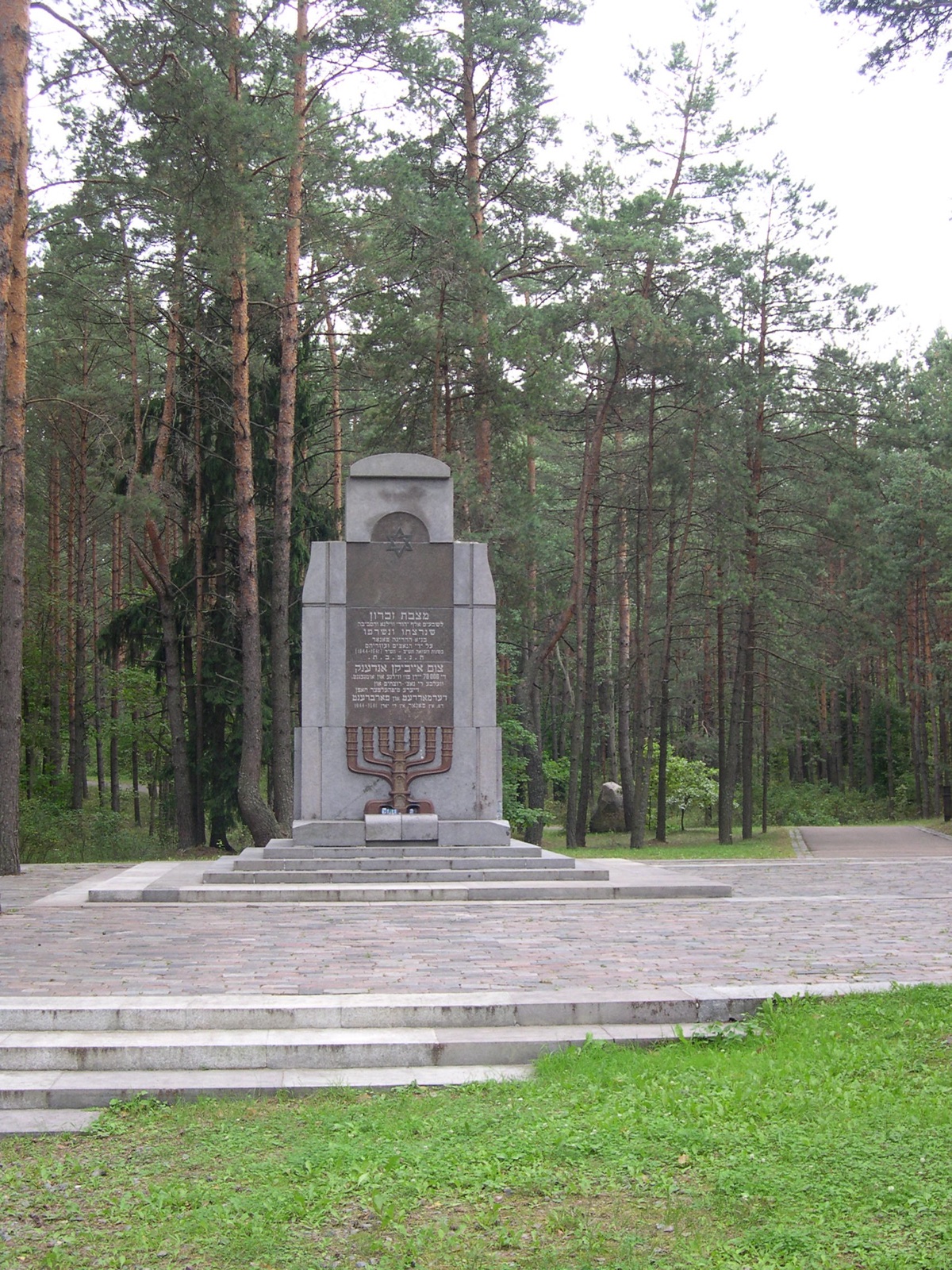
The memorial at Paneriai, outside Vilnius, where tens of thousands of the Jews of Vilna were shot.
Postwar memorial photograph upyernoz from Haverford, USA · September 2, 2006 · Wikimedia Commons CC BY 2.0: license for The memorial at Paneriai, outside Vilnius, where tens of thousands of View the record: The memorial at Paneriai, outside Vilnius, where tens of thousands of
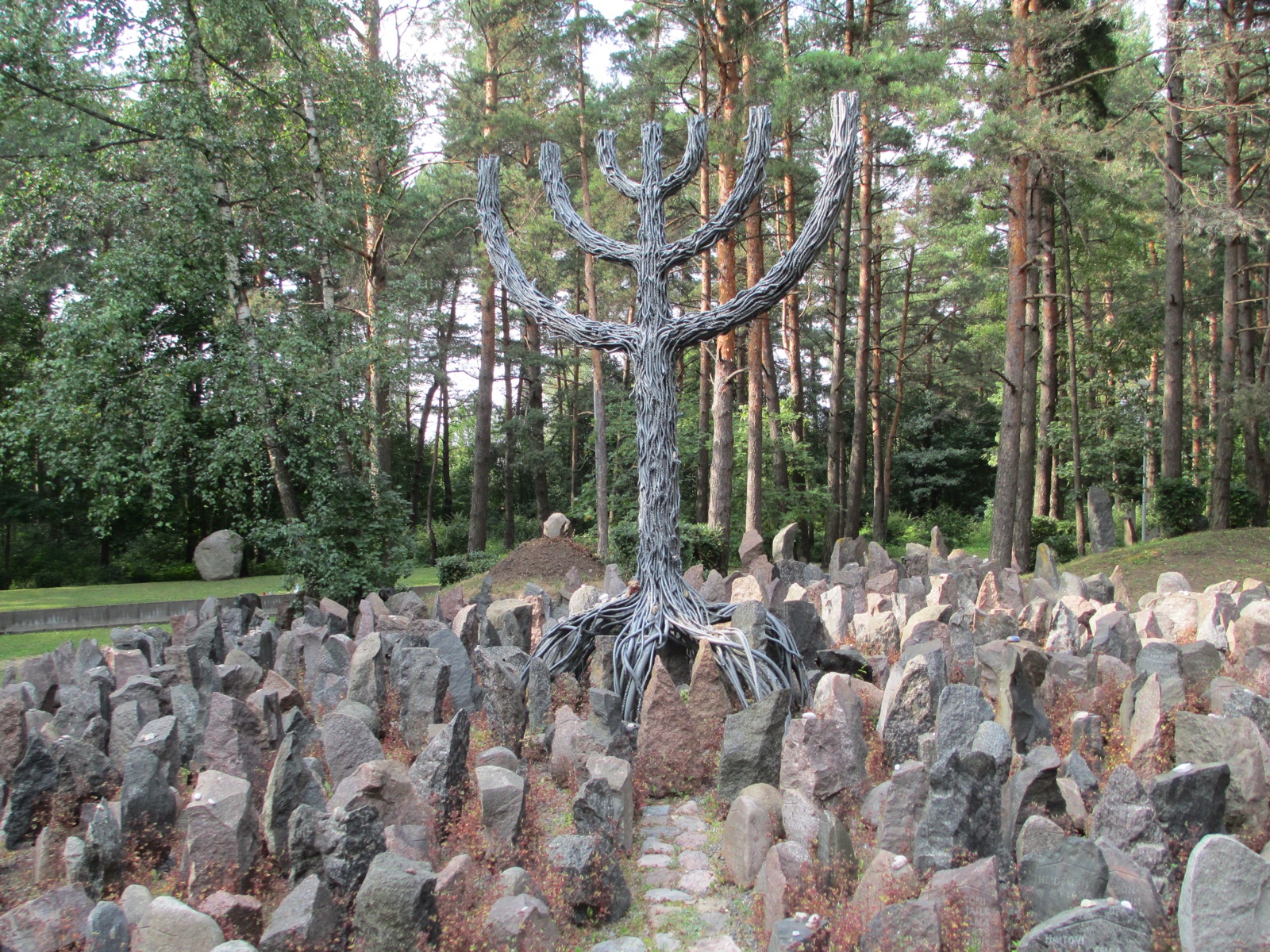
The memorial in the Rumbula forest outside Riga.
Postwar memorial photograph Avi1111 dr. avishai teicher · July 26, 2013 · Wikimedia Commons CC BY-SA 3.0: license for The memorial in the Rumbula forest outside Riga. View the record: The memorial in the Rumbula forest outside Riga.
The memorials came late and several of them came grudgingly. For decades the Soviet convention was to record the dead as peaceful Soviet citizens, without saying that they had been killed for being Jews. Recovering that sentence took until the 1990s in most places.
The dates
The shooting phase of the Holocaust did not run on its own timetable. It tracked the front line.
June 22, 1941
Germany and its allies invade the Soviet Union with more than 3,500,000 troops. The Einsatzgruppen cross the border behind the army.
Late June 1941
The first mass shootings in the Baltic and eastern Poland, often with the participation of local auxiliaries.
July 1941
The killing widens from men of military age to women and children.
Late August 1941
Kamianets-Podilskyi, one of the first large-scale mass murders of the campaign. The victims were Jews deported from Hungary and the town's own Jews; the SS and police leader reported 23,600 dead.
September 29 and 30, 1941
Babyn Yar. The killers' own report gives 33,771 dead in two days.
October 29, 1941
The Ninth Fort at Kovno. More than 9,200 Jews from the ghetto are shot, nearly 4,300 of them children.
Summer and fall 1941
The killing widens from the occupied Soviet territories into a program for the whole of Europe. No document has been found showing by whom, or at what time, that was decided; many scholars believe the order was never put in writing.
November 30 and December 8 and 9, 1941
The Rumbula shootings outside Riga. At least 25,000 Jews from the Riga ghetto are killed.
December 8, 1941
Killing begins at Chełmno, the first fixed site where the Nazis used poison gas to murder Jews. In the occupied Soviet territories, shooting remains the preferred method.
January 20, 1942
At the Wannsee Conference, Heydrich presents plans to coordinate the murder of the Jews of all Europe. The shootings in the east have been going on for almost seven months.
Summer 1943
Sonderaktion 1005, under way since 1942, reaches Babyn Yar. Prisoners are forced to open the graves and burn the remains.
1947 to 1948
The Einsatzgruppen trial at Nuremberg. Twenty four Einsatzgruppen leaders are indicted; twenty two stand trial.
1991
The menorah memorial is raised at Babyn Yar on the fiftieth anniversary, after Ukrainian independence.
Show the other 1 dates
1976
A monument goes up at Babyn Yar that does not say the victims were Jews.
Questions people ask
What does Einsatzgruppen mean?
Task forces, or special action groups. They were units of the Security Police and the SD, the SS intelligence service. In practice they were mobile killing squads, and that is the plainer description.
How many people did the Einsatzgruppen kill?
In the first nine months of the war against the Soviet Union they organized and helped to carry out the shooting of more than half a million people, the vast majority of them Jews. Across the whole shooting phase of the Holocaust, as many as two million Jews were murdered.
Is it true that a third of Holocaust victims were shot rather than gassed?
Almost one third, yes. The United States Holocaust Memorial Museum puts it that way: almost one third of the six million were murdered in mass shootings. Most people picture only the camps, and that picture is incomplete.
What happened at Babi Yar?
On September 29 and 30, 1941, the Jews of Kyiv were ordered to assemble, taken to a ravine on the edge of the city, made to undress and shot in small groups. The report filed by the killers gives 33,771 dead over the two days.
Why is it spelled Babyn Yar sometimes and Babi Yar other times?
Babi Yar is the older transliteration from Russian. Babyn Yar is from Ukrainian and is now the more usual form. They are the same place.
Who else took part besides the Einsatzgruppen?
Units of the Waffen SS, Order Police battalions, the Wehrmacht, allied Romanian forces, and local collaborators in the occupied countries. Three thousand men in four units could not have done this alone, and they did not.
Why are there so few photographs?
There are photographs, and many of them were taken by the perpetrators or by soldiers standing nearby. This page publishes the order, the map, the sites and the memorials, and does not publish images of people at the moment of death.
Did the Germans try to hide what they had done?
Yes, systematically. From 1942, under the code name Sonderaktion 1005, prisoners were forced to dig up mass graves and burn the remains. At Babyn Yar, from August 1943, about three hundred prisoners from the Syrets camp were used for this.
Were the killers ever tried?
Some were. The Einsatzgruppen trial at Nuremberg indicted twenty four Einsatzgruppen leaders and tried twenty two of them; one killed himself and one was found too ill to stand trial. Others were tried in the countries where they had committed their crimes, among them 15 members of the German police, tried in Kyiv in January 1946 for Babyn Yar. Many were never brought to trial at all.
Why did the Soviet memorials not mention Jews?
Soviet practice was to record the dead as peaceful Soviet citizens. The monument put up at Babyn Yar in 1976 did not say the victims were Jews. The menorah memorial that does was raised only after Ukrainian independence.
For educators
Free, and made for a classroom
Project Witness is a nonprofit Holocaust education organization in New York. Tell us what you teach and we will send you what fits your classroom.
How we know
Where a figure comes from a report written by the killers, the page says so, because that is a particular kind of evidence and it needs to be read as one.
The survivors quoted on this page speak in Project Witness's own recorded testimonies. Each passage was checked against the audio of the recording, and the link under it says where in the testimony it begins.
Every source this page rests on.
- Einsatzgruppen United States Holocaust Memorial Museum, Holocaust Encyclopedia
- Invasion of the Soviet Union, June 1941 United States Holocaust Memorial Museum, Holocaust Encyclopedia
- Mass Shootings of Jews during the Holocaust United States Holocaust Memorial Museum, Holocaust Encyclopedia
- Babi Yar United States Holocaust Memorial Museum, Holocaust Encyclopedia The figure of 33,771 comes from a report written by the killers. It is the best figure we have and it is not a neutral one.
- Mass Shootings at Babyn Yar (Babi Yar) United States Holocaust Memorial Museum, Holocaust Encyclopedia
- Babi Yar and the Jews of Kiev: written testimonies Yad Vashem
- Babi Yar and the Jews of Kiev: historical background Yad Vashem
- Kamenets-Podolsk United States Holocaust Memorial Museum, Holocaust Encyclopedia The figure of 23,600 is Friedrich Jeckeln's own report. YIVO gives the same figure and dates the killing a day later, August 27 to 29.
- Vilna United States Holocaust Memorial Museum, Holocaust Encyclopedia
- The Holocaust in Kovno United States Holocaust Memorial Museum, Holocaust Encyclopedia
- Riga United States Holocaust Memorial Museum, Holocaust Encyclopedia
- Chełmno United States Holocaust Memorial Museum, Holocaust Encyclopedia
- Reinhard Heydrich: In Depth United States Holocaust Memorial Museum, Holocaust Encyclopedia
- The Wannsee Conference Yad Vashem Cited for what the record does not show: no document has been found naming who decided on the total extermination of the Jews, or when.
- Subsequent Nuremberg Proceedings, Case 9: the Einsatzgruppen Case United States Holocaust Memorial Museum, Holocaust Encyclopedia
- Postwar Trials United States Holocaust Memorial Museum, Holocaust Encyclopedia
- Kam’ianets’-Podil’s’kyi, by Benyamin Lukin YIVO Encyclopedia of Jews in Eastern Europe
- Medzhibizh, by Moshe Rosman YIVO Encyclopedia of Jews in Eastern Europe
Words used on this page
Show the 3 terms
- Einsatzgruppen
- Task forces, or special action groups. Units of the Security Police and the SD, the SS intelligence service, that followed the German army into the countries it invaded and occupied. For the invasion of the Soviet Union there were four of them, with about 3,000 men between them. Source: USHMM Holocaust Encyclopedia, Einsatzgruppen, for Einsatzgruppen
- Aktion
- German for an operation or action, and the regime's word for its organized measures against Jews. The authorities called the November 1938 pogrom an Aktion. In the occupied east the word named a mass shooting, which usually began with German units and local collaborators rounding up the Jewish residents of a village, town or city. Source 1: USHMM Holocaust Encyclopedia, Kristallnacht, for AktionSource 2: USHMM Holocaust Encyclopedia, Mass Shootings of Jews during the Holocaust, for Aktion
- Sardinenpackung
- Sardine packing. The name, used irreverently, for a method in which victims were made to lie on the ground and were shot in the back of the neck, with earth scattered thinly over them before the next people were made to lie on top. Source: USHMM Holocaust Encyclopedia, Mass Shootings of Jews during the Holocaust, for Sardinenpackung