Turning Points · March 12, 1938
The Anschluss was not an invasion that Austria resisted.
German troops crossed the border on March 12, 1938, and were met with cheers and flowers. The violence against Vienna's Jews had already started the night before, and Austrians were the ones carrying it out.
Project Witness records and preserves Holocaust survivor testimony. This page is free to use, in classrooms and out of them.
Written for readers 14 and up. Some passages, and one photograph, show the public humiliation of Jews in Vienna.
The short answers
- What was the Anschluss?
- The annexation of Austria by Nazi Germany in March 1938. It was the regime's first act of territorial expansion, and it was accomplished without a shot being fired.
- When did it happen?
- Hitler's ultimatum came on March 11, 1938. German troops crossed the border at about five in the morning on March 12. The law reuniting Austria with Germany was signed on March 13.
- Did Austria resist?
- No. Chancellor Schuschnigg resigned and told Austrians not to resist, and the troops were met with cheers and flowers rather than gunfire.
- How many Jews lived in Vienna?
- About 170,000 in 1938, with roughly 80,000 more people of mixed Jewish and Christian background. Together that was more than a tenth of the city.
- What were the scrubbing parties?
- Jews were dragged into the street and made to scrub pro-independence slogans off the pavements on their hands and knees, with crowds standing around watching. The violence began on the night of March 11, before the German army had even arrived, and the scrubbing parties were its most notorious form.
- Was the 99 percent vote real?
- The plebiscite of April 10 returned about 99 percent in favor, but between 300,000 and 400,000 people were barred from voting, and the ballot paper itself printed the Yes circle much larger than the No.
Three days in March
Chancellor Kurt Schuschnigg had called a plebiscite on Austrian independence. On March 11, 1938, Hitler demanded that he cancel it, resign, and hand the chancellorship to the Austrian Nazi Arthur Seyss-Inquart. Facing the threat of invasion, Schuschnigg gave way. That evening he went on the radio, announced his resignation, and told Austrians not to resist.
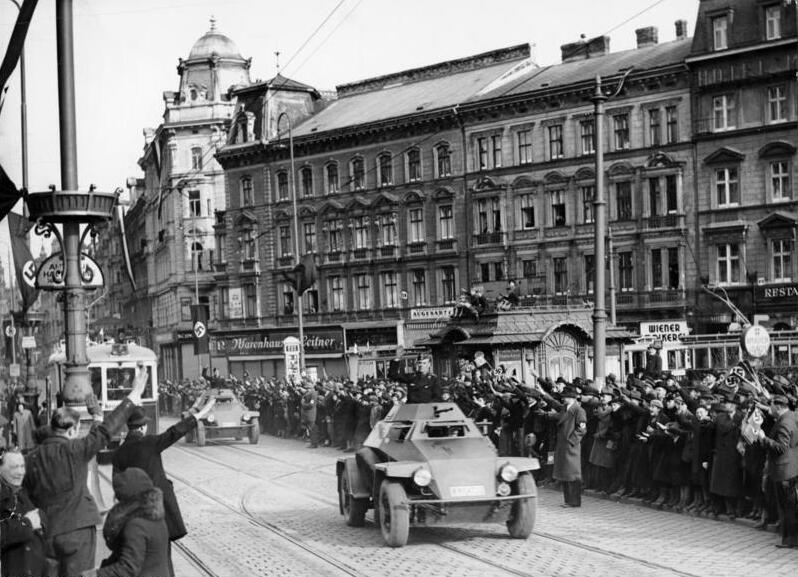
Photographed by a German participant or onlooker Photographer unknown · Taken in March 1938 · Bundesarchiv, Bild 183-1987-0922-503 CC BY-SA 3.0 de: licence for German troops entering Vienna in March 1938. View the record: German troops entering Vienna in March 1938.
German troops crossed the border at about five the next morning. They were not met with armed resistance. They were met with cheers and flowers. On March 13 Seyss-Inquart signed the law that folded Austria into Germany.
The welcome, and why it matters
Before you read on: true or false?
Six things people say about Austria in 1938. Choose, then see what the sources say.
German troops had to fight their way into Austria.
Show the answer
It is false.
They crossed the border at about five in the morning on March 12, 1938, and were met with cheers and flowers, not gunfire. The Chancellor had told Austrians not to resist.
Source: United States Holocaust Memorial Museum, The AnschlussThe attacks on Vienna's Jews started after the German army arrived.
Show the answer
It is false.
The violence began on the night of March 11, the night the Chancellor resigned, before German troops crossed the border. Austrians carried it out.
Source: United States Holocaust Memorial Museum, The AnschlussIn 1943 the Allies called Austria "the first free country to fall a victim to Hitlerite aggression."
Show the answer
It is true.
Those are the words of the Moscow Declaration of 1943, signed by Britain, the Soviet Union and the United States. This page explains why the description does not hold.
Source: The Avalon Project, Yale Law School, The Moscow DeclarationEvery adult in Austria could vote in the plebiscite of April 1938.
Show the answer
It is false.
Between 300,000 and 400,000 people were barred from voting, among them Jews, Roma and political opponents.
Source: United States Holocaust Memorial Museum, The AnschlussIn 1938 and 1939 the regime's aim for Austria's Jews was to force them out of the country.
Show the answer
It is true.
Adolf Eichmann's Central Office for Jewish Emigration pushed Jews out and stripped them of their property as they went. By May 17, 1939, nearly half of Austria's Jews had left.
Source: United States Holocaust Memorial Museum, ViennaKristallnacht, in November 1938, was mild in Vienna compared with Germany.
Show the answer
It is false.
The Holocaust Encyclopedia calls it particularly brutal in Vienna. Most of the city's synagogues and prayer houses were set on fire, and many burned to shells while the public and the fire department looked on.
Source: United States Holocaust Memorial Museum, Vienna
In 1943 the Allies called Austria "the first free country to fall a victim to Hitlerite aggression". The phrase does not survive the photographs.
Now, the Austrians will tell you that they were the first victims of Hitler. Not true. He was a welcome guest, a welcome liberator.Rabbi Fabian Schoenfeld, who grew up in Vienna and was 14 in March 1938. Project Witness testimony.Watch the full testimony. This passage begins at 4:45: Rabbi Fabian Schoenfeld, Project Witness
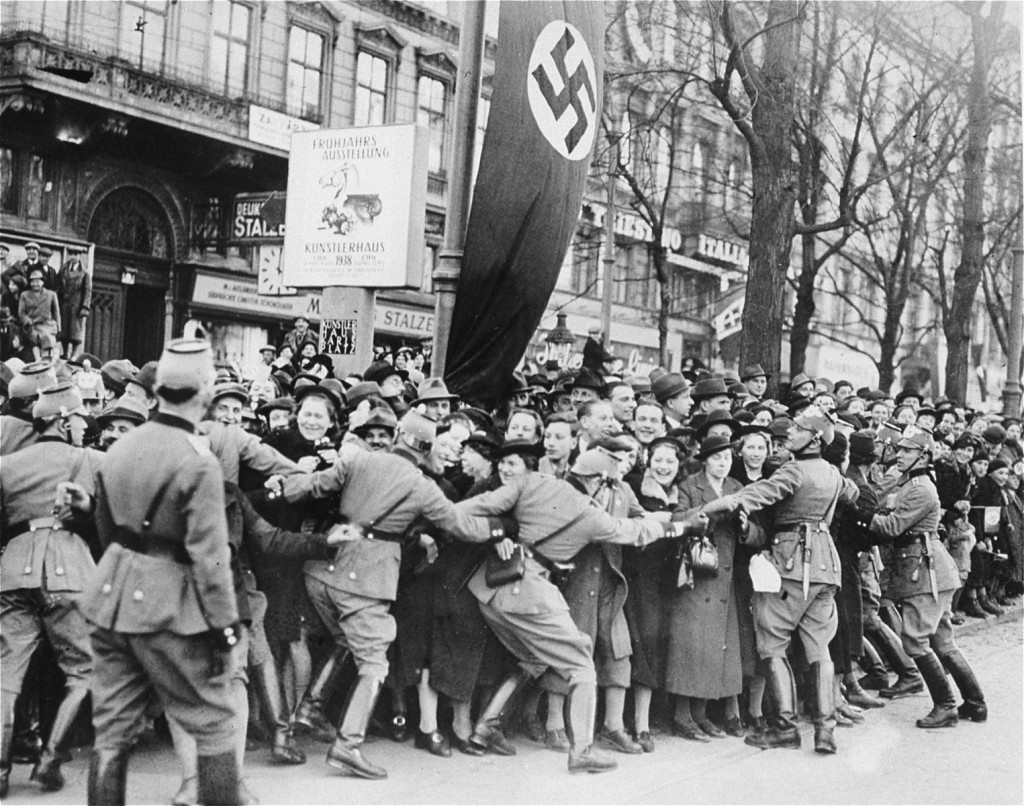
Staged for propaganda Wide World Photo · March 1938 · United States Holocaust Memorial Museum Public domain View the record: A crowd in Vienna greeting Hitler in March 1938.
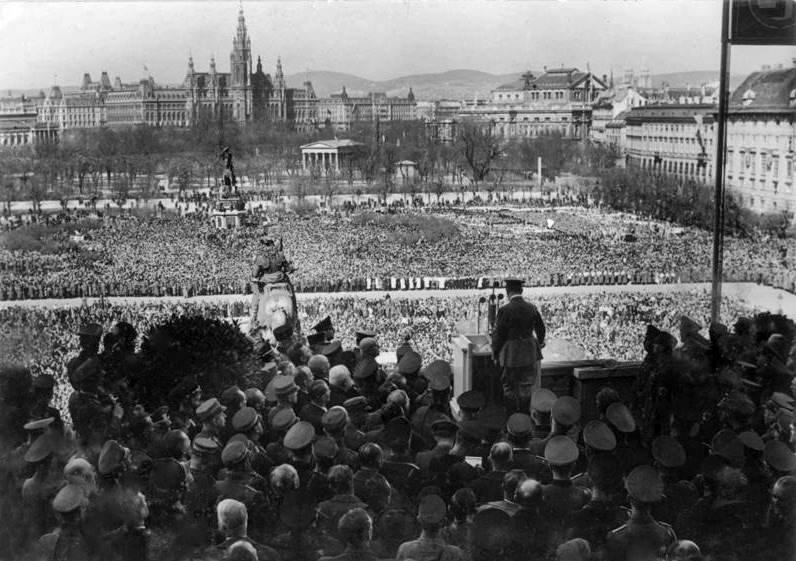
Staged for propaganda Photographer unknown · March 15, 1938 · Bundesarchiv, Bild 183-1987-0922-500 CC BY-SA 3.0 de: licence for Hitler speaking on the Heldenplatz in Vienna. The square was full. View the record: Hitler speaking on the Heldenplatz in Vienna. The square was full.
These are propaganda photographs, made to show exactly this. Not every Austrian was in that square. The anti-Jewish violence that began on the night of March 11 was carried out by Austrians, before the German army arrived, and no photographer staged that.
Antisemitism was already part of Austrian politics. Karl Lueger, Vienna's mayor when the young Hitler arrived in the city in 1908, had won votes with economic antisemitism, and the Austrian nationalist Georg von Schönerer had argued that all ethnic Germans belonged in one country while promoting racial antisemitism. Hitler later claimed his own antisemitism was formed in Vienna, partly inspired by Lueger, though the Holocaust Encyclopedia says that is probably not entirely true.
The other European powers did not punish the violation of the treaties that forbade this. Their acceptance of it was a significant act of appeasement.
What happened to Vienna's Jews
About 170,000 Jews lived in Vienna in 1938, and roughly 80,000 more people of mixed Jewish and Christian background. Together they were more than a tenth of the city, and Vienna was one of the great centers of Jewish life in Europe.
It is worth being specific about what was there. Vienna was an important center of Jewish culture and education. Many of its Jews were well integrated into the life of the city, and Jews made up significant proportions of its doctors and lawyers, its businessmen and bankers, its artists and journalists. Theodor Herzl had studied at the university there.
And we belonged to a shul. It was called the Schiff Shul. Why? Because it's, the street where it was on was Schiffgasse. ... And I was bar mitzvah in that shul in Vienna. But we lived far, too far to go there every day. We went there on Shabbos, you know, on Yontif. So I davened, on my block was a rebbe. There was rebbes in Vienna who came there for, in the First World War, because Vienna was safer. The Chortkover Rebbe was in Vienna. The Kopyczynitzer Rebbe was in Vienna.Erwin Lazar, born in Vienna in 1923, on his family's shul and the Hasidic rebbes who lived in the city. Project Witness testimony.Watch the full testimony. This passage begins at 2:26: Erwin Lazar, Project Witness
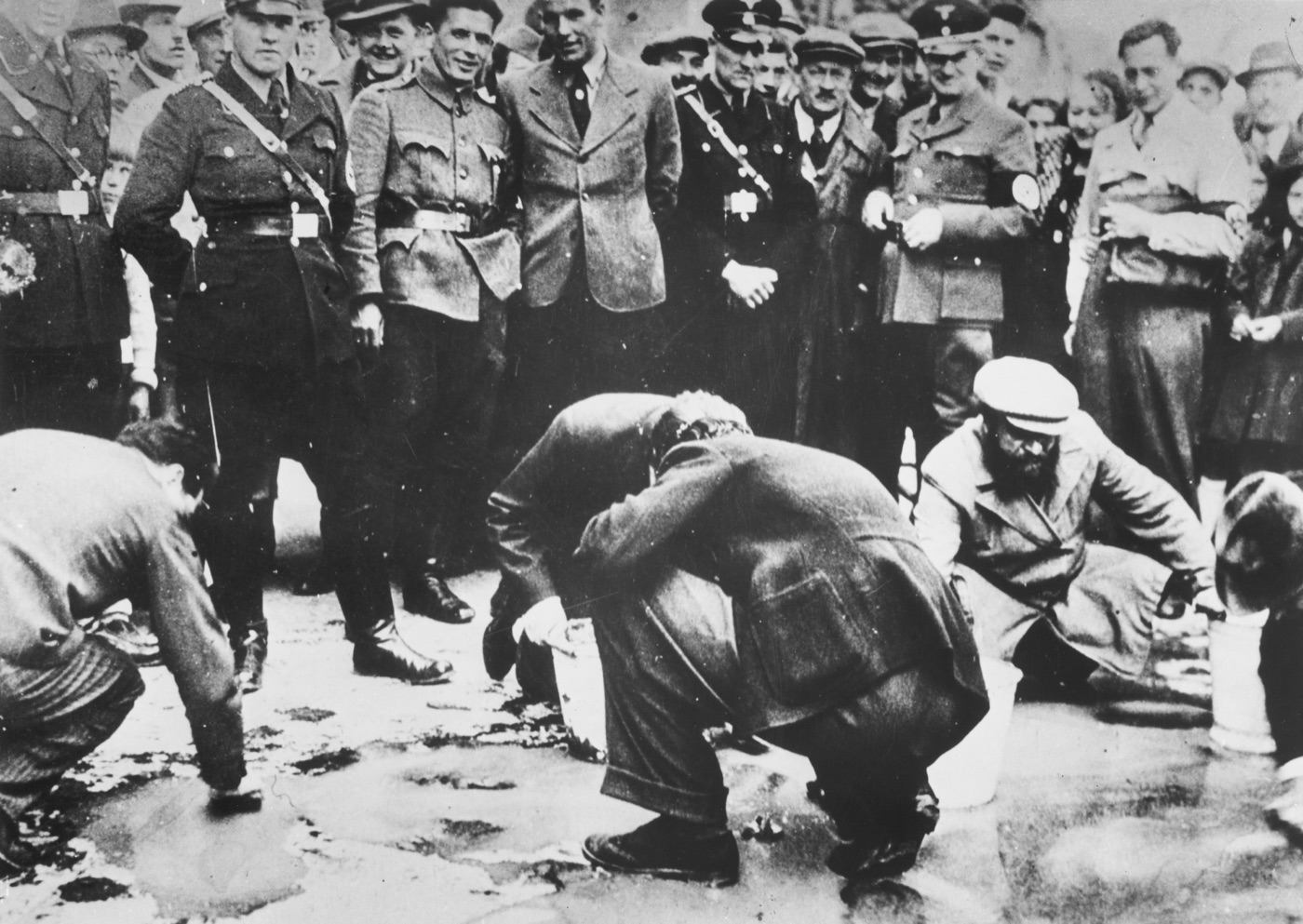
Photographed by a German participant or onlooker Photographer unknown · March to April 1938 · United States Holocaust Memorial Museum Public domain View the record: Vienna, March or April 1938. Jewish men forced onto their hands and
The people forced to kneel here were photographed in the middle of a public humiliation and did not consent to any of it. We publish the photograph because the crowd is in it, and the crowd is the point.
The violence began on March 11, the night Schuschnigg resigned, before German troops had crossed the border.
So this was painted all over. So they ca- got the Yidden to s- to cr- scrub it off with cold water and a brush. ... They would call them in and make them scrub with cold water with a brush. So I was, I went Purim. I went to bring shalach manos to my aunt. So she happened to live on the market square and in our neighborhood ... And I saw a whole crowd in the center there, where there was a wa- a clock ... and people were scrubbing. I saw it.Kitty Schick, who was 11 or 12, on the slogans from the canceled plebiscite and what she saw on Purim 1938, days after the Anschluss. Project Witness testimony.Watch the full testimony. This passage begins at 1:04:13: Kitty Schick, Project Witness
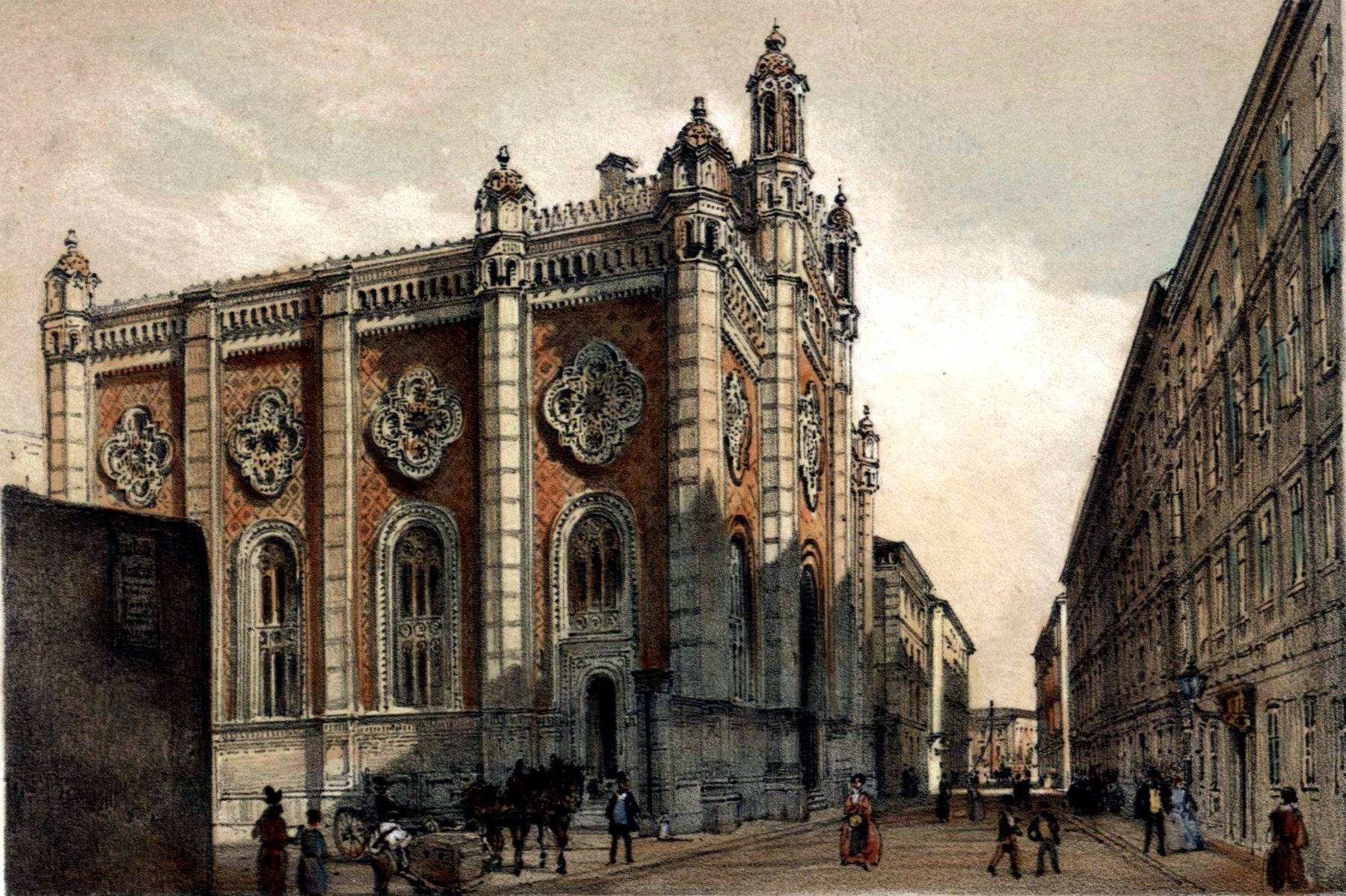
Among the people forced to scrub the sidewalks was Israel Taglicht, then in his seventies, the rabbi of the Leopoldstädter Tempel since 1932. He was made to carry a placard that read "I am a Jew," and he was beaten. Foreign pressure got him out to England.
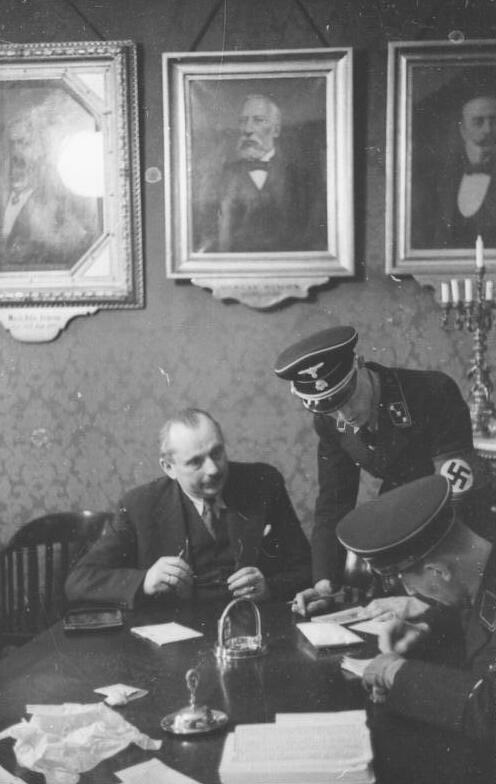
Photographed by the SS Photographer unknown · March 18, 1938 · Bundesarchiv, Bild 152-65-15A CC BY-SA 3.0 de: licence for An SS raid on the offices of the Vienna Jewish community, March 18, View the record: An SS raid on the offices of the Vienna Jewish community, March 18,
The community's offices were shut and its board members were imprisoned at Dachau. By the summer of 1939 hundreds of factories had been closed and thousands of Jewish-owned businesses confiscated.
Adolf Eichmann, then an SS captain, set up a Central Office for Jewish Emigration in Vienna with Walter Stahlecker. Its purpose was forced emigration: Jews were pushed out of the country and stripped of most of what they owned as they went, and it was efficient enough that it became the model exported back to Germany. By May 17, 1939, nearly half of Austria's Jews had emigrated, leaving about 121,000 behind.
Leaving meant standing in long lines, night and day, outside municipal, police and passport offices, paying an exit fee, and registering almost everything you owned, which was taken as you went.
And my mother put me on the, on the train, and I looked around me and everyone was crying, and, and it was a terrible scene. And I looked at my mother, and she was smiling. And I said, "Mama, warum weinst du nicht?" [Mama, why aren't you crying?] ... And, and she said, "Mein Kind [my child], why should I cry? I'm going to see you very soon ... Don't worry."Blanka Rosenfeld, who was nine when her mother put her and one of her brothers on a Kindertransport from Vienna. She never saw her mother again. Project Witness testimony.Watch the full testimony. This passage begins at 4:33: Blanka Rosenfeld, Project Witness
Kristallnacht, eight months after the Anschluss, was particularly brutal in Vienna. Most of the city's synagogues and small prayer houses were set on fire, and many burned to shells while the public and the fire department looked on. The Leopoldstädter Tempel was set on fire on the morning of November 10. Thousands of Jewish men were arrested and sent to concentration camps.
Some uniformed Nazis came into our apartment, and I had money stuffed into my stockings 'cause we figured they wouldn't search a little girl. And of course, many, many years later I realized that this must have been the night of November 9th and 10th, which was Kristallnacht. My father's shtiebel was ransacked. All the holy books and the Torah scrolls were thrown onto a bonfire in the middle of the street.Frieda Korobkin, who was six; her father, an Orthodox rabbi, led a small shtiebel in Vienna. Project Witness testimony.Watch the full testimony. This passage begins at 5:00: Frieda Korobkin, Project Witness
The deportations began in the autumn of 1939, when about 1,500 Jews were sent from Vienna to Nisko in occupied Poland. By October 1942 only about 8,000 Jews were left in Austria. In the end some 47,555 Austrian Jews were deported east, and the vast majority of them were murdered.
The ninety-nine percent
A new plebiscite was held on April 10, after the fact, and returned about 99 percent in favor of the union. Two things about that number.
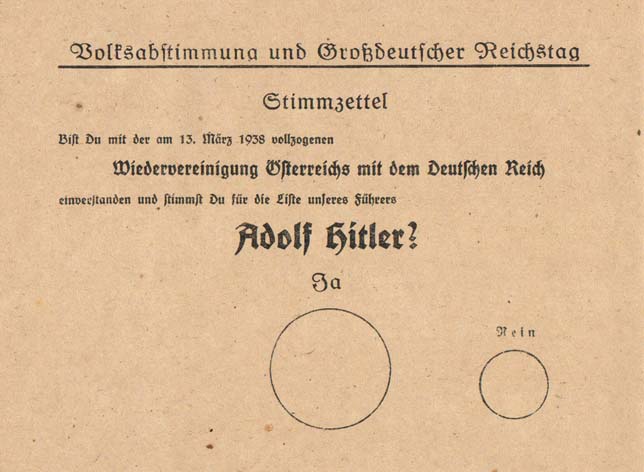
Photographer unknown · 1938 · Wikimedia Commons Public domain View the record: The ballot paper. The circle for Ja is roughly twice the diameter of
And between 300,000 and 400,000 people were barred from voting altogether: Jews, Roma, and political opponents, who were the people the vote was about.
Why this is a turning point
Vienna is where the machinery was tested at speed. Germany had taken five years to move from boycott to expropriation. Austria was made to run the same course in about fifteen months, and the Central Office for Jewish Emigration invented there became the template.
It also settled a question that had been open. The powers that could have acted did not, and the regime drew the obvious conclusion.
The next turning point in this series is the closing of the doors in 1938 and 1939, when Evian, the Kindertransport and the St. Louis showed whether anywhere would take Europe's Jews in.
The dates
Three days for the country, and a great deal less than that for the people living in it.
Show the other 3 dates
Questions people ask
What does Anschluss mean?
Was Austria Hitler's first victim?
Did anyone resist?
What were the scrubbing parties?
Why did the anti-Jewish measures move so fast in Austria?
What was the Central Office for Jewish Emigration?
How many Austrian Jews got out?
Why did other countries not stop it?
Was the 99 percent vote rigged?
What happened to Vienna's Jewish community?
Free, and made for a classroom
Project Witness is a nonprofit Holocaust education organization in New York. Tell us what you teach and we will send you what fits your classroom.
How we know
Every source this page rests on.
- Nazi Territorial Aggression: The Anschluss United States Holocaust Memorial Museum, Holocaust Encyclopedia
- Vienna United States Holocaust Memorial Museum, Holocaust Encyclopedia
- Stimmzettel, the ballot paper for the plebiscite of April 10, 1938 Wikimedia Commons, scan by a Wikipedia contributor
- The Moscow Declaration The Avalon Project, Yale Law School
- Adolf Eichmann United States Holocaust Memorial Museum, Holocaust Encyclopedia
- Adolf Hitler: Early Years, 1889-1921 United States Holocaust Memorial Museum, Holocaust Encyclopedia
- Austria United States Holocaust Memorial Museum, Holocaust Encyclopedia
- Taglicht, David Israel Encyclopaedia Judaica (2007), via the Jewish Virtual Library
- Leopoldstädter Tempel (in German) Wien Geschichte Wiki, City of Vienna
- The Evian Conference United States Holocaust Memorial Museum, Holocaust Encyclopedia
- Voyage of the St. Louis United States Holocaust Memorial Museum, Holocaust Encyclopedia
- Anti-Jewish Legislation in Prewar Germany United States Holocaust Memorial Museum, Holocaust Encyclopedia
- 1938 Key Dates United States Holocaust Memorial Museum, Holocaust Encyclopedia
Words used on this page
Show the term
- Anschluss
- Germany's annexation of Austria on March 11 to 13, 1938. The regime called it reunification, which the Holocaust Encyclopedia calls a misnomer, because Austria had never been part of the German Empire. Source: USHMM Holocaust Encyclopedia, Nazi Territorial Aggression: The Anschluss, for Anschluss