Turning Points · 1942
The camps were not all the same kind of place.
A concentration camp and a killing center were different institutions with different purposes, and the word most people use covers both. Here is what each one was, who was in it, and what happened to them.
Project Witness records and preserves Holocaust survivor testimony. This page is free to use, in classrooms and out of them.
Written for readers 14 and up. Some pages describe killing methods and public humiliation.
The concentration camps: the short answers
- How many camps
- USHMM documents more than 44,000 camps, ghettos and other sites of incarceration. The volume of its encyclopedia that covers the SS concentration camps describes 23 main camps and 898 subcamps.
- The first camp
- Dachau, March 22, 1933. Seven weeks after Hitler became chancellor.
- What they were for
- Holding people the regime called enemies, with no charge, no trial and no release date. Work, punishment, terror.
- Why they existed at all
- Antisemitism was at the foundation of the Holocaust, in USHMM's words, and a basic tenet of Nazi ideology. The first prisoners in 1933 were the regime's German political opponents. Beginning in 1941 Nazi leaders decided to murder the Jews of Europe, and that decision changed what the camps were used for.
- Concentration camp vs killing center
- A concentration camp registered you and worked you. A killing center murdered you within hours and never wrote your name down.
- Who was held
- German Communists, Social Democrats and trade unionists first. Then Jehovah's Witnesses, Roma and Sinti, gay men, clergy, people the regime classified as asocial, Soviet prisoners of war, and Jews: a few at first, then about 26,000 after Kristallnacht in November 1938.
- The deadliest
- Auschwitz-Birkenau, a concentration camp and a killing center at once, with approximately one million Jewish victims. After it, Treblinka II, with an estimated 925,000.
- Liberation
- Majdanek in July 1944. Bergen-Belsen April 15, 1945, Dachau April 29, Theresienstadt May 9.
- Where the camps sit in the Holocaust
- Six million Jews were murdered. USHMM states that figure in its own voice, independent research lands between five and six million, and Yad Vashem writes that there is no precise figure. Approximately 2.7 million of the six million were murdered at the five killing centers.
- How many died in the camps
- An estimate USHMM cites puts deaths of registered concentration camp prisoners at 795,889 to 955,215, not counting registered Jewish prisoners at Auschwitz and Majdanek. Adding the Jews, registered and unregistered, murdered at Auschwitz, approximately one million, and at Majdanek, at least 89,000, gives 1,885,889 to 2,045,215. The Majdanek component is disputed. Chelmno, Belzec, Sobibor and Treblinka II are in neither figure: they stood outside the concentration camp system, and almost nobody sent there was ever registered.
Each of these has a fuller answer below.
What were the concentration camps?
A prison outside the law, opened in 1933 for Germans, six years before the war and eight years before the first killing center.
A Nazi concentration camp was a prison camp where people were held with no charge, no trial and no release date. The SS called the instrument Schutzhaft, protective custody, which meant arrest with no judge and no end. You were sent for what you were or what you believed, then registered, numbered, marked with a colored triangle and put to work. Death was common. For most prisoners, death was not the reason they had been brought there.
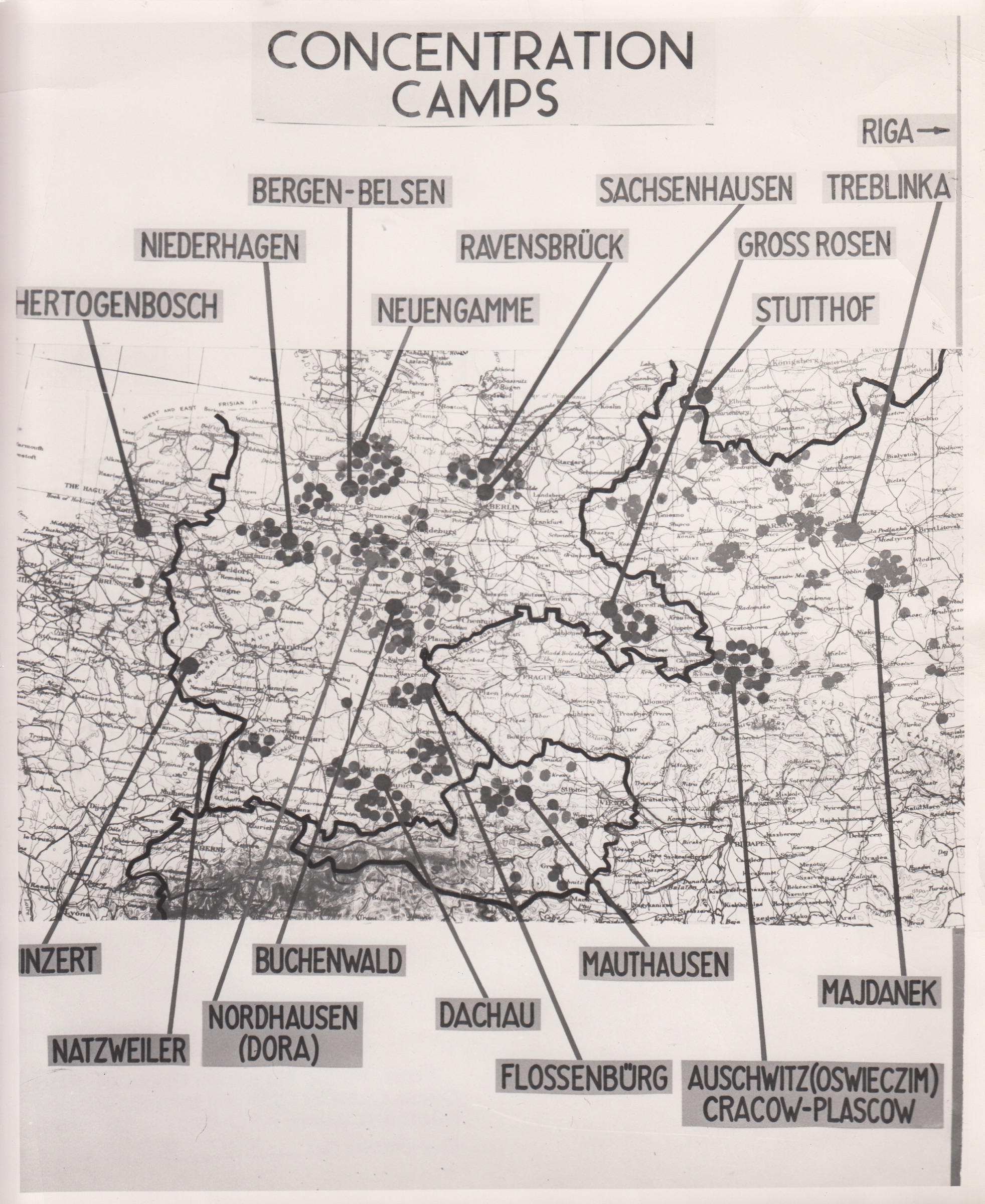
The prosecution's own map of the network, put in evidence at United States v. Oswald Pohl, the 1947 Nuremberg trial of the SS office that ran the camps. One heading files Treblinka and Majdanek and Auschwitz alongside Dachau, and that flattening is what the rest of this page takes apart. Map of concentration camp locations, prosecution exhibit at the Pohl Trial, Nuremberg, 1947. National Archives and Records Administration, 169155812.
Trial exhibit OMGUS Military Tribunal · April 8, 1947 · US National Archives and Records Administration, NARA catalog id 169155812 Public domain View the record: The prosecution's own map of the network, put in evidence at United
The ideology came before the camp. Antisemitism was at the foundation of the Holocaust, USHMM writes, and a basic tenet of Nazi ideology: the regime blamed Jews for Germany's social, economic, political and cultural problems and taught that Jews were a separate and inferior race. In 1933 that belief acquired a police force and a prison camp. The people it put in the camp first were Germans, Communists and Social Democrats and trade unionists, and for five more years the campaign against Jews ran through law and boycott and the street rather than through the wire. Then, on November 10 and 11, 1938, in the days after Kristallnacht, almost 11,000 Jewish men were interned at Dachau. Most were released within weeks or months, many after proving they had arranged to leave the country. The object then was still to drive Jews out of Germany.
Then the object became killing them. Beginning in 1941, in USHMM's wording, Nazi leaders decided to implement the mass murder of Europe's Jews, and the German government's own name for it was the Final Solution to the Jewish Question. USHMM calls the decision to deport and systematically murder the European Jews one of the most significant events to alter the makeup of the concentration camp system. Five killing centers were built to carry it out, four of them outside the concentration camp system altogether. Inside the concentration camps the effect was a sorting: the ability to work offered a Jew the chance of survival, and the ones the SS judged unable to work were the first to be shot or deported.
Six million Jews were murdered. USHMM states the number in its own voice. No single German document accounts for every death; the figure is built from hundreds of thousands of pages of German records read against prewar and postwar population data, and independent research lands between five and six million, because the estimates rest on census comparisons and wartime documents, not on a single list of names. Of the six million, approximately 2.7 million were murdered at the five killing centers. About 2 million were murdered in mass shootings and related massacres. Between 800,000 and 1,000,000 were murdered in ghettos, labor camps and concentration camps.
War was used as grounds to ban releases in September 1939, which handed the SS a captive labor force. In March 1942 Himmler folded the camp Inspectorate into the SS Economic-Administration Main Office under Oswald Pohl, and the SS began renting prisoners to war industries for a fee.
The biggest number attached to the word is the one most often misused. USHMM's Encyclopedia of Camps and Ghettos project covers more than 44,000 camps, ghettos and other sites of incarceration: about 6,000 written up in narrative entries, prisoner-of-war camps and military brothels among them, and an estimated 38,000 forced-labor camps for a database still to come with Volume VII. Volume I, the volume that covers the SS concentration camps, describes 23 main camps and 898 subcamps. A headline reporting 44,000 concentration camps is off by a factor of roughly fifty.
A concentration camp and a death camp are not the same thing
Six kinds of site, six questions you can ask yourself. The answers are not interchangeable.
Most people call every Nazi site a concentration camp. It is the commonest error in the subject and it is not a quarrel about vocabulary. The phrase makes a reader picture barracks, roll call and a prisoner population in the tens of thousands. At Treblinka almost everyone was dead within hours of the train stopping.
-
Concentration camp
In GermanKonzentrationslager, KL or KZ
The question that separates itWere people registered and kept alive to be used?
Arrivals went on the roll, took a number and were worked. Dachau had a gas chamber that was never used for mass killing. At least 41,500 people died there anyway.
Dachau, Buchenwald, Sachsenhausen, Mauthausen, Ravensbrück
-
Forced-labor camp
In GermanVernichtung durch Arbeit, the policy USHMM renders as annihilation through work
The question that separates itWas the site built around a job?
A quarry, a plant, a rail line. Move the work and the camp has no reason to exist. The SS also used work itself as a way of killing: certain prisoners were put to labor in conditions built to produce illness, injury and death.
Treblinka I, Trawniki, Budzyń, the Dachau subcamps
-
Killing center
In GermanVernichtungslager, death camp
The question that separates itWas there a camp population?
If the answer is a work detail of several hundred to a thousand prisoners and nobody else, because everyone else was killed on arrival, it is a killing center. USHMM counts five, Yad Vashem six.
Chelmno, Belzec, Sobibor, Treblinka II, Auschwitz-Birkenau
-
Transit camp
In GermanDurchgangslager
The question that separates itWhere did people die?
If the mass death attached to a site happened at the end of a train line elsewhere, it is a transit camp. Westerbork had a school, and from 1943 a train left every Tuesday.
Westerbork, Drancy, Mechelen, Fossoli di Carpi
-
Ghetto
In GermanJüdischer Wohnbezirk for the open kind
The question that separates itWas it a place that already existed?
A district of a real town, with streets and a prewar name, walled or fenced or declared off limits. A camp is purpose-built barracks. Theresienstadt sits on the line.
Warsaw, Łódź, Kraków, Vilna
-
Prisoner-of-war camp
In Germanrun by the army, not the SS
The question that separates itWho ran it, and who was in it?
A formal distinction that says nothing about how deadly the camp was. About 3.6 percent of British and American prisoners died in German hands. About 57 percent of 5.7 million Soviet prisoners did.
Stalag IX B, Bergen-Belsen 1940 to 1945
Treblinka shows why the labels carry weight. There were two Treblinkas a mile apart with the same name. Treblinka I was a forced-labor camp. Treblinka II was a killing center, and in fourteen months its staff murdered an estimated 925,000 Jews there, along with Poles, Roma and Soviet prisoners of war in unknown numbers. A handful from each transport were kept alive to run the killing. Isadore Helfing lived because the prisoner who drove the camp's horse cart was shot and he was picked to replace him.
In account of that thing, I survived in Treblinka. I, from then on I had nothing to do with the people, with the, working by the dead people. I just used the horse. I learned how to clean horses, and feed them, and bring water.
Isadore Helfing, one of the small number of Jewish prisoners kept alive at Treblinka as labor. United States Holocaust Memorial Museum Collection.
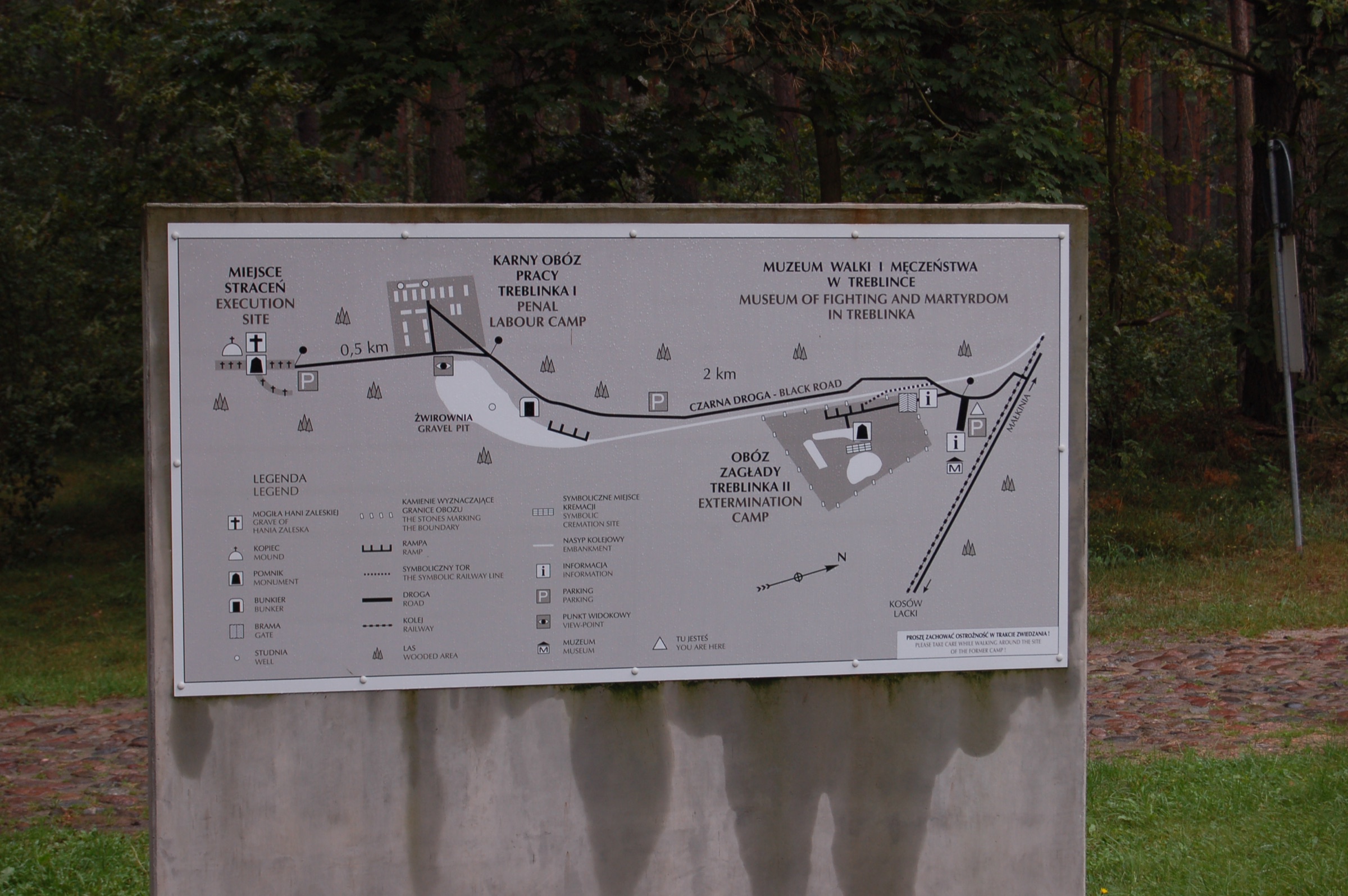
The on-site plan of both Treblinka camps, the labor camp and the killing center a mile apart. Tajchman Maria / Wikimedia Commons, CC BY-SA 4.0. Labels in Polish.
Postwar memorial photograph Tajchman Maria · August 29, 2009 · Wikimedia Commons (photograph of an on-site interpretive plan) CC BY-SA 4.0: licence for The on-site plan of both Treblinka camps, the labor camp and the View the record: The on-site plan of both Treblinka camps, the labor camp and the
Try it: what kind of place was this?
Seven camps. Decide what kind of place each one was, then check your answer against its record.
Bergen-Belsen
Show the answer
A concentration camp.
The question that separates itWere people registered and kept alive to be used?
It was not a killing center. It became a place of mass death in its last four months, when the SS emptied camps in the east and dumped tens of thousands of starving people here with no food, no water and no sanitation, and typhus did the rest.
Open the record for Bergen-BelsenTreblinka II
Show the answer
A killing center.
The question that separates itWas there a camp population?
Most people who arrived were dead within two hours. There was no registration, no tattoo, no prisoner number.
Open the record for Treblinka IIWesterbork
Show the answer
A transit camp.
The question that separates itWhere did people die?
Westerbork was an orderly place with a hospital, a school, a cabaret and a football pitch, run day to day by a Jewish administration under German command, and every Tuesday a train left it for the east. That is the whole horror of a transit camp: the conditions inside were bearable precisely because nobody was meant to stay.
Open the record for WesterborkAuschwitz
Show the answer
A concentration camp and killing center.
Established as a concentration camp in spring 1940, Auschwitz became a killing center as well when mass gassing began at Birkenau in 1942. The two functions ran side by side on the same complex until the end.
Open the record for AuschwitzTreblinka I
Show the answer
A forced-labor camp.
The question that separates itWas the site built around a job?
Treblinka I was a gravel-pit labor camp about a mile and a half from the killing center. Polish and Jewish prisoners worked the quarry and a nearby irrigation project. People were imprisoned here, held for months, and died of exhaustion, beatings and shooting.
Open the record for Treblinka IDachau
Show the answer
A concentration camp.
The question that separates itWere people registered and kept alive to be used?
It was a prison outside the law: no charge, no trial, no release date. It was never a killing center.
Open the record for DachauTheresienstadt
Show the answer
A transit ghetto.
The question that separates itWhere did people die?
Tens of thousands died there of hunger, overcrowding and disease. Most of the rest were put on trains to Auschwitz and the other killing centers.
Open the record for Theresienstadt
All 61 camps are sorted this way in the directory further down this page, each with its full record.
The camp that was built to be photographed
At Theresienstadt most of the surviving photographs and film were made in order to deceive. Publishing them without saying so delivers the SS message intact.
Theresienstadt was an eighteenth-century garrison town in Bohemia. The SS emptied it of its Czech inhabitants and began filling it with Jews on November 24, 1941. USHMM calls it at once a transit ghetto for Czech Jews and an old-age ghetto for elderly German and Austrian Jews, decorated veterans of the First World War, and well-known figures such as artists and community leaders. In May 1943 the SS renamed it a Jewish settlement.
Then they rebuilt it. The campaign had a name, Verschönerung, beautification. USHMM dates the order to February and March 1944, the Terezín Initiative Institute to the end of 1943. Crews put up a music pavilion, a playground, a theater, shops and a café, and barbed wire came down along the visitors' route. A month before the visit one building was fitted out as a school. No lesson was ever taught in it. About 7,500 people were deported to Auschwitz between May 15 and May 18, 1944 to thin the look of overcrowding. Most were murdered on July 10 and 11.
The delegation came on June 23, 1944 and stayed from 11 in the morning until 7 at night. Maurice Rossel of the International Committee of the Red Cross conducted it, with three months of practical experience, alongside two Danes. German officers escorted them throughout, and Rossel was not allowed to speak privately with anyone except the Jewish elder, Paul Eppstein, who welcomed the delegation with figures the SS had falsified. They watched the finale of the children's opera Brundibár and a soccer game with a cheering crowd. All three reported favorably and repeated the lie that Jews were not deported from Theresienstadt. Eight hours bought that. Rossel's report called Theresienstadt a final camp from which nobody was normally sent on, and the ICRC's archives record that its 1946 report left the visit out.
In August and September 1944 the SS filmed the place. The title on the film is Theresienstadt. Ein Dokumentarfilm aus dem jüdischen Siedlungsgebiet, a documentary film from the Jewish settlement area, which carries the SS fiction in the title; it is widely known by another name, Der Führer schenkt den Juden eine Stadt, which was not the title on the film. Kurt Gerron, a Jewish German director imprisoned there, was made to direct it under SS supervision, and the cast and musicians were prisoners. Gerron went to Auschwitz on the last train out, October 28, 1944, and was killed on arrival. The film survives only in fragments, and many of the people visible in them were murdered within weeks of being filmed smiling.
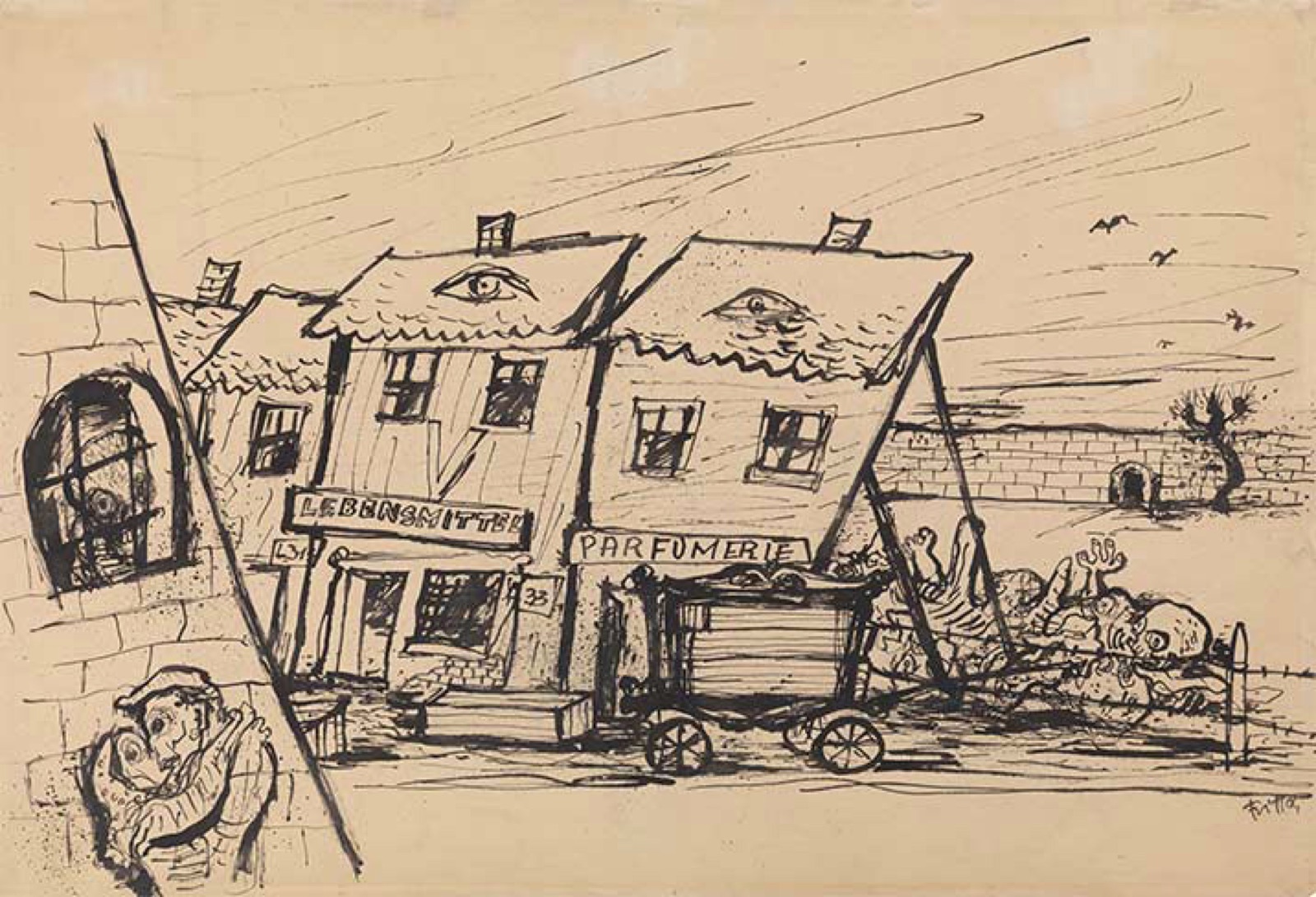
Bedrich Fritta, Facades for the International Commission. Fritta ran the ghetto's drawing office, which produced graphic work to SS order, and secretly used its materials to draw what was actually there. Ink, pen and brush. Jewish Museum Berlin, permanent loan from the Fritta-Haas family. Public domain via Wikimedia Commons.
Made clandestinely by a prisoner Bedrich Fritta (Fritz Taussig), 1906 to November 1944 · 1943 or 1944, Jewish Museum Berlin prints 1943/44 and adds that it may be as early as autumn 1942 · Wikimedia Commons Public domain View the record: Bedrich Fritta, Facades for the International Commission. Fritta ran
Watch, 1:51:40 Free, no sign-up
Ella Stein-Weisberger, born 1930 in Lom u Mostu, was a child in Theresienstadt and sang in the children's opera Brundibár. She describes the plywood plaque she burned the Theresienstadt emblem into by hand, inscribed on the back to her mother. Free to watch. Project Witness.
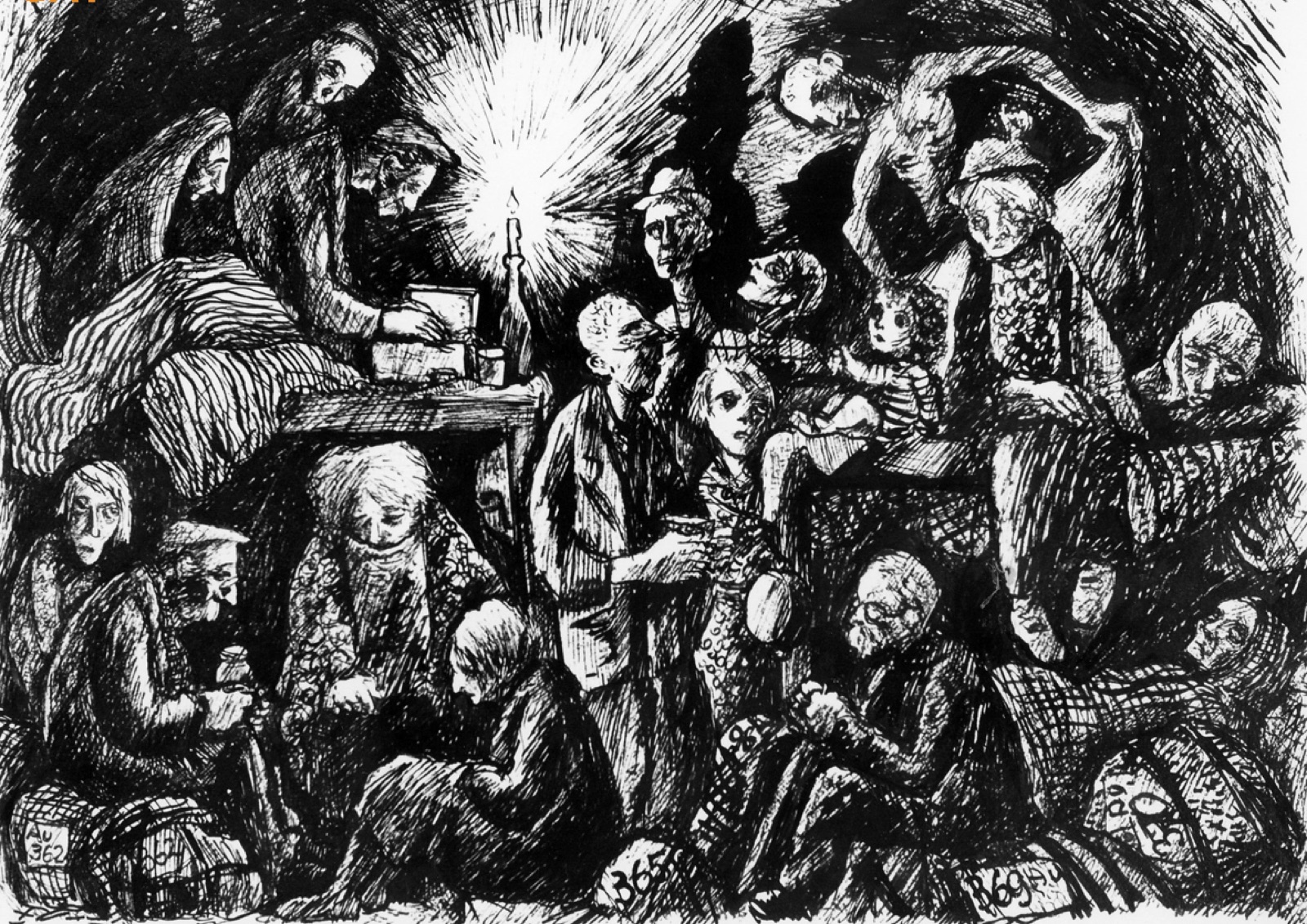
Bedrich Fritta, In the Living Quarters. The SS found drawings like this one in the summer of 1944 and called them atrocity propaganda. Fritta and his family were sent to the Gestapo prison in the Small Fortress on July 17. He was deported to Auschwitz in October and died there in November. Ghetto Fighters House, via Wikimedia Commons. Public domain.
Made clandestinely by a prisoner Bedrich Fritta (Fritz Taussig), 1906 to November 1944 · between 1941 and 1944 · Wikimedia Commons Public domain View the record: Bedrich Fritta, In the Living Quarters. The SS found drawings like
The beautification saved nobody who performed in it. USHMM records more than 18,000 people deported from Theresienstadt to Auschwitz on 11 transports between September 28 and October 28, 1944, after the filming, and many of the people visible in the film were on them. About 140,000 Jews were sent to Theresienstadt in all. Deaths inside the ghetto are put at about 34,000 by USHMM and over 35,000 by the Terezín Memorial. USHMM counts about 88,000 deported onward and 3,500 survivors of those transports. The Memorial counts more than 87,000 sent east on 63 trains and 3,800 who lived to see liberation. Nothing here is averaged. Soviet troops entered on May 9, 1945 and found around 30,000 alive.
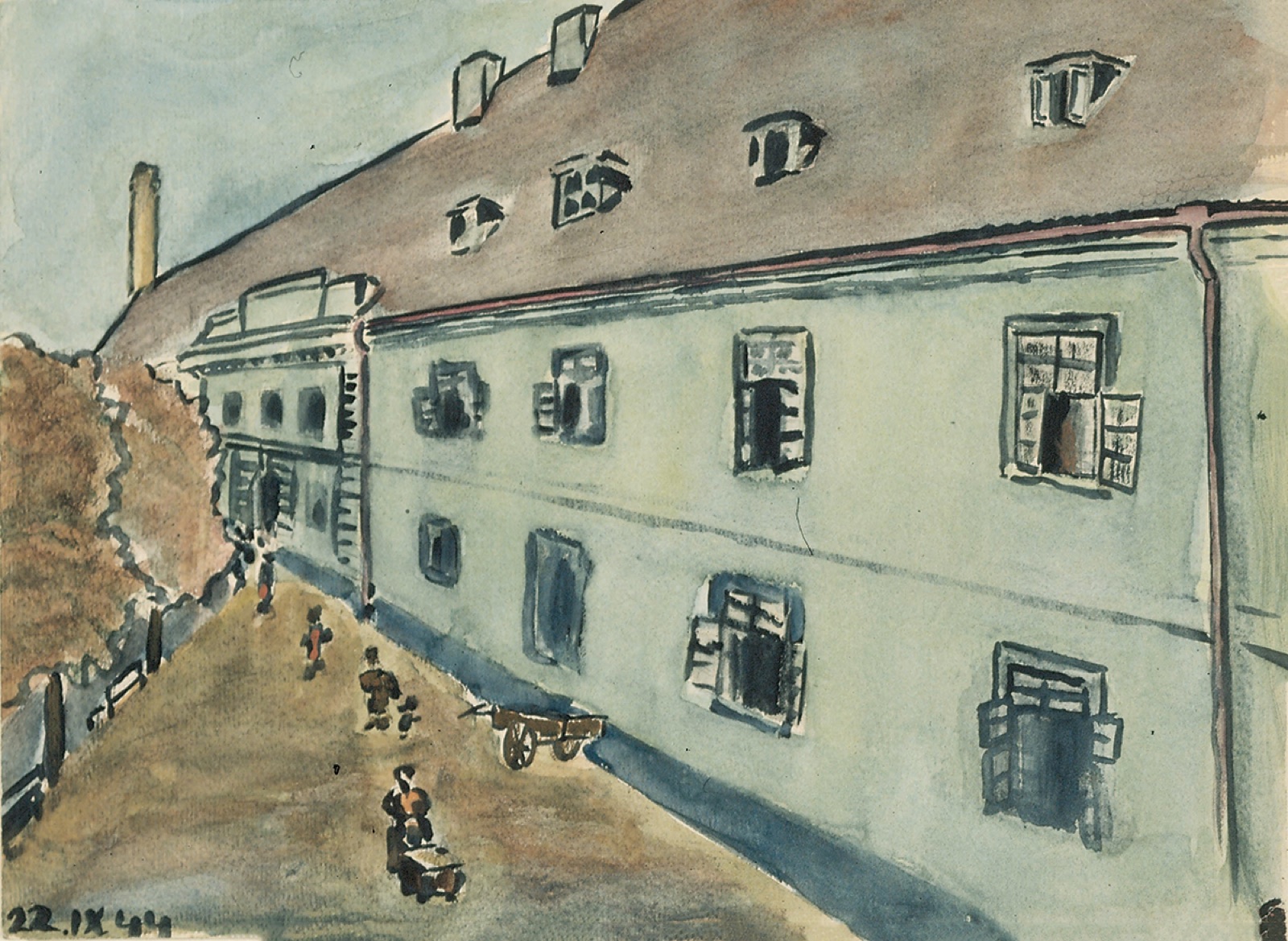
Petr Ginz, Street in Theresienstadt. Ginz was deported from Prague to Theresienstadt in 1942, at fourteen, and edited Vedem, the clandestine magazine he and other boys in the youth barracks wrote and passed around. He drew this street from inside the ghetto and dated it in the lower left, 22.IX.44. The SS had finished filming the town on September 11, eleven days before the date on this sheet. Six days later, on September 28, 1944, Ginz was deported to Auschwitz and murdered on arrival. He was sixteen. Watercolor, ink and pencil on paper. Collection of the Yad Vashem Art Museum, Jerusalem.
Made clandestinely by a prisoner Petr Ginz (1928-1944) · Inscribed 22.IX.44 in the lower left, read as September 22, 1944. Yad Vashem publishes no date for this sheet. · Yad Vashem Art Museum, Jerusalem Yad Vashem View the record: Petr Ginz, Street in Theresienstadt. Ginz was deported from Prague to
...one day when we were doing the drawings with her, she said, children, you are not number. You have a name.
Ella Stein-Weisberger, who was a child in Theresienstadt, remembering her art teacher. Project Witness testimony. Watch the full testimony. This passage begins at 43:54: Ella Stein-Weisberger, Project Witness
Dachau
Dachau opened on March 22, 1933, seven weeks after Hitler took power, on the grounds of a disused munitions factory ten miles northwest of Munich. Himmler announced it as the first concentration camp for political prisoners, and that is who arrived: German Communists, Social Democrats, trade unionists.
That October the commandant, Theodor Eicke, issued brutal punishment rules and standing orders for the camp SS. Made Inspector of Concentration Camps, he imposed the Dachau code on the whole system, and Dachau became the training school for SS guards. It matters not because it was first but because it was copied.
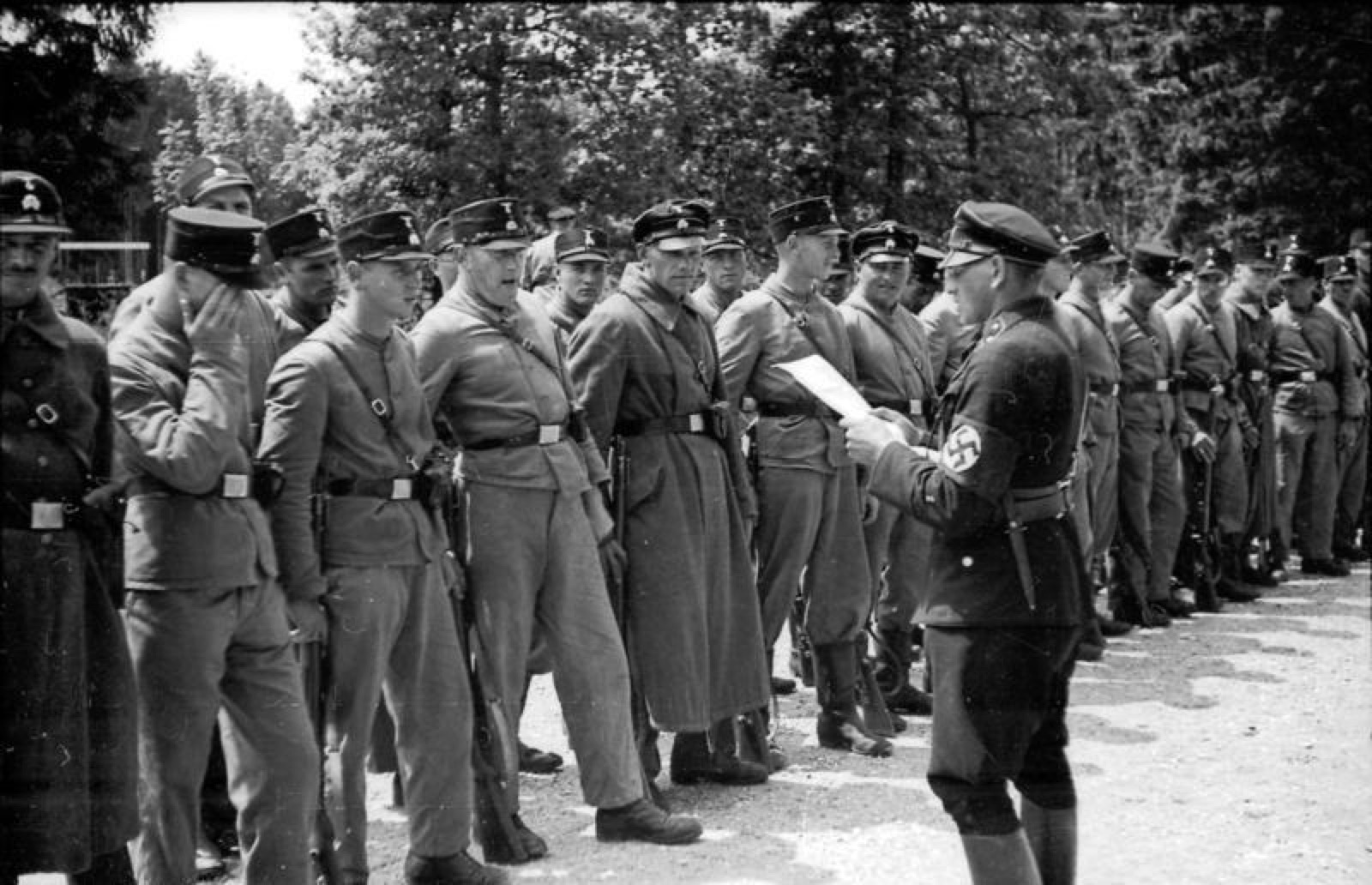
SS guard detachment on parade, Dachau, May 27, 1933. Photograph by Friedrich Franz Bauer. Bundesarchiv, Bild 152-01-16 / Friedrich Franz Bauer / CC BY-SA 3.0 DE.
Photographed at the time Friedrich Franz Bauer · May 27, 1933 · Bundesarchiv, Bild 152-01-16 CC BY-SA 3.0 de: licence for SS guard detachment on parade, Dachau, May 27, 1933. Photograph by View the record: SS guard detachment on parade, Dachau, May 27, 1933. Photograph by
Its population tracked the regime's growing list of enemies: Jehovah's Witnesses, Roma, gay men, people it classified as asocial, clergy, Soviet prisoners of war. After Kristallnacht almost eleven thousand Jewish men were interned here. Most were released within weeks or months, many after proving they had arranged to leave Germany. Jews came back in numbers only at the end, on transports out of the east.
Dachau ran roughly 140 subcamps, most of them in southern Bavaria at armaments plants. Kaufering and Muehldorf, the largest complexes, were built to dig bombproof bunkers for fighter-plane factories. David Lenga was seventeen when he was sent from Auschwitz to Dachau on August 31, 1944, where he was “registered, de-loused and assigned the barrack and the wooden bin where I had to live and sleep.” From there he was transferred to Kaufering. From 1942 physicians ran high-altitude, hypothermia, seawater, and drug experiments here, and hundreds died or were harmed.
And I knew I'm gonna be killed. I knew it. So my right hand and my left hand all of a sudden started moving in perfect harmony. And the Strauss Blue Danube was heard coming out of my violin. ... Instead, the SS guard was humming the melody ... And he, he just smiled and, “Let him live.”
Sandor (Shony) Alex Braun, oral history, United States Holocaust Memorial Museum Collection. Hear it at the United States Holocaust Memorial Museum: Sandor (Shony) Alex Braun
Dachau had a gas chamber and it was never used for mass killing. It stood in the 1942 crematorium building known as Barrack X, and USHMM's finding is flat: no credible evidence it was used to murder human beings. Selection did the work instead. Prisoners too sick to work went to the Hartheim killing center near Linz, where more than 2,500 Dachau prisoners were gassed. Others were shot on the camp's ranges, at least 4,000 Soviet prisoners of war among them. At least 41,500 died at Dachau by the memorial's count and at least 40,000 by USHMM's. Both are floors: men brought here to be executed were never registered.
Typhus broke out in December 1944, and more than fifteen thousand prisoners died of disease, starvation and SS violence before liberation, more than a third of everyone Dachau killed in twelve years. On April 26, 1945 the registers listed 67,665 prisoners across the camp and its subcamps. That day the SS marched more than seven thousand south toward Tegernsee, and at least 25,000 were walked or shipped out in all. Anyone who could not keep going was shot.
American units reached the camp on April 29, 1945 and freed roughly 32,000 people. Part of the gap between 67,665 and 32,000 is the marches; the rest is the subcamps, which the 67,665 included. On the approach the troops found more than thirty railroad cars of bodies.
Saturday we arrived to Dachau, and Sunday morning we were liberated by the Americans. ...somebody came in, a Jewish soldier comes in.
Yitzchok Weiss, who reached Dachau the day before it was liberated. Project Witness testimony. Watch the full testimony. This passage begins at 25:27: Yitzchok Weiss, Project Witness
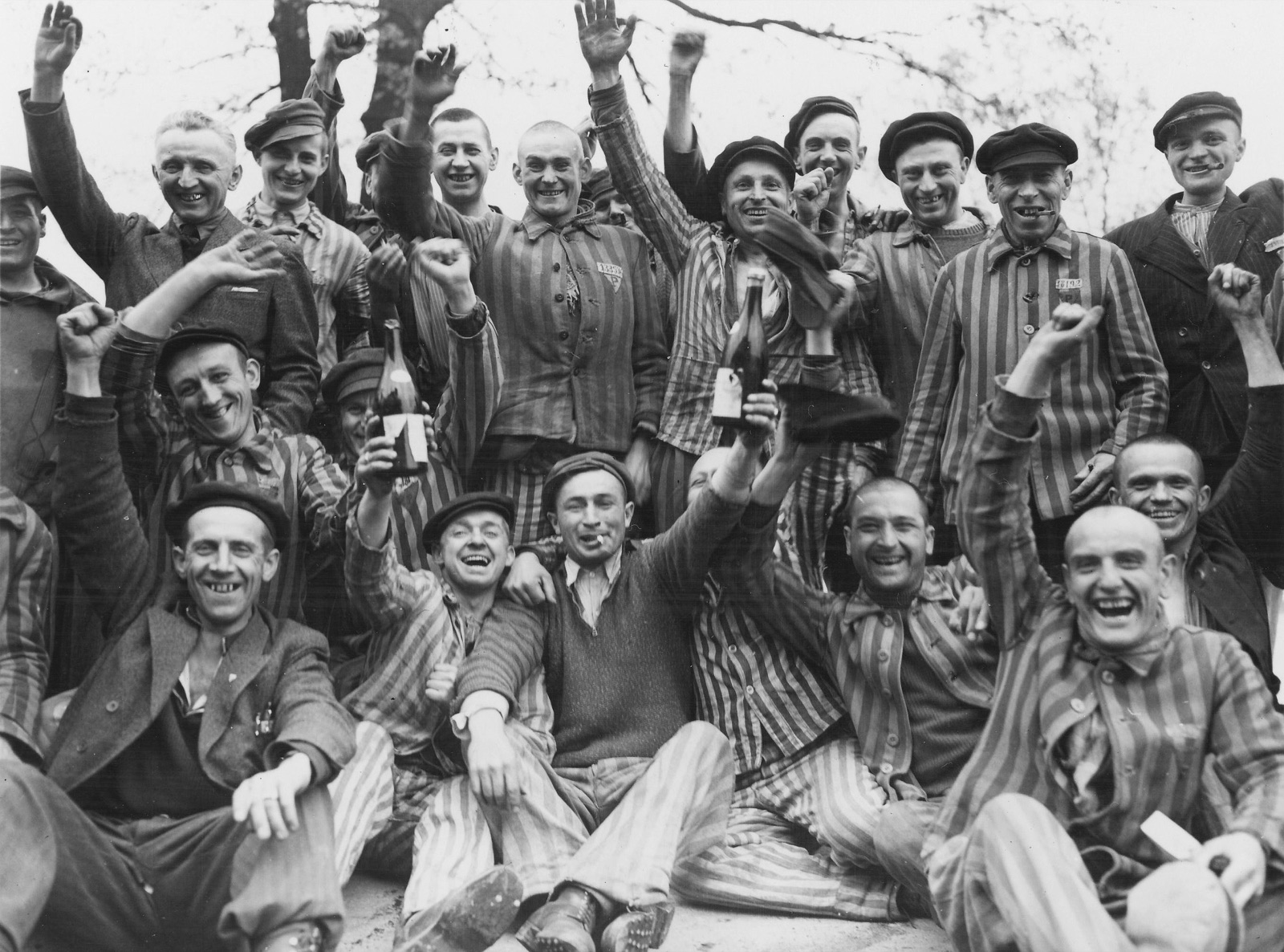
Polish prisoners celebrate their liberation, Dachau, April or May 1945. Photograph by T/4 Arland Musser, US Army Signal Corps. National Archives and Records Administration, 111-SC-207743.
Photographed by liberating forces T/4 Arland Musser, US Army Signal Corps · April 29 to May 1945 · United States Holocaust Memorial Museum, photograph #83818, USHMM #83818; NARA 111-SC-207743 Public domain View the record: Polish prisoners celebrate their liberation, Dachau, April or May
Bergen-Belsen
Bergen-Belsen was not a killing center. It killed by hunger, thirst, cold, filth, and epidemic disease, and by an SS administration that watched and did nothing. Bella Jakubowicz Tovey, deported to Bergen-Belsen in 1944 from a subcamp of Gross-Rosen, put the difference plainly: “Bergen-Belsen was, was not a, was not like Auschwitz. There were no gas chambers. They didn't need any gas chambers, it was a really death camp.”
It began as a Wehrmacht camp, built in 1940 eleven miles north of Celle, and until 1943 it held only prisoners of war. Some fourteen thousand Soviet prisoners died there by the spring of 1942, and more than 19,500 lay in the camp cemetery by January 1945. Almost no popular account of Belsen mentions them.
In April 1943 the SS took the southern section from the army and made it an Aufenthaltslager, holding Jews it meant to trade for Germans interned abroad, or for currency and goods. Conditions there were at first unlike any other camp: prisoners kept their luggage, wore civilian clothes, ran a religious life in secret, and twenty-seven diaries survive from it. At least 14,600 Jewish prisoners were sent there. About 2,560 were ever released.
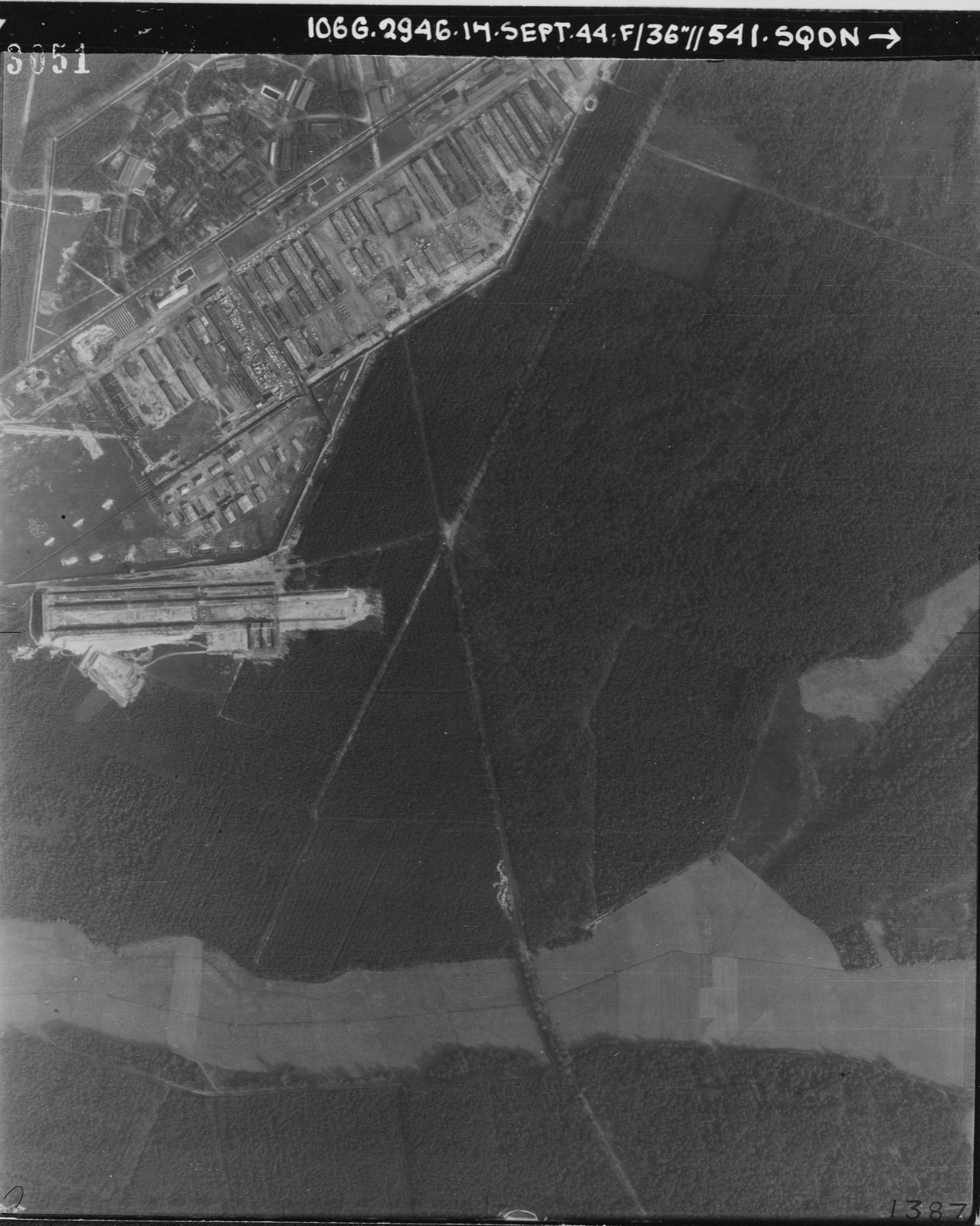
The best-known photographs of Belsen date from April 1945 and after. This one shows the camp seven months earlier, still running. Bergen-Belsen from the air, 541 Squadron, RAF, September 17, 1944. National Collection of Aerial Photography, NCAP-000-000-003-440.
Aerial reconnaissance RAF, 541 Squadron · September 17, 1944 · Wikimedia Commons, NCAP-000-000-003-440; sortie 106G/2946, frame 3051; 541 Squadron RAF Public domain View the record: The best-known photographs of Belsen date from April 1945 and after.
Then it became a dumping ground. From December 1944 at least 85,000 men, women and children arrived on transports and death marches from camps closer to the front. There was no water for them, almost no sanitation, no shelter. Typhus, typhoid, tuberculosis and dysentery went through the barracks, and the Bergen-Belsen Memorial's account of the SS response is one clause: they never seriously tried to contain them. More than eighteen thousand people died in March 1945 alone.
Bergen-Belsen was hell on earth. Nothing ever in literature could compare to anything what Bergen-Belsen was. When we arrived, the dead were not carried away any more, you stepped over them, you fell over them if you couldn't walk.
Alice Lok Cahana, oral history, United States Holocaust Memorial Museum Collection. Hear it at the United States Holocaust Memorial Museum: Alice Lok Cahana
Anne Frank and her sister Margot died of typhus here. The Dutch state fixed their date of death at March 31, 1945, a legal presumption entered in 1954. Research published by the Anne Frank House in 2015 concluded both were dead by the end of February. USHMM writes February or March, the memorial writes March, and no source supports a particular day.
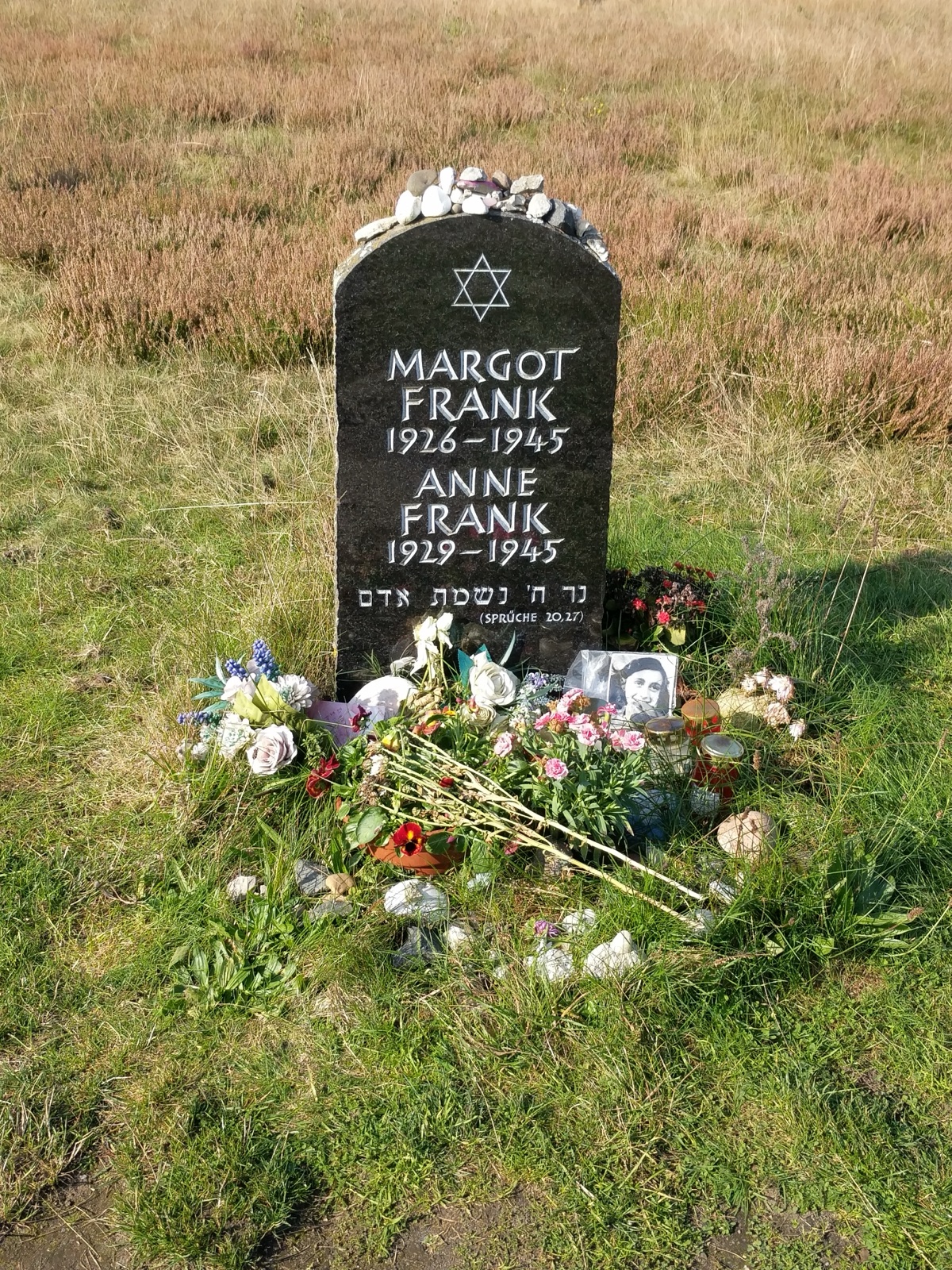
The stone marks their memory and not their grave. Nobody knows where either sister lies. Memorial stone for Anne and Margot Frank, Bergen-Belsen. Photograph by Sipalius, CC BY-SA 4.0.
Postwar memorial photograph Sipalius · October 8, 2021 · Wikimedia Commons (own work) CC BY-SA 4.0: licence for The stone marks their memory and not their grave. Nobody knows where View the record: The stone marks their memory and not their grave. Nobody knows where
The camp was handed over on April 15, 1945 without a shot, after days of ceasefire talks, and the SS destroyed the administrative files first. British troops found thousands past saving and about thirteen thousand dead lying unburied. The unit war diary at the National Archives, WO 171/4773, records the first sight of them: “little more than living skeletons, with haggard yellowish faces.”
It was about 5pm on 15 April 1945 when the miracle actually happened: the first British tank rolled into the camp. ... We did not greet our liberators with shouts of joy. We were silent.
Anita Lasker-Wallfisch, from Survival: Holocaust Survivors Tell Their Story (Quill/Aegis, 2003). © Aegis Institute. As published by the Holocaust Memorial Day Trust.
A British tribunal sat at Lueneburg in the autumn of 1945. It convicted 30 of the 48 charged, and commandant Josef Kramer, chief woman guard Elisabeth Volkenrath and Irma Grese were among the eleven hanged at Hamelin that December. Many had served at Auschwitz first, and the tribunal charged them with that too. After that, almost nothing. At least 480 people worked as guards or headquarters staff at Belsen, and more than two hundred are known by name and never stood trial. German courts held one trial about the camp, at Jena in 1949, and it ended in acquittal.
The memorial counts at least 52,000 dead out of 120,000 imprisoned, USHMM approximately 50,000, and since 1990 it has recovered about 11,500 names. The SS destroyed the registry, so the rest of the dead will stay nameless.
They came in, they looked at us... there were thousands and thousands of dead people. They didn't know what to do. ...You couldn't step. Every step was a body.
Toby Frankfurter, on the day British troops reached Bergen-Belsen. Project Witness testimony. Watch the full testimony. This passage begins at 37:33: Toby Frankfurter, Project Witness
What a day was
The day began and ended with counting. Roll call, the Appell, was held after waking and again when the work details came back, and prisoners stood in ranks in the open until the numbers came out right.
Every morning we were counted. Why we were counted I cannot tell you, but it had to be precise and if the numbers didn't come out, you had to be counted again. It if took one hour, if it took five hours, they didn't care. ... Whether it was cold, whether it was raining, whether it was sunshine...you had to be counted.
Ruth Moser Borsos, describing Bergen-Belsen. Oral history, United States Holocaust Memorial Museum Collection. Hear it at the United States Holocaust Memorial Museum: Ruth Moser Borsos
Buchenwald's roll call square covered twenty thousand square meters, watched by machine guns and lit by floodlights. The memorial there records that some roll calls ran as long as seventy-two hours and that people died standing on it.
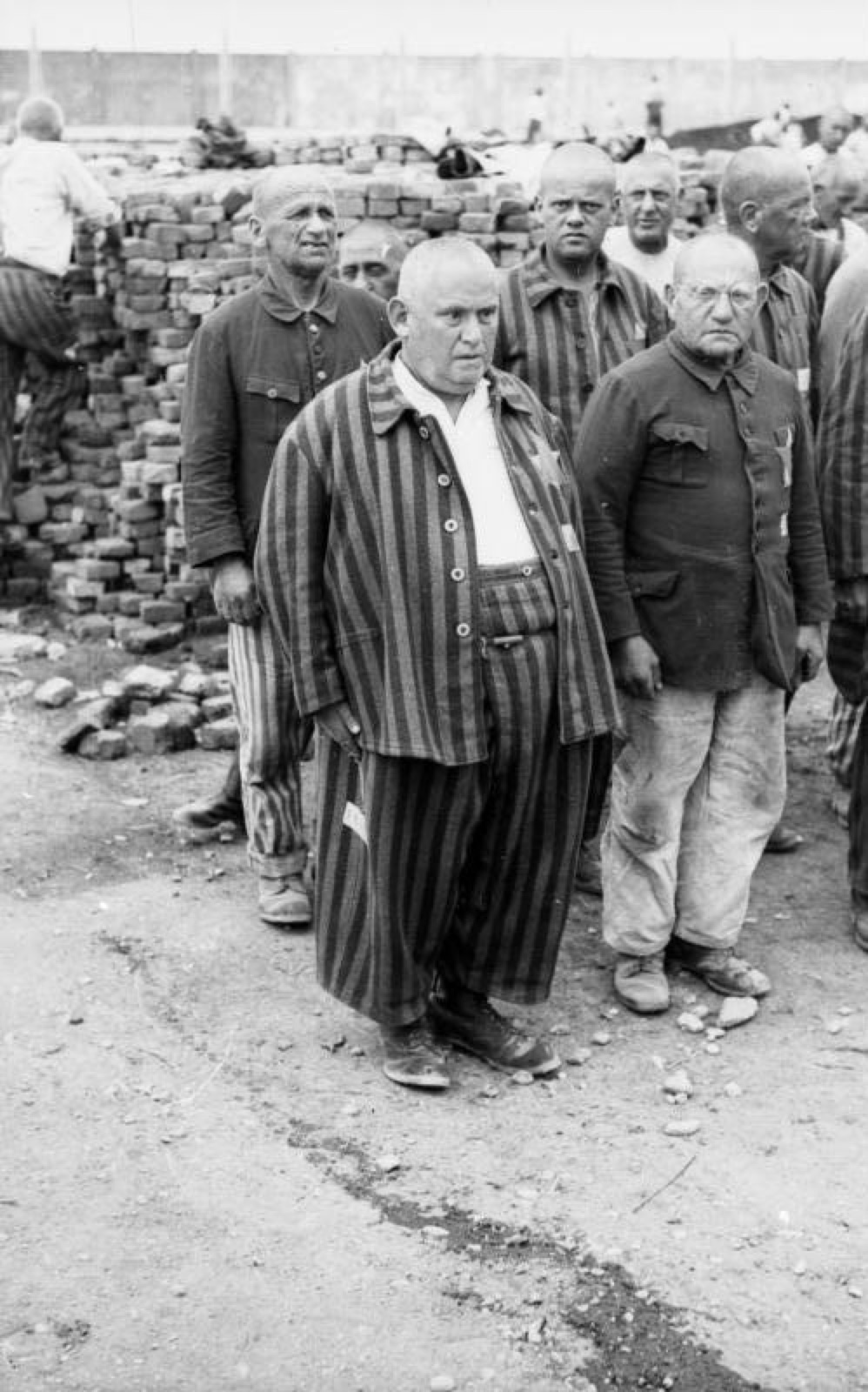
Prisoners lined up for roll call, Dachau, July 20, 1938. Photograph by Friedrich Franz Bauer. The German Federal Archive's own caption calls the men “presumably Jews,” and that uncertainty is part of the record. Bundesarchiv, Bild 152-27-13A / Friedrich Franz Bauer / CC BY-SA 3.0 DE.
Photographed at the time Friedrich Franz Bauer · July 20, 1938 · Bundesarchiv, Bild 152-27-13A CC BY-SA 3.0 de: licence for Prisoners lined up for roll call, Dachau, July 20, 1938. Photograph View the record: Prisoners lined up for roll call, Dachau, July 20, 1938. Photograph
But we did have to stand a roll call like four or five hours each day when they counted us. But you never knew the next morning which children were still going to be there, because they died overnight.
Leah Scharf, who was ten years old in Bergen-Belsen. Project Witness testimony. Watch the full testimony. This passage begins at 10:28: Leah Scharf, Project Witness
Food was a watery vegetable soup and about half a piece of bread a day, which Yad Vashem notes was not enough for people doing hard labor. They slept in tiers. Blanka Rothschild, deported from the Lodz ghetto to Ravensbrueck, described it: “We slept two, three to a wooden, uh, bunk. The tiers in Ravensbrueck were packed with human beings.” She also said the thing no camp record holds: “the human spirit suffered more than the physical spirit.”
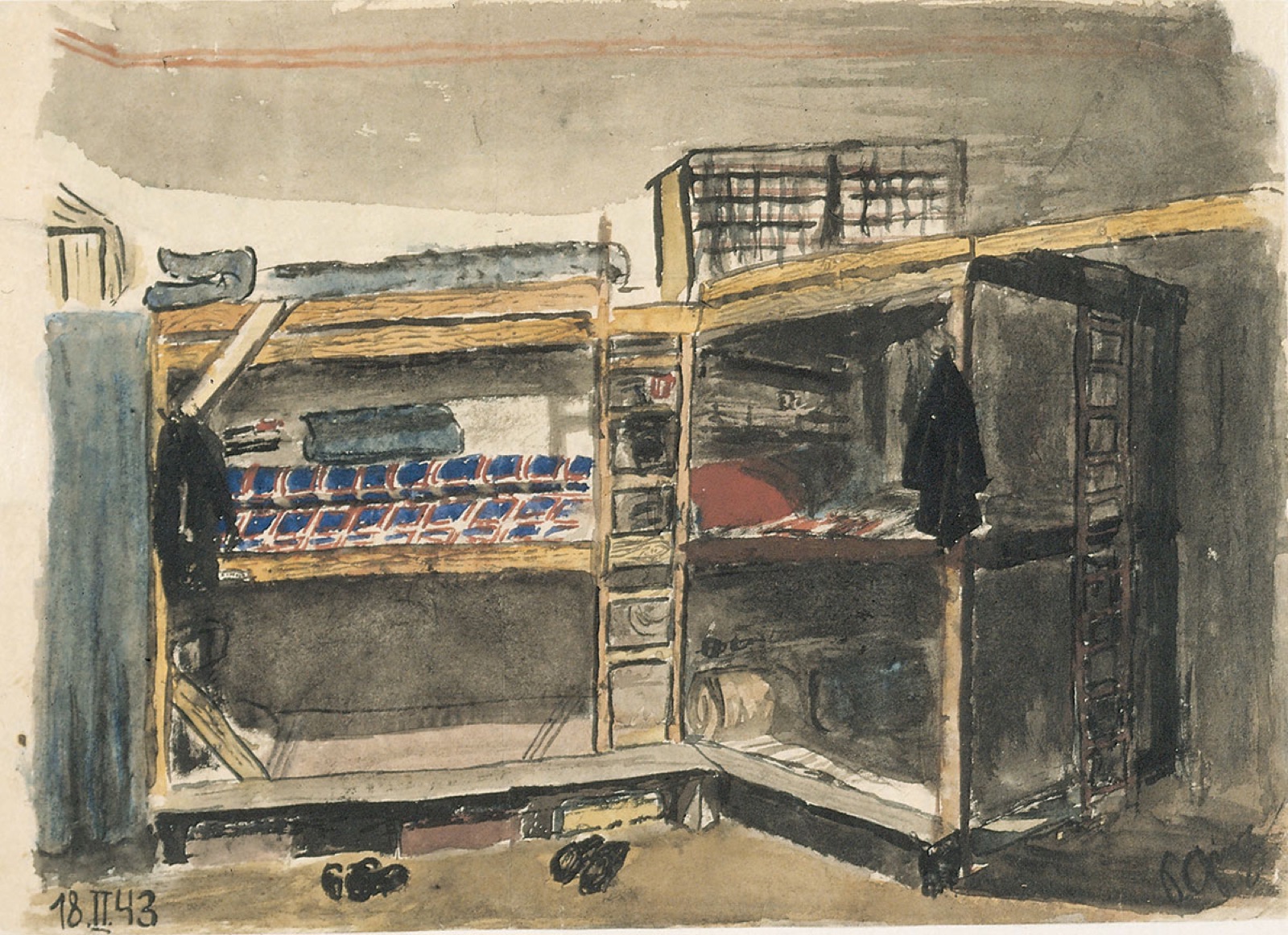
Petr Ginz, Interior of Living Quarters in the Theresienstadt Ghetto, dated 18.II.43 in the lower left. Ginz had turned fifteen earlier that month. He drew the tiered bunks he slept among, the ladder between them, the coats hung on the frames and the shoes left on the floor. Theresienstadt was a ghetto and transit camp, not a concentration camp of the kind described here. What it records is a prisoner's own view of how people were made to sleep. Watercolor, ink and pencil on paper. Collection of the Yad Vashem Art Museum, Jerusalem.
Made clandestinely by a prisoner Petr Ginz (1928-1944) · Inscribed 18.II.43 in the lower left, February 18, 1943. · Yad Vashem Art Museum, Jerusalem Yad Vashem View the record: Petr Ginz, Interior of Living Quarters in the Theresienstadt Ghetto,
Work was the purpose and the method. In the spring of 1942 Himmler reorganized the camps under the SS Economic and Administrative Main Office, and from there the SS hired prisoners out at a profit, on signed contracts, to military and civilian agencies and to private firms making armaments, uniforms and building materials. Himmler was running the murder of the Jews of Europe in the same months. The two demands pulled against each other and the SS never chose between them. It ran them both through the same prisoners.
That is the policy the phrase names. USHMM renders it annihilation through work, Vernichtung durch Arbeit, and it was a program, not a description of hard conditions. Categories of prisoner were selected for it and put to work under conditions that would directly and deliberately lead to illness, injury and death. The labor was taken out of the person and the person died of the labor, and both halves were the point. In the autumn of 1942 thousands of people released from German prisons as security suspects were sent to the concentration camps and worked to death under that program. For Jews the same policy ran the other way round: while the Final Solution was being carried out, the ability to work offered a chance of survival, and the ones the SS judged unable to work were the first to be shot or deported. Some of the work fed the war economy. Much of it was pointless, done without tools, clothing, food or rest. At Mauthausen prisoners were driven up 186 steps out of a stone quarry carrying boulders.
Between the SS and the prisoners the SS placed prisoners. Kapos ran the work details, and camp elders, block elders and clerks ran the barracks. USHMM is direct about the reason: it saved German manpower and money, and it broke solidarity. The privileges were real: more food and better clothing. So was the price. Primo Levi called this a grey zone and put the responsibility on the state that built it. The Mauthausen Memorial quotes Hans Maršálek, a former prisoner: “For a long time I didn't notice that I had become a part of this death machinery.”
The marking system arrived later than people assume. The SS began sewing colored inverted triangles onto prisoners' clothing in 1937 and 1938, four and five years after the first camp opened, and applied it unevenly. What the colors record is how the SS sorted people. They describe nobody.
| Marking | The category the SS assigned |
|---|---|
| Red triangle | Political prisoners. |
| Green triangle | People the SS classified as criminals. |
| Black or brown triangle | People the regime classified as asocial, a label it applied to Roma, nonconformists, and vagrants. |
| Pink triangle | Gay men and men accused of homosexuality. |
| Purple triangle | Jehovah's Witnesses. |
| Yellow star | Jewish prisoners, sewn onto the uniform. |
| Yellow triangle under a second triangle | A Jewish prisoner also placed in another category. A Jewish political prisoner wore yellow beneath red. |
| A letter on the badge | The first letter of the German name of the prisoner's country: P for Poles, T for Czechs. |
Source: United States Holocaust Memorial Museum, Classification System in Nazi Concentration Camps.
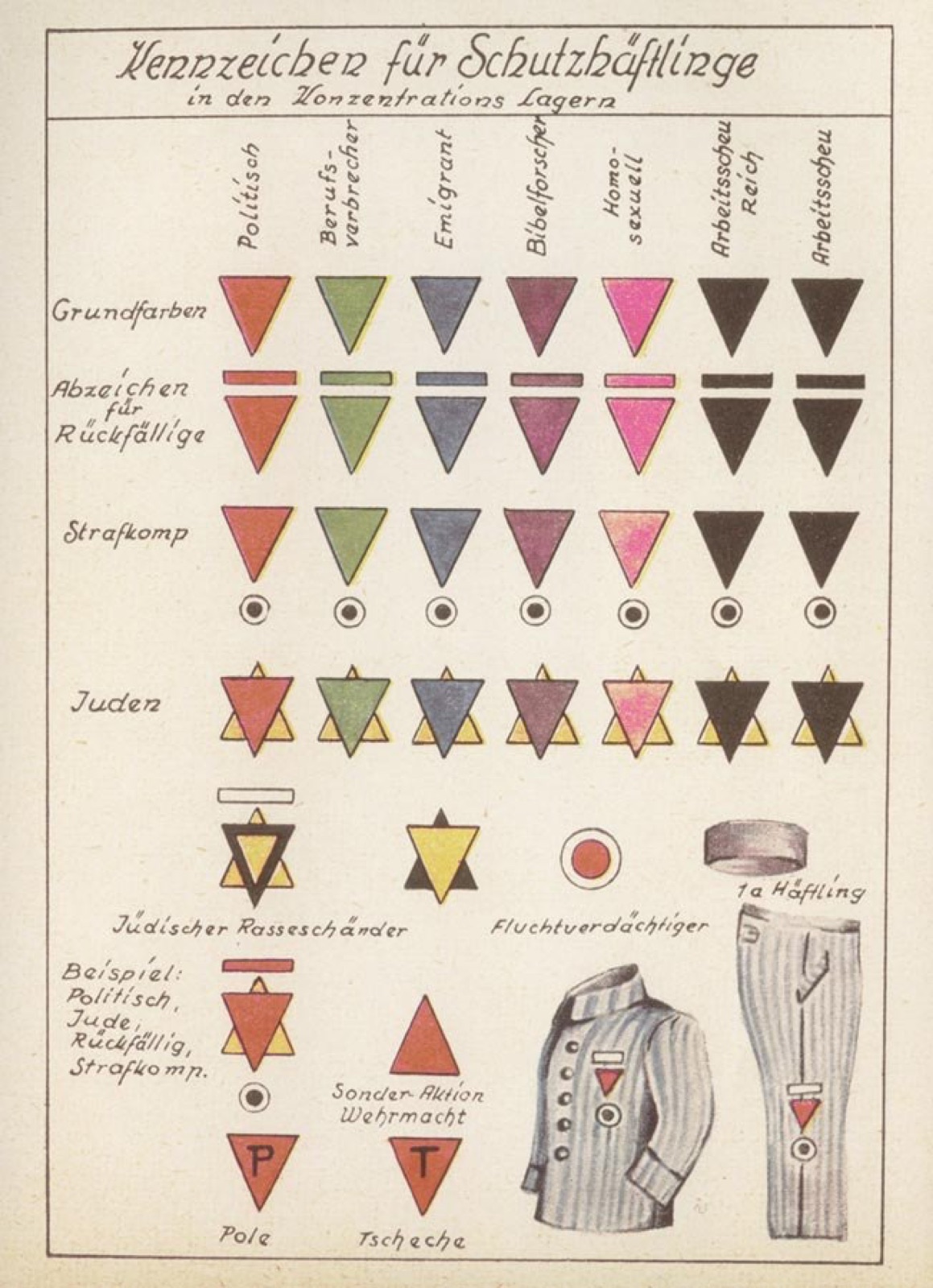
The period chart, not a modern redraw. German-language chart of prisoner markings, 1940s. Wikimedia Commons; the file page tags it public domain as a German official work and also licenses it CC BY-SA 4.0.
Period document Photographer unknown · 1940s · via Wikimedia Commons Public domain View the record: The period chart, not a modern redraw. German-language chart of
A guard could read a prisoner's official identity from across the yard. That was the design.
The killing centers
Nazi Germany built five killing centers to murder Jews with poison gas: Chelmno, Belzec, Sobibor, Treblinka and Auschwitz-Birkenau. Only the last was also a concentration camp, which is why Auschwitz still held about 67,000 registered prisoners when the SS began evacuating it in January 1945, and only three men are known to have survived Belzec.
There was a selection at these camps, just not for a labor force. Staff kept a few people from each transport to empty the gas chambers and sort the clothing of the dead, murdered them, and took replacements from the next train.
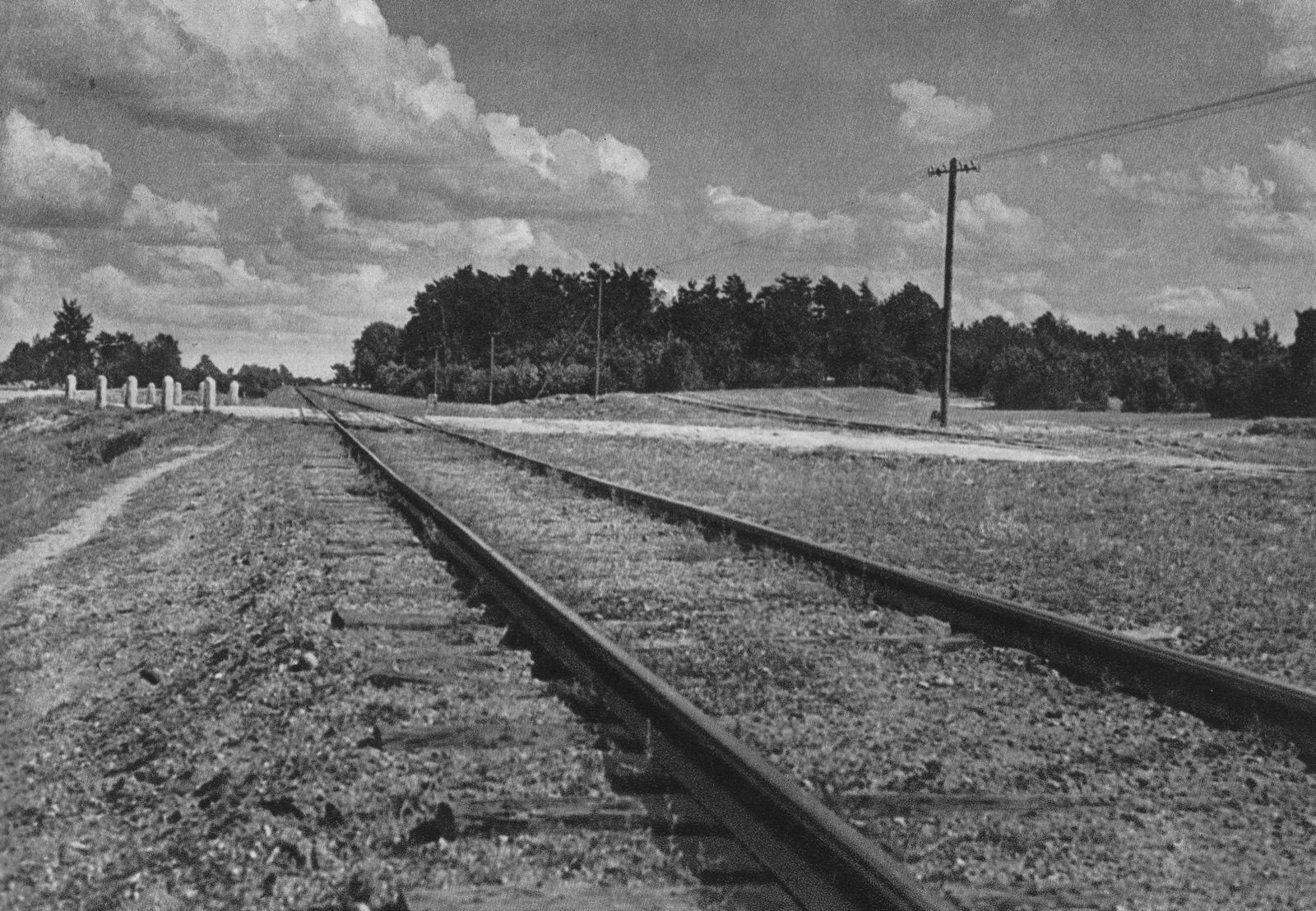
A spur off a working railway, ending nowhere. The railway siding to Treblinka, 1945. From J. Gumkowski and A. Rutkowski, 'Treblinka' (Warsaw, 1962). Public domain.
Postwar memorial photograph Photographer unknown · 1945 · Wikimedia Commons Public domain View the record: A spur off a working railway, ending nowhere. The railway siding to
Chelmno came first. On December 8, 1941 the Germans killed about 700 Jewish men, women and children from Kolo in the cargo compartments of vans piped with engine exhaust. USHMM puts the dead at 156,300 or more, Yad Vashem at approximately 320,000. Seven Jewish men are known to have escaped.
How did I know my mother arrived at Chelmno? There were many handbags, a mountain of handbags. Once, I found a handbag with my mother's pictures and all her documents.
Szymon Srebrnik, Chełmno survivor, quoted in United States Holocaust Memorial Museum, Holocaust Encyclopedia, 'Chelmno'. Hear it at the United States Holocaust Memorial Museum: Szymon Srebrnik
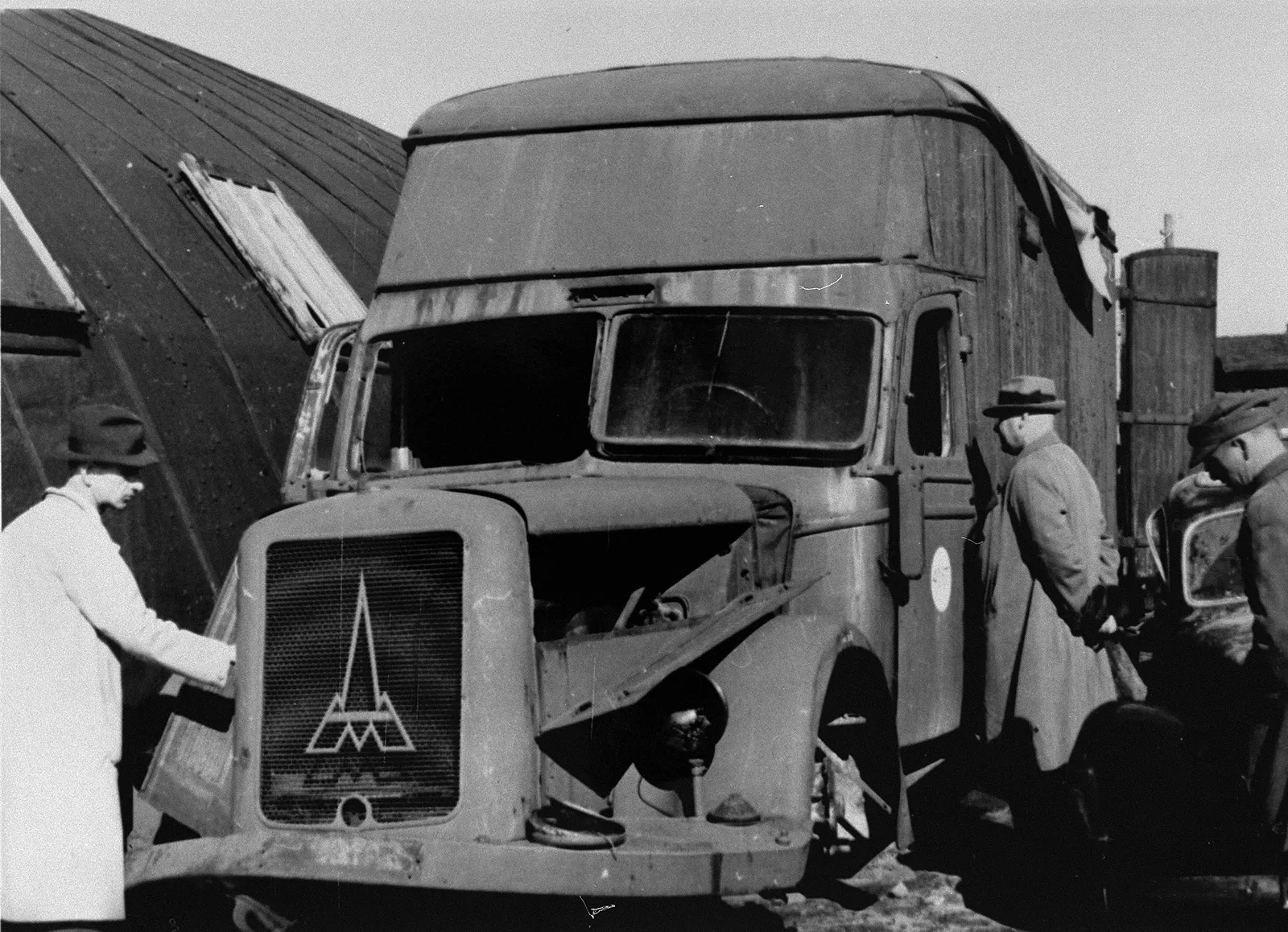
A van of the type the SS converted into a mobile gas chamber. It is not an identified Chelmno vehicle. Magirus-Deutz van found at Kolo, Poland, 1945. Archives of the Polish Ministry of Justice. Public domain.
Postwar photograph Photographer unknown · 1945 · Archives of the Polish Ministry of Justice Public domain View the record: A van of the type the SS converted into a mobile gas chamber. It is
Belzec opened in March 1942 and closed that December, killing approximately 434,500 people by USHMM's count with carbon monoxide from a large engine, the method then copied at Sobibor and Treblinka. Rudolf Reder gave the principal survivor account.
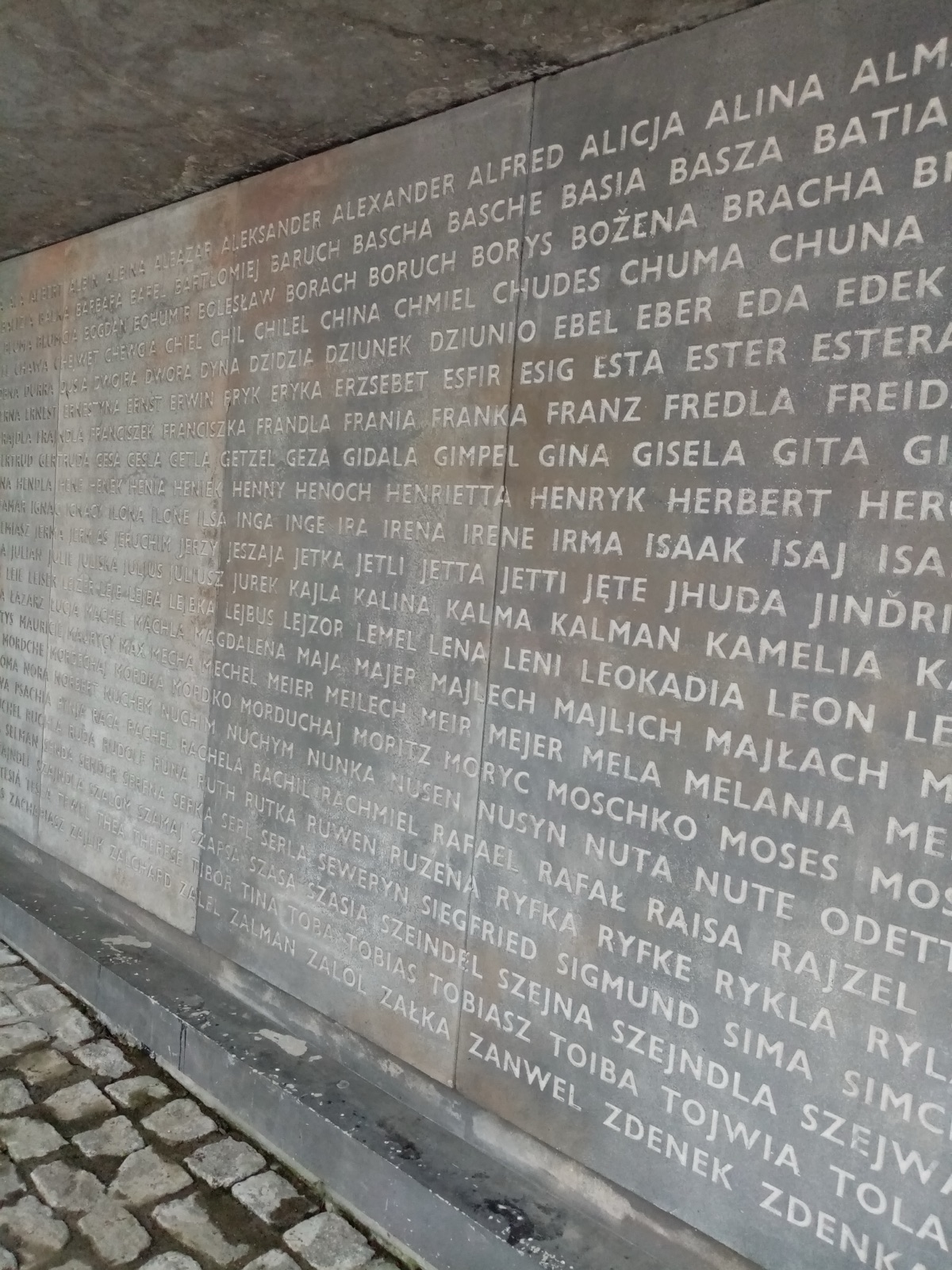
Jewish given names inscribed in the Ohel Niche, Belzec Museum and Memorial Site, photographed in 2020. Photo: Dreamcatcher25 / Wikimedia Commons, CC BY-SA 4.0.
Postwar memorial photograph Dreamcatcher25 · July 7, 2020 · Wikimedia Commons CC BY-SA 4.0: licence for Jewish given names inscribed in the Ohel Niche, Belzec Museum and View the record: Jewish given names inscribed in the Ohel Niche, Belzec Museum and
Sobibor opened in spring 1942 on a rail spur in the Lublin district and killed at least 167,000 people by USHMM's count, about 250,000 by Yad Vashem's older figure. Arrivals were walked down a fenced path the SS called the tube, into chambers labeled as showers. Treblinka II opened in July 1942, and in fourteen months its staff murdered an estimated 925,000 Jews.
But in five, ten minutes this place had to look spotless. And it looked spotless. Like there was never nobody on the place, so the next transport when it comes in, they shouldn't see what's going on.
Abraham Bomba, Treblinka. Oral history, US Holocaust Memorial Museum Collection. Hear it at the United States Holocaust Memorial Museum: Abraham Bomba
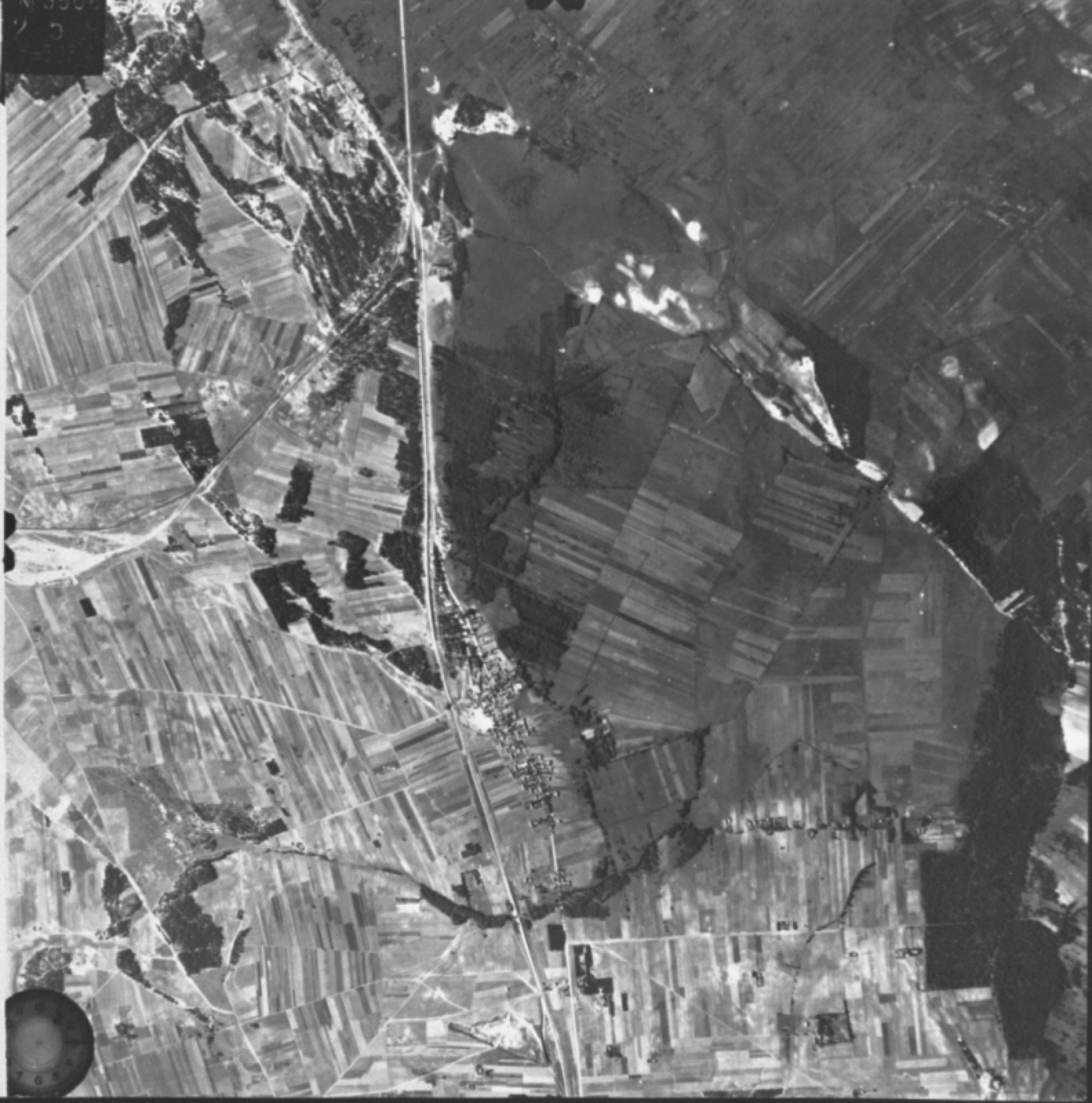
Reconnaissance photograph of the Treblinka area, taken after November 1943, by which time the SS had dismantled the killing center and tried to disguise the site. United States Holocaust Memorial Museum, courtesy of National Archives and Records Administration, College Park. Public domain.
Aerial reconnaissance Photographer unknown · After November 30, 1943 · United States Holocaust Memorial Museum, courtesy of National Archives and Records Administration, College Park, USHMM photo archive pa29035; NARA Source Record ID: 373-Aerial Photographs--GX12225 Public domain View the record: Reconnaissance photograph of the Treblinka area, taken after November
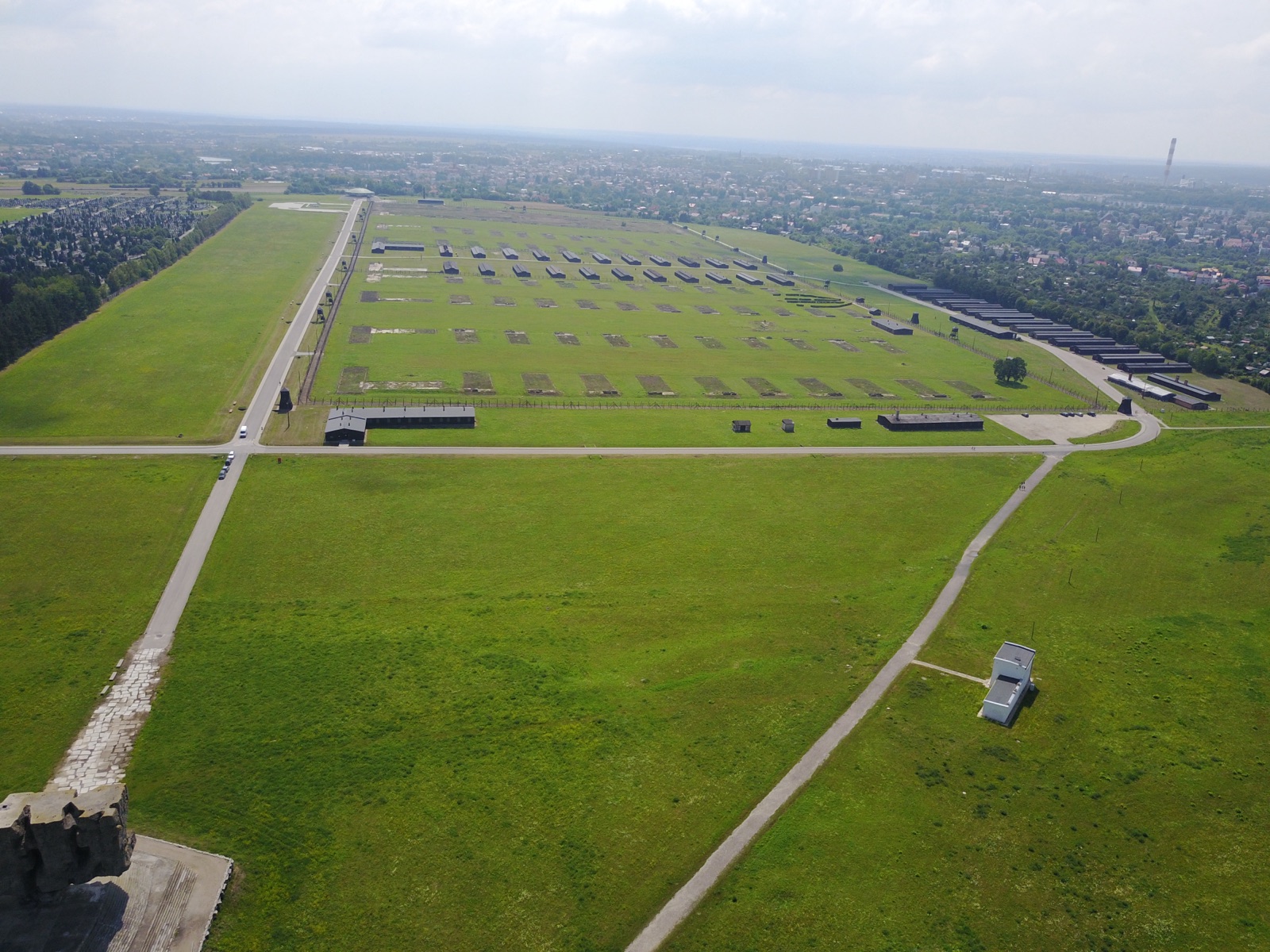
Majdanek from the air in 2018, still standing: barracks, fence lines, watchtowers, the crematorium. The Red Army arrived before the SS could level it. Photo: Fallaner / Wikimedia Commons, CC BY-SA 4.0.
Postwar memorial photograph Fallaner · July 18, 2018 · Wikimedia Commons CC BY-SA 4.0: licence for Majdanek from the air in 2018, still standing: barracks, fence lines, View the record: Majdanek from the air in 2018, still standing: barracks, fence lines,
Majdanek, and a number that changed
Majdanek is where the categories give out. It sat on the edge of Lublin, beside the suburb of Majdan Tatarski. It opened in October 1941 for Soviet prisoners of war, became a concentration camp people survived for years, and also built and used gas chambers. On November 3, 1943 the SS and police shot about 18,000 Jews there in one day, in an operation the Germans called Erntefest, harvest festival. USHMM counts five killing centers and treats Majdanek as a concentration camp that also gassed people. Yad Vashem counts six death camps and includes it.
Majdanek is also where the numbers moved. For decades the published toll was 360,000, an estimate made in 1948 by the judge Zdzislaw Lukaszkiewicz. A 1992 article by Czeslaw Rajca brought it to 235,000. In 2005 Tomasz Kranz, who headed research at the State Museum at Majdanek, published approximately 78,000, about 59,000 of them Jews. He got there by counting: surviving fragments of the camp death book, the death registry, the notices the Germans sent to parishes in Lublin, the testimony SS men gave at their Dusseldorf trial, and the accounts of prisoners who lived. USHMM has not adopted it and publishes 80,000 to 110,000 for the main camp. Zygmunt Mankowski of the museum board called the findings highly authoritative and said in the same breath that they should be accepted with a certain caution, because nobody knows how many prisoners passed through Majdanek or how many deaths went unregistered.
A figure that comes down is not a crime that shrinks. It came down because a Holocaust museum's own historians went back to the perpetrators' paperwork and their trial testimony and counted again. Revised counts have also lowered Belzec's toll, from 600,000 to about 434,500.
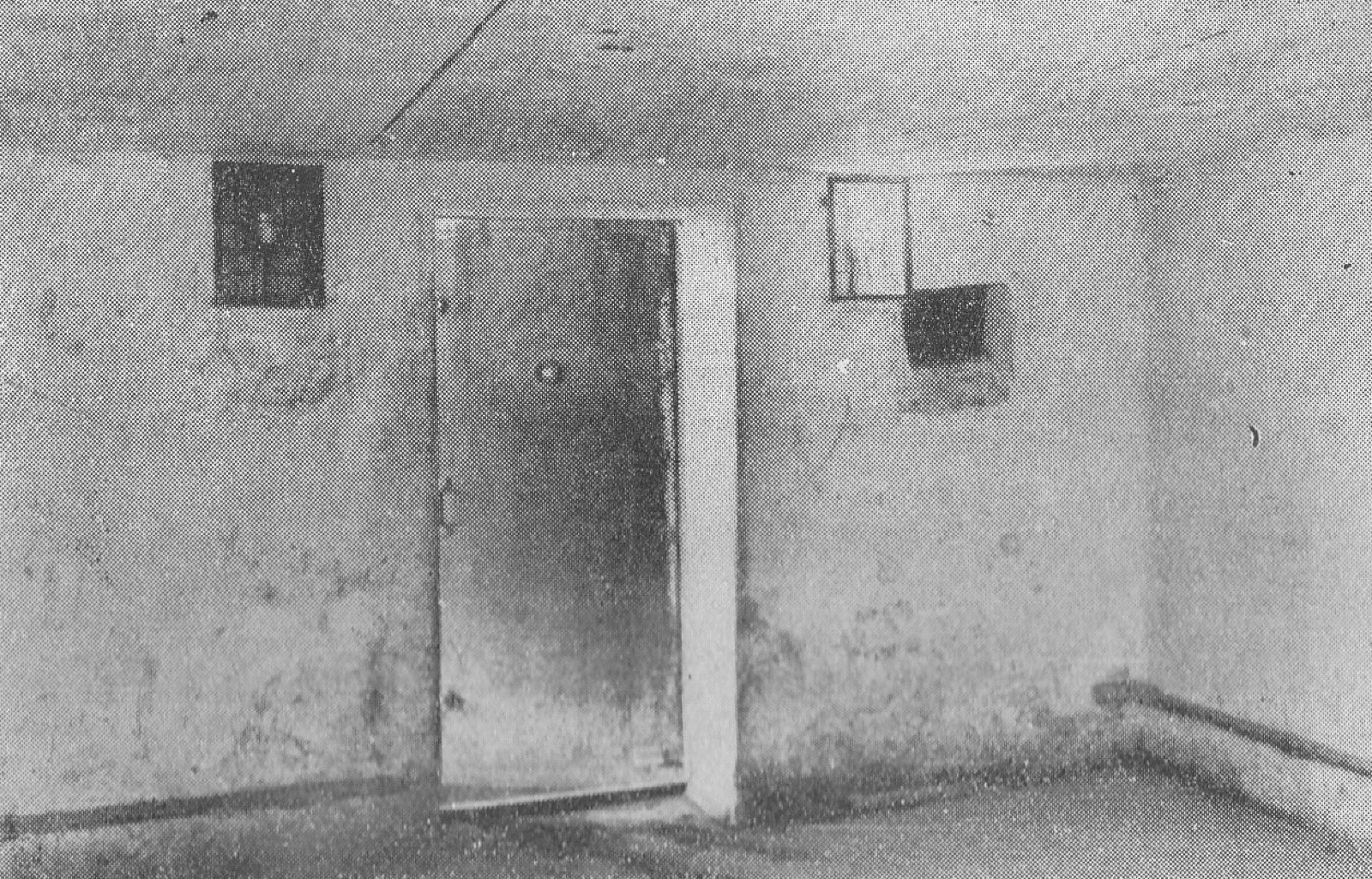
An intact gas chamber at Majdanek, published by the Main Commission for the Investigation of German Crimes in Poland in its Bulletin, Vol. IV (1948). Photographer and date unknown. Public domain.
Postwar photograph Photographer unknown · n.d. · Wikimedia Commons, Vol. IV, 1948 Public domain View the record: An intact gas chamber at Majdanek, published by the Main Commission
The Red Army reached Majdanek in July 1944 and found fewer than 500 prisoners and a camp still standing. That is why a photograph exists of the inside of a gas chamber. At Treblinka there is a field.
The revolts
By the summer of 1943 fewer transports were arriving at Sobibor. The prisoners who ran the camp had already learned that Belzec had been dismantled and its last workers killed. They were not guessing.
A committee under Leon Feldhendler, who had headed the Judenrat in Zolkiew, planned a mass escape and got nowhere, because none of them had ever been soldiers. In September a transport of Jewish Red Army prisoners arrived from Minsk, and Lieutenant Alexander Pechersky had a plan within three weeks.
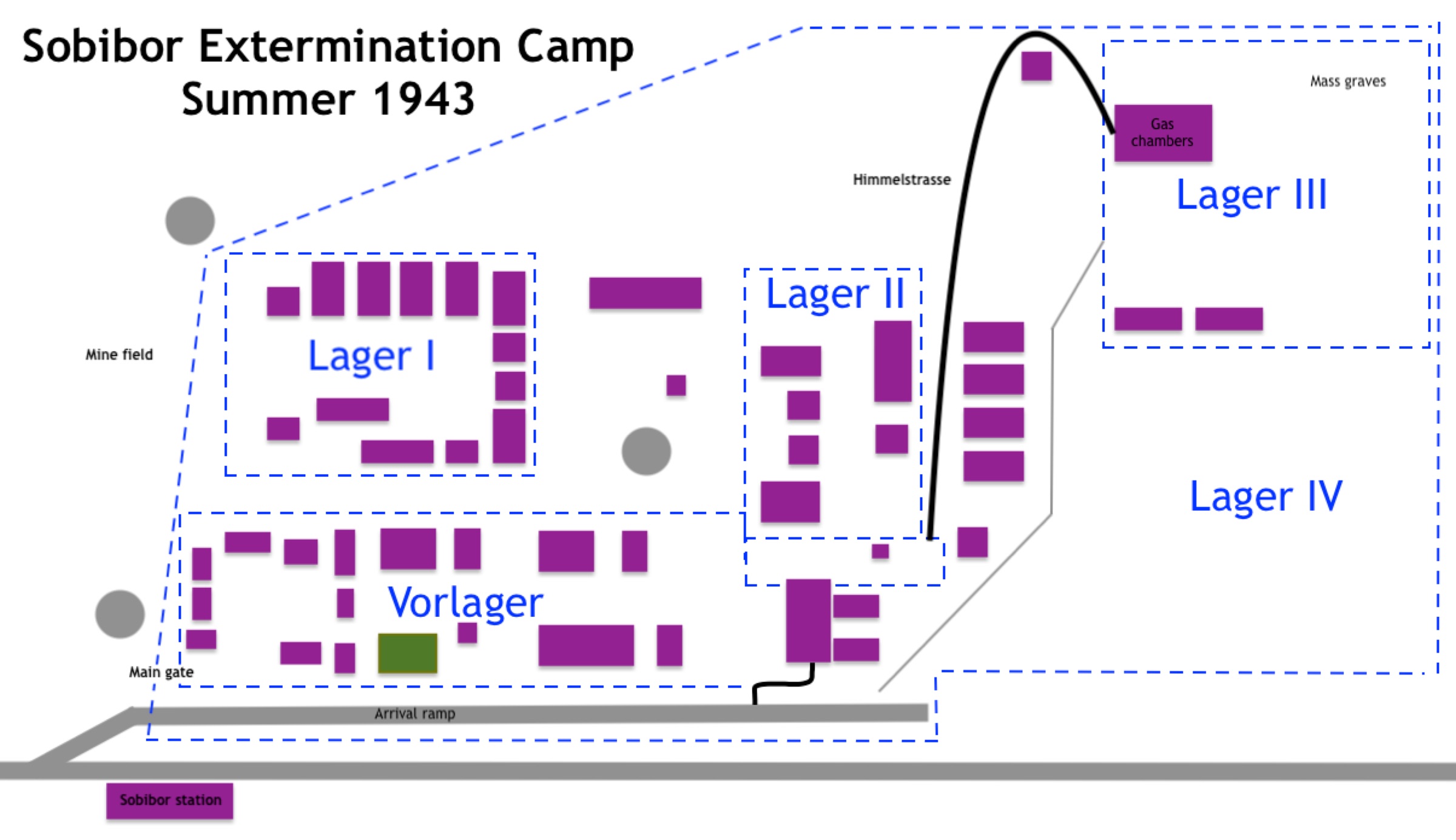
Three camps inside one fence: the workshops where the SS were killed, the sorting sheds, and the killing area at the end of the path the guards called the tube. Reconstruction of Sobibor as it stood in summer 1943, drawn in 2020, not to scale, and the mapmaker notes that further archaeology may change it. Botterweg14 / Wikimedia Commons, CC BY-SA 4.0.
Map drawn after the events Botterweg14 · June 14, 2020 · Wikimedia Commons (user-created reconstruction) CC BY-SA 4.0: licence for Three camps inside one fence: the workshops where the SS were killed, View the record: Three camps inside one fence: the workshops where the SS were killed,
The plan was to kill the SS one at a time in the workshops in the hour before evening roll call, then take the gate and the towers when the roughly 600 prisoners lined up to be counted. It began on October 14, 1943. Deputy commandant Johann Niemann came to the tailor shop for a suit fitting and was killed with an axe. Ten more died the same way over the next hour.
Then it went wrong. Karl Frenzel, the officer they most needed to account for, could not be found. The organizers climbed onto a table in front of the assembled prisoners and said so, and that it was every man for himself.
And as I was on top, I noticed there are a lot of bodies already on the mines, some people went before me. I got a bullet shot from the tower right here, and I fell down. ... I started hopping on dead bodies, and soon I reached the woods, we were in the woods, and it was...I felt, I did it, I made it.
Esther Raab, Sobibor. Oral history, US Holocaust Memorial Museum Collection. Hear it at the United States Holocaust Memorial Museum: Esther Raab
Chaim Engel, who killed a guard that afternoon and got out with Selma Wijnberg, later his wife, remembered the other half of it.
Some people didn't ran at all. They gave up. They didn't want to run. They just gave up. They, they just, waited 'til they get killed.
Chaim Engel. US Holocaust Memorial Museum Collection Hear it at the United States Holocaust Memorial Museum: Chaim Engel
Of about 600 prisoners, roughly 300 got out through the wire and the minefield. At least 100 were hunted down within days. Of the perhaps 200 not caught immediately, about 50 were alive at the end of the war. Everyone still inside was shot by the end of the next day.
Sobibor is the one revolt that closed a camp. After October 14 the SS brought Jewish prisoners from Treblinka to tear the killing installations down, then murdered them. Yad Vashem puts it flatly: the revolt put an end to the camp.
Toivi Blatt was sixteen. He remembered one sentence of what Pechersky said from the table.
But the sentence I remember exactly what he said, was, 'If somebody of you will survive, you should remember to told...to tell the world the story of Sobibor.' And that what I did never forget, and that what I am doing.
Tomasz (Toivi) Blatt. US Holocaust Memorial Museum Collection Hear it at the United States Holocaust Memorial Museum: Tomasz (Toivi) Blatt
Treblinka, August 2, 1943
Treblinka came first, and it did not close the camp. It was begun by Dr. Julian Chorazycki, a Warsaw physician and the first leader of its organizing committee, who took poison in April 1943 after the deputy commandant found him carrying money meant to buy weapons.
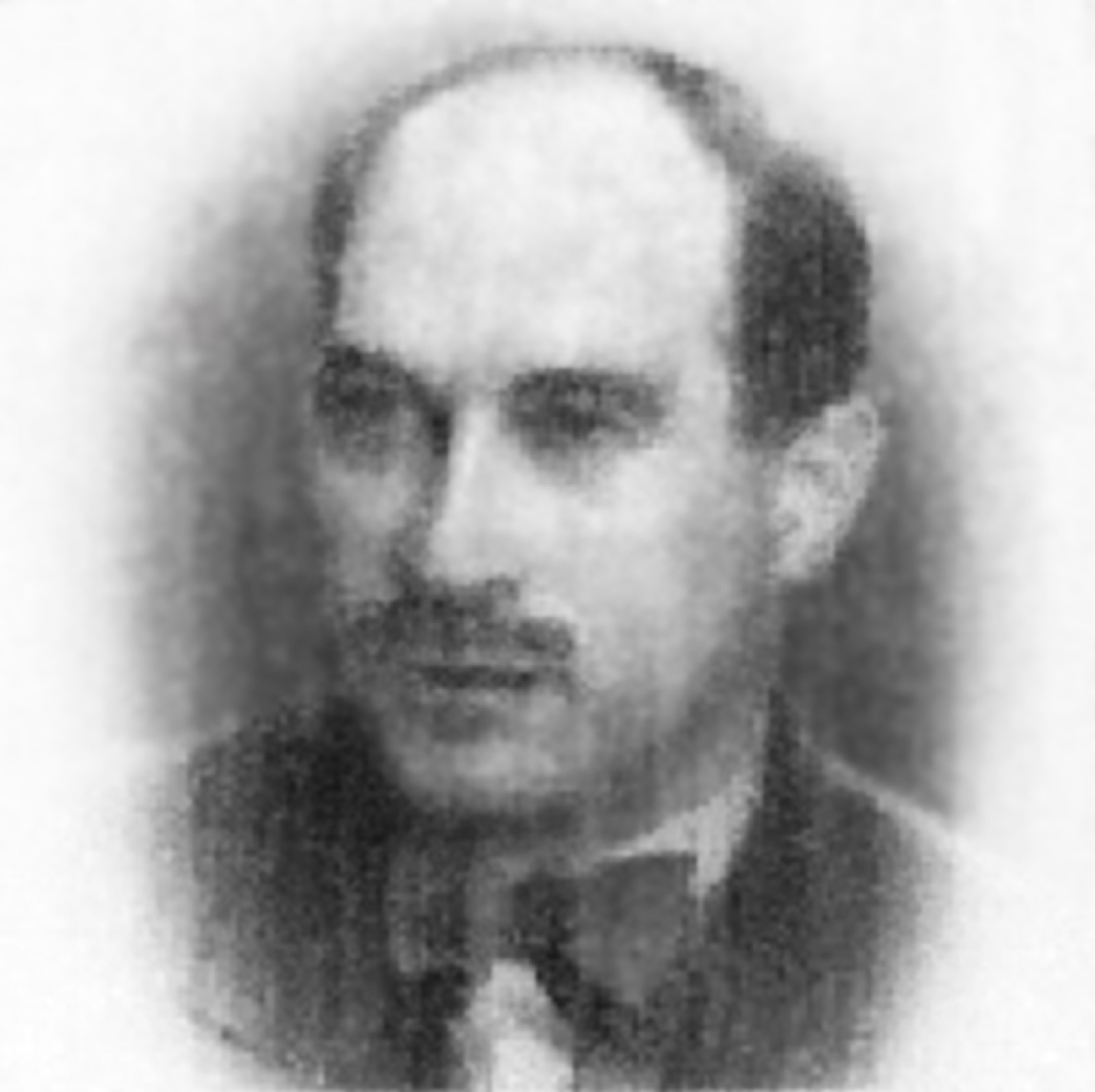
He died four months before the revolt he had begun to plan. The photograph comes from an occupation-authority questionnaire, which is why it exists at all. Dr. Julian Chorazycki, 1940. Central Medical Library of Warsaw (L. 1001, k. 7). Public domain.
Portrait or personal record Photographer unknown · September 10, 1940 · Central Medical Library of Warsaw (Główna Biblioteka Lekarska), reference L. 1001, k. 7. Reproduced in Agnieszka Haska, 'Julian Eliasz Chorazycki (1885-1943)', Zaglada Zydow. Studia i Materialy, no. 9 (2013), p. 249, Central Medical Library of Warsaw, L. 1001, k. 7 Public domain View the record: He died four months before the revolt he had begun to plan. The
About a thousand prisoners were in on it. They took weapons from the camp armory and were discovered before they could take the camp. Hundreds rushed the main gate into machine-gun fire, and the camp burned. More than 300 got out and about two thirds were tracked down and killed. Only dozens of Treblinka's prisoners are known to have escaped and survived.
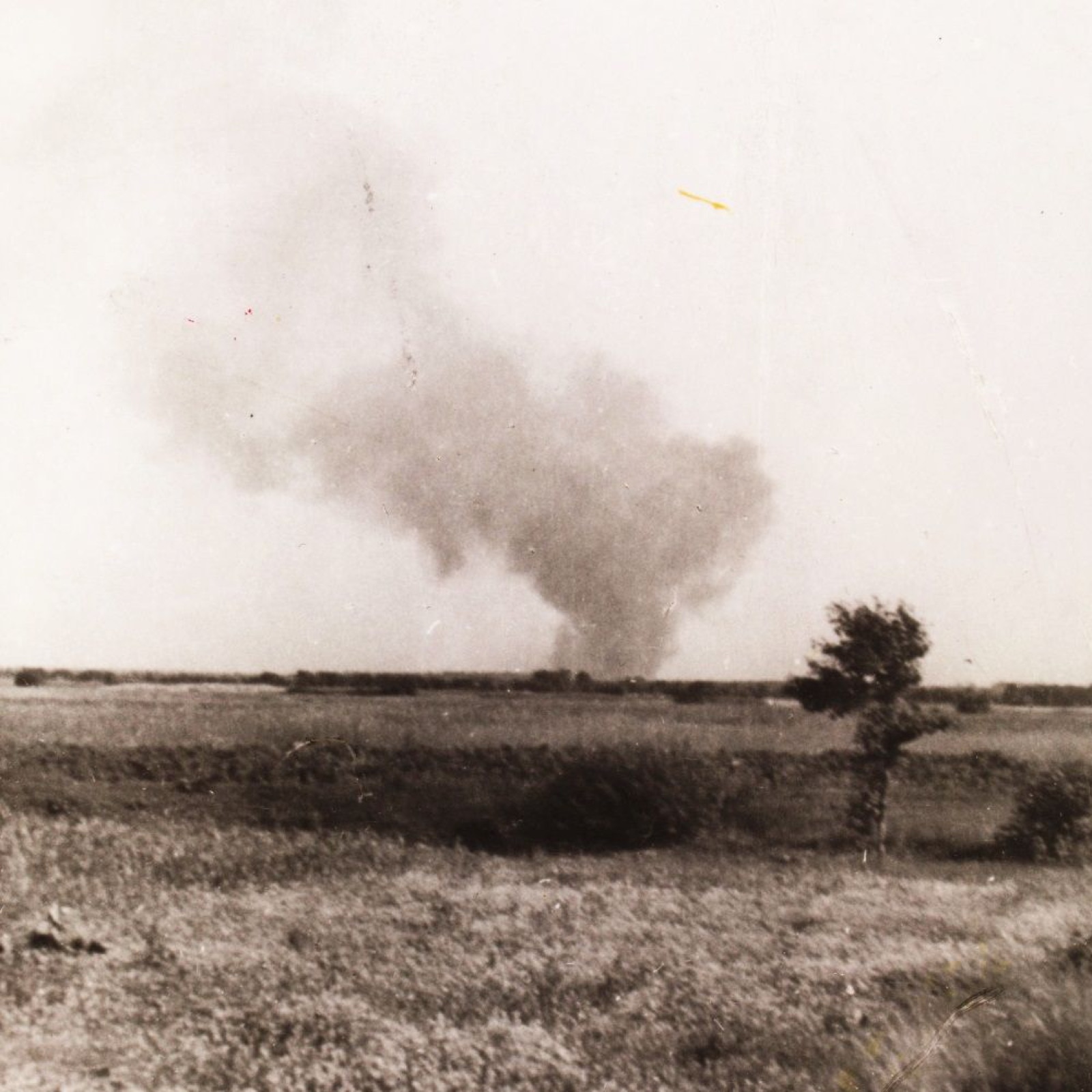
A Jewish revolt photographed while it was happening. Smoke rising from Treblinka during the prisoner revolt, August 2, 1943. Photographed clandestinely by Franciszek Ząbecki, a Polish railway worker at Treblinka station. Public domain.
Made clandestinely by a witness Franciszek Ząbecki, a Polish railway worker at Treblinka station · August 2, 1943 · Wikimedia Commons Public domain View the record: A Jewish revolt photographed while it was happening. Smoke rising
And after the revolt only sixty-seven people remained. We escaped, three hundred, maybe more. Some didn't want to run. Where to? They had nowhere to run. Everything, there are no ghettos, there's nothing. There are no Jews anymore. So where to run? I ran because of that, I thought I had a father and a mother. And I made it. After four days I was in Warsaw.
Samuel Willenberg, who escaped from Treblinka in the revolt of August 2, 1943. Project Witness testimony, translated from Hebrew.Watch the full testimony. This passage begins at 1:08:33: Samuel Willenberg, Project WitnessSpoken in Hebrew. Show the original
ואחרי מרד נשארו רק שישים ושבע איש. ברחנו שלוש מאות, אולי יותר. חלק לא רצה לברוח. לאן? לא היה להם לאן לברוח. הכל, אין גטאות, אין כלום. אין כבר יהודים. אז לאן לברוח? אני ברחתי בגלל זה, חשבתי שיש לי אבא ואמא. והגעתי. אחרי ארבע ימים הייתי בוורשה.
Samuel Willenberg got out that day. He was the last survivor of the Treblinka revolt when he died in Israel in 2016, and he spent his later years making sculptures of what he had seen. One of them is the escape.
Many of the prisoners who tried to escape were killed while trying to climb over the wires, and in order to escape I actually had to climb over the bodies of my friends who were killed there. I was wounded in my foot during the escape.
Samuel Willenberg. Yad Vashem Read it at Yad Vashem: Samuel Willenberg
Watch, 1:26:25 Free, no sign-up
Samuel Willenberg, born 1923 in Czestochowa, on Treblinka and the revolt of August 2, 1943. Project Witness.
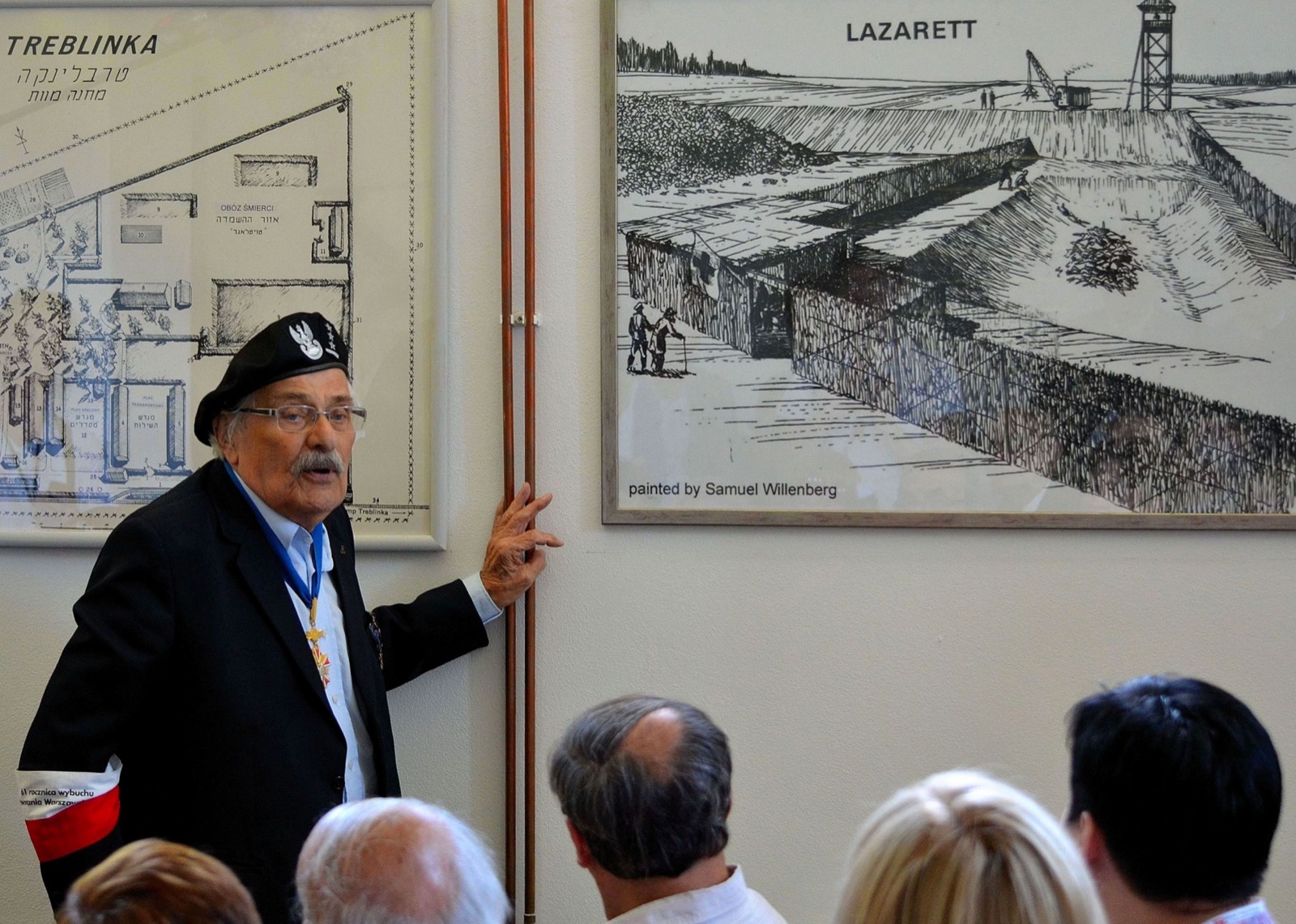
Seventy years to the day after he ran out through the smoke. Samuel Willenberg at Treblinka, August 2, 2013. Photo: Adrian Grycuk / Wikimedia Commons, CC BY-SA 3.0 PL.
Postwar memorial photograph Adrian Grycuk (User:Boston9), cropped by User:Poeticbent · August 2, 2013 · Wikimedia Commons CC BY-SA 3.0 pl: licence for Seventy years to the day after he ran out through the smoke. Samuel View the record: Seventy years to the day after he ran out through the smoke. Samuel
Prisoners of the Sonderkommando at Auschwitz-Birkenau revolted on October 7, 1944. That account is on our Auschwitz page.
None of these revolts freed a camp. One of them closed a camp. All three left behind people who could say what the place had been.
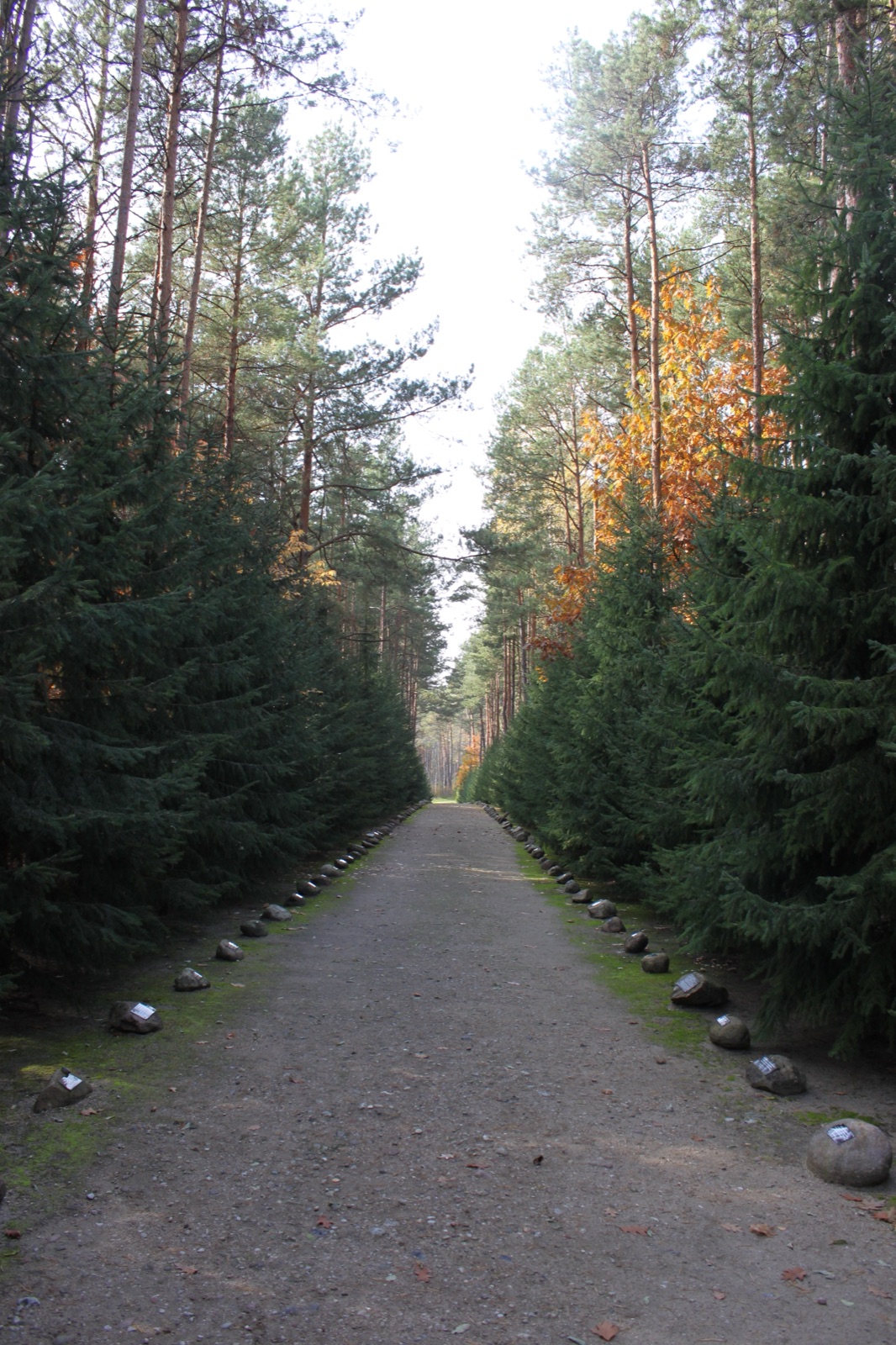
The remembrance avenue at Sobibor, October 14, 2013, the seventieth anniversary of the uprising. Photo: Anton-kurt / Wikimedia Commons, CC BY-SA 3.0.
Postwar memorial photograph Anton-kurt · October 14, 2013 (photographed on the 70th anniversary of the uprising) · Wikimedia Commons CC BY-SA 3.0: licence for The remembrance avenue at Sobibor, October 14, 2013, the seventieth View the record: The remembrance avenue at Sobibor, October 14, 2013, the seventieth
What the soldiers found
Liberation was not a day. It ran from July 1944 to May 1945, camp by camp, and the killing went on while it happened.
Soviet troops reached Majdanek in July 1944 and Auschwitz on January 27, 1945. Between those dates the SS emptied the camps ahead of the advancing armies, on foot and by train. Prisoners probably coined the name for these forced evacuations: death marches. In January 1945 SS reports recorded more than 700,000 people still registered. Historians estimate that nearly half were dead by the end of May.
US Third Army units entered Buchenwald on April 11, 1945, where the camp's underground had taken control before they arrived. Nobody agrees on how many were alive at Bergen-Belsen when the British took it over four days later. USHMM puts it at around 55,000, the Bergen-Belsen Memorial at some 53,000, the National Army Museum at more than 60,000. The camp had collapsed and no accurate count was possible.
So he said with me Vidui. And some five or ten minutes later... he was screaming to me, Victory, English! Victory, English! I didn't know victory, what it is. English I knew, but victory, I didn't know that it is, that is, that you are liberated.
Moshe Kraus, sick with typhus in Bergen-Belsen, who had just said the Vidui, the deathbed confession, with another prisoner when the British arrived. Project Witness testimony. Watch the full testimony. This passage begins at 20:58: Moshe Kraus, Project Witness
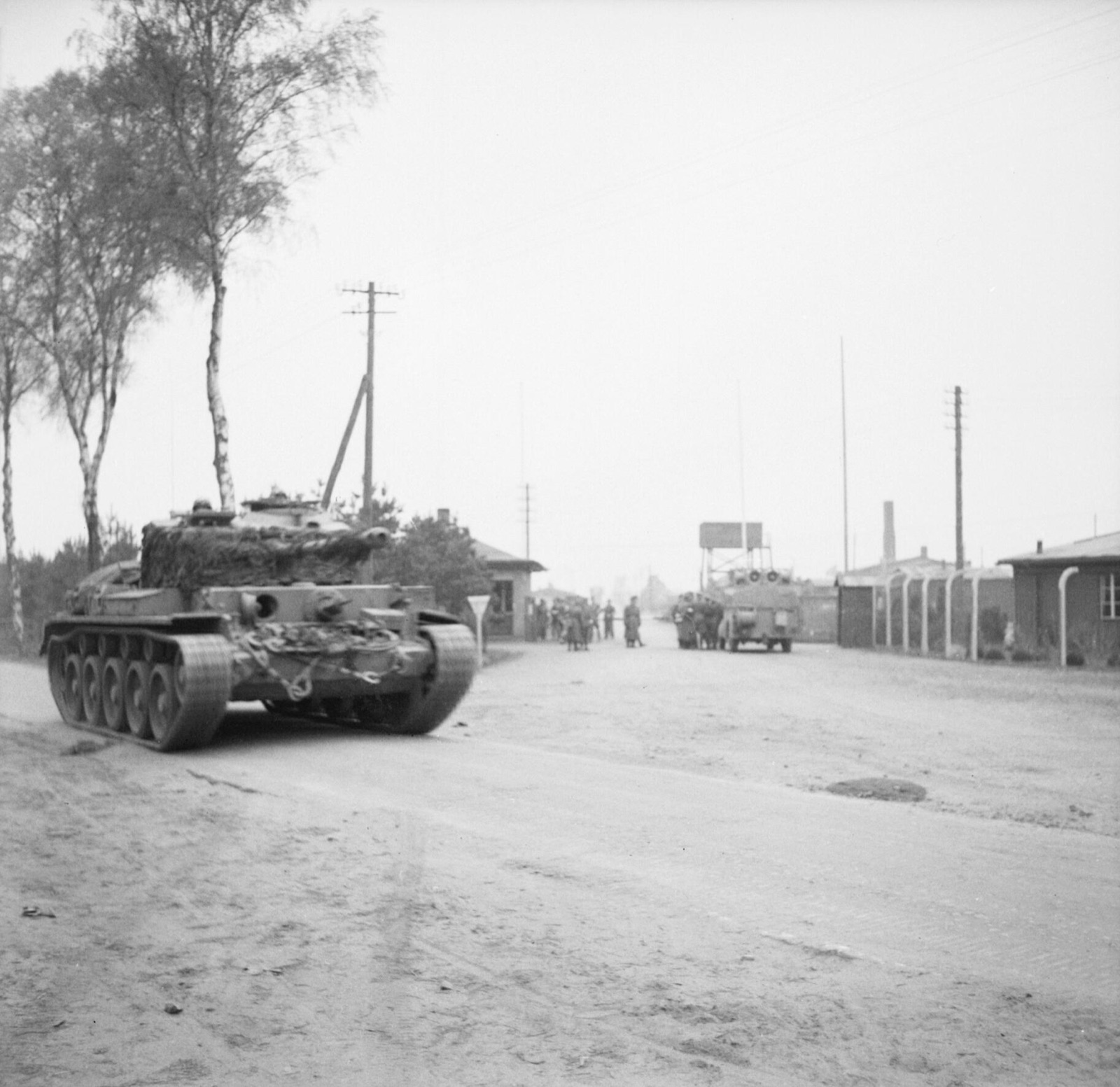
The first British vehicles at the gate. Every photograph in this section was taken by the army that arrived, so the whole of it is April 1945 and after. None of it shows the five years the camp had already run. A Comet tank of 11th Armoured Division passes the gate at Bergen-Belsen, April 15, 1945. Photograph by Sgt Morris, No 5 Army Film and Photographic Unit. Imperial War Museums, BU 3928. Public domain (Crown copyright expired).
Photographed by liberating forces Sgt Morris, No 5 Army Film and Photographic Unit · April 15, 1945 · Imperial War Museums, IWM BU 3928 Public domain View the record: The first British vehicles at the gate. Every photograph in this
the gate of the camp ... opened up and a jeep with four military police, the English dressed up in the white belts and the white gloves and the red hats. ... And a truck with loudspeakers behind them, and he said, 'My dear friends...' in every language. In German, in Polish, in Yiddish, you name it. 'From now on you are free.'
Alan Zimm, oral history, US Holocaust Memorial Museum Collection, gift of the Jewish Community Federation of Richmond. Hear it at the United States Holocaust Memorial Museum: Alan Zimm
Then the part the newsreels do not carry. Around 14,000 people died after liberation, despite immediate British medical relief. Abraham Lewent, liberated from a train that month, gave the reason more exactly than the number does.
And they were so hungry, they didn't care, and they ate it. So hundreds died from eating this stuff, because their stomach was not used to food.
Abraham Lewent. US Holocaust Memorial Museum Collection Hear it at the United States Holocaust Memorial Museum: Abraham Lewent
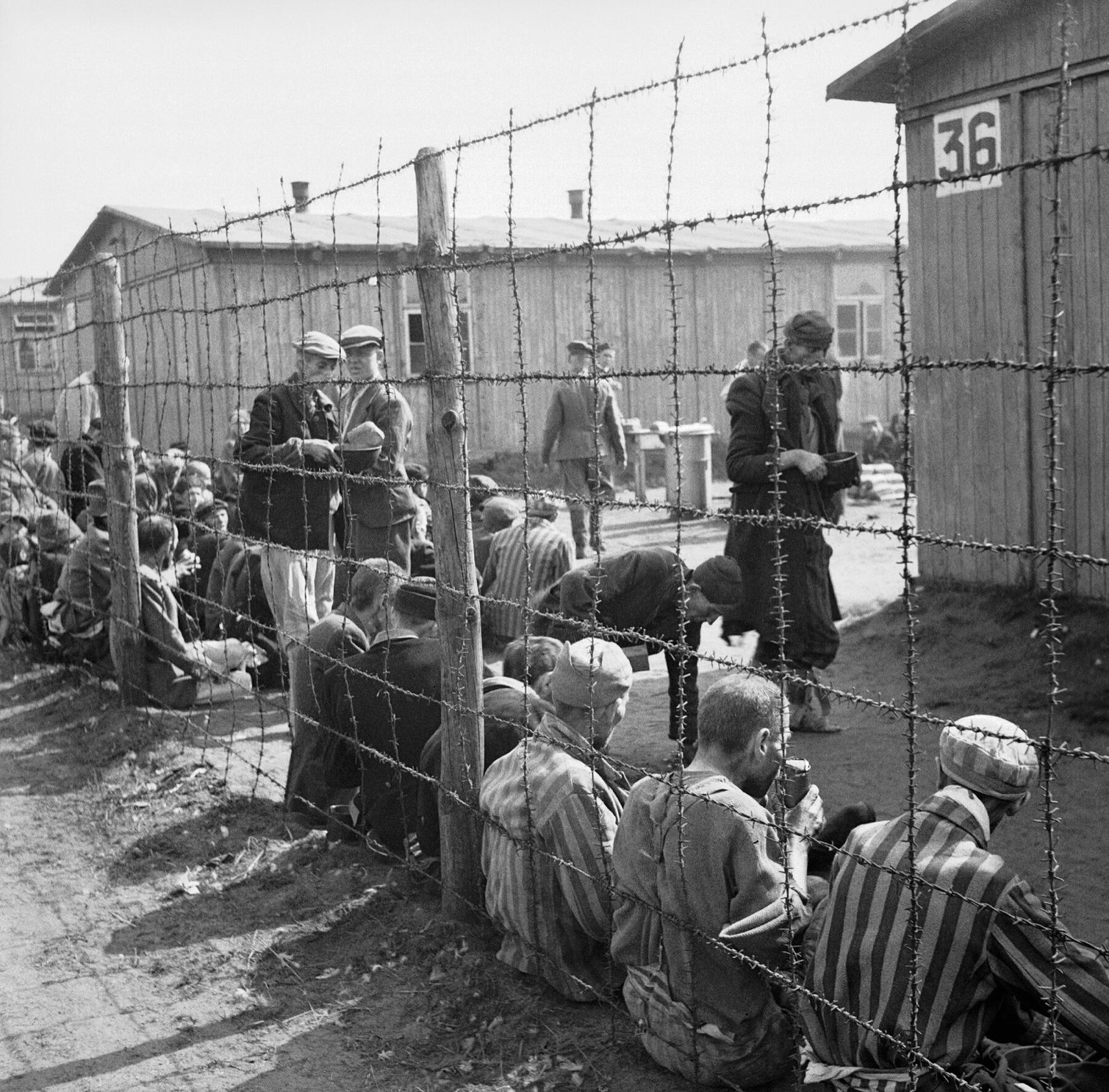
Survivors eat their first meal after liberation, Bergen-Belsen, April 1945. Photograph by Sgt Harry Oakes, No 5 Army Film and Photographic Unit. Imperial War Museums, BU 4006. Public domain.
Photographed by liberating forces Sgt H Oakes, No 5 Army Film and Photographic Unit · April 1945 · Imperial War Museums, IWM BU 4006 Public domain View the record: Survivors eat their first meal after liberation, Bergen-Belsen, April
American forces freed roughly 32,000 people at Dachau on April 29 and reached Mauthausen on May 5, where prisoners had already begun taking the camp over. The SS had gassed 1,441 sick prisoners there between April 21 and 25, and on April 28 murdered 33 Upper Austrian Socialists and Communists in the gas chamber, which USHMM records as the last gassing operation in the Third Reich.
Nothing finished when the gates opened.
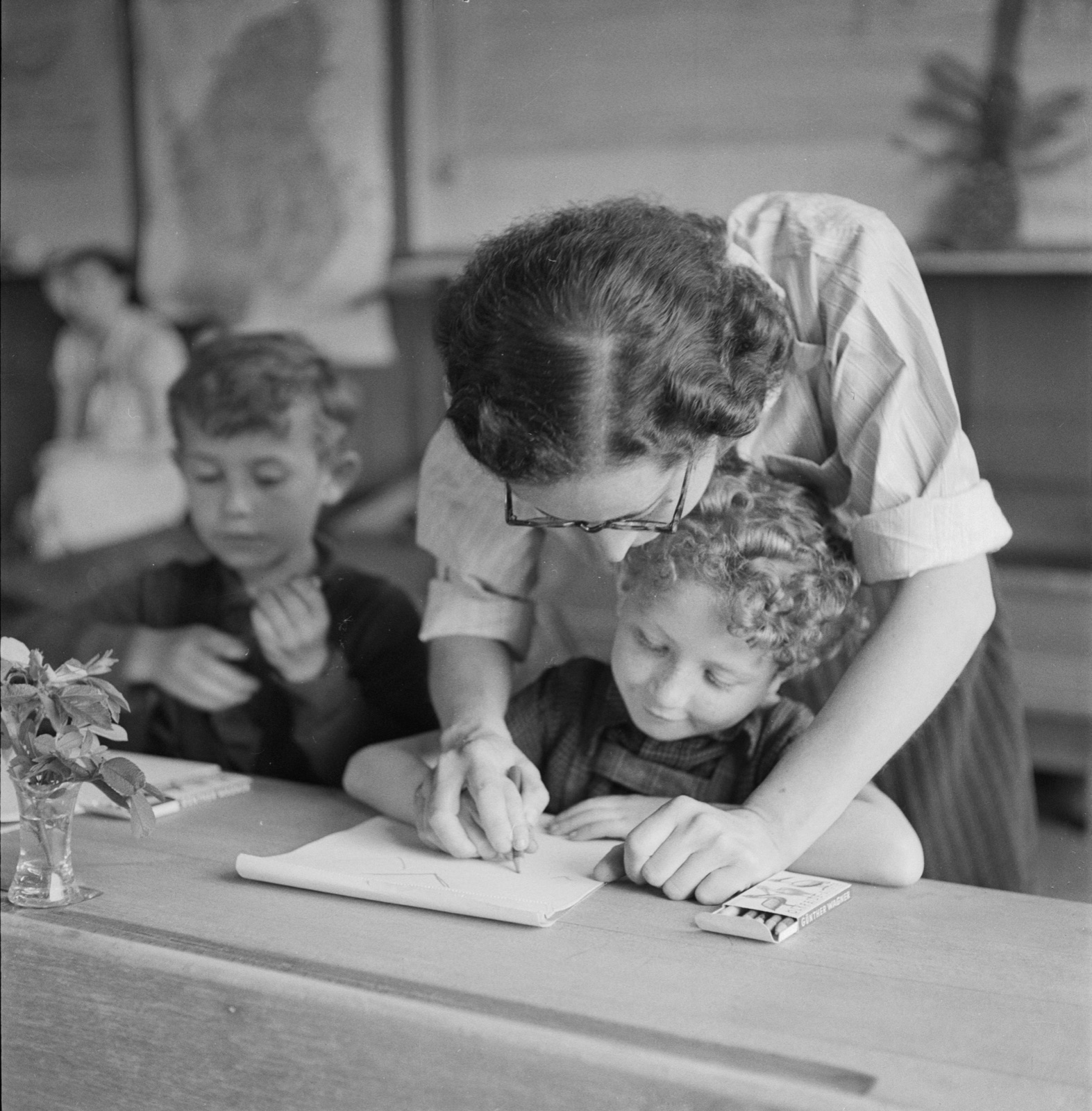
Children learn to write at the school opened at Belsen after liberation, June 1945. Photograph by Sgt Hewitt, No 5 Army Film and Photographic Unit. Imperial War Museums, BU 7802. Public domain.
Photographed by liberating forces Sgt Hewitt, No 5 Army Film and Photographic Unit · June 1945 · Imperial War Museums, IWM BU 7802 Public domain View the record: Children learn to write at the school opened at Belsen after
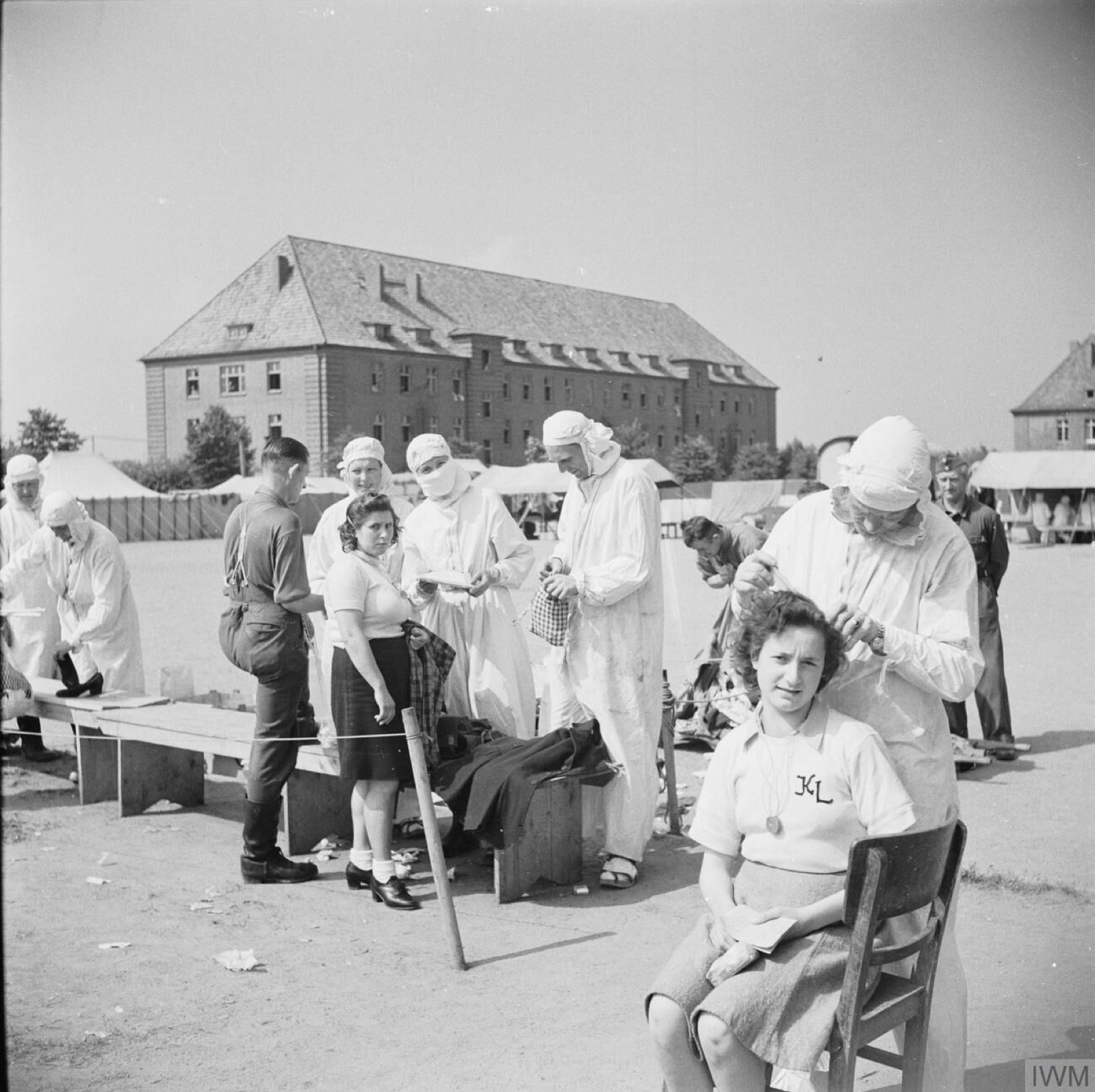
For some of the people who lived, recovery began outside Germany: Sweden agreed to take 6,000 Belsen survivors for six months. Three Polish girls, former Belsen prisoners, at the Swedish Transit Hospital at Luebeck before traveling to Sweden, July 1945. Photograph by Sgt Evans, No 5 Army Film and Photographic Unit. Imperial War Museums, BU 9221. Public domain.
Photographed by liberating forces Sgt Evans, No 5 Army Film and Photographic Unit · 1945 · Imperial War Museums, IWM BU 9221 Public domain View the record: For some of the people who lived, recovery began outside Germany:
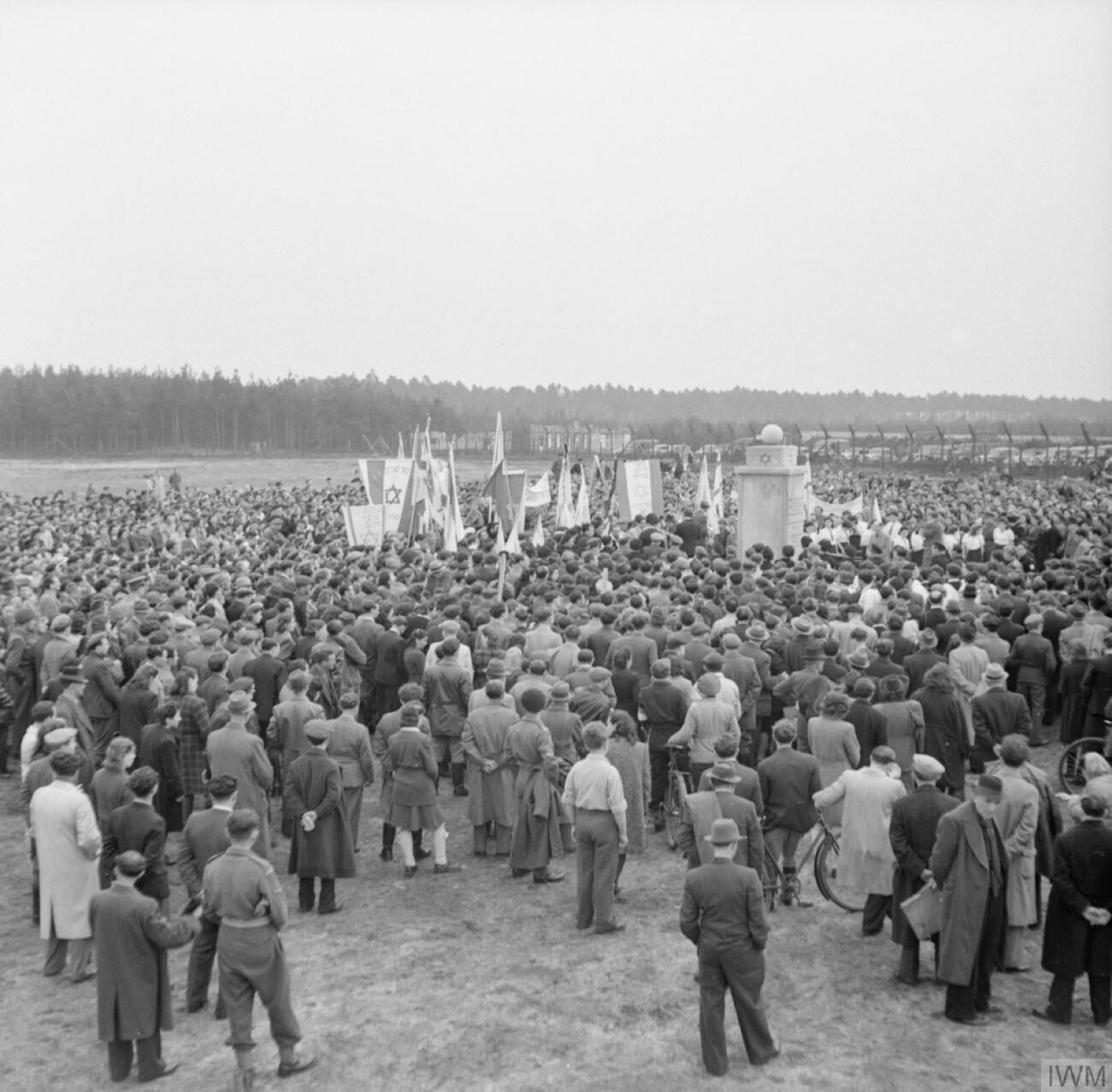
Their own stone, under their own communal organization, cut with words adapted from Job 16:18. The unveiling of the Jewish memorial stone at Belsen, April 15, 1946. Photograph by Sgt R Makin, No 5 Army Film and Photographic Unit. Imperial War Museums, BU 12581. Public domain.
Photographed by liberating forces Sgt R Makin, No 5 Army Film and Photographic Unit · April 1946 · Imperial War Museums, IWM BU 12581 Public domain View the record: Their own stone, under their own communal organization, cut with
Bella Jakubowicz Tovey was in a hospital bed at Belsen when a British soldier asked whether he could do anything for her. She asked for warm socks and for sugar.
when the war ended, I...I weighed the equivalent of probably what is 70 pounds, and I was skin and bone. ... I put on the socks and I started to cry because I didn't have any calf. ... the knee-length socks wouldn't stay on.
Bella Jakubowicz Tovey. US Holocaust Memorial Museum Collection Hear it at the United States Holocaust Memorial Museum: Bella Jakubowicz Tovey
Every camp, and what kind it was
The table below covers 61 sites, the ones people come looking for by name. Dachau and Bergen-Belsen are in it. So are Treblinka II, Westerbork, Drancy and Alderney.
Read the group headings first. They answer what happened to the person who arrived, and two rows can carry the same death toll and describe completely different places.
All 61 camps in this directory, 1933 to 1945.
Swipe the map sideways to see all of Europe.
- Killing centers 4
- Camps that also killed on site 6
- Concentration camps 20
- Forced-labor camps 14
- Transit and internment camps 13
- The early camps, 1933 to 1936 4
The 61 camps in the directory below, by the kind of place each one was. Five places are named: the four killing centers, Chelmno, Belzec, Sobibor and Treblinka II, and Auschwitz-Birkenau, which was a killing center and a concentration camp at once. All five stood on occupied Polish territory. Today's borders are drawn for orientation. Positions are approximate, and where a record gives only a year, the camp appears from December of that year.
Drawn by Project Witness from the directory's own records. Base map: Natural Earth, public domain.
Sixty-one camps.
Most people call every one of these a concentration camp. Four of them were not. At Treblinka II there was no registration, and most people who arrived were dead within two hours.
- Killing centers 4
- Built to kill. Almost nobody was imprisoned here. Most people were dead within hours of arriving.
- Camps that also killed on site 6
- A camp that also functioned as a place of mass killing, without being one of the five purpose-built killing centers. This group also includes Auschwitz, which was both a concentration camp and one of the five killing centers, along with a police detention camp, a killing site and a euthanasia killing center.
- Concentration camps 20
- A prison outside the law. People were held, worked, starved and beaten. Tens of thousands died in them. They were not built to kill on arrival. This group also includes Kauen (Kovno), a sealed Jewish quarter that the SS took over in 1943 and turned into a concentration camp.
- Forced-labor camps 14
- Built around a job. People were worked until they could not work, and then killed or sent away to die.
- Transit and internment camps 13
- A waiting room for a train. Conditions were often bearable, because nobody was meant to stay. The toll is measured at the destination. This group also includes four internment camps, often built by a country other than Germany for its own purposes, along with Theresienstadt, a transit ghetto where about 34,000 people died, and Sereď, a labor and transit camp.
- The early camps, 1933 to 1936 4
- The camps of 1933 to 1936, before the SS standardized the system. Most prisoners were released.
Filled glyphs mark the four families in which most of the dying happened at the sites themselves; outline glyphs mark the transit and internment camps, where most of the deaths tied to the site happened at the far end of a train line, and the early camps, which came before the system killed on that scale.
Where two institutions publish different numbers, this directory prints both with the institutions named, and averages nothing. Most of those gaps are about scope, one museum counting a whole camp system while another counts the main camp. Majdanek is not one of those. There the institutions are counting the same ground.
Showing all 61 camps.
Killing centers 4 of 61
Built to kill. Almost nobody was imprisoned here. Most people were dead within hours of arriving.
How you tell: ask how many prisoners were held there at any one moment; if the honest answer is a work detail of a few hundred to about a thousand prisoners and nobody else, because everyone else was killed on arrival, it was a killing center.
| Camp | What kind of site it was | Where it is today | The full record |
|---|---|---|---|
| Belzec Bełżec Deaths recorded here: approximately 434,500USHMM Where:Poland | killing center Killing center | PolandGerman-occupied Poland (General Government, Lublin District) | Open the recordfor Belzec |
BelzecBelzec was built next to a rail siding in southeastern Poland and existed to kill the Jews of Galicia and the Krakow and Lublin districts. Transports arrived, people were told to undress for disinfection, and they were driven into chambers where carbon monoxide from a large engine killed them. Only a few hundred Jewish prisoners were kept alive at a time to empty the chambers and sort belongings, and they were killed and replaced. Notable for the first Operation Reinhard killing center, and the one whose death toll rests on a captured German document.
The figure has been revised Early postwar Polish investigations gave approximately 600,000, and Yitzhak Arad's 1984 study in Yad Vashem Studies XVI, drawing on the Polish Main Commission, also used a figure near 600,000. The current figure of approximately 434,500 rests on the Hoefle Telegram, a German radio message of January 11, 1943 that was rediscovered in British archives in 2000 and published by Peter Witte and Stephen Tyas in Holocaust and Genocide Studies in 2001. It records 434,508 arrivals at Belzec through December 31, 1942, which covers essentially the whole operating life of the camp since it closed that month. The number went down because a German arrival count surfaced, not because the crime shrank.
| |||
| Chelmno Kulmhof, Chełmno nad Nerem, Kulmhof an der Nehr Deaths recorded here: at least 156,300USHMM Where:Poland | killing center Killing center | PolandGerman-annexed Poland (Reichsgau Wartheland) | Open the recordfor Chelmno |
ChelmnoChelmno was the first place the Nazis used gas to murder Jews systematically, starting in December 1941. There were no barracks, no roll calls and no prisoner registration. People were brought from the Lodz ghetto and the surrounding region to a manor house, told they were being sent for resettlement and to wash, then loaded into sealed vans that piped engine exhaust into the cargo compartment while driving to a forest clearing four kilometers away. Notable for the first Nazi site to use gas for mass murder of Jews, and the killing ground of the Lodz ghetto.
| |||
| Sobibor Sobibór, SS-Sonderkommando Sobibor Deaths recorded here: at least 167,000USHMM Where:Poland | killing center Killing center | PolandGerman-occupied Poland (General Government, Lublin District) | Open the recordfor Sobibor |
SobiborSobibor sat on a rail spur in a wooded corner of eastern Poland and existed to kill Jews from Poland, the Netherlands, France, Slovakia and the occupied Soviet territories. Arrivals were marched down a fenced path the SS called the tube, into chambers labeled as showers, and killed with carbon monoxide piped from an engine. On October 14, 1943 the prisoners kept alive to run the camp killed eleven SS men and broke out, and the SS shut the place down and erased it. Notable for the most successful uprising in any Nazi camp, which ended the camp's existence.
The figure has been revised Readers will encounter about 250,000, which comes from Yitzhak Arad's 1984 study in Yad Vashem Studies XVI citing the Polish Main Commission, and from an undated Yad Vashem Shoah Resource Center entry. The lower current figure draws in part on the Hoefle Telegram of January 11, 1943, rediscovered in British archives in 2000 and published in 2001, which supplies contemporaneous German arrival counts that did not exist when the older estimates were made. Note that the same body of new evidence pushed Treblinka's figure up, not only Belzec's and Sobibor's down.
| |||
| Treblinka II Treblinka killing center, Treblinka B Deaths recorded here: approximately 925,000 Jews, plus an unknown number of Poles, Roma and Soviet prisoners of warUSHMM Where:Poland | killing center Killing center | PolandGerman-occupied Poland (General Government, Warsaw District) | Open the recordfor Treblinka II |
Treblinka IITreblinka II was a killing installation of about 1,312 by 1,968 feet, roughly the area of thirty-four soccer fields, surrounded by a barbed-wire fence woven with branches and watched from towers twenty-six feet high. It had a reception area, a small living area for the prisoners kept alive to work, and a killing area. Most people who arrived were dead within two hours. There was no registration, no tattoo, no prisoner number. Notable for the deadliest of the Operation Reinhard killing centers and the destination of most of the Warsaw ghetto.
The figure has been revised Yitzhak Arad's 1984 figure was about 850,000. The current figure is higher, not lower, and draws in part on the same new documentary evidence that lowered Belzec and Sobibor: the Hoefle Telegram of January 11, 1943, published in 2001. So the revisions run in both directions, on the strength of evidence rather than in one convenient direction.
| |||
Camps that also killed on site 6 of 61
A camp that also functioned as a place of mass killing, without being one of the five purpose-built killing centers. This group also includes Auschwitz, which was both a concentration camp and one of the five killing centers, along with a police detention camp, a killing site and a euthanasia killing center.
How you tell: ask whether killing people was itself one of the site's purposes, not only a result of how prisoners were treated; if it was, and the site is not one of the four killing centers, it belongs here.
| Camp | What kind of site it was | Where it is today | The full record |
|---|---|---|---|
| Auschwitz Oświęcim, Auschwitz-Birkenau, KL Auschwitz Deaths recorded here: approximately 1.1 millionUSHMM Where:Poland | concentration camp and killing center Camp and killing site | PolandGerman-annexed Poland (Upper Silesia) | Open the recordfor Auschwitz |
AuschwitzAuschwitz was three main camps and dozens of subcamps: Auschwitz I, the original concentration camp; Auschwitz II-Birkenau, the killing center; and Auschwitz III-Monowitz, a labor camp attached to the IG Farben plant. It is the one site where the two institutions this page distinguishes were physically fused, and that is why so many people assume every camp worked the way Auschwitz did. Most did not. Notable for the largest of the camps and the only killing center that was also a functioning concentration camp for tens of thousands of registered prisoners.
A caution about the numbers Readers may have seen four million, a figure placed on the Birkenau memorial by the postwar Polish authorities and removed in 1990. That number was never the finding of independent scholarship.
| |||
| Hartheim Schloss Hartheim, Hartheim Castle, T4 killing center Hartheim Deaths recorded here: about 30,000 people murdered at Hartheim between 1940 and 1944Hartheim Castle memorial Where:Austria | euthanasia killing center Camp and killing site | AustriaAustria (annexed to Germany) | Open the recordfor Hartheim |
HartheimHartheim is a Renaissance castle outside Linz where the Nazi state gassed disabled people. It is in this directory for one reason: it is the link between the murder of the disabled and the murder of camp prisoners. The gas chamber technique, the personnel and the deception all moved from the euthanasia centers into the camp system, and camps including Dachau, Mauthausen and Gusen sent prisoners here to be killed when they could no longer work. A reader who thinks the camps invented gassing has the sequence backward. Notable for the bridge between the euthanasia program and the camps, both in method and in personnel.
| |||
| Jasenovac Jasenovac camp complex, Logor Jasenovac Deaths recorded here: between 77,000 and 99,000USHMM Where:Croatia | concentration camp and killing site Camp and killing site | CroatiaIndependent State of Croatia (Axis client state) | Open the recordfor Jasenovac |
JasenovacJasenovac was not run by Germans. It was built and operated by the Ustaša, the Croatian fascist movement that governed the Independent State of Croatia as an Axis client, and it was guarded by Croatian political police and Ustaša militia. Its principal victims were Serbs, then Roma, then Jews. It is in this directory because it shows that the camp system extended beyond German hands, and because the arguments over its death toll are among the most politicized in the field. Notable for an Axis client state's own camp complex, and the most politically contested death toll in Holocaust-era scholarship.
A caution about the numbers USHMM states plainly that "Determining the number of victims for Yugoslavia, for Croatia, and for Jasenovac is highly problematic" because documents were destroyed and because scholarship on the question has been shaped by ideology. Figures in circulation range from tens of thousands to over 700,000, and the extremes in both directions are political rather than evidentiary.
| |||
| Maly Trostinets Maly Trostenets, Малы Трасцянец, Trostinets Deaths recorded here: tens of thousands, most of them Jews USHMM more than 150,000 victims of all groups 2002 memorial stone in the Blagovshchina Forest Figures in conflict Where:Belarus | killing site Camp and killing site | BelarusGerman-occupied Belorussia (Reichskommissariat Ostland) | Open the recordfor Maly Trostinets |
Maly TrostinetsMaly Trostinets was a former collective farm outside Minsk that the Germans used as a killing ground. Jews from the Minsk ghetto and Jews deported by train from Vienna, Germany, the Protectorate and elsewhere in Central Europe were taken to the Blagovshchina forest and shot, or killed in gas vans on the way. For Viennese Jewry in particular it was a principal destination, which is why it is far better known in Austria than in the English-speaking world. Notable for the principal killing site for Jews deported from Vienna, and a death toll still genuinely in dispute.
A caution about the numbers No total is agreed. A 2002 memorial stone in the Blagovshchina Forest gives more than 150,000 victims of all groups. USHMM gives tens of thousands, most of them Jews.
| |||
| Risiera di San Sabba Risiera, Polizeihaftlager San Sabba, San Sabba Deaths recorded here: about 5,000 USHMM, most of them political prisoners no precise count is possible, with at least 2,000 estimated at the 1976 trial and 4,000 to 5,000 by some historians Civico Museo della Risiera di San Sabba Figures in conflict Where:Italy | police detention camp and killing site Camp and killing site | ItalyGerman-occupied Italy (Operational Zone Adriatic Littoral) | Open the recordfor Risiera di San Sabba |
Risiera di San SabbaSan Sabba was a disused rice-husking plant on the edge of Trieste that the SS turned into a detention camp with a crematorium, the only Nazi camp on Italian soil with one. It held and killed partisans, political prisoners and Jews from northeastern Italy, Slovenia and Croatia, and it was the point from which the Jews of Trieste were deported. Notable for the only Nazi camp in Italy with a crematorium.
| |||
| Sajmište Semlin, Sajmiste, Judenlager Semlin, Staro Sajmište, Anhaltelager Semlin Deaths recorded here: around 6,280 people, virtually all Jews and mostly women and children, were killed by gas van between March and May 1942 (USHMM), in addition to deaths in the later phase of the camp Where:Serbia | concentration camp and killing site Camp and killing site | SerbiaIndependent State of Croatia territory administratively, German-occupied Serbia operationally (Belgrade Fair grounds across the Sava from Belgrade) | Open the recordfor Sajmište |
SajmišteSajmište was built on the Belgrade Fair exhibition grounds, modernist pavilions from the 1930s, and used to hold the Jewish women, children and elderly of Serbia after the men had already been shot. Between March and May 1942 a gas van drove between the camp and the village of Jajinci several times a day, killing the prisoners on the way. Serbia was declared free of Jews in the summer of 1942, one of the earliest such declarations anywhere. Notable for the murder of almost the entire remaining Jewish population of Serbia by gas van, and the near-total absence of the site from popular Holocaust memory.
| |||
Concentration camps 20 of 61
A prison outside the law. People were held, worked, starved and beaten. Tens of thousands died in them. They were not built to kill on arrival. This group also includes Kauen (Kovno), a sealed Jewish quarter that the SS took over in 1943 and turned into a concentration camp.
How you tell: ask whether arrivals were registered and kept alive to be used; if they were entered on the camp roll, assigned a number and put to work, it was a concentration camp.
| Camp | What kind of site it was | Where it is today | The full record |
|---|---|---|---|
| Bergen-Belsen Belsen, Konzentrationslager Bergen-Belsen Deaths recorded here: at least 52,000 in the concentration camp, out of 120,000 imprisoned thereBergen-Belsen Memorial Where:Germany | concentration camp Concentration camp | GermanyGermany (Lower Saxony) | Open the recordfor Bergen-Belsen |
Bergen-BelsenBergen-Belsen is the camp most Americans and Britons picture when they hear the word, because the British Army filmed it. It was not a killing center. It became a place of mass death in its last four months, when the SS emptied camps in the east and dumped tens of thousands of starving people here with no food, no water and no sanitation, and typhus did the rest. Roughly 55,000 people were found alive on April 15, 1945, and more than 13,000 of them died after liberation. Notable for the camp the British liberated and filmed, where Anne and Margot Frank died.
| |||
| Buchenwald Konzentrationslager Buchenwald, Ettersberg Deaths recorded here: at least 56,000USHMM Where:Germany | concentration camp Concentration camp | GermanyGermany (Thuringia, near Weimar) | Open the recordfor Buchenwald |
BuchenwaldBuchenwald was built on the Ettersberg hill above Weimar, a few miles from Goethe's oak. It held political prisoners, Jews, Roma, Jehovah's Witnesses, gay men and Soviet prisoners of war, and by 1944 more than half its prisoners were in outlying subcamps making weapons. Its underground prisoner organization was the most developed of any camp, which is why it could act on April 11, 1945. Notable for the organized prisoner resistance that acted at liberation, and the children's block that kept several hundred boys alive.
| |||
| Dachau Konzentrationslager Dachau, KZ Dachau Deaths recorded here: at least 40,000USHMM Where:Germany | concentration camp Concentration camp | GermanyGermany (Bavaria) | Open the recordfor Dachau |
DachauDachau was the first camp the Nazi state built, and it ran for all twelve years of the regime, from its second month to the last days of the war. It was a prison outside the law: no charge, no trial, no release date. Commandant Theodor Eicke wrote the punishment regulations here in October 1933, then took them to the rest of the system when Himmler made him Inspector of Concentration Camps, and Dachau became the school where SS camp guards were trained. Notable for the first regular Nazi concentration camp and the model for all the others.
| |||
| Flossenbürg Flossenbuerg, Konzentrationslager Flossenbürg Deaths recorded here: an estimated 30,000USHMM Where:Germany | concentration camp Concentration camp | GermanyGermany (Bavaria, near the Czech border) | Open the recordfor Flossenbürg |
FlossenbürgFlossenbürg was built beside a granite quarry in the hills of the Upper Palatinate, close enough to the Czech border that its subcamps eventually spread across both sides. It began as a camp for men the SS classified as criminals and expanded into a labor complex assembling Messerschmitt aircraft. In April 1945 the SS hanged several prisoners connected to the July 20 plot against Hitler, among them Admiral Wilhelm Canaris and the pastor Dietrich Bonhoeffer. Notable for the granite quarry, and the executions of Canaris and Bonhoeffer in April 1945.
| |||
| Gross-Rosen Groß-Rosen, Rogoźnica, Konzentrationslager Gross-Rosen Deaths recorded here: at least 40,000USHMM Where:Poland | concentration camp Concentration camp | PolandGermany (Lower Silesia) | Open the recordfor Gross-Rosen |
Gross-RosenGross-Rosen started as a quarry detail sent out from Sachsenhausen and became one of the largest camp systems in the east, with almost a hundred subcamps scattered across Lower Silesia and the Sudetenland making aircraft parts, munitions and textiles. In the last year it became overwhelmingly a camp of Jewish women. In January 1945 it absorbed thousands of prisoners marched west from Auschwitz and Blechhammer, and then was itself evacuated. Notable for the Silesian subcamp network, and the destination of the January 1945 marches out of Auschwitz.
| |||
| Gunskirchen Gunskirchen Lager, Waldlager Deaths recorded here: between 2,700 and 5,000 died in the campMauthausen Committee Austria Where:Austria | concentration camp Concentration camp | AustriaAustria (annexed to Germany) | Open the recordfor Gunskirchen |
GunskirchenGunskirchen was a set of wooden huts in a wood, built at the end of 1944 and then filled in April 1945 with thousands of Hungarian Jews marched there from Mauthausen. There was no water and effectively no food. It is included here because it is where a great many people who had survived everything else died in the final three weeks, and because the American units that found it produced some of the most widely circulated liberation accounts. Notable for the end point of the April 1945 Mauthausen evacuation marches.
| |||
| Gusen Gusen I, Gusen II, Gusen III, Bergkristall, Langenstein Deaths recorded here: some 35,000USHMM Where:Austria | concentration camp Concentration camp | AustriaAustria (annexed to Germany) | Open the recordfor Gusen |
GusenGusen was three miles from Mauthausen and killed more people than most main camps. Prisoners quarried granite at Gusen and Kastenhof, and from November 1943 dug the Bergkristall tunnels where Messerschmitt jet fighter fuselages were built. Gusen II is widely regarded as the worst place in the Mauthausen system. Almost nothing of it is marked today, because a housing estate was built over the site in the 1960s. Notable for a camp deadlier than most main camps, built over by a postwar housing estate.
| |||
| Herzogenbusch Vught, Kamp Vught, Konzentrationslager Herzogenbusch, 's-Hertogenbosch Deaths recorded here: Died in the camp several hundred USHMMDeported from here about 12,000 Jews were held and all were eventually deported to Sobibor and Auschwitz USHMM Where:Netherlands | concentration camp Concentration camp | NetherlandsGerman-occupied Netherlands | Open the recordfor Herzogenbusch |
HerzogenbuschHerzogenbusch was the only full SS concentration camp built in the occupied Netherlands, set up because the German police chief in the Netherlands thought Westerbork was deporting Jews too slowly and Amersfoort was badly run. It held Jews awaiting deportation alongside Dutch resistance members, hostages and Jehovah's Witnesses. Its Jewish section was emptied to Sobibor and Auschwitz in 1943, including the children taken in June 1943 in what the Dutch remember as the children's transport. Notable for the only SS concentration camp in the occupied Netherlands, and the children's transport of June 1943.
| |||
| Kauen Kovno Kovno ghetto, Kaunas ghetto, Konzentrationslager Kauen, Slobodka Deaths recorded here: tens of thousands Where:Lithuania | ghetto converted to concentration camp Concentration camp | LithuaniaGerman-occupied Lithuania (Reichskommissariat Ostland) | Open the recordfor Kauen |
KauenSome 30,000 Jews were shut behind wire in the Slobodka district of Kaunas in August 1941. Over the following months the Germans and their Lithuanian auxiliaries marched thousands of them out to the Ninth Fort, a nineteenth-century Tsarist fortification on the edge of the city, and shot them in the ditches. In September 1943 the SS converted what remained into a concentration camp, and in July 1944 they burned it and shipped the survivors to Stutthof and Dachau. Notable for the Ninth Fort, and the ghetto's own secret photographic and documentary record.
| |||
| Majdanek Lublin/Majdanek, Konzentrationslager Lublin, KL Lublin Deaths recorded here: approximately 78,000 State Museum at Majdanek, main camp 80,000 to 110,000 USHMM, main camp Figures in conflict Where:Poland | concentration camp Concentration camp Classified differently by Yad Vashem | PolandGerman-occupied Poland (General Government, Lublin District) | Open the recordfor Majdanek |
MajdanekMajdanek sat on the edge of the city of Lublin, in plain view of a main road, with no attempt at concealment. It held Soviet prisoners of war, Polish political prisoners and Jews, worked them, and also gassed people. On November 3, 1943 the SS and police shot roughly 18,000 Jews there in a single day as part of Operation Harvest Festival, the largest single-day, single-location massacre of the Holocaust. Because the Red Army arrived faster than the SS expected, the gas chambers and crematorium survived. Notable for the first major camp liberated, with its killing apparatus intact, and the site of the largest one-day massacre of the Holocaust.
The figure has been revised Two earlier figures were in wide circulation: 360,000, from a 1948 publication by the judge Zdzislaw Lukaszkiewicz, and 235,000, from a 1992 article by Dr. Czeslaw Rajca. In 2005 Tomasz Kranz, head of the Research Department of the State Museum at Majdanek, published a new figure of approximately 78,000, of whom about 59,000 were Jews and about 19,000 were people of other backgrounds, mostly Poles and Belarusians. The finding was reported by the Auschwitz-Birkenau State Museum on December 23, 2005, under the headline "Majdanek Victims Enumerated: Changes in the History Textbooks." The figure came down because a Holocaust museum's own research department did the counting again with better records, which is what serious history looks like.
| |||
| Mauthausen Konzentrationslager Mauthausen, Mauthausen-Gusen Deaths recorded here: at least 95,000USHMM Where:Austria | concentration camp Concentration camp | AustriaAustria (annexed to Germany, 1938) | Open the recordfor Mauthausen |
MauthausenMauthausen was built above a granite quarry on the Danube in Upper Austria and graded by the SS as the worst camp in the system. Prisoners carried granite blocks up more than 180 steps out of the Wiener Graben quarry, and the SS used the climb itself as a method of killing. The camp had a gas chamber, and prisoners were also killed by shooting, by being pushed from the quarry edge and by being left outside in winter. Notable for the only camp the SS graded category III, and the quarry stairs.
| |||
| Mittelbau-Dora Dora-Mittelbau, Dora-Nordhausen, Nordhausen, Mittelbau Deaths recorded here: at least 20,000 across the Mittelbau systemMittelbau-Dora Memorial Where:Germany | concentration camp Concentration camp | GermanyGermany (Thuringia) | Open the recordfor Mittelbau-Dora |
Mittelbau-DoraMittelbau-Dora is where the V-2 rocket was built. After the RAF bombed Peenemünde in August 1943, production moved into tunnels dug through a gypsum ridge in the Harz mountains, and the digging was done by concentration camp prisoners who for months were not allowed out of the tunnels at all. They slept underground in the dust and the noise. More people died making the V-2 than were killed by it. Notable for the underground V-2 rocket factory, and the fact that the weapon killed more of its builders than its targets.
| |||
| Natzweiler-Struthof Natzweiler, Le Struthof, Konzentrationslager Natzweiler Deaths recorded here: between 19,000 and 20,000 USHMM, whole camp system, 1941 to 1945 around 17,000 Struthof memorial, about 3,000 of them in the main camp Figures in conflict Where:France | concentration camp Concentration camp | FranceGerman-annexed Alsace | Open the recordfor Natzweiler-Struthof |
Natzweiler-StruthofNatzweiler was cut into a mountainside in the Vosges, terraced barracks stepping down a slope above a quarry of red granite that Albert Speer wanted for Nazi building projects. It is the only concentration camp the SS built on French soil. From 1943 it held Nacht und Nebel prisoners, resistance members seized in western Europe and made to vanish. In August 1943 the SS built a gas chamber here and killed more than eighty Jewish prisoners so that the Strasbourg anatomist August Hirt could assemble a collection of Jewish skeletons. Notable for the only SS concentration camp on French soil, the Night and Fog prisoners, and the Hirt skeleton collection.
| |||
| Neuengamme Konzentrationslager Neuengamme Deaths recorded here: more than 50,000 USHMM at least 42,900 Neuengamme Memorial, including deaths on the evacuation marches and the bombed prisoner ships Figures in conflict Where:Germany | concentration camp Concentration camp | GermanyGermany (Hamburg) | Open the recordfor Neuengamme |
NeuengammeNeuengamme was built beside a brickworks on a canal outside Hamburg and grew into the main camp for northern Germany, with roughly eighty subcamps clearing bomb rubble and making weapons. Two events at its end are widely known. In April 1945 the SS murdered twenty Jewish children, brought from Auschwitz for tuberculosis experiments, along with their four Jewish caregivers, in the basement of the Bullenhuser Damm school in Hamburg. And on May 3, 1945 British aircraft attacked ships in Lübeck Bay carrying evacuated prisoners; the Cap Arcona, with more than 4,500 prisoners aboard, burned and capsized. Notable for the Bullenhuser Damm children, and the Cap Arcona sinking days before the German surrender.
| |||
| Ravensbrück Ravensbrueck, Konzentrationslager Ravensbrück Deaths recorded here: an estimated 20,000 to 30,000 of the women held thereUSHMM Where:Germany | concentration camp Concentration camp | GermanyGermany (Brandenburg) | Open the recordfor Ravensbrück |
RavensbrückRavensbrück was the SS's camp for women, built on a lake north of Berlin, and it was also where the SS trained the women who guarded female prisoners across the whole system. Prisoners sewed uniforms and later assembled electrical components for Siemens. Doctors carried out experiments here, deliberately infecting wounds to test sulfonamide drugs, transplanting and amputating bone, and sterilizing women and children, many of them Roma. Notable for the main Nazi concentration camp for women, and the training school for female SS guards.
| |||
| Riga-Kaiserwald Kaiserwald, Mežaparks, Konzentrationslager Riga-Kaiserwald Deaths recorded here: Not establishedNo reliable total for the camp itself. Where:Latvia | concentration camp Concentration camp | LatviaGerman-occupied Latvia (Reichskommissariat Ostland) | Open the recordfor Riga-Kaiserwald |
Riga-KaiserwaldKaiserwald was built in a wooded suburb of Riga in March 1943 and absorbed the survivors of the Riga ghetto when it was liquidated that summer, along with Jews deported from Germany, Austria and Czechoslovakia. It was a labor camp feeding Latvian industry. In 1944 the SS killed those unfit to work and shipped the rest to Stutthof by sea. Notable for the concentration camp that absorbed the Riga ghetto, and the Baltic evacuation route to Stutthof.
| |||
| Sachsenhausen Konzentrationslager Sachsenhausen, Oranienburg-Sachsenhausen Deaths recorded here: an estimated 30,000 to 50,000USHMM, based on recent research Where:Germany | concentration camp Concentration camp | GermanyGermany (Brandenburg) | Open the recordfor Sachsenhausen |
SachsenhausenSachsenhausen was built in 1936 as the SS's idea of a perfect camp, a triangle of barracks fanning out from a single gate tower so that one machine gun could cover the whole roll-call square. The Inspectorate of Concentration Camps moved its headquarters next door in 1938, which made this the administrative center of the entire system. Prisoners were worked in a brickworks, in SS workshops, and in a counterfeiting operation that forged British banknotes. Notable for the SS's architectural model camp and the headquarters of the concentration camp system.
| |||
| Stutthof Sztutowo, Konzentrationslager Stutthof Deaths recorded here: more than 60,000USHMM Where:Poland | concentration camp Concentration camp | PolandFree City of Danzig, then German-annexed territory (Reichsgau Danzig-West Prussia) | Open the recordfor Stutthof |
StutthofStutthof was set up in a marshy strip of forest east of Danzig on the day the war began, and it was the first camp the Germans established outside their 1937 borders and the last one liberated. It was first a camp for Polish civilians from Danzig and Pomerania, and from 1944 it took in tens of thousands of Jewish women deported from the Baltic ghettos and from Auschwitz. In the evacuation, about 5,000 prisoners from the subcamps were marched to the Baltic shore, forced into the water and machine-gunned. Notable for the first camp established outside Germany's prewar borders and the last major camp liberated.
| |||
| Vaivara Konzentrationslager Vaivara, Vaivara camp system Deaths recorded here: thousands Where:Estonia | concentration camp Concentration camp | EstoniaGerman-occupied Estonia (Reichskommissariat Ostland) | Open the recordfor Vaivara |
VaivaraVaivara was the SS administrative center for around twenty labor camps scattered across northeastern Estonia, where Jews deported from the Vilna and Kovno ghettos and from Latvia mined oil shale and built defensive works. Estonia is the northern edge of the Holocaust and its camps are among the least known in the whole system. Notable for the northernmost concentration camp system, and the Klooga killings found intact by Soviet troops.
| |||
| Warsaw concentration camp KL Warschau, Gęsiówka, Gesiowka Deaths recorded here: Not establishedThe Institute of National Remembrance says the number of victims cannot be determined precisely. Where:Poland | concentration camp Concentration camp | PolandGerman-occupied Poland (General Government, Warsaw District) | Open the recordfor Warsaw concentration camp |
Warsaw concentration campAfter the Warsaw ghetto uprising was crushed and the ghetto burned, the Germans built a concentration camp in the ruins and brought in prisoners, many of them Jews from Greece and Hungary, to pull down what was left and sort the bricks for reuse. On August 5, 1944, in the first days of the Warsaw Uprising, Polish Home Army soldiers broke into the camp and freed several hundred Jewish prisoners, many of whom then fought in the uprising. Notable for a concentration camp built inside the ruins of the ghetto it had helped destroy, and the Home Army's liberation of its prisoners.
A caution about the numbers Claims of greatly inflated death tolls at KL Warschau circulated in Poland in the 2000s and were examined and rejected by the Institute of National Remembrance.
| |||
Forced-labor camps 14 of 61
Built around a job. People were worked until they could not work, and then killed or sent away to die.
How you tell: ask whether the site was built around a job, such as a quarry, a plant, a rail line or a canal; if moving the work would leave the camp with no reason to exist, it was a forced-labor camp.
| Camp | What kind of site it was | Where it is today | The full record |
|---|---|---|---|
| Alderney Lager Sylt, Lager Norderney, Lager Borkum, Lager Helgoland, Alderney camps Deaths recorded here: likely between 641 and 1,027 2024 UK government expert review 389 Official estimate made after liberation in 1945 Figures in conflict Where:Bailiwick of Guernsey, a British Crown dependency | forced-labor camp Forced-labor camp | Bailiwick of Guernsey, a British Crown dependencyGerman-occupied Channel Islands | Open the recordfor Alderney |
AlderneyAlderney is the northernmost Channel Island, British territory, and the Germans occupied it and built four labor camps there to fortify it as part of the Atlantic Wall. Prisoners came from Ukraine, Poland, Russia and the Soviet territories, and a significant group of French Jews was held at Lager Norderney. In March 1943 the SS took over Lager Sylt and ran it as a subcamp of Neuengamme, which makes it the only SS concentration camp on British soil. Notable for the only Nazi concentration camp on British soil, and a death toll revised upward in 2024.
The figure has been revised The official estimate made after liberation in 1945 put the deaths on Alderney at 389. A UK government expert review published in 2024 raised the estimate to a likely range of 641 to 1,027.
| |||
| Blechhammer Blachownia Śląska, Sławięcice Deaths recorded here: approximately 250 USHMM, in the camp almost 200 Auschwitz-Birkenau State Museum, in the camp Figures in conflict Where:Poland | forced-labor camp Forced-labor camp | PolandUpper Silesia | Open the recordfor Blechhammer |
BlechhammerBlechhammer was the second-largest Auschwitz subcamp after Monowitz, attached to a synthetic fuels plant. Because the Americans bombed the plant from June 1944, prisoners were also sent out to find and defuse unexploded bombs. On January 21, 1945 about 4,000 prisoners were marched out toward Gross-Rosen; roughly 800 were shot on the way over ten to thirteen days. Notable for the second-largest Auschwitz subcamp, and a documented January 1945 death march.
| |||
| Ebensee Zement, Ebensee subcamp of Mauthausen Deaths recorded here: more than 8,100Mauthausen Memorial Where:Austria | forced-labor camp Forced-labor camp | AustriaAustria (annexed to Germany) | Open the recordfor Ebensee |
EbenseeEbensee sat in an alpine valley in the Salzkammergut, and its prisoners dug tunnels through the mountain for a project codenamed Zement, intended to move rocket and refinery production underground away from Allied bombers. The work was done at a pace calculated to use people up. When American forces arrived in early May 1945 they found survivors in a condition comparable to Belsen. Notable for the alpine tunnel project and the condition of the survivors at liberation.
| |||
| HASAG Częstochowa Czestochowa, Częstochowa-Warta, HASAG Apparatebau, Częstochowa forced-labor camps Deaths recorded here: Not establishedNo verified total. Where:Poland | forced-labor camp Forced-labor camp | PolandGerman-occupied Poland (General Government, Radom District) | Open the recordfor HASAG Częstochowa |
HASAG CzęstochowaThe HASAG camps at Częstochowa held Jewish forced laborers from the Częstochowa ghetto and later prisoners evacuated from Skarżysko-Kamienna. Because the Red Army reached Częstochowa in January 1945 faster than the Germans expected, several thousand Jewish prisoners were still alive there, which makes it one of the few places in occupied Poland where a substantial Jewish forced-labor population survived to liberation. Notable for one of the few forced-labor camps in Poland where a large Jewish workforce survived to liberation.
| |||
| Janowska Janowska Street camp, Zwangsarbeitslager Lemberg-Janowska, Lviv-Janowska Deaths recorded here: at least 6,000 were murdered when the camp was liquidated in November 1943 (USHMM); in all, tens of thousands of Jews from Lvov and Eastern Galicia were murdered there (Yad Vashem) Where:Ukraine | forced-labor camp Forced-labor camp | UkraineGerman-occupied Poland (District Galicia, General Government) | Open the recordfor Janowska |
JanowskaJanowska sat on the edge of Lviv beside a factory the Germans took over, and it worked as three things at once: a labor camp, a holding pen for Jews being shipped to Belzec, and a place of shooting. It was also the base for Sonderkommando 1005, the unit forced to dig up and burn the bodies of people already murdered across Galicia in order to destroy the evidence. On November 19, 1943 those prisoners rose and tried to escape. A few got away and most were caught and killed. Notable for the Sonderkommando 1005 evidence-destruction unit and the November 19, 1943 revolt.
| |||
| Kaufering Kaufering camp complex, Landsberg-Kaufering, Ringeltaube Deaths recorded here: thousands Where:Germany | forced-labor camp Forced-labor camp | GermanyGermany (Bavaria) | Open the recordfor Kaufering |
KauferingKaufering was eleven camps in the Bavarian countryside near Landsberg, built in 1944 to house prisoners digging enormous concrete bunkers where Messerschmitt Me 262 jet fighters were to be assembled out of reach of Allied bombers. Most of the prisoners were Jews, many of them Hungarian and Lithuanian, and the camps were partly underground earth huts. This is where the Dachau system's Jewish population mostly was in the last year of the war, not at Dachau itself. Notable for the largest concentration of Jewish prisoners in the Dachau system, building jet fighter bunkers.
| |||
| Klooga Klooga camp, Klooga subcamp of Vaivara Deaths recorded here: approximately 2,000 killed in September 1944 Where:Estonia | forced-labor camp Forced-labor camp | EstoniaGerman-occupied Estonia | Open the recordfor Klooga |
KloogaKlooga held Jews from the Vilna ghetto at forced labor making concrete and cutting timber. In September 1944, with Soviet forces days away, the Germans shot the prisoners and piled the bodies on log pyres to burn them, and then ran out of time. A small number of prisoners hid and survived to describe what happened. Notable for the killing the Germans did not have time to conceal.
| |||
| Melk Melk subcamp of Mauthausen, Quarz Deaths recorded here: 4,896 died in the campMelk Memorial Where:Austria | forced-labor camp Forced-labor camp | AustriaAustria (annexed to Germany) | Open the recordfor Melk |
MelkMelk was a former artillery barracks below the great baroque abbey on the Danube. Its prisoners dug tunnels at Roggendorf for the Steyr-Daimler-Puch works. Project Witness holds testimony covering Melk tunnel labor, which is unusual, since the subcamps are where most concentration camp prisoners actually were by 1944 and are the least documented part of the system online. Notable for one of the largest Mauthausen subcamps, and an example of how the system's center of gravity moved to the subcamps.
| |||
| Mühldorf Muhldorf, Muehldorf, Mühldorf am Inn subcamp complex, Weingut I Deaths recorded here: about 4,000 of the more than 8,300 prisonersMühldorfer Hart memorial Where:Germany | forced-labor camp Forced-labor camp | GermanyGermany (Bavaria) | Open the recordfor Mühldorf |
MühldorfMühldorf was the sister project to Kaufering: a group of Dachau subcamps whose prisoners, mostly Hungarian Jews, poured a vast arched concrete bunker meant to house aircraft production. It is included because Project Witness holds testimony from Mühldorf survivors and because the bunker still stands in the forest, one of the largest physical remains of Nazi forced labor anywhere. Notable for the surviving concrete bunker in the Mühldorfer Hart forest.
| |||
| Plaszow Płaszów, Kraków-Płaszów, Zwangsarbeitslager Plaszow (forced-labor camp from 1942), Konzentrationslager Plaszow (concentration camp from January 1944) Deaths recorded here: thousands, mostly by shootingUSHMM Where:Poland | forced-labor camp Forced-labor camp | PolandGerman-occupied Poland (General Government, Krakow District) | Open the recordfor Plaszow |
PlaszowPlaszow was built on top of two Jewish cemeteries on the southern edge of Krakow, and prisoners were made to break up the gravestones and pave the camp roads with them. It held the Jews of Krakow after the ghetto was liquidated in March 1943, along with Jews from surrounding towns. People were shot on a hill inside the camp. Oskar Schindler's enamelware factory stood next to it, and he moved about 1,000 of his Jewish workers out of the camp system in 1944. Notable for the camp in Schindler's List, built on Jewish cemeteries.
| |||
| Poniatowa Zwangsarbeitslager Poniatowa Deaths recorded here: the SS and police shot between 15,000 and 20,000 Jews at Trawniki and Poniatowa together on November 3 and 4, 1943USHMM Where:Poland | forced-labor camp Forced-labor camp | PolandGerman-occupied Poland (General Government, Lublin District) | Open the recordfor Poniatowa |
PoniatowaPoniatowa held Jews who had survived the Warsaw ghetto, moved there in 1943 to work in Walter Toebbens's textile plants. It existed for about a year. On November 4, 1943 the SS shot everyone in it. Poniatowa and Trawniki together are what Operation Harvest Festival looked like away from Majdanek: a workforce the Germans had built and then destroyed within days of deciding that Jewish prisoners who had already revolted twice were too dangerous to keep. Notable for destroyed in a single day in Operation Harvest Festival, along with Trawniki and Majdanek.
| |||
| Skarżysko-Kamienna Skarzysko-Kamienna, HASAG Skarżysko, Hugo Schneider AG Skarżysko Deaths recorded here: between 18,000 and 23,000 of the 25,000 to 30,000 Jews brought thereYad Vashem Where:Poland | forced-labor camp Forced-labor camp | PolandGerman-occupied Poland (General Government, Radom District) | Open the recordfor Skarżysko-Kamienna |
Skarżysko-KamiennaSkarżysko-Kamienna was a munitions plant run by the private German firm Hugo Schneider AG, known as HASAG, which used Jewish forced labor supplied by the SS and paid for by the piece. It is one of the clearest cases in the whole system of a private company profiting directly from Jewish slave labor and from the deaths that labor produced. HASAG ran a similar operation at Częstochowa. Notable for a private German munitions company running its own camps for Jewish forced labor.
| |||
| Trawniki Zwangsarbeitslager Trawniki, SS-Ausbildungslager Trawniki Deaths recorded here: at least 6,000 Jewish prisoners of Trawniki and Dorohucza were shot on November 3, 1943USHMM Where:Poland | forced-labor camp Forced-labor camp | PolandGerman-occupied Poland (General Government, Lublin District) | Open the recordfor Trawniki |
TrawnikiTrawniki matters twice over. It was a labor camp where Jews, many of them survivors of the Warsaw ghetto uprising, made brushes and furs until the SS shot them all in a single day. It was also the school where the SS trained roughly 5,082 auxiliary guards, mostly Soviet prisoners of war and young men from Ukraine, and then sent them to Belzec, Sobibor, Treblinka and to the ghetto clearances in Warsaw, Krakow and Lviv. The killing centers could not have been staffed without it. Notable for the training camp for the auxiliary guards who staffed the Operation Reinhard killing centers.
| |||
| Treblinka I Treblinka labor camp, Arbeitslager Treblinka, Treblinka A Deaths recorded here: approximately 10,000 Poles, Jews and RomaTreblinka Museum Where:Poland | forced-labor camp Forced-labor camp | PolandGerman-occupied Poland (General Government, Warsaw District) | Open the recordfor Treblinka I |
Treblinka ITreblinka I was a gravel-pit labor camp about a mile and a half from the killing center. Polish and Jewish prisoners worked the quarry and a nearby irrigation project. People were imprisoned here, held for months, and died of exhaustion, beatings and shooting. It is included in this directory precisely because its existence is the clearest illustration of why one word cannot cover both institutions. Notable for the labor camp that shared a name with the deadliest of the Operation Reinhard killing centers, and is constantly confused with it.
| |||
Transit and internment camps 13 of 61
A waiting room for a train. Conditions were often bearable, because nobody was meant to stay. The toll is measured at the destination. This group also includes four internment camps, often built by a country other than Germany for its own purposes, along with Theresienstadt, a transit ghetto where about 34,000 people died, and Sereď, a labor and transit camp.
How you tell: ask where the people sent there died; if the mass death associated with the site happened somewhere else, at the end of a train line, it was a transit camp.
| Camp | What kind of site it was | Where it is today | The full record |
|---|---|---|---|
| Amersfoort Kamp Amersfoort, Polizeiliches Durchgangslager Amersfoort, PDA Deaths recorded here: Died in the camp 661 people, 395 of them by execution Nationaal Monument Kamp AmersfoortDeported from here Not established Where:Netherlands | transit camp Transit or internment | NetherlandsGerman-occupied Netherlands | Open the recordfor Amersfoort |
AmersfoortAmersfoort was a police transit camp in the central Netherlands, notorious among Dutch prisoners for its brutality, from which people were sent on to Vught, to German concentration camps and to forced labor in Germany. It was not primarily a camp for Jews, though Jewish prisoners passed through it. Notable for the Dutch police transit camp remembered for the severity of its regime.
| |||
| Bolzano Gries, Bozen, Polizeiliches Durchgangslager Bozen Deaths recorded here: Not establishedNo verified total. Where:Italy | transit camp Transit or internment | ItalyGerman-occupied Italy (Operational Zone Alpine Foothills) | Open the recordfor Bolzano |
BolzanoBolzano took over from Fossoli in the summer of 1944 as the main transit camp for deportations out of northern Italy, sending prisoners north to Mauthausen, Dachau, Flossenbürg, Ravensbrück and Auschwitz. It held Jews, partisans and political prisoners. Notable for the last main transit camp for deportations out of Italy.
| |||
| Borgo San Dalmazzo Campo di Borgo San Dalmazzo Deaths recorded here: Died in the camp Not established Deported from here 329 Jews were deported via Drancy to Auschwitz on November 21, 1943, and 26 more via Fossoli on February 15, 1944; 20 of them survived Borgo San Dalmazzo deportation memorial Where:Italy | transit camp Transit or internment | ItalyGerman-occupied Italy | Open the recordfor Borgo San Dalmazzo |
Borgo San DalmazzoBorgo San Dalmazzo is a small entry that carries a large point. Jews who had found refuge in the Italian-occupied zone of southern France crossed the Alps into Italy in September 1943 when Italy surrendered, expecting safety, and were caught in the German occupation instead. They were held in this camp at the foot of the mountains and deported. Notable for the camp that caught the Jews who fled over the Alps expecting Italian protection.
| |||
| Breendonk Fort Breendonk, Auffanglager Breendonk Deaths recorded here: Died in the camp several hundred USHMMDeported from here Not established Where:Belgium | internment camp Transit or internment | BelgiumGerman-occupied Belgium | Open the recordfor Breendonk |
BreendonkBreendonk was a First World War fortress ringed by a moat, which the Germans turned into a camp in August 1940. It was small, fewer than 4,000 people ever passed through, and it was used for interrogation. Jews held there were sent on to Mechelen and from there to Auschwitz. Because it was built of concrete and survived intact, it is one of the most physically complete Nazi camp sites anywhere. Notable for the most intact surviving Nazi camp structure in western Europe.
| |||
| Drancy Camp de Drancy, Cité de la Muette Deaths recorded here: Died in the camp 127 internees Deported from here approximately 64,000 Jews were deported from Drancy, and fewer than 2,000 of them survived USHMM Where:France | transit camp Transit or internment | FranceGerman-occupied France | Open the recordfor Drancy |
DrancyDrancy was an unfinished municipal housing estate northeast of Paris, a horseshoe of concrete blocks meant for working families, which the Germans and the French police turned into the collection point for the deportation of Jews from France. About 64,000 people were held in those courtyards and sent east on 62 transports. For the first two years it was run by French police, a fact that shaped French argument about the war for the next fifty years. Notable for the camp from which almost all Jews deported from France left, and the two years it was staffed by French police.
| |||
| Fossoli di Carpi Campo di Fossoli, Fossoli Deaths recorded here: Died in the camp Not established Deported from here 12 transports deported 2,772 Jews from Fossoli in 1944, 2,338 of them to Auschwitz; separate transports took political prisoners to Mauthausen Fondazione Fossoli Where:Italy | transit camp Transit or internment | ItalyItalian Social Republic / German-occupied Italy | Open the recordfor Fossoli di Carpi |
Fossoli di CarpiFossoli was the main assembly point for the deportation of Jews from Italy after the German occupation of the north in September 1943. Primo Levi was held here before being put on the train to Auschwitz on February 22, 1944, and the opening chapter of If This Is a Man describes the night before that departure. Notable for the camp from which Primo Levi was deported to Auschwitz.
| |||
| Gurs Camp de Gurs Deaths recorded here: Died in the camp some 800 detainees during 1940 and 1941 alone USHMMDeported from here 3,907 Jewish prisoners were handed to the Germans between August 6, 1942 and March 3, 1943 USHMM Where:France | internment camp Transit or internment | FranceFrance (unoccupied zone, Vichy administration) | Open the recordfor Gurs |
GursGurs was a mud field in the foothills of the Pyrenees, rows of wooden huts with no floors, built in weeks in 1939 to hold the defeated of the Spanish Civil War. Vichy then used it to hold Jews, including thousands of German Jews whom the Nazi authorities in Baden and the Palatinate simply pushed over the border in October 1940 and dumped on France. From 1942 the Vichy government handed its Jewish prisoners to the Germans for deportation. Notable for the French camp that held German Jews expelled from Baden, and the clearest case of a democracy's camp turned to Nazi ends.
| |||
| Les Milles Camp des Milles Deaths recorded here: Died in the camp Not established Deported from here more than 2,000 Jews were deported from Les Milles, principally to Auschwitz by way of Drancy USHMM Where:France | internment camp Transit or internment | FranceFrance (unoccupied zone, Vichy administration) | Open the recordfor Les Milles |
Les MillesLes Milles was a brick and tile works outside Aix-en-Provence where France interned German and Austrian nationals in 1939, a category that swept up many of the writers and artists who had fled Hitler. Between 1939 and 1942 the internees produced more than 400 works of art and murals on the factory walls. In August and September 1942 Vichy sent more than 2,000 Jews from here toward Auschwitz. Notable for the murals painted by interned artists on the walls of the tile works, which survive in place.
| |||
| Mechelen Malines, Dossin barracks, SS-Sammellager Mecheln, Kazerne Dossin Deaths recorded here: Died in the camp Not established Deported from here 25,257 Jews were deported from Mechelen, most of them to Auschwitz-Birkenau USHMM Where:Belgium | transit camp Transit or internment | BelgiumGerman-occupied Belgium | Open the recordfor Mechelen |
MechelenMechelen was a single three-story army barracks in a Belgian city of 60,000, chosen because it sat on the rail line halfway between Antwerp and Brussels, where most Belgian Jews lived. Twenty-eight trains left it. It is also the site of the only successful armed attack on a Holocaust deportation train: on the night of April 19, 1943, three young members of the resistance stopped the twentieth convoy with a red lantern and opened a boxcar, and more than a hundred people got out. Notable for the twentieth convoy, the only Holocaust deportation train stopped by armed resistance.
| |||
| Rivesaltes Camp de Rivesaltes, Camp Joffre Deaths recorded here: Died in the camp Not established Deported from here 2,289 Jews were deported from Rivesaltes in nine convoys to Auschwitz by way of Drancy Mémorial du Camp de Rivesaltes Where:France | internment camp Transit or internment | FranceFrance (unoccupied zone, Vichy administration) | Open the recordfor Rivesaltes |
RivesaltesRivesaltes was a windswept army camp near Perpignan that Vichy used to hold whole families, unusually for the French camps, which meant it held large numbers of children. Jewish, Spanish Republican and Roma families were interned there. In 1942 nine convoys left for Auschwitz through Drancy. Aid workers from Swiss and Quaker relief organizations got some of the children out. Notable for a Vichy camp that held families, and the rescue of children from it by relief workers.
| |||
| Sereď Sered, Sered' labor camp Deaths recorded here: Died in the camp Not established Deported from here at least 4,463 people were deported from Sereď between March and October 1942, and from September 1944 to March 1945 eleven transports from Sereď and several from Prešov deported about 13,500 more; about 16,000 Jews passed through the camp, most of whom perished Sereď Holocaust Museum Where:Slovakia | labor and transit camp Transit or internment | SlovakiaSlovak Republic (Axis client state), then German-occupied Slovakia | Open the recordfor Sereď |
SereďSereď is the clearest example of an Axis client state building its own camps. From 1941 the Slovak government held Jews here at forced labor making furniture, concrete pipes and wooden toys. When the Germans occupied Slovakia after the 1944 uprising, Alois Brunner, who had run Drancy, took over and turned it into a deportation camp. Notable for a camp built and run by a Slovak government, later taken over by Alois Brunner.
| |||
| Theresienstadt Terezín, Terezin, Theresienstadt ghetto, Ghetto Theresienstadt Deaths recorded here: Died in the ghetto about 34,000 USHMMDeported from here about 88,000 were deported onward and only about 3,500 of those survived USHMM Where:Czech Republic | transit ghetto Transit or internment | Czech RepublicProtectorate of Bohemia and Moravia (German-occupied Czechoslovakia) | Open the recordfor Theresienstadt |
TheresienstadtTheresienstadt was an eighteenth-century garrison town in Bohemia that the SS emptied of its civilians and filled with Jews. It held Czech Jews on their way to be killed, and it held elderly German and Austrian Jews, decorated First World War veterans and well-known figures whose disappearance would have raised questions, under the fiction that they were being resettled to a spa town. Tens of thousands died there of hunger, overcrowding and disease. Most of the rest were put on trains to Auschwitz and the other killing centers. Notable for the camp the SS built to be photographed, and the cultural life the prisoners made inside it anyway.
| |||
| Westerbork Kamp Westerbork, Polizeiliches Durchgangslager Westerbork, Judendurchgangslager Westerbork Deaths recorded here: Died in the camp Not established Deported from here approximately 100,000 Jews were deported through it, most of them to Auschwitz-Birkenau and Sobibor, where they were murdered USHMM Where:Netherlands | transit camp Transit or internment | NetherlandsGerman-occupied Netherlands | Open the recordfor Westerbork |
WesterborkWesterbork was an orderly place with a hospital, a school, a cabaret and a football pitch, run day to day by a Jewish administration under German command, and every Tuesday a train left it for the east. That is the whole horror of a transit camp: the conditions inside were bearable precisely because nobody was meant to stay. About 100,000 people passed through, among them Anne Frank, who was deported from here to Auschwitz on September 3, 1944, and Etty Hillesum, who wrote from the camp before her deportation. Notable for the Tuesday transports, and the place from which almost all Dutch Jewry was deported.
| |||
The early camps, 1933 to 1936 4 of 61
The camps of 1933 to 1936, before the SS standardized the system. Most prisoners were released.
How you tell: ask when the camp opened and who ran it; if it was set up in 1933 by the SA, the SS, the police or local officials, before Himmler centralized the camps into a system, it was one of the early camps.
| Camp | What kind of site it was | Where it is today | The full record |
|---|---|---|---|
| Columbia-Haus Columbia Haus, Columbia-Haus Berlin, Konzentrationslager Columbia Deaths recorded here: Not establishedNo reliable figure. Where:Germany | early concentration camp Early camp | GermanyGermany (Berlin, Tempelhof) | Open the recordfor Columbia-Haus |
Columbia-HausColumbia-Haus was a former military prison in Berlin, in the middle of the capital, used by the Gestapo for interrogation under torture. It was demolished in 1938 to make room for the expansion of Tempelhof airport. It is included here because it disposes of the idea that the camps were all remote: this one was a twenty-minute walk from an airport terminal in a city of four million. Notable for a concentration camp in the middle of Berlin, demolished in 1938 to expand an airport.
| |||
| Esterwegen Konzentrationslager Esterwegen, Esterwegen moor camp Deaths recorded here: Not establishedNo reliable figure for the concentration camp phase. Where:Lower Saxony, Germany | early concentration camp Early camp | Lower Saxony, GermanyGermany (Emsland, Prussia) | Open the recordfor Esterwegen |
EsterwegenEsterwegen was one of the first camps, a set of huts in the peat bogs near the Dutch border where prisoners were made to cut moor with spades. Carl von Ossietzky, the pacifist journalist who edited Die Weltbühne, was imprisoned here and was awarded the Nobel Peace Prize in 1936 while a prisoner; he died in 1938 of tuberculosis contracted in custody. Esterwegen is in this directory to show what the camps were before they were what most people picture. Notable for an early moor camp, and the imprisonment of Nobel laureate Carl von Ossietzky.
| |||
| Lichtenburg KZ Lichtenburg, Prettin Deaths recorded here: Not establishedNo reliable figure. Where:Germany | early concentration camp Early camp | GermanyGermany (Prussian Saxony) | Open the recordfor Lichtenburg |
LichtenburgLichtenburg was a Renaissance castle in Prettin used as a camp from 1933. Its importance is that it was the women's concentration camp before Ravensbrück existed, holding Jehovah's Witnesses, political prisoners and women the regime classified as asocial. When Ravensbrück opened in May 1939 the women were moved there. Lichtenburg is the missing first chapter of the women's camp story. Notable for the women's concentration camp before Ravensbrück.
| |||
| Oranienburg the 1933 camp KZ Oranienburg, Konzentrationslager Oranienburg Deaths recorded here: at least sixteen documented deaths during its sixteen monthsSachsenhausen Memorial Where:Germany | early concentration camp Early camp | GermanyGermany (Brandenburg) | Open the recordfor Oranienburg |
OranienburgOranienburg opened on March 21, 1933, one day before Dachau, in a disused brewery in a town north of Berlin, run by the local SA. It held Communists, Social Democrats and journalists from Berlin. Most were released. It is included here to show the starting point: a camp with no gas, no tattoo, no railway, in a brewery, holding local political opponents, three weeks into the regime. Notable for one of the first camps, opened the day before Dachau, and closed within sixteen months.
| |||
Some sites resist the column. USHMM counts five killing centers and leaves Majdanek out; Yad Vashem's published list of death camps has six and includes it. The table gives each site one type in its row.
One type per row is not the same as one type per site. The killing center group lists four. Auschwitz is the fifth, filed on its own as concentration camp and killing center because both were running on the same ground at the same time. Majdanek is not in that five. It ran gas chambers and USHMM still does not count it; Yad Vashem does. The table files it as a concentration camp, USHMM's classification, and this paragraph is where the disagreement is recorded.
Majdanek was a camp near Lublin, and over there was five fields. That means every field had eight or nine hundred people and it was barracks and there's nothing to do Majdanek. The only thing you were Majdanek you did, you sit sometime all day long, and sometime they took you out to work and a half of them never came back.
Abraham Lewent, held at Majdanek. United States Holocaust Memorial Museum Collection. Hear it at the United States Holocaust Memorial Museum: the source of this quotation
The figure at the top of this page is more than 44,000 and this table has 61 rows. Both are right. The 44,000 counts the camps, ghettos and other sites of incarceration that USHMM has documented for Nazi Germany and its allies; this table holds the camps people search for.
USHMM's Holocaust Encyclopedia was read directly for most entries. Where it has no article, the site's own memorial foundation or state museum was used.
Sub-camps are mostly absent, and the reason is arithmetic. Buchenwald administered at least 88 sub-camps by USHMM's count and 139 by the memorial's. They appear here only where people search for them by name: Kaufering, Mühldorf, Ebensee, Melk, Gunskirchen, Gusen, Blechhammer, Klooga and Mittelbau-Dora.
There are no prisoner-of-war camps in the table. The army ran those, not the SS, and they form a separate system with its own records. At least 50,000 Soviet prisoners died in the three linked POW camps at Bergen-Belsen, Oerbke and Wietzendorf, separately from the at least 52,000 who died in the concentration camp on the same ground.
Majdanek's toll came down, and the whole story belongs here, because a reader who has met 360,000 somewhere else deserves to know where that number came from and what replaced it. The 360,000 was published in 1948 by the judge Zdzisław Łukaszkiewicz. In 2005 Tomasz Kranz, then head of the research department of the State Museum at Majdanek, counted again and arrived at approximately 78,000. He worked from what survives of the camp death book and the death registry, from the notices of prisoner deaths the Germans sent to parishes in Lublin, from testimony that SS men garrisoned at Majdanek gave at their Düsseldorf trial in the late 1970s and early 1980s, and from survivor accounts. The figure fell because the museum's own researchers worked from the perpetrators' records and sworn testimony. The museum board called the findings highly authoritative and asked that they be accepted with some caution.
That is not the end of it. USHMM puts the dead at 80,000 to 110,000 for the main camp alone, and at a minimum 95,000 to 130,000 across the whole Majdanek system. Compare like with like and USHMM's floor for the main camp still stands above Kranz's approximately 78,000, so scope does not explain this one away. Two serious institutions are counting the same ground and reaching different numbers. The entry carries both and averages neither.
Treblinka's depends on who is counting: USHMM gives an estimated 925,000 Jews, Yad Vashem approximately 870,000 people, and the Treblinka Museum between 800,000 and 900,000. Auschwitz appears as a single row.
What happened to the sites
The Germans destroyed the killing centers before the war ended, and they did it deliberately. Prisoners were forced to dig up the mass graves and burn the bodies on grates made from rail track, then take the camps apart. At Belzec the ground was plowed over, a manor house went up, and trees and crops were planted so the site would read as a farm, with a former guard installed to work the land. At Treblinka they sowed lupine and put a farmer on the property. Sobibor was planted with pines.
It nearly worked. These are the sites with the fewest photographs and the fewest survivors. Of Chelmno, USHMM records that seven Jewish men are known to have escaped and that six of them survived the war.
The memorials were built to answer that. Treblinka's covers 22,000 square meters of concrete set with 17,000 stones. Two hundred sixteen carry the names of the towns whose Jews were transported there. One carries a person's name: Janusz Korczak, and the children. Belzec's opened in 2004: a straight path cut through the field of graves, sinking until its walls stand far above the visitor's head. At Sobibor, archaeologists uncovered the remains of the gas chambers in 2014.
Bergen-Belsen went the other way. British troops burned the camp to stop the typhus, on May 21, 1945 by the National Army Museum's dating. That is why nothing of the camp's buildings survives: the grounds today are mass graves and open heath. In the barracks nearby the British ran a displaced persons camp for as many as 12,000 survivors; it emptied in 1950 and the last residents left in 1951.
The Germans took the killing centers apart so that nobody would be able to say what had stood there. That is the part that failed. Max Steinmetz survived Dachau.
The road into the Treblinka memorial in winter. Treblinka, January 2018. Photo: Rakoon / Wikimedia Commons, CC0 1.0. (Attribution is not required; Project Witness credits voluntarily.)
Postwar memorial photograph Rakoon · January 20, 2018 · Wikimedia Commons CC0: licence for The road into the Treblinka memorial in winter. Treblinka, January View the record: The road into the Treblinka memorial in winter. Treblinka, January
The most important message that I want to convey, at this time, is that I survived and I am alive today. Hitler and Nazi Germany did not win. I am grateful that I survived to be able to tell people what Nazi Germany did, not only to my family, but to the world.
Max Steinmetz, Dachau. Dachau Concentration Camp Memorial Site, 'Messages by survivors and liberators.' Read it at the Dachau Memorial Site: the source of this quotation
The camps in dates, 1933 to 1945
March 22, 1933
The first prisoners arrive at Dachau
A disused munitions factory ten miles northwest of Munich. Hitler has been chancellor seven weeks.
July 1934
Himmler takes the camps
After the Röhm purge, Hitler authorizes Himmler to centralize the camps under a new SS Inspectorate. Until now whoever opened a camp ran it.
November 10 and 11, 1938
Kristallnacht fills the camps
About 30,000 Jewish men are arrested and roughly 26,000 sent to Dachau, Sachsenhausen and Buchenwald. Most are released within months.
December 8, 1941
The first killing center starts work at Chelmno
Roughly 700 Jews from the town of Kolo are murdered in the sealed cargo compartments of gas vans.
July 1942
Treblinka II opens a mile from Treblinka I
Between late July and September around 265,000 Jews are deported there from the Warsaw ghetto.
October 14, 1943
The Sobibor uprising
Prisoners kill eleven SS men and auxiliaries. Of roughly 600, about 300 break through the wire and the minefield.
January 1945
More than 700,000 prisoners are still registered
Nearly half are dead by the end of May, killed on the forced evacuations prisoners called death marches or by starvation and disease in the overcrowded camps.
April 15, 1945
The British take over Bergen-Belsen
No fighting, after several days of truce talks. Roughly 55,000 people are alive and thousands lie unburied.
Show the other 16 dates
October 1933
Dachau writes the rulebook
Theodor Eicke's punishment code and standing orders are later imposed on every other camp.
1936 to 1939
The prewar system takes shape
Sachsenhausen 1936, Buchenwald 1937, Flossenbürg and Mauthausen 1938, Ravensbrück 1939.
1940
Bergen-Belsen opens as a prisoner-of-war camp
Eleven miles north of Celle. More than 19,500 Soviet prisoners are buried in its cemetery by January 1945.
1942 to 1944
The subcamps multiply
By 1944 there are about 30 main camps and hundreds of subcamps beside factories and mines. At Buchenwald more than half the prisoners are already in subcamps by mid-1944.
March 1942
The camps are folded into an SS business empire
The Inspectorate moves into the SS Economic Administration Main Office under Oswald Pohl.
March 17, 1942
Belzec begins killing
The first Operation Reinhard center. By December approximately 434,500 Jews are dead and it closes.
Early May 1942
Sobibor begins killing
The second Reinhard center. About fifty German and Austrian personnel run it, with Trawniki-trained auxiliaries.
April 1943
Bergen-Belsen becomes an SS camp
The SS takes the southern section to hold Jews it means to trade. Around 2,560 are ever released.
June 1943
Belzec is erased
The graves are exhumed, the bodies burned, the site plowed, a former guard installed to farm it.
August 2, 1943
The Treblinka revolt
About a thousand prisoners seize weapons and set the camp on fire. Estimates of how many get out run from about 200 to more than 300.
November 3, 1943
Operation Erntefest at Majdanek
SS and police shoot approximately 18,000 Jews outside the camp in one day, the largest single-day, single-location massacre of the Holocaust.
July 22 to 24, 1944
Majdanek is captured almost intact
The first major concentration camp liberated. The Germans had no time to destroy the evidence.
March 1945
Bergen-Belsen's worst month
More than 18,000 die. Anne and Margot Frank are among the dead of that winter: the Anne Frank House says February, USHMM February or March.
April 4 and 11, 1945
American troops reach Ohrdruf, then Buchenwald
Ohrdruf is the first Nazi camp entered by American forces. Eisenhower, Patton and Bradley come to see it.
April 29, 1945
Dachau is liberated
Roughly 32,000 freed. On the way in the troops find more than thirty railroad cars filled with bodies.
May 5 to 9, 1945
The last camps
Mauthausen and Gusen on May 5. On May 9 Soviet troops enter Theresienstadt, where around 30,000 prisoners remain, and liberate Stutthof.
Questions people ask about the camps
Was Treblinka a concentration camp?
No. Treblinka I was a forced-labor camp. Treblinka II, a mile away, was a killing center where an estimated 925,000 Jews were murdered between July 1942 and September 1943. It held no comparable prisoner population because almost everyone brought there was killed on arrival.
What were concentration camps?
Prisons outside the law. The SS held people it called enemies with no charge, no trial and no release date, under a police order called Schutzhaft, protective custody. Prisoners were registered, numbered, marked with a colored triangle and put to forced labor. Killing on arrival was not what these camps were built to do.
How many concentration camps were there?
USHMM has documented more than 44,000 camps, ghettos and other sites of incarceration. That figure includes ghettos, prisoner-of-war camps and forced-labor sites, so it is not a count of concentration camps. Volume I of its Encyclopedia of Camps and Ghettos covers 110 early camps, 23 main concentration camps and 898 subcamps.
What is the difference between a concentration camp and a death camp?
A concentration camp held people. A killing center, USHMM's term for what are also called death camps, killed them. Arrivals at Belzec, Sobibor, Treblinka II and Chelmno were dead within about two hours and were never registered. Only a small work detail was kept alive to run the killing.
What was the first concentration camp?
Dachau, ten miles northwest of Munich. The first transports arrived on March 22, 1933, seven weeks after Hitler became chancellor. USHMM calls it the first regular concentration camp of the Nazi government. Improvised SA, SS and police camps already existed. Dachau is where the system was standardized.
What happened at Bergen-Belsen?
It began in 1940 as a German army prisoner-of-war camp. In April 1943 the SS took part of it to hold Jews it hoped to trade for interned Germans. From December 1944 it became the dumping ground for transports evacuated from the east, and it collapsed. It killed by starvation, thirst and typhus.
What was Dachau?
The model for the whole system. It opened in March 1933 for political prisoners and ran until American troops arrived on April 29, 1945. Its commandant Theodor Eicke wrote the punishment regulations later imposed on every other camp. More than 200,000 people were imprisoned there and at least 41,500 died, by the memorial's count.
How many people died in the concentration camps?
There is no single agreed total, because the SS destroyed records and never registered many of the people it killed. One estimate cited by USHMM puts deaths in the concentration camp system at between 1,885,889 and 2,045,215, counting the Jews killed at Auschwitz and Majdanek. The per-camp figures are floors: at least 41,500 at Dachau, 52,000 at Bergen-Belsen, 56,000 at Buchenwald, 95,000 at Mauthausen. The killing centers are counted separately. Treblinka II alone killed approximately 925,000 Jews.
Were there uprisings in the camps?
Yes. At Treblinka on August 2, 1943 the camp's roughly 1,000 prisoners rose up with stolen weapons and set part of the camp on fire, and more than 300 got out. At Sobibor on October 14, 1943 prisoners killed eleven SS men and several of their Trawniki-trained guards. Prisoner undergrounds also took control at Buchenwald and Mauthausen.
What was the Sobibor uprising?
On October 14, 1943 prisoners at the Sobibor killing center killed eleven SS men, including deputy commandant Johann Niemann, and several Trawniki-trained guards, by luring them one at a time into workshops for fittings. Of roughly 600 prisoners, about 300 got through the wire and the minefield, and about 50 survived the war.
What was Theresienstadt?
A walled garrison town in Bohemia that the SS emptied of its inhabitants and ran as a ghetto and transit camp. More than 140,000 Jews passed through it, and the two institutions holding the records do not agree on the totals: USHMM gives about 34,000 dead in the ghetto and 3,500 survivors of the onward transports, the Terezín Memorial over 35,000 dead and 3,800 survivors. In 1944 the SS built a music pavilion, a playground and a theater to deceive a Red Cross delegation.
When were the camps liberated?
Majdanek was first, taken almost intact by Soviet troops on July 23, 1944. Soviet forces reached Auschwitz on January 27, 1945. American units entered Ohrdruf on April 4 and Buchenwald on April 11. The British took over Bergen-Belsen on April 15. Dachau fell on April 29, Mauthausen May 5, Theresienstadt and Stutthof May 9.
Were the concentration camps only in Germany?
No. The early camps and several of the largest stood on German soil: Dachau, Buchenwald, Sachsenhausen, Ravensbrück. Every killing center stood in occupied or annexed Poland. Transit camps operated in the Netherlands, Belgium, France and Italy, and Germany's Axis allies ran their own.
For educators
Free, and made for a classroom
Project Witness is a nonprofit Holocaust education organization in New York. Tell us what you teach and we will send you what fits your classroom.
Thank you. We will send classroom materials to your inbox.
Where this came from
Every fact here comes from a named source. Most of the images are public domain or carry a free license, and where the license asks for attribution the credit runs with the image. The two Petr Ginz drawings are the exception. Yad Vashem holds that work, and Project Witness publishes it on its own assertion of rights rather than under a license.
- Bergen-Belsen For the Bergen-Belsen Memorial, on the exchange camp and the final months
- Bundesarchiv For German Federal Archives photography of the camp system
- Dachau For the Dachau Concentration Camp Memorial Site, on the first camp and on the Barrack X gas chamber
- Imperial War Museum For British Army Film and Photographic Unit material from the liberation of Bergen-Belsen
- Majdanek For the State Museum at Majdanek, including its own revision of the death toll
- National Archives For US Army Signal Corps photography and the liberation footage
- Project Witness For recorded survivor testimony, including Samuel Willenberg on the Treblinka revolt
- Terezin For the Terezin Memorial and the Terezin Initiative Institute
- United States Holocaust Memorial Museum For the Holocaust Encyclopedia, the Encyclopedia of Camps and Ghettos, the oral history collection and the photograph archive
- Yad Vashem For the Shoah Resource Center and the testimony collection
Every image credit on this page
Map of Nazi concentration camps, prosecution exhibit at the Pohl Trial, Nuremberg, 1947. National Archives and Records Administration, 169155812. Plan of the two Treblinka camps. Tajchman Maria / Wikimedia Commons, CC BY-SA 4.0. Bedrich Fritta (Fritz Taussig), 1906 to November 1944, Wikimedia Commons; file page credits Jewish Museum Berlin. Drawing held at the Jewish Museum Berlin on permanent loan from the Fritta-Haas family, photographed by Jens Ziehe., public domain. Project Witness. Bedrich Fritta (Fritz Taussig), 1906 to November 1944, Wikimedia Commons; file page credits Ghetto Fighters House, public domain. Collection of the Yad Vashem Art Museum, Jerusalem. SS guard detachment on parade, Dachau, May 27, 1933. Photograph by Friedrich Franz Bauer. Bundesarchiv, Bild 152-01-16 / Friedrich Franz Bauer / CC BY-SA 3.0 DE Polish prisoners celebrate their liberation, Dachau, April or May 1945. Photograph by T/4 Arland Musser, US Army Signal Corps. National Archives and Records Administration, 111-SC-207743; United States Holocaust Memorial Museum, photograph #83818. Bergen-Belsen photographed from the air by 541 Squadron, RAF, September 17, 1944. National Collection of Aerial Photography, NCAP-000-000-003-440 (sortie 106G/2946, frame 3051). Public domain. The memorial stone for Anne and Margot Frank, Bergen-Belsen. Photograph by Sipalius, CC BY-SA 4.0. Prisoners lined up for roll call, Dachau, July 20, 1938. Photograph by Friedrich Franz Bauer. Bundesarchiv, Bild 152-27-13A / Friedrich Franz Bauer / CC BY-SA 3.0 DE German-language chart of prisoner markings used in Nazi concentration camps, 1940s. Public domain, via Wikimedia Commons. The railway siding to Treblinka, 1945. From J. Gumkowski and A. Rutkowski, 'Treblinka' (Warsaw, 1962). Public domain. Magirus-Deutz van found at Kolo, Poland, 1945. Archives of the Polish Ministry of Justice. Public domain. Jewish given names inscribed in the Ohel Niche, Belzec Museum and Memorial Site. Photo: Dreamcatcher25 / Wikimedia Commons, CC BY-SA 4.0. Aerial photograph of the Treblinka area. United States Holocaust Memorial Museum, courtesy of National Archives and Records Administration, College Park. Public domain. Aerial view of the Majdanek site. Photo: Fallaner / Wikimedia Commons, CC BY-SA 4.0. The Hoefle Telegram, January 11, 1943. The National Archives (UK), HW 16/23. Contains public sector information licensed under the Open Government License v3.0. Interior of a gas chamber at Majdanek. Main Commission for the Investigation of German Crimes in Poland, Bulletin Vol. IV (1948). Public domain. Map of Sobibor, summer 1943. Botterweg14 / Wikimedia Commons, CC BY-SA 4.0. Dr. Julian Chorazycki, 1940. Central Medical Library of Warsaw (L. 1001, k. 7). Public domain. Smoke rising from Treblinka during the prisoner revolt, August 2, 1943. Photographed clandestinely by Franciszek Ząbecki, a Polish railway worker at Treblinka station. Public domain. Samuel Willenberg at Treblinka, August 2, 2013, on the seventieth anniversary of the revolt. Photo: Adrian Grycuk / Wikimedia Commons, CC BY-SA 3.0 PL. The remembrance avenue at Sobibor, photographed on October 14, 2013, the seventieth anniversary of the uprising. Photo: Anton-kurt / Wikimedia Commons, CC BY-SA 3.0. A Comet tank of 11th Armoured Division passes the gate at Bergen-Belsen, April 15, 1945. Photograph by Sgt Morris, No 5 Army Film and Photographic Unit. Imperial War Museums, BU 3928. Public domain (Crown copyright expired). Survivors eat their first meal after liberation, Bergen-Belsen, April 1945. Photograph by Sgt Harry Oakes, No 5 Army Film and Photographic Unit. Imperial War Museums, BU 4006. Public domain. Children learn to write at the school opened at Belsen after liberation, June 1945. Photograph by Sgt Hewitt, No 5 Army Film and Photographic Unit. Imperial War Museums, BU 7802. Public domain. Three Polish girls, former Belsen prisoners, at the Swedish Transit Hospital at Cambrai Barracks, Luebeck, before travelling to Sweden to recuperate, 1945. Photograph by Sgt Evans, No 5 Army Film and Photographic Unit. Imperial War Museums, BU 9221. Public domain. The unveiling of the Jewish memorial stone at Belsen, April 1946. Photograph by Sgt R Makin, No 5 Army Film and Photographic Unit. Imperial War Museums. Public domain. Treblinka, January 2018. Photo: Rakoon / Wikimedia Commons, CC0 1.0. (Attribution is not required; Project Witness credits voluntarily.)
No Holocaust denial publication was consulted or cited. Sites that mirror encyclopedia text outside the publishing institution's control were excluded.
Words used on this page
Show the term
- Displaced person (DP)
- A survivor or refugee living, after the war, in a camp or urban centre rather than at home. More than 250,000 Jewish displaced persons lived in them in Germany, Austria and Italy between 1945 and 1952. Almost all the camps had closed by 1952; Foehrenwald, the last, ran until 1957. Source: USHMM Holocaust Encyclopedia, Displaced Persons and Foehrenwald Displaced Persons Camp, for Displaced person (DP)