More than a hundred million people have seen Schindler's List. Far fewer have read a
single page of testimony. This is what the films get right, what they change, and what they
leave out, assessed the way a graduate seminar assesses them.
The girl in the red coat. Schindler's List, Spielberg, 1993.
Keneally's book describes the child in the scarlet coat; what the film adds is the color, in a film built to look like documentary.
Scroll
01
Film is how the Holocaust is actually taught
Not by curriculum, and mostly not by testimony. By whichever movie a person
happened to watch, at whatever age they happened to watch it.
100M+
Estimated audience for Schindler's List, in theaters and on its first TV broadcast
200+
Films mapped in the teaching matrix this page draws on
90
Years of Holocaust cinema, from Nazi propaganda to now
6
Distinct eras, each with its own conventions and blind spots
That is not a complaint about film. It is a description of the job.
A person who watches The Boy in the Striped Pajamas at thirteen carries its
premise for decades: that a German boy could wander to the fence of an extermination camp
and befriend the child inside. It could not have happened. The fences were electrified and
guarded, and a child that age arriving at Auschwitz was almost never selected for the camp
at all. The story's whole emotional payoff depends on that impossibility, which is a
deeper failure than getting a date wrong.
Meanwhile a person who watches The Zone of Interest comes away with something
closer to the documented truth about how genocide is administered by people who go home
for dinner. Same medium, opposite outcome.
So the question is never whether to use film. It is which film, for whom, framed by what.
This page is the answer we teach.
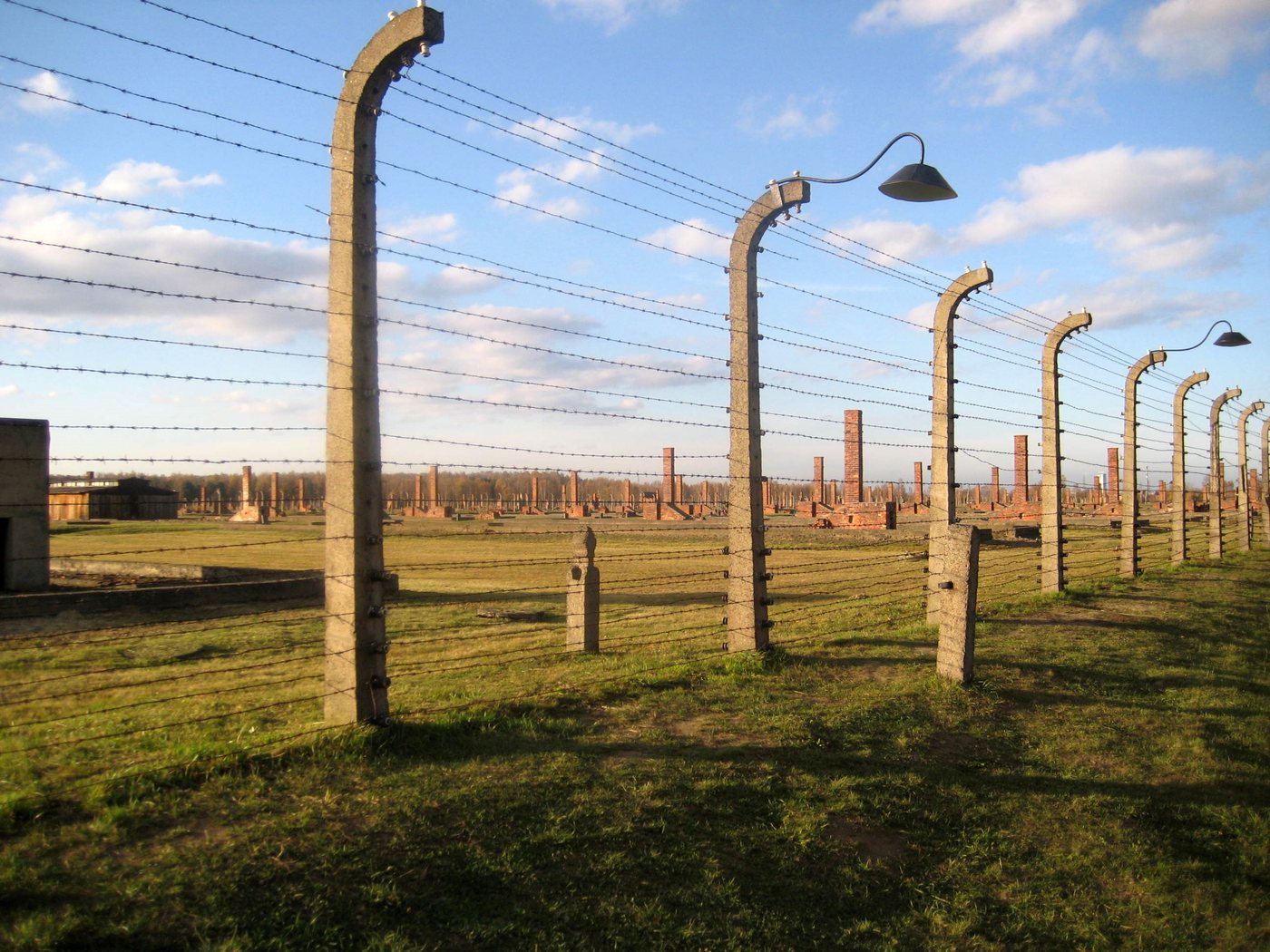
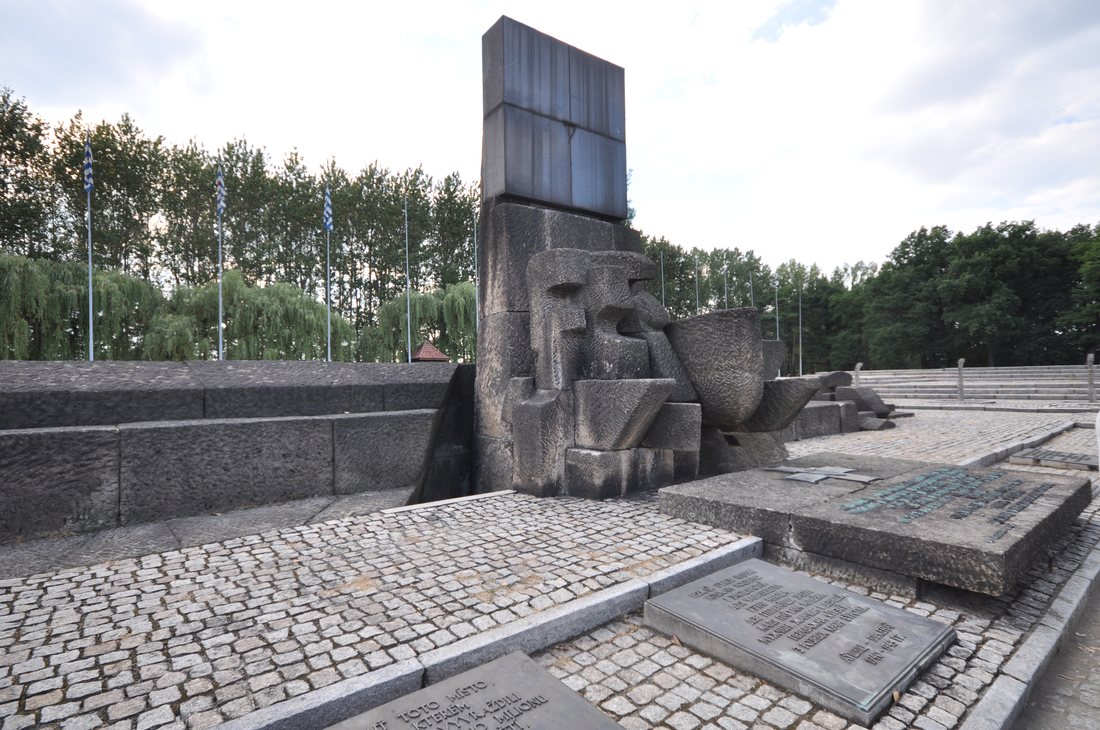
Auschwitz-Birkenau as it stands. Every film on this page is an attempt to put an
audience inside this, and every one of them makes a choice about how much to show.
Films are included because they are historically significant, widely assigned, critically
acclaimed, or pedagogically useful, including works we consider problematic, which are
included precisely because students will encounter them. Inclusion is not endorsement.
Curatorial method, Holocaust Film Landscape Matrix v2.1
02
The films people actually search for
The list of Holocaust movies people look up is short and predictable, and
it is not the list scholars would choose. Each one below is assessed on five dimensions:
historical accuracy, pedagogical value, ethical representation, audience appropriateness, and
how much framing it needs.
Schindler's List
Steven Spielberg · 1993 · 195 min · 7 Academy Awards including Best Picture
Essential viewingSignificant framing needed
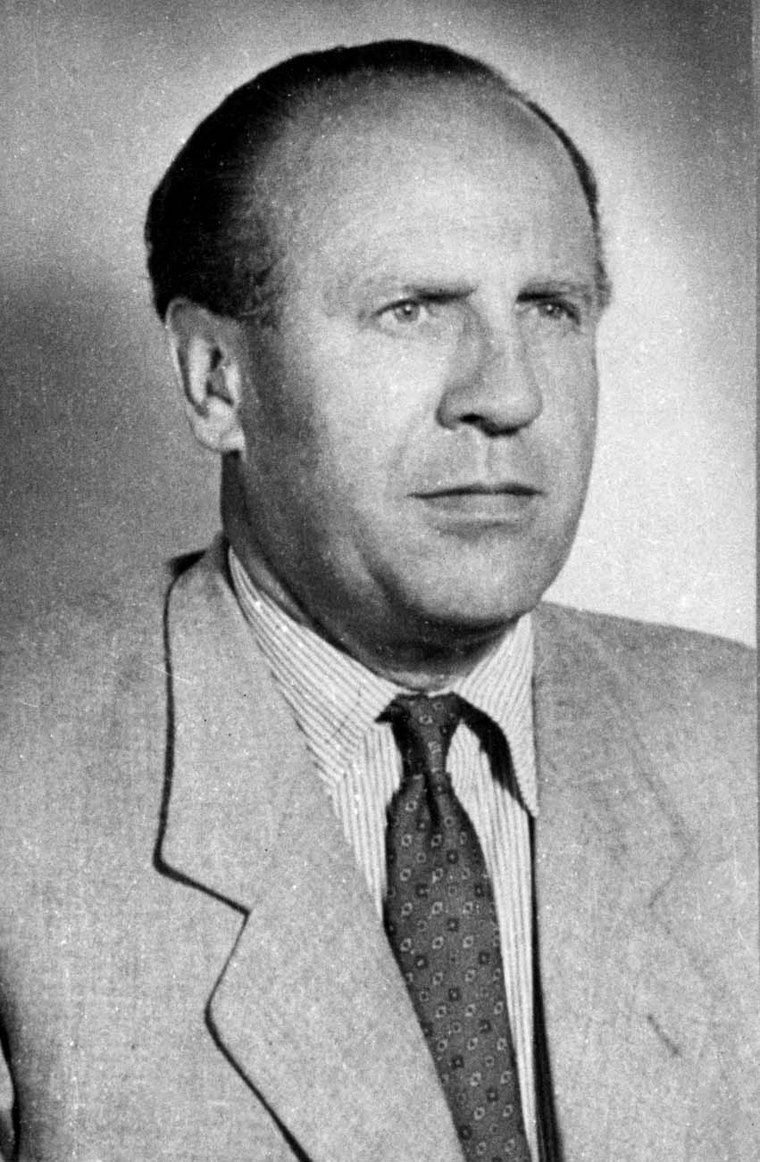
The actual Oskar Schindler. A Nazi Party member, a war profiteer, and the man
who saved roughly 1,200 people. The film has to hold all three at once, and the debate
is about whether it does. Wartime photograph, Yad Vashem Photo Archive.
The most widely seen Holocaust film in history, and one of the most contested. It can be
historically grounded, pedagogically powerful, and ethically criticized all at once, which
is exactly why it is the best film to learn to evaluate on.
Historical accuracy
High, with caveats. Built on Thomas Keneally's researched
Schindler's Ark. The Krakow Ghetto, Plaszow and Birkenau are rendered with care.
Timelines compress and some scenes are invented. The girl in the red coat is not one of them: she is in Keneally's book, and the film's addition is the color.
Pedagogical value
Very high. It puts the mechanisms of persecution on screen
and asks what individual choice means inside a system built to destroy moral agency.
Ethical representation
Strong but contested. Claude Lanzmann argued that
recreating the Holocaust with actors is inherently illegitimate. Dara Horn notes the film
centers a non-Jewish rescuer and casts Jews mainly as recipients of salvation.
Who it is for
Graduate and adult: essential. Undergraduate: with content
warnings. High school: possible with real preparation, or use selected clips. Middle
school: no.
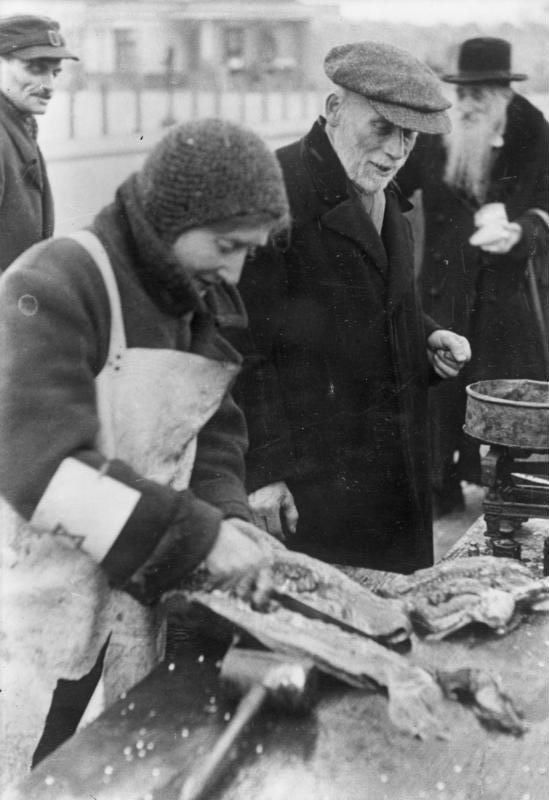
The Krakow Ghetto, photographed at the time. This is the place the film
reconstructs, and comparing the two is the most useful hour a class can spend on it.
Bundesarchiv.
What to pair it with. Miriam Hansen's Schindler's List Is Not Shoah
and Horn's critique before viewing. Afterwards, the question worth an hour: more than a hundred
million people now know something about the Holocaust from this film. What do they know
that is not quite right?
The Zone of Interest
Jonathan Glazer · 2023 · Academy Award, Best International Feature
Advanced seminarHistorically sound
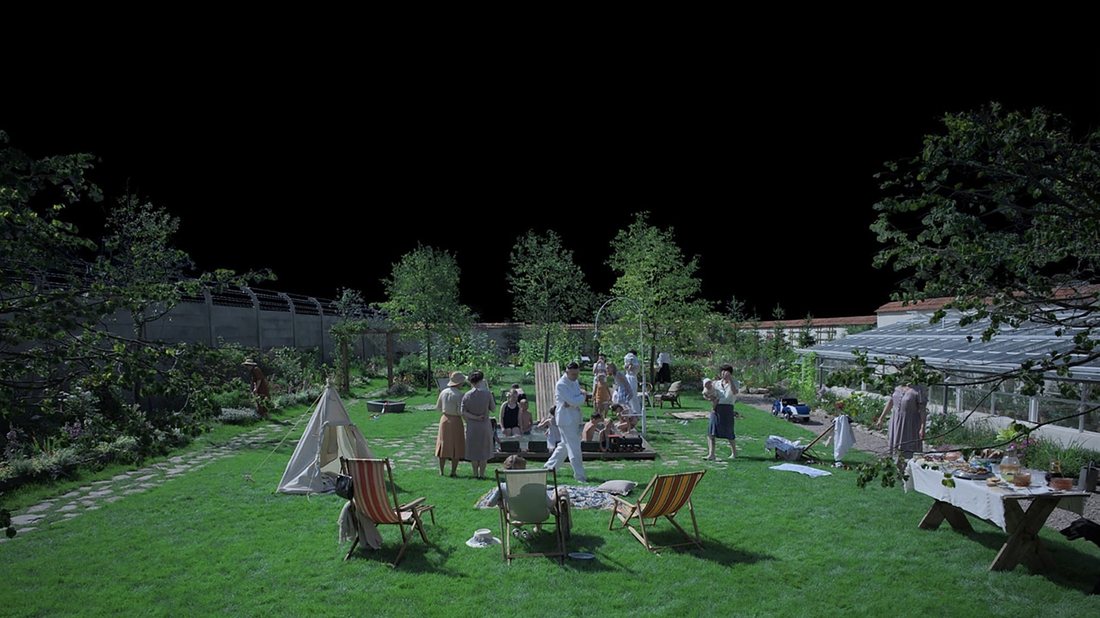
The Hoss family garden, against the camp wall. The Zone of Interest, 2023.
The Hoss family keeps a garden, hosts parties and raises children on the other side of the
Auschwitz wall. The inside of the camp is never shown. It is almost only heard, and that
decision is the whole argument: genocide as domestic routine, administered by people who found it
unremarkable.
Historical accuracy
Strong. Rudolf Hoss commanded Auschwitz and did live
with his family beside it. The film's restraint is itself a historical claim, and a
defensible one.
Why it matters
It is the clearest available answer to the question students
ask most: how could ordinary people do this? The answer the film gives is that they did
not experience themselves as doing anything.
Who it is for
Adult and advanced students. Its power depends on knowing what
is behind the wall, so it is a poor first Holocaust film and an excellent fifth.
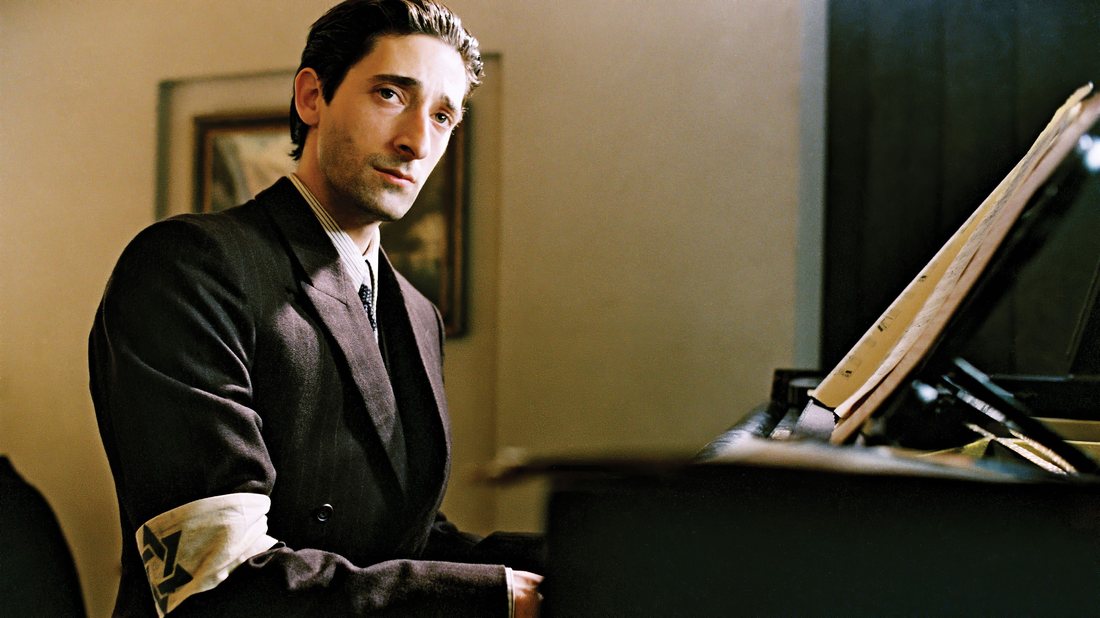
The Pianist
Roman Polanski · 2002 · Palme d'Or · 3 Academy Awards
Historically sound
Wladyslaw Szpilman at the piano. The Pianist, 2002.
Wladyslaw Szpilman's survival in the Warsaw Ghetto and the ruins beyond it. Polanski
survived the Krakow Ghetto as a child, and the film's refusal of uplift comes from
somewhere real. Survival here is mostly luck, and the film says so.
Historical accuracy
High. Adapted from Szpilman's own memoir, written
immediately after the war before memory had time to organize itself into narrative.
What it does that others do not
It centers a Jewish protagonist who is
neither hero nor symbol, and it declines to make his survival mean anything. That is
unusual and it is honest.
Who it is for
Adult, undergraduate, and high school with preparation.
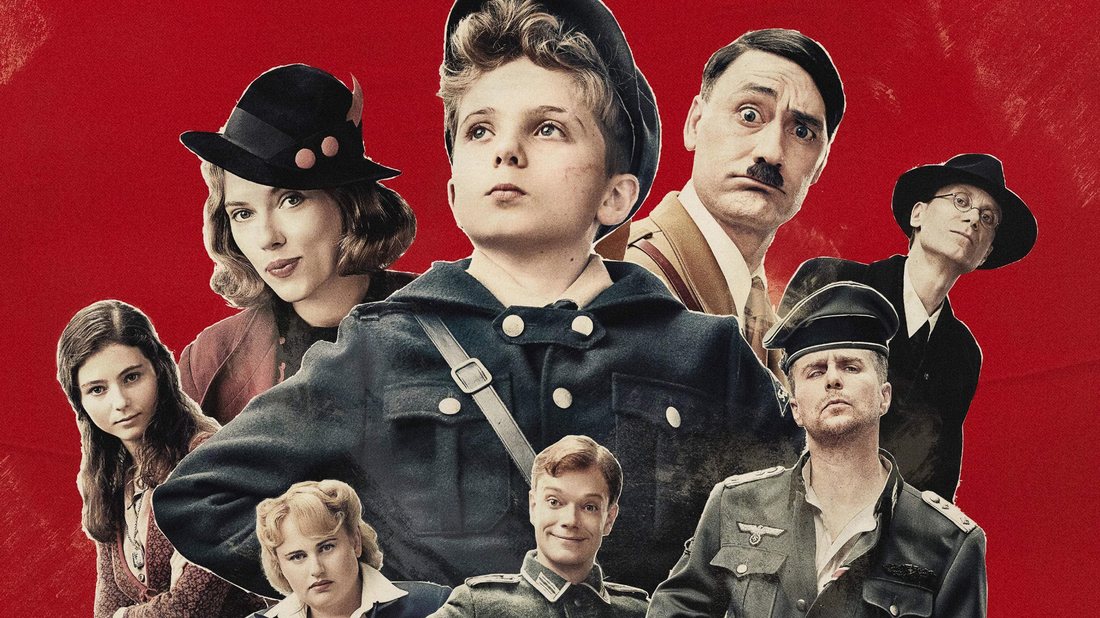
Jojo Rabbit
Taika Waititi · 2019 · Academy Award, Best Adapted Screenplay
Framing required
The imaginary Hitler, played by Taika Waititi. Jojo Rabbit, 2019.
A satire in which a Hitler Youth boy has an imaginary Hitler for a friend, played by
Waititi, who is Maori and Jewish. The film is about the manufacture of a fanatic and its
undoing, not about the camps, and confusing the two is where classroom use goes wrong.
What it is actually about
Indoctrination, and how a child is talked into
hatred and then talked out of it by meeting one person. Read that way it is precise.
The risk
Satire requires the audience to already know the reality being
satirized. Students who have not learned the history will read the comedy as the tone of
the period rather than as a weapon aimed at it.
Who it is for
Secondary and up, only after the historical grounding is in
place. Never as an introduction.
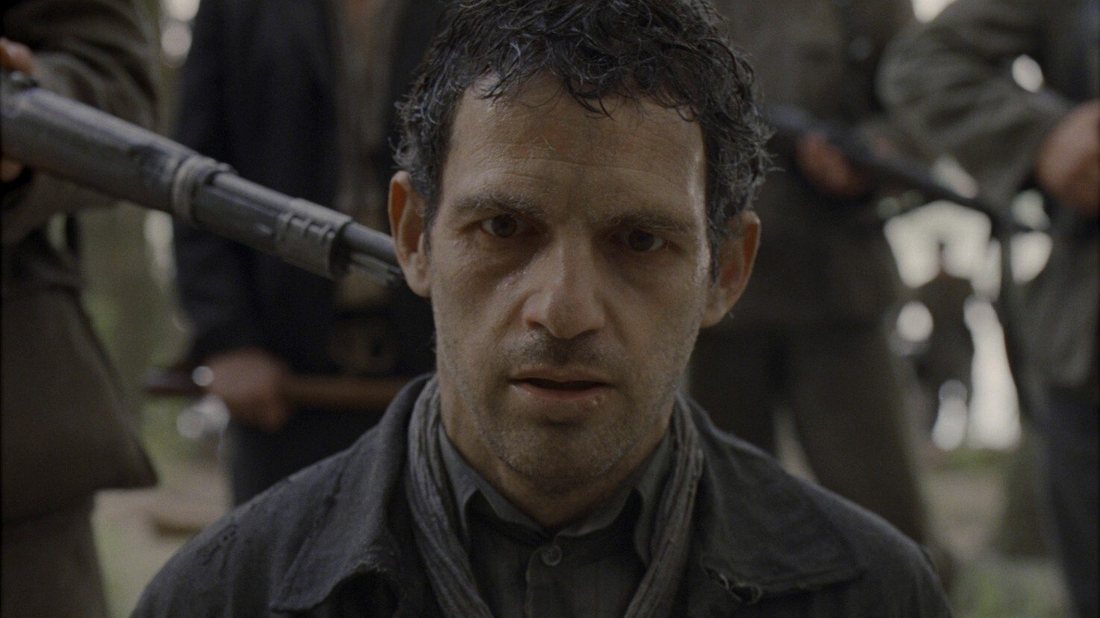
Son of Saul
Laszlo Nemes · 2015 · Academy Award, Best Foreign Language Film
Advanced seminarHistorically sound
The camera stays on Saul's face; the killing happens out of focus. Son of Saul, 2015.
Alberto Errera, the Greek Jewish Sonderkommando prisoner credited with the secret
photographs taken at Birkenau in late summer 1944, using a camera the camp resistance
took from victims' luggage. They are among the only photographs of the killing process
at Auschwitz-Birkenau. From Four
Photographs, Project Witness Microshort Stories.
A Sonderkommando at Birkenau, filmed with the camera locked to his face so that the killing
happens at the blurred edges of the frame. The formal choice is an ethical one: you are
denied the spectacle, and left with the man.
Historical accuracy
High, and unusually specific about the Sonderkommando,
whose position the film refuses to simplify into either complicity or heroism.
Pair with
The Grey Zone (Tim Blake Nelson, 2001), on the
Sonderkommando uprising. The two films together are the closest cinema comes to this
subject honestly.
Who it is for
Adult and graduate. Extremely difficult viewing.
Shoah
Claude Lanzmann · 1985 · 9½ hours · widely held to be the greatest Holocaust documentary made
Advanced seminar
Birkenau today. Shoah refuses archival footage and films the places as they now are.
Nine and a half hours with no archival footage at all. Only testimony, and the camera standing in
fields and at railheads where the events happened and nothing now remains. Lanzmann
interviewed survivors, bystanders and perpetrators, and the method is the argument: the
past is not available as image, only as witness.
Why it is the counterweight
Lanzmann's objection to Schindler's List
is not incidental. Shoah, finished eight years earlier, is the alternative he had already built. Teaching the two against each
other is the single most productive pairing in Holocaust film education.
Practical note
Nine and a half hours defeats most syllabi. Selected sequences work,
provided the length itself is discussed rather than quietly edited away.
Its companion in the documentary canon is Alain Resnais's Night and Fog (1956),
thirty-two minutes, which does the opposite: it looks directly at the archival footage, and
it was made while the camps were still recent.
03
The films to handle with care
These are widely taught and widely loved. The course includes them because
students will meet them anyway, and because being able to say precisely what is wrong with a
film is a more useful skill than avoiding it.
The Boy in the Striped Pajamas
Mark Herman · 2008 · one of the most criticized films in Holocaust education
Historically impossible
The scene that could not have happened. The Boy in the Striped Pyjamas, 2008.
Its premise cannot have happened. Camp perimeters were electrified, patrolled and
impossible to sit beside unnoticed, and a boy of that age arriving at Auschwitz would
almost certainly have been murdered on arrival rather than held in the camp. The friendship
the story depends on had no physical possibility of occurring.
The deeper problem
It centers the perpetrator's child. The emotional payoff
is the German family's grief, which quietly makes the Holocaust a tragedy that happened
to Germans.
Why it is still in the matrix
Because it is assigned constantly, and because
teaching students to identify exactly why it fails is more valuable than pretending they
have not seen it.
The Book Thief
Brian Percival · 2013 · from the Markus Zusak novel
Softens to background
A well-made film about a non-Jewish German girl, in which the persecution of Jews recedes
into set dressing for someone else's coming of age. The hidden Jewish character exists
largely to develop her.
The pattern it belongs to
Structural distortion rather than malice:
centering non-Jewish experience, and resolving on warmth. Students should be able to
name that pattern, because it recurs across dozens of films they will like.
Usable how
As a case study in what gets displaced when the Holocaust becomes
a backdrop, rather than as an account of the period.
Life is Beautiful
Roberto Benigni · 1997 · 3 Academy Awards
Genuinely contested
A father convinces his son the camp is a game. The film is beautifully made and the debate
about it has never resolved: does the comedy protect the child and honor the father, or does
it make the camps survivable in the imagination in a way they were not?
Where it sits
Unlike The Boy in the Striped Pajamas, this is not a
factual impossibility. It is an argument about representation, and reasonable scholars
land on both sides.
Usable how
Excellent seminar material precisely because it is unresolved.
Poor introductory material for the same reason.
Four patterns account for most of the distortion, and almost none of it is
malicious.
Narrative convenience compresses events until cause and effect are wrong.
False equivalence centers non-Jewish suffering as though the persecution were
symmetrical. Sentimentality insists on a redemptive ending that the history
does not supply. Universalization turns a genocide aimed at Jews into a
general lesson about intolerance, which sounds generous and erases the actual target.
Educators need to spot these even in films they admire. Especially in films they admire.
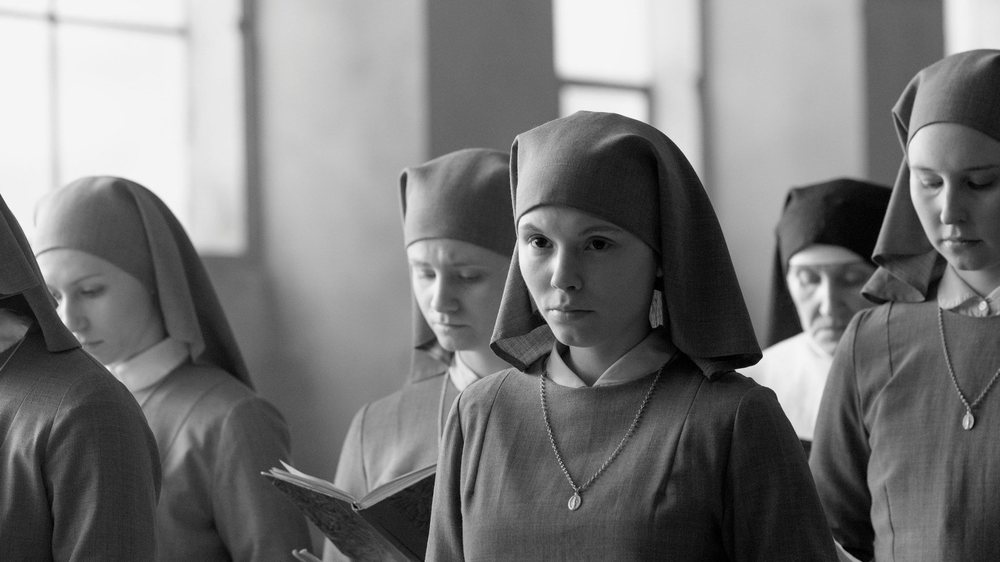
The opposite of all four patterns. Ida (Pawel Pawlikowski, 2013) tells a
Polish Jewish story in the aftermath, refuses a redemptive ending, and composes its people
small inside the frame rather than centring them for comfort.
04
How to judge a Holocaust film yourself
Five dimensions. A film can score well on some and badly on others, and
most important films do exactly that.
1
Historical accuracy
What is documented, what is compressed, what is invented. Invention is not automatically
disqualifying. Invention that the story structurally depends on usually is.
2
Pedagogical value
What questions does it open that matter? A flawed film that provokes the right argument can
out-teach a careful one that provokes nothing.
3
Ethical representation
Are victims people or devices? Whose agency does the film grant? Does it look at suffering,
or does it stage it?
4
Audience appropriateness
Graduate, undergraduate, secondary, community. Content, running time and prior knowledge
all move this, and the honest answer is often "not this group."
5
Contextual framing
How much scaffolding does it need to be understood correctly? Some films need a paragraph.
Some need a syllabus. Some cannot be framed into safety.
Every film starts with a perfect score and loses points only when the
evidence demands it. Weigh the flaws in proportion: a momentary slip costs little, and an
absurd founding premise can make a film indefensible.
After Rich Brownstein, author of Holocaust Cinema Complete, whose review method
underlies this framework
05
Before the Holocaust was filmed, it was advertised
Holocaust cinema opens in 1933, and the first people making it are the
perpetrators. A dozen kinds of film, built by a state that understood the medium better than
anyone alive at the time.
The reason to teach these is not historical curiosity. It is that they worked.
Goebbels ran a film industry, not a pamphlet operation. Most of what it produced was
entertainment with the ideology carried underneath, and the most-watched Nazi films are not
the ones with swastikas on the poster. That is the lesson worth carrying out of this section:
propaganda that announces itself is the least effective kind.
1. Fuhrer cult
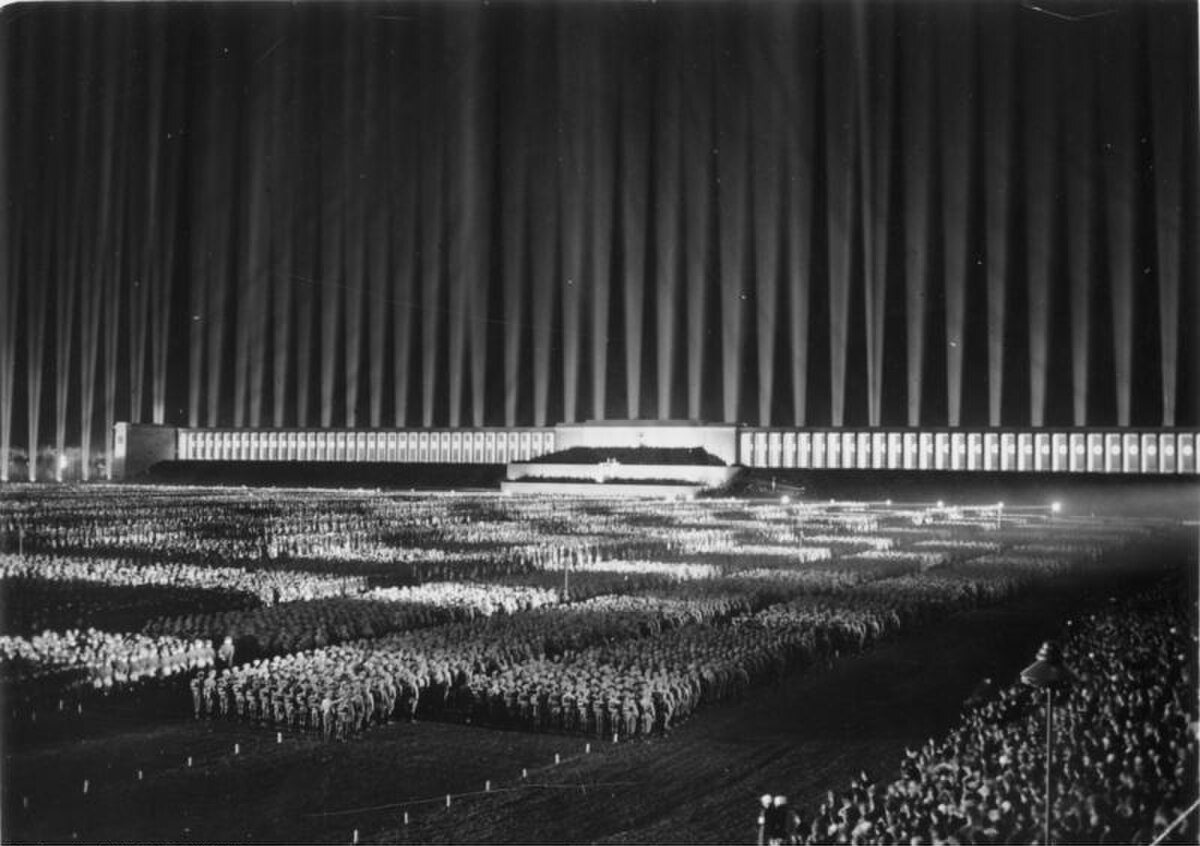
Triumph of the Will
Riefenstahl’s record of the 1934 Nuremberg rally, commissioned by Hitler. Still studied as one of the most technically accomplished propaganda films ever made, which is precisely the problem it sets a classroom.
The Cathedral of Light, Nuremberg. 152 searchlights aimed upward to build a room out of air.
2. Hero and martyr films
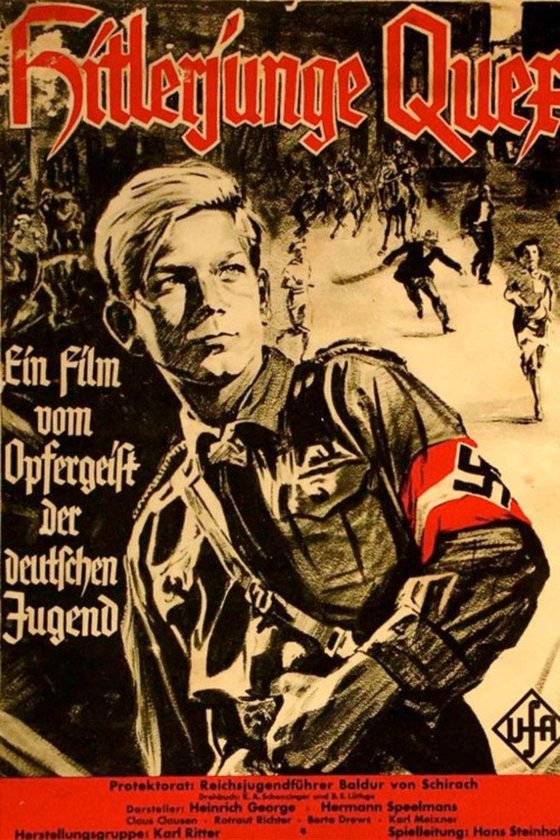
Hitlerjunge Quex
One of three 1933 films glorifying Nazi martyrdom, the so-called SA trilogy. A million viewers by January 1934. Goebbels called it the first large-scale transmission of Nazi ideology through cinema.
Original 1933 release poster. Reproduced for criticism and scholarship.
3. Antisemitic features
Jud Suss
Veit Harlan on set. More than twenty million people saw the finished film. Himmler ordered every member of the SS and police to watch it. It is entertainment first, which is what made it work.
Production photograph, 1940. Jewish extras were conscripted from occupied Poland.
4. Pseudo-documentary
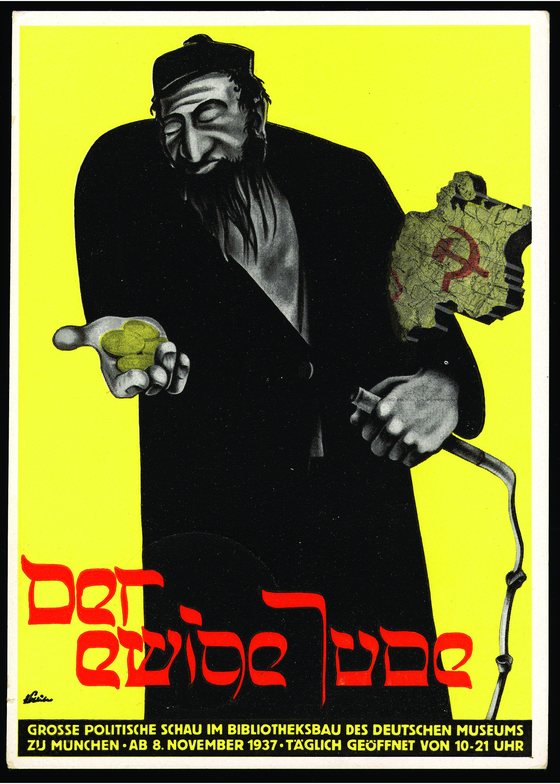
Der ewige Jude
Real people, filmed in the ghettos under conditions the Nazis had themselves created, then presented as evidence of what Jews naturally are. A box-office disappointment, it was made compulsory viewing for SS and police units, Wehrmacht special units and camp guards.
Poster for the 1937 Munich exhibition Der ewige Jude, which preceded the film. Reproduced for criticism and scholarship.
The apparatus around the films
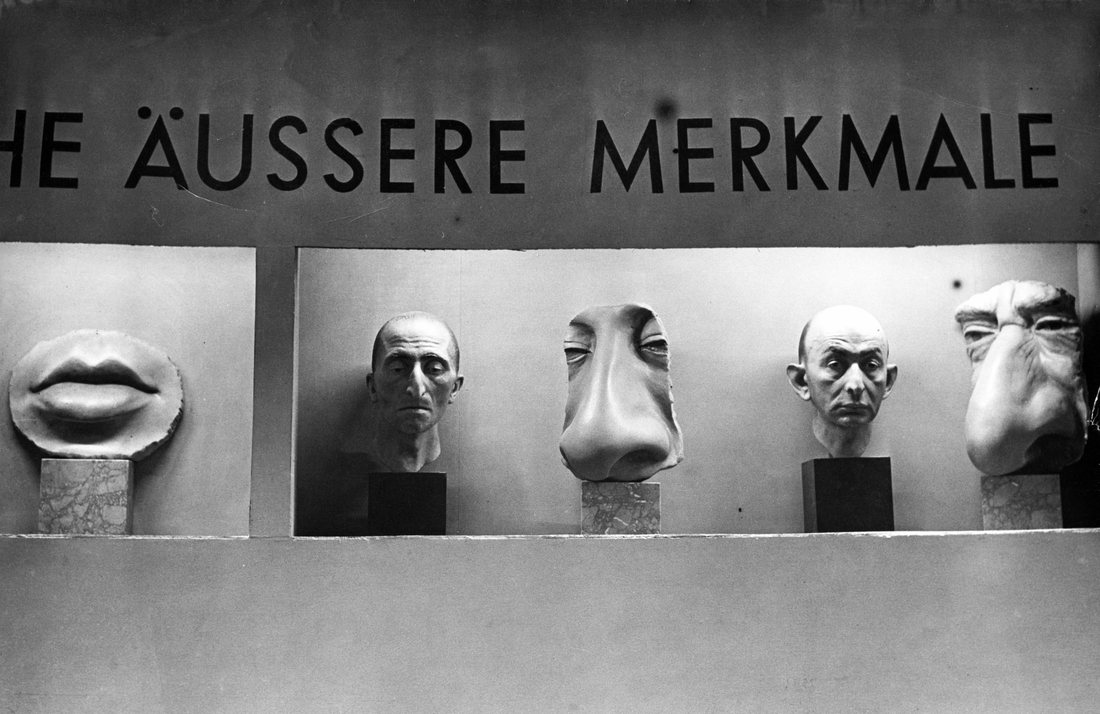
The exhibition halls
The films did not arrive alone. Museum exhibitions, schoolbooks, board games and shop-window displays taught the same lesson in parallel, so that by the time an audience sat down in a cinema the argument was already familiar.
“External characteristics” display from a travelling exhibition. Plaster casts presented as racial science.
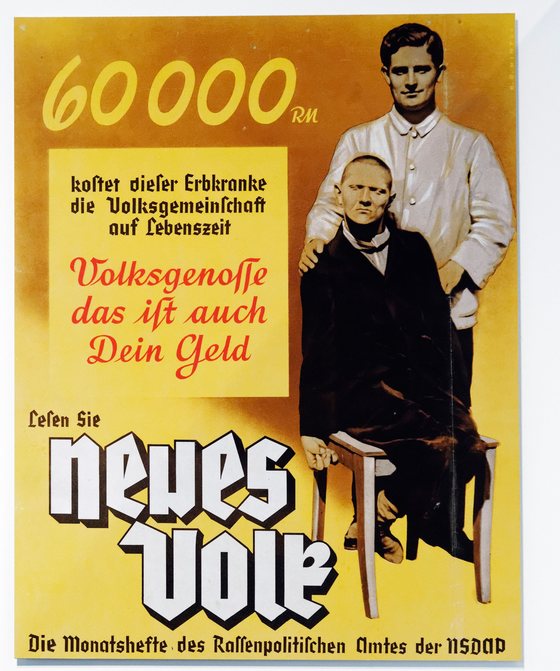
7. Racial hygiene and euthanasia
Ich klage an
A sympathetic drama arguing for mercy killing, released in 1941 while the regime was murdering disabled people. Cinema was used to build consent for the first mass killing programme.
Racial-hygiene poster: the cost of a disabled citizen, addressed to the taxpayer.
8. Historical epics
Kolberg
The last major Nazi production and the most expensive film of the Nazi era. The Wehrmacht supplied soldiers by the thousands as extras in the war's last year, to film a story about refusing to surrender.
Premiered 30 January 1945, when cinemas in many German cities had been destroyed.
9. Entertainment with ideology inside
Die grosse Liebe
The most commercially successful film of the Third Reich. A wartime romance with songs about endurance and waiting. No politics on the surface, which is exactly the point, and why it outperformed everything overtly ideological.
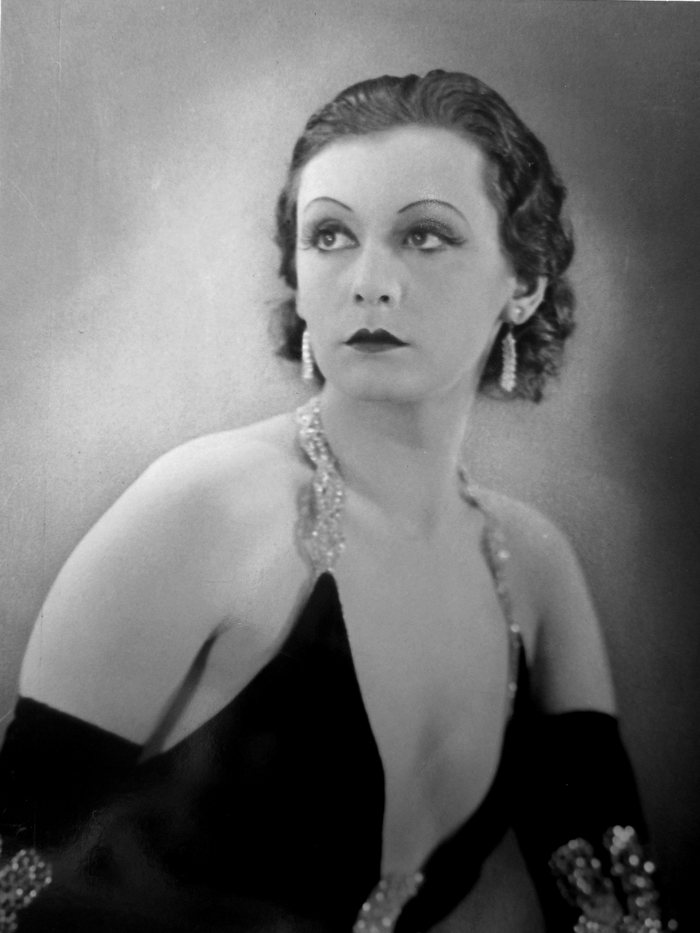
Zarah Leander, 1942. Wunschkonzert (1940), released two years earlier, was also a major success.
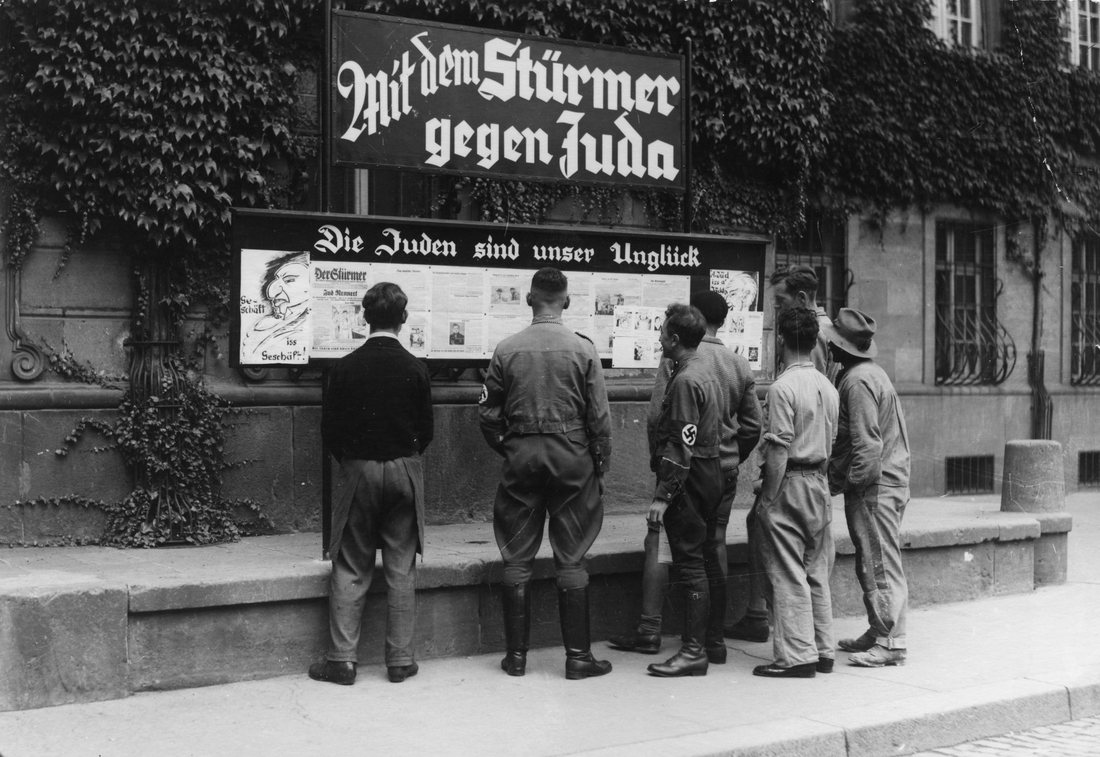
A Der Sturmer display case on an ordinary street. The banner reads
“the Jews are our misfortune.” This is the environment the films were released
into, and the reason a single film could do so much work so quickly.
Two categories are absent above because their films are the least remembered and among the
most revealing: military victory documentaries such as Feldzug in
Polen and Sieg im Westen, which manufactured consent for the war itself, and
anti-Allied features such as Ohm Krüger, which showed German
audiences British concentration camps in the Boer War.
All twelve categories, with directors and dates, are in the course's full matrix.
06
Ninety years, six eras, more than 200 films
Holocaust cinema did not begin after the war. It began in 1933, made by the
perpetrators, and every era since has been arguing with the one before it.
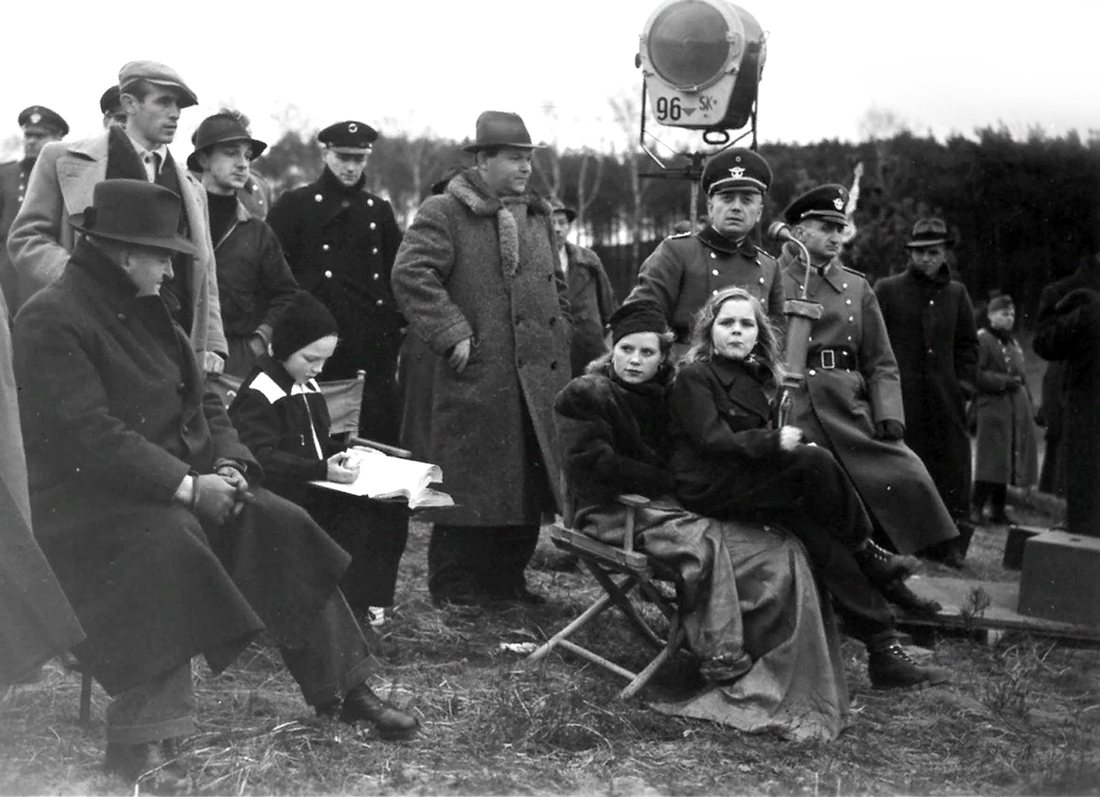
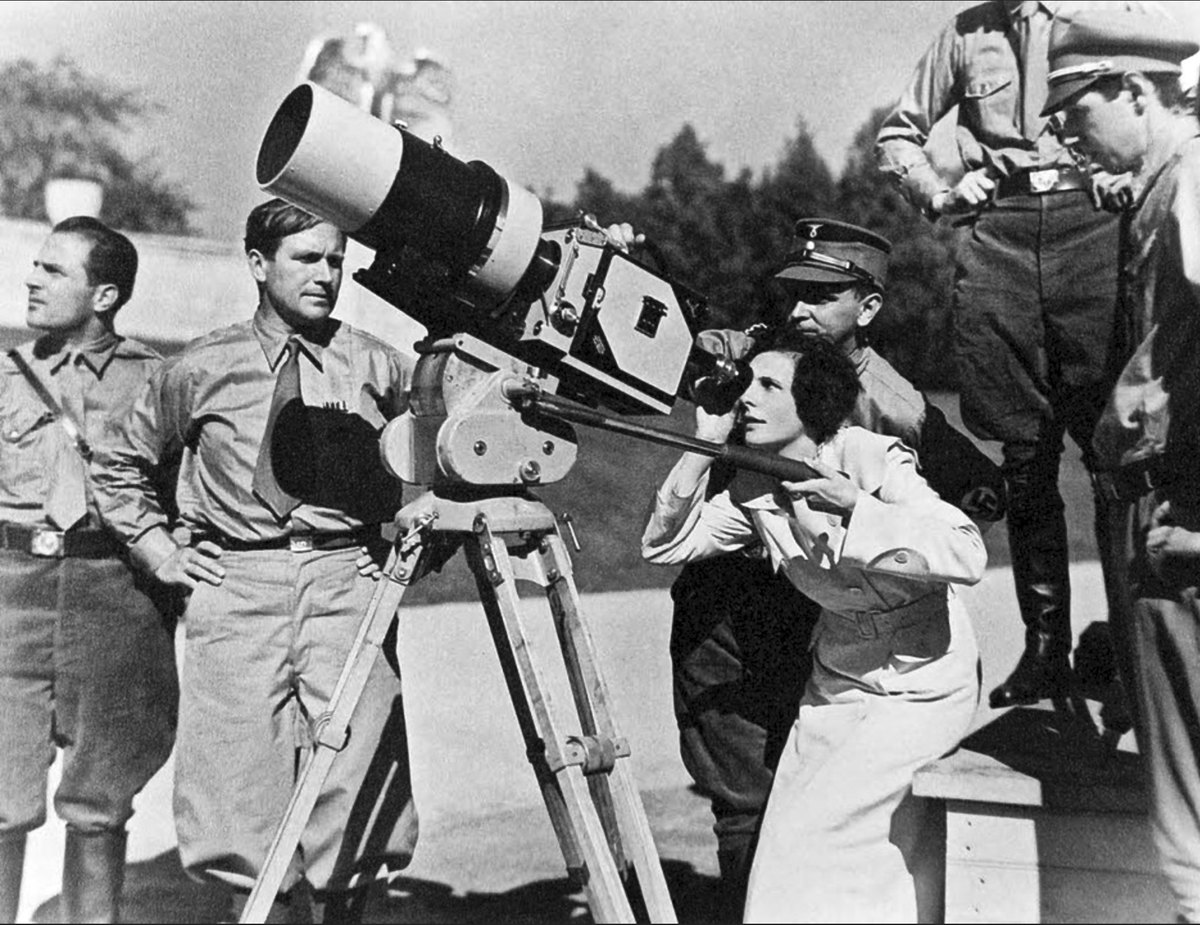
Leni Riefenstahl operating at the Nuremberg rally grounds, surrounded by the men
she was filming. Triumph of the Will was commissioned by Hitler and is still
studied as one of the most technically accomplished propaganda films ever made, which is exactly
the problem it poses to a classroom. Production photograph, 1934.
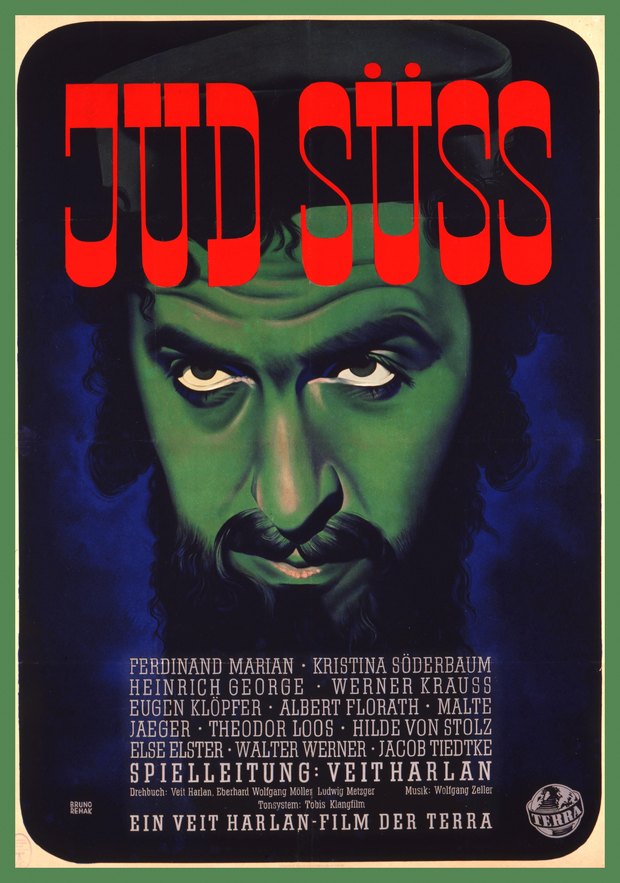
The artifact this page exists to be able to look at
The 1940 release poster for Jud Suss, directed by Veit Harlan. More than twenty
million people saw the film. Himmler ordered every member of the SS and the police to
watch it. It is the most commercially successful antisemitic film ever made, and it works
by making the caricature on this poster feel like an observation.
It is reproduced here because a course on Holocaust film that cannot show what Nazi
cinema actually looked like is not teaching the subject. The image is the evidence. Being
able to name what it is doing, and how competently it does it, is the skill.
Original 1940 German release poster,
designer Bruno Rehak, Terra Film. Reproduced for criticism and scholarship.
Der ewige Jude, 1940. Real people, filmed under conditions the Nazis created, then presented as proof of what they claimed.
The Nazi era and wartime
1933 to 1945
Two opposed bodies of film made simultaneously: the most sophisticated state propaganda
apparatus in history, and the Allied and exile films answering it.
Triumph of the Will (1935)
Jud Suss (1940), seen by more than 20 million
Der ewige Jude (1940)
The Great Dictator (1940)
Liberation and immediate postwar
1945 to 1960
Liberation footage, the first trials, and a period in which most of the world decided not
to look at what had just been filmed.
Night and Fog (1956)
The Last Stop (1948)
The Diary of Anne Frank (1959)
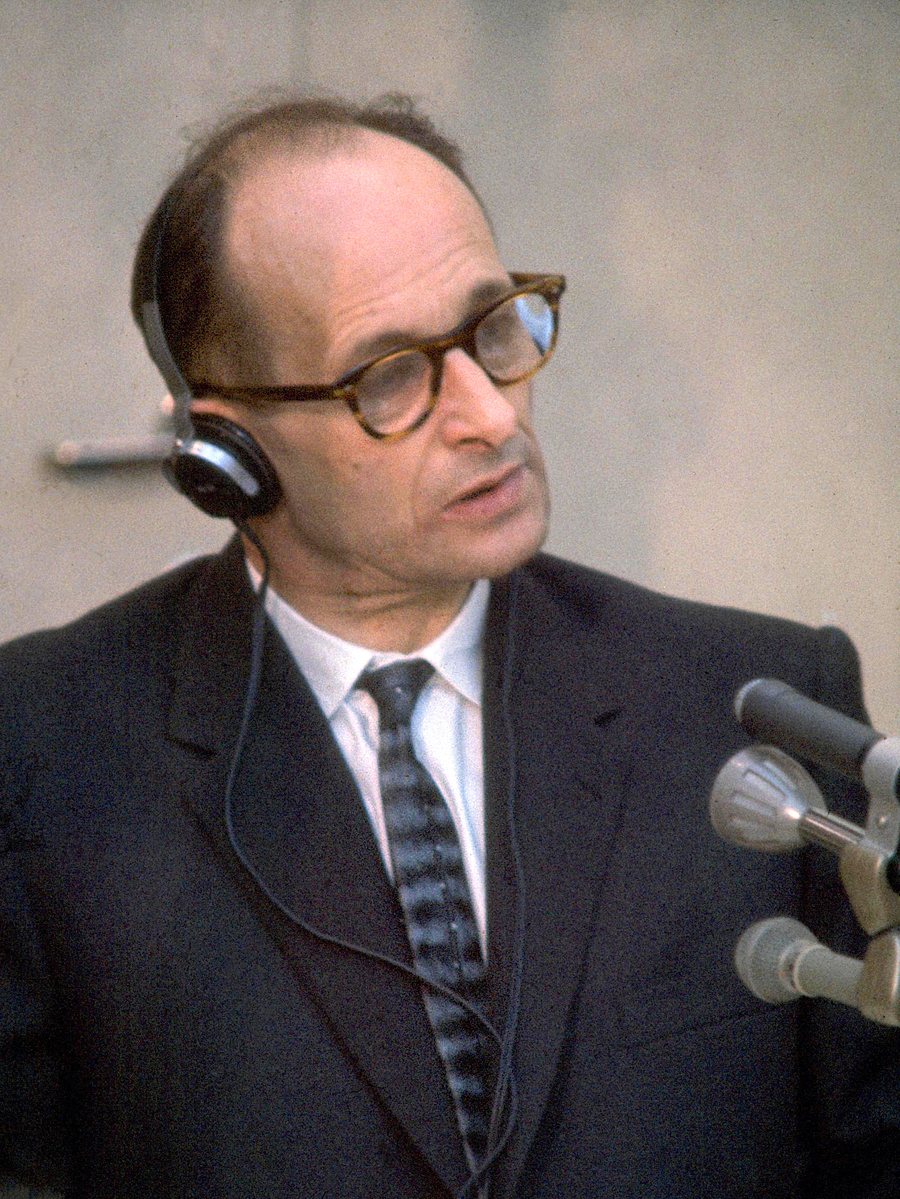
Adolf Eichmann in the glass booth, Jerusalem, 1961. The trial put survivor testimony on television.
The awakening
1960 to 1978
The Eichmann trial puts survivor testimony on television, and cinema slowly follows.
Judgment at Nuremberg (1961)
The Shop on Main Street (1965)
The Sorrow and the Pity (1969)
The breakthrough
1978 to 2000
The Holocaust miniseries reaches audiences no film had, and the canon as most
people know it is built.
Shoah (1985)
Schindler's List (1993)
Europa Europa (1990)
Life is Beautiful (1997)
The contemporary era
2000 to now
Formal experiment, the perpetrator's interior, and the last decades in which survivors can
still speak for themselves on camera.
The Pianist (2002)
Son of Saul (2015)
The Zone of Interest (2023)
Denial (2016)
Testimony moves from film to database to interactive avatar.
The digital frontier
Emerging
Interactive testimony, volumetric survivor holograms, virtual reality reconstruction, and
the unresolved question of what happens to witness when the witness is synthesized.
Interactive testimony projects
VR camp reconstructions
Archive-driven documentary
The full matrix also maps films by national cinema, by perpetrator and bystander focus, by
gendered experience, by persecuted groups beyond Jews, and by the spectrum running from
outright denial to well-meaning distortion. It is a teaching instrument rather than a
filmography, and it is openly incomplete: African, Asian and Latin American perspectives are
underrepresented, films without English subtitles are underrepresented, and some films are
simply lost.
07
One story, nine adaptations, more than sixty years
Anne Frank has been adapted hundreds of times, and each
version tells you more about its own decade than about her.
The 1959 George Stevens film. An NBC production in 1980. A 1988 telling from Miep Gies's
point of view, and another in 2023. A Japanese animated feature in 1995. An ABC miniseries in
2001. A German film in 2016. Ari Folman's animated Where Is Anne Frank in 2021, and
the Dutch My Best Friend Anne Frank the same year, told by Hannah Goslar, who found
Anne at Bergen-Belsen and spoke to her through the wire.
The diary ends before the worst of it, and many adaptations stop where it stops. The
exceptions are the ones to teach: ABC's 2001 miniseries follows Anne from Amsterdam to her
last days at Bergen-Belsen, and Folman's film takes its viewers to the camp where she died.
We make the films we wish existed when we started teaching this
Project Witness is a nonprofit Holocaust education organization in New York. Our films are
built from survivor testimony and documented record. The survivor testimonies and the
Microshort Stories are free to watch, with no login and no account.
We Dared to Write follows six young diarists of the Holocaust, only one of whom is
a household name. The Microshort Stories are ninety-second animated films built for
classrooms, each on one person and one act of courage, resistance or witness.
Four Photographs, Project Witness Microshort Stories. Alberto Errera, credited with
the photographs, worked inside the Sonderkommando at Birkenau. Four frames survive.
This page synthesizes the teaching materials of HJSG 644, The Holocaust in Movies and
Documentaries, a graduate course written and taught by Israel B. Bitton. The film
assessments come from that course's Holocaust Film Landscape Matrix, version 2.1, which maps
more than 200 films across six eras, and from its Film Evaluation Framework.
The review methodology underlying the framework is Rich Brownstein's,
from Holocaust Cinema Complete. The Schindler's List assessment draws on
Miriam Hansen's Schindler's List Is Not Shoah, Claude Lanzmann's objections to
dramatization, and Dara Horn's critique of the rescue narrative. Institutional guidance from
the United States Holocaust Memorial Museum informs the audience-appropriateness judgments.
A note on images. Film posters and stills reproduced on this page appear for
the purpose of criticism, comment, scholarship and teaching, which is fair use under 17 U.S.C.
§107. Each is a single low-resolution image tied to the specific critical argument beside
it, each is attributed, and none substitutes for viewing the work it comes from. This follows
the Society for Cinema and Media Studies statement of best practices for fair use in scholarly
publishing. Historical photographs are credited to their archives. The animated still from
Four Photographs is Project Witness's own work.
If you hold rights in anything reproduced here and want it removed,
write to us and we will take it down
while we discuss it.
Written by Israel B. Bitton, Deputy Director, Project Witness, from his own
graduate course materials. Published August 18, 2026. Found an error?
Tell us and we will check it against the
sources and correct it.