Turning Points · July 1944 to 1957
Liberation was not the end of the dying.
British soldiers reached Bergen-Belsen on April 15, 1945, and found about 55,000 people alive. More than 13,000 of them died in the next three months. The war in Europe ended that May. For the survivors, the waiting went on for years.
Project Witness records and preserves Holocaust survivor testimony. This page is free to use, in classrooms and out of them.
Written for readers 14 and up. This page describes how prisoners died during and after the liberation of the camps. It shows no photographs of the dead.
The short answers
- When did the Holocaust end?
- There is no single date. Allied troops reached the camps between July 1944 and May 1945, Germany surrendered on May 7 to 9, 1945, almost all the displaced persons camps had closed by 1952, and the last of them, Foehrenwald, ran until 1957. For a survivor the end came whenever they found somewhere to live.
- When was Auschwitz liberated?
- On January 27, 1945, by Soviet troops. They found over 6,000 emaciated prisoners still alive. The United Nations later made that date its International Day of Commemoration in memory of the victims of the Holocaust.
- What were the death marches?
- Forced evacuations of the camps, increasingly on foot from the winter of 1944 and on the largest scale from January 1945, as the Allies closed in. Guards shot prisoners who could not keep up. Yad Vashem puts the prisoners who died on them, Jews and non-Jews, at between 200,000 and 250,000.
- Did liberation save everyone it reached?
- No. The British found about 55,000 people alive at Bergen-Belsen on April 15, 1945, and more than 13,000 of them died of malnutrition or disease within three months.
- Did survivors go home?
- Most from eastern Europe could not or would not. Their communities had been destroyed and antisemitism had not gone away; people who tried to go back often feared for their lives. More than 250,000 Jewish survivors lived in displaced persons camps and centers between 1945 and 1952.
- Where did they end up?
- Over 80,000 went to the United States, about 136,000 to Israel, and another 20,000 to Canada, South Africa and elsewhere. Most waited years for a country to let them in.
Before you read on: true or false?
Six statements about the end of the Holocaust. Choose true or false, then see what the sources say.
Auschwitz was the first Nazi camp the Allies reached.
Show the answer
It is false.
The first major camp to be liberated was Majdanek, in Lublin. Soviet troops reached it in July 1944, six months before Auschwitz, and found it virtually intact.
Source: United States Holocaust Memorial Museum, Liberation of Nazi CampsWhen Soviet troops reached Auschwitz, most of its prisoners were still there.
Show the answer
It is false.
In the weeks before, the SS had forced most of the prisoners to march west. The soldiers found over 6,000 still alive.
Source: United States Holocaust Memorial Museum, Liberation of Nazi CampsAmerican troops liberated Bergen-Belsen.
Show the answer
It is false.
British forces liberated it on April 15, 1945, and found around 55,000 prisoners there.
Source: United States Holocaust Memorial Museum, Bergen-BelsenThousands of people died after their camp had been liberated.
Show the answer
It is true.
At Bergen-Belsen alone, more than 13,000 of the people the British found alive died of malnutrition or disease within three months.
Source: United States Holocaust Memorial Museum, Liberation of Nazi CampsMost Jewish survivors went back to their hometowns after the war.
Show the answer
It is false.
Most survivors from eastern Europe could not go back, or would not, because of antisemitism and the destruction of their communities. Those who did often feared for their lives.
Source: United States Holocaust Memorial Museum, Displaced PersonsThe last displaced persons camp closed in 1952.
Show the answer
It is false.
Almost all of them had closed by 1952, but Foehrenwald, southwest of Munich, ran until 1957 as a home for Jews who had nowhere else to go.
Source: United States Holocaust Memorial Museum, Foehrenwald Displaced Persons Camp
The marches
From the winter of 1944, and on the largest scale from January 1945, the SS emptied the camps ahead of the advancing armies and drove the prisoners deeper into Germany, more and more of them on foot. The name death march was probably coined by the prisoners themselves.
The SS had three reasons. It did not want prisoners left behind to tell the liberators what had happened. It thought it needed them to keep armament production going. And some SS leaders, Himmler among them, believed they could use Jewish prisoners as hostages to bargain for a separate peace in the west. The Holocaust Encyclopedia calls that belief irrational.
The evacuation of Auschwitz began on January 17, 1945. Tens of thousands of prisoners, most of them Jews, were marched 55 kilometers (about 30 miles) to Gliwice or 63 kilometers (about 35 miles) to Wodzisław Śląski in the middle of a Polish winter, and from there most were put on unheated freight trains to camps in Germany. Guards shot anyone who fell behind or could not go on.
The largest marches set out from Auschwitz and Stutthof. In the winter the columns went west to Buchenwald, Flossenbürg, Dachau and Sachsenhausen, and in the spring the SS moved prisoners again, from Buchenwald and Flossenbürg to Dachau and Mauthausen. The camps inside Germany filled with prisoners from the east.
As the evacuations came to depend on marches and open rail cars, the number who died of exhaustion and exposure along the routes rose dramatically. Yad Vashem puts the dead of the marches, from the summer of 1944 to the end of the war, at between 200,000 and 250,000 prisoners. Between a quarter and a third of them were Jews.
We went on a death march, and that's the whole beginning of misery, that if somebody would have predicted to me what a death march would entail, and they would say, "You know what? You could get your freedom. You buy your freedom up. You get five years of what I had before, I take the five years." That's how brutal ... But they were killing people, whoever dropped out, and it didn't take long to drop out. Below zero temperature, you walk with no clothes, with the pajamas on. People dropping out every minute, every minute, five, 10 guy, and they were killed right on the spot.
Israel Katz, who was marched out of Monowitz, part of Auschwitz, in January 1945 with his brother Pinchas. His brother did not survive the evacuations. Project Witness testimony. Watch the full testimony. This passage begins at 42:20: Israel Katz, Project Witness
The camps are opened
The first major camp to be liberated was Majdanek, in Lublin. Its last staff abandoned it in haste, without fully dismantling it, and when Soviet troops arrived during the night of July 22 to 23, 1944, they found it virtually intact, with substantial evidence of the mass murder committed there.
The camps reached, month by month
Each mark is a camp, colored by the army or organization that reached it and shaped by what the troops found. Press play, or move through the months, and select a mark for its record.
All 26 camps on this map, July 1944 to May 1945. Troops found prisoners still in 13 of them.
Swipe the map sideways to see all of it.
- Soviet forces
- United States Army
- British Army
- Canadian forces
- Other forces, the Red Cross, or not recorded
- Troops found prisoners still in the camp
- The camp had been emptied or destroyed, or its prisoners murdered
- Handed over or abandoned before the troops came
From July 1944 through the winter the Soviet army reached the camps in the east. Most had already been emptied or demolished, or their prisoners murdered; the SS had marched or shipped the living west. In April and May 1945 the American and British armies reached the camps inside Germany and Austria, where many of the prisoners they found had survived death marches into the interior.
Drawn by Project Witness from the records of its camps directory, each researched against the USHMM Holocaust Encyclopedia or the camp's memorial; the table names the source for every camp. It shows the camps whose records give the month troops or relief workers reached them, where the directory rates the record high or medium-high confidence; subcamps that sit on their main camp at this scale are left out. Base map: Natural Earth, public domain.
The 26 camps on this map, in the order the troops reached them
| Reached | Camp | Reached by | What they found |
|---|---|---|---|
| July 1944 | Treblinka I | Soviet forces reached the area in late July 1944 after the camp was evacuated and its remaining prisoners shot. | Emptied, and the last prisoners shot. Source: Treblinka I |
| July 23, 1944 | Majdanek | Soviet forces (Red Army) | Prisoners still in the camp. Source: Majdanek |
| August 1944 | Drancy | The German administration fled in mid-August 1944 as Allied forces neared Paris; the camp was taken over by the French Red Cross. USHMM does not name a liberating unit. | Handed over before the troops came. Source: Drancy |
| August 1944 | Kauen (Kovno) | Not liberated as a camp. The Germans evacuated it in early July 1944 and burned the ghetto; Soviet forces took Kaunas on August 1, 1944. | Emptied before the troops came. Source: Kauen (Kovno) |
| September 1944 | Mechelen | The Germans closed the camp in September 1944 as Allied forces advanced. | Abandoned before the troops came. Source: Mechelen |
| October 1944 | Riga-Kaiserwald | Not liberated. The camp was evacuated to Stutthof in summer and fall 1944; Soviet forces took Riga on October 13, 1944. | Emptied before the troops came. Source: Riga-Kaiserwald |
| October 1944 | Sajmište | The site was abandoned on July 26, 1944; Belgrade was taken by Yugoslav Partisan and Soviet forces in October 1944. | Abandoned before the troops came. Source: Sajmište |
| October 26, 1944 | Herzogenbusch | Allied forces reached the emptied camp on October 26, 1944. The Germans evacuated it September 5 and 6, 1944. | Emptied before the troops came. Source: Herzogenbusch |
| January 1945 | Chelmno | Not liberated as an operating camp. Soviet forces reached the area in January 1945 after the Germans destroyed the site. | Demolished before the troops came. Source: Chelmno |
| January 1945 | Plaszow | Soviet forces reached Krakow in January 1945 after the camp had been emptied and largely demolished. | Demolished before the troops came. Source: Plaszow |
| January 27, 1945 | Auschwitz | Soviet forces (Red Army) | Prisoners still in the camp. Source: Auschwitz |
| February 13, 1945 | Gross-Rosen | Soviet forces (Red Army) | Prisoners still in the camp. Source: Gross-Rosen |
| April 11, 1945 | Buchenwald | United States Army, 6th Armored Division, Third Army. The prisoner resistance organization moved first as the US forces approached. | Prisoners still in the camp. Source: Buchenwald |
| April 11, 1945 | Dora-Mittelbau | United States Army | Prisoners still in the camp. Source: Dora-Mittelbau |
| April 12, 1945 | Westerbork | Canadian forces | Prisoners still in the camp. Source: Westerbork |
| April 15, 1945 | Bergen-Belsen | British Army (11th Armoured Division), under a local truce negotiated with the German command | Prisoners still in the camp. Source: Bergen-Belsen |
| April 22, 1945 | Sachsenhausen | Soviet and Polish army units | Prisoners still in the camp. Source: Sachsenhausen |
| April 23, 1945 | Flossenbürg | United States Army, 358th and 359th Infantry Regiments, 90th Infantry Division | Prisoners still in the camp. Source: Flossenbürg |
| April 29, 1945 | Dachau | United States Army | Prisoners still in the camp. Source: Dachau |
| End of April 1945 | Risiera di San Sabba | Yugoslav Partisan and Allied forces entered Trieste at the end of April 1945; the SS blew up the crematorium on April 29, 1945 before withdrawing. | Emptied before the troops came. Source: Risiera di San Sabba |
| April 30, 1945 | Ravensbrück | Soviet forces (Red Army) | Prisoners still in the camp. Source: Ravensbrück |
| May 1945 | Jasenovac | Yugoslav Partisans overran the site in early May 1945 after the Ustaša destroyed it and killed the remaining prisoners. | The Ustaša had destroyed the camp and killed the last prisoners. Source: Jasenovac |
| May 1945 | Theresienstadt | The International Committee of the Red Cross took over the administration in early May 1945; the SS commandant Karl Rahm and his staff fled; Soviet forces then took control of the area. | Handed over before the troops came. Source: Theresienstadt |
| May 4, 1945 | Neuengamme | British forces reached the emptied camp on May 4, 1945. The SS had evacuated the main camp from April 19 and completed the evacuation on April 30. | Emptied before the troops came. Source: Neuengamme |
| May 5, 1945 | Mauthausen | United States Army; a reconnaissance unit reached the camp on May 5, 1945, with the 11th Armored Division arriving in the following days | Prisoners still in the camp. Source: Mauthausen |
| May 9, 1945 | Stutthof | Soviet forces (Red Army) | Prisoners still in the camp. Source: Stutthof |
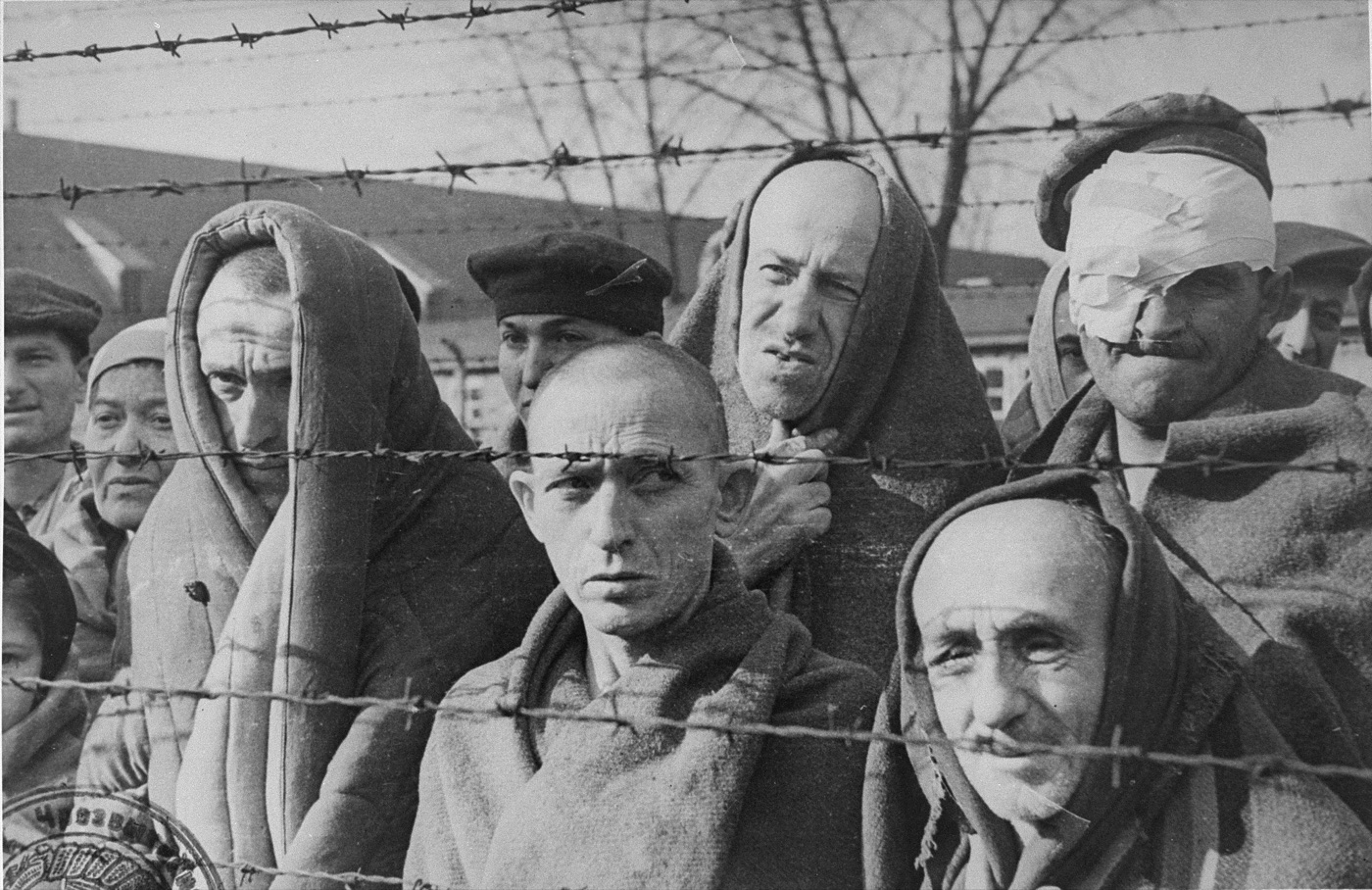
Auschwitz after the Soviet army arrived on January 27, 1945. A still from the film shot by the unit of the First Ukrainian Front.
Photographed by liberating forces Alexander Voronzow and others · 1945 · Wikimedia Commons Public domain View the record: Auschwitz after the Soviet army arrived on January 27, 1945
Soviet troops entered Auschwitz on January 27, 1945. In the weeks before, the SS had forced most of the prisoners to march west, and the soldiers found over 6,000 emaciated prisoners alive. The retreating Germans had destroyed most of the warehouses, and what they had not managed to destroy was still there: hundreds of thousands of men's suits, more than 800,000 women's garments, and more than 14,000 pounds of human hair.
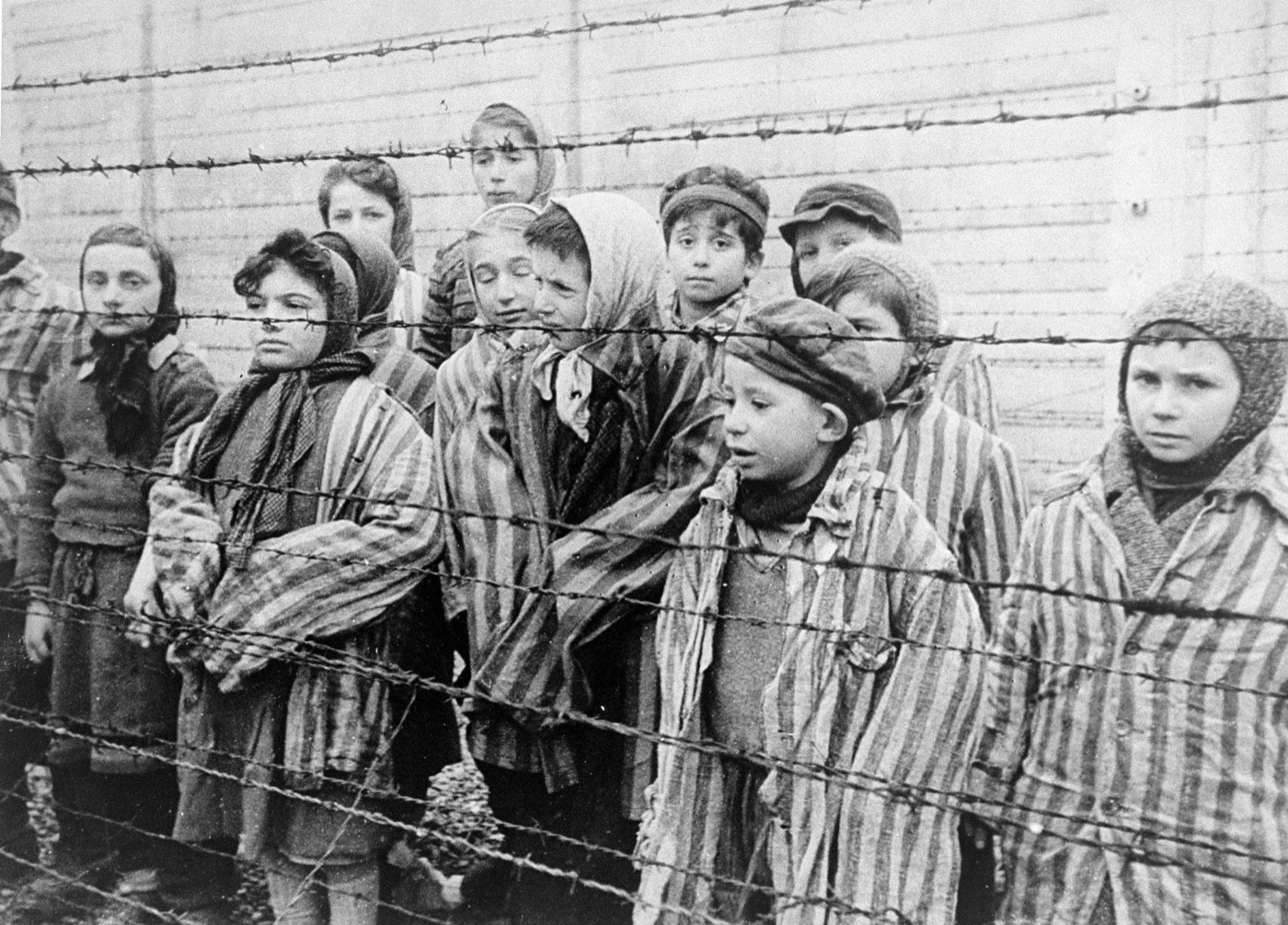
Child survivors at Auschwitz, filmed by the Soviet unit after the liberation.
Photographed by liberating forces Alexander Voronzow and others in his group, ordered by Mikhael Oschurkow · 1945 · United States Holocaust Memorial Museum, USHMM pa14532 Public domain View the record: Child survivors at Auschwitz
The Russians were advancing very quickly, and the, the Russian army came in in January. I don't know exact the day. I, I have the date. And they came in, and what the Russians sent in advance with their army, I guess they had done fighting prior to getting to Auschwitz, they had sent a humanitarian crew, and there were a lot of doctors and supplies. They came in these huge, it was wintertime. It was freezing, and the snow was this high. And they came with these huge horse-drawn sleds with people dressed in their pelts, and, you know, they really, the burly Russians. And they came in, and of course, they must have been horrified at what they saw. And my mother spoke German very well, and she went around with these Russian doctors who also spoke German, and they tried to save people. A lot of people were beyond help.
Helen Flantzer, who was four when the Soviet army reached Auschwitz. Some of what she tells, she heard from her mother, who was in the camp with her. Project Witness testimony. Watch the full testimony. This passage begins at 35:55: Helen Flantzer, Project Witness
American forces reached Buchenwald on April 11, 1945, and encountered more than 20,000 prisoners. Earlier that same day an underground prisoner resistance organization had seized control of the camp to stop the retreating guards from committing atrocities. That April American troops also liberated Dachau, Dora-Mittelbau and Flossenbürg, and in early May, Mauthausen. In northern Germany British forces liberated Bergen-Belsen and reached Neuengamme, and Soviet forces reached Sachsenhausen, Ravensbrück and Stutthof.
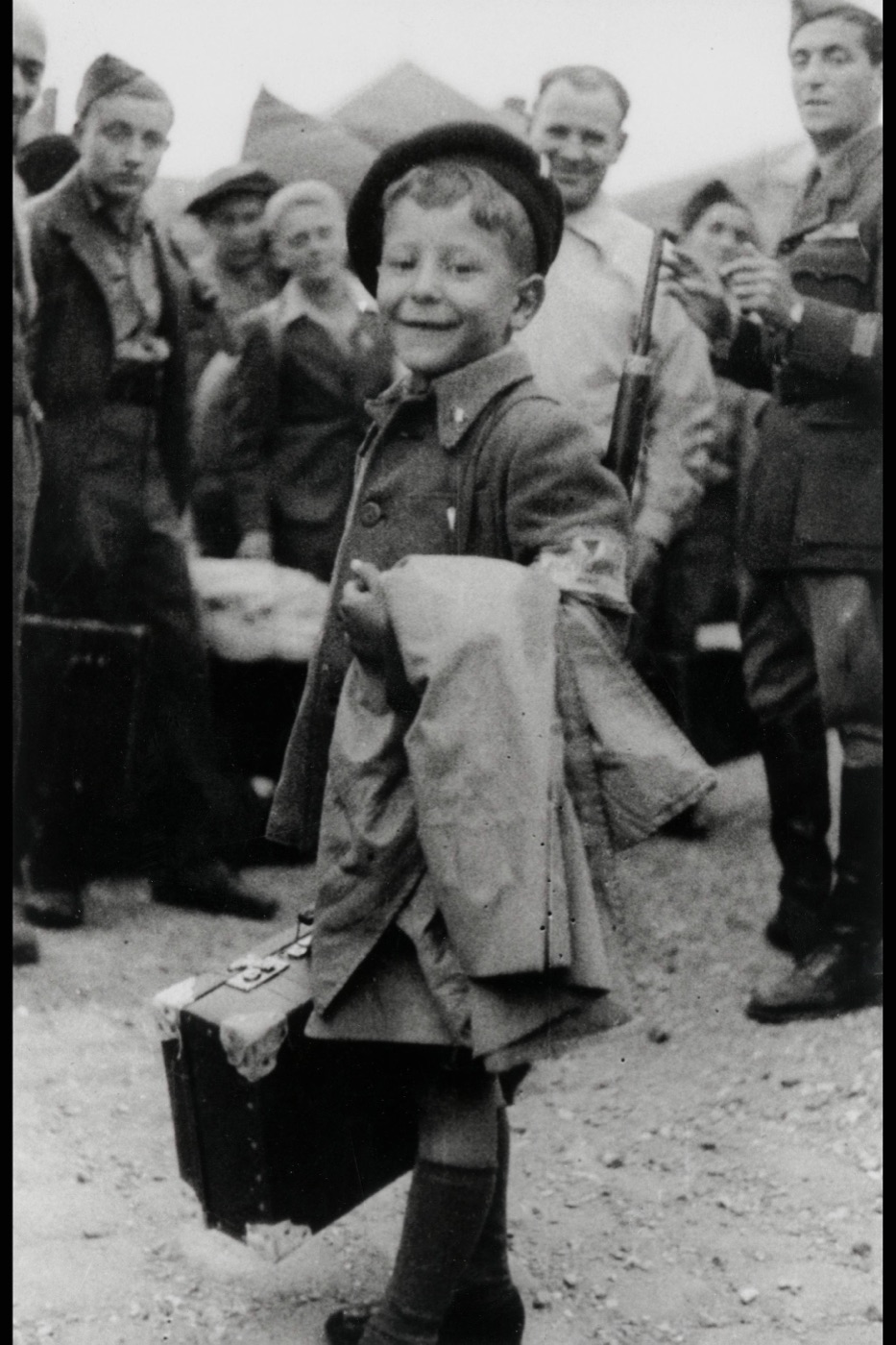
Buchenwald, 1945. The Israel Government Press Office identifies the boy with the suitcase as eight-year-old Israel Meir Lau, leaving the camp after its liberation, with his older brother, Naphtali Lau-Lavie, behind him. His family called him Lulek. Their father, Rabbi Moshe Chaim Lau of Piotrków, had been deported to Treblinka in 1942, and their mother, Chaya, was murdered in Ravensbrück. In the summer of 1945 the brothers reached the Land of Israel. He later served as Ashkenazi Chief Rabbi of Israel and told this story in his autobiography, Out of the Depths.
Portrait or personal record Photographer unknown · 1945 · Israel Government Press Office, National Photo Collection Public domain View the record: Buchenwald, 1945
Dov Landau was one of some 300 boys in Buchenwald. After the liberation he looked after an older boy, Tulek, sick with typhus in the hospital outside the camp, and Tulek asked him to bring his little brother, Lolek, to the window. They were the Lau brothers: Yad Vashem captions a photograph of the two in Buchenwald after liberation "Lolek and Naftali."
So one day when he was already able to, to, to talk to me like a human being, so he said to me, "Dov, ... I have a, a wish to you. I have some-, somewhere in the, in the camp here my small brother, you know, seven, eight years old. Please go and find this kid, you know, and bring him here to my, to my bed in the hospital. I want to see him." ... he told me, "My name is Tulek." They call Tulek. And the, the brother what you have to go to find me, his name is Lolek. ... I took Lolek by my arms, and I put him on the blocks, you know, to see the, the, through the window, you know, his brother.
Dov Landau. Project Witness testimony. Watch the full testimony. This passage begins at 1:04:38: Dov Landau, Project Witness
Germany surrendered unconditionally on May 7, 1945, in the west and on May 9 in the east.
What liberation did not stop
Bergen-Belsen began as a camp for prisoners of war. From the fall of 1944 the SS sent it prisoners evacuated from camps closer to the front, many of them survivors of the marches, and the camp's population rose month after month despite the deaths.
British forces liberated the camp on April 15, 1945, and found around 55,000 prisoners, many of them seriously ill with typhus. About 37,000 people had died there since May 1943. More than 13,000 of those found alive died in the three months that followed, of malnutrition or disease, too ill to recover. When the survivors had been moved out, the British burned the whole camp down to stop the typhus spreading.
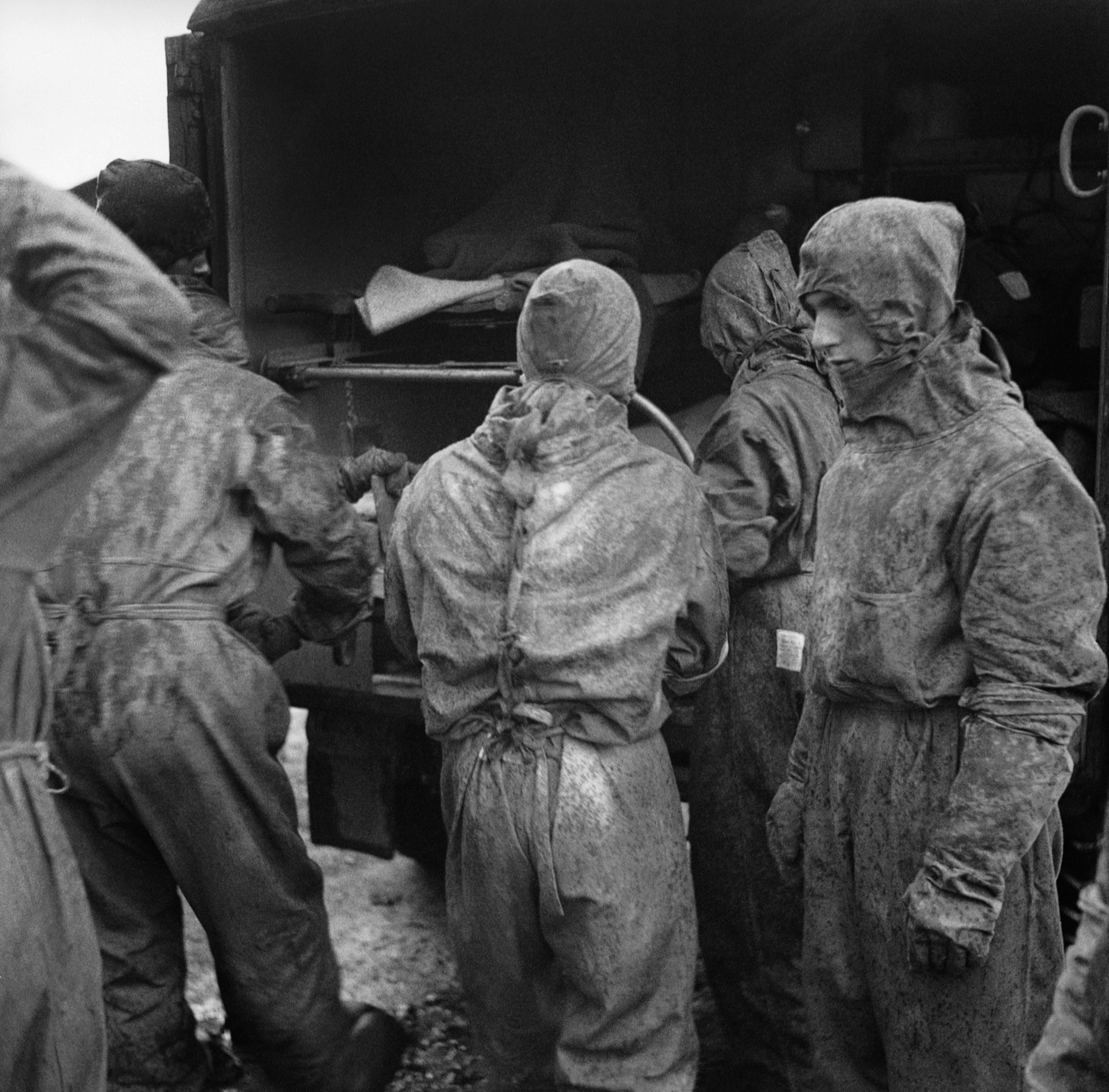
Men of 11 Light Field Ambulance, Royal Army Medical Corps, in protective clothing, loading the sick into an ambulance during the evacuation of Bergen-Belsen in April 1945.
Photographed by liberating forces No 5 Army Film & Photographic Unit, Oakes, H (Sgt) · 1945 · Imperial War Museums, IWM BU 4194 Public domain View the record: Men of 11 Light Field Ambulance, Royal Army Medical Corps
In all, about 50,000 people died in the Bergen-Belsen camp complex, most of them Jews. Anne Frank and her sister Margot were among them; they died there in February or March 1945, weeks before the British came.
Petchka Mandelker was marched from Auschwitz to Bergen-Belsen in the winter and liberated there by the British. Years later an interviewer asked her whether liberation had felt like techiyas hameisim, the resurrection of the dead.
That is it. We were liberated. We were, we start to living. We start to living again. We were reborn, but we were reborn to a world of nothingness. A world of nothingness. Can you imagine? ... We were born, there was no brother, no sister, no parents, no children, nowhere to go. Nothingness.
Petchka Mandelker. Project Witness testimony. Watch the full testimony. This passage begins at 17:13: Petchka Mandelker, Project Witness
Going home
Most survivors from eastern Europe could not or would not go home. Their communities had been destroyed and antisemitism had not gone away; people who tried to return often feared for their lives. In Kielce, in Poland, on July 4, 1946, rioters killed 42 Jews.
But he [Rabbi Solomon Schonfeld] saved, he saved us. Not only did he save us, he gave us freedom. He gave us life. He gave us freedom. We were, we were in a country which hated us, hated us. There were pogroms after the war. Who wanted to stay there? Who would have wanted to stay?
Lili Stern, who was hidden in Lwów during the war and came to London after it on a transport organized by Rabbi Solomon Schonfeld. Project Witness testimony. Watch the full testimony. This passage begins at 40:54: Lili Stern, Project Witness
Many moved west instead, to territories the Allies had liberated, and waited in camps for somewhere to go. After Kielce, 150,000 Polish Jews who had survived the war in the Soviet Union fled eastern Europe as well.
Nowhere to go
Between 1945 and 1952 more than 250,000 Jewish displaced persons lived in camps and urban centers in Germany, Austria and Italy. Many of the camps were former concentration camps and German army camps. At Bergen-Belsen the British set up the displaced persons camp in German army barracks near the old camp, and more than 12,000 survivors lived there until 1951.
In the first months many still wore their camp uniforms and were housed beside non-Jews, sometimes even beside Nazi collaborators. In June 1945 the United States government sent Earl Harrison to see how the survivors were living. He visited 30 camps in Germany and Austria. Many of the Jewish survivors he found were under armed guard behind barbed wire, some in the very camps where they had been prisoners, in crowded and unsanitary quarters, while the German population around them lived far better. He summed it up for President Truman in one sentence.
...we appear to be treating the Jews as the Nazis treated them, except that we do not exterminate them.
Earl G. Harrison, report to President Truman, August 1945 Read it at the United States Holocaust Memorial Museum: Earl G. Harrison
Harrison delivered the report to Truman on August 24, 1945, and General Dwight D. Eisenhower, who commanded the American forces in Europe, moved within weeks. He ordered camps for Jewish survivors alone, raised their ration from 2,200 calories a day to 2,500 on September 20, and had the barbed wire taken down.
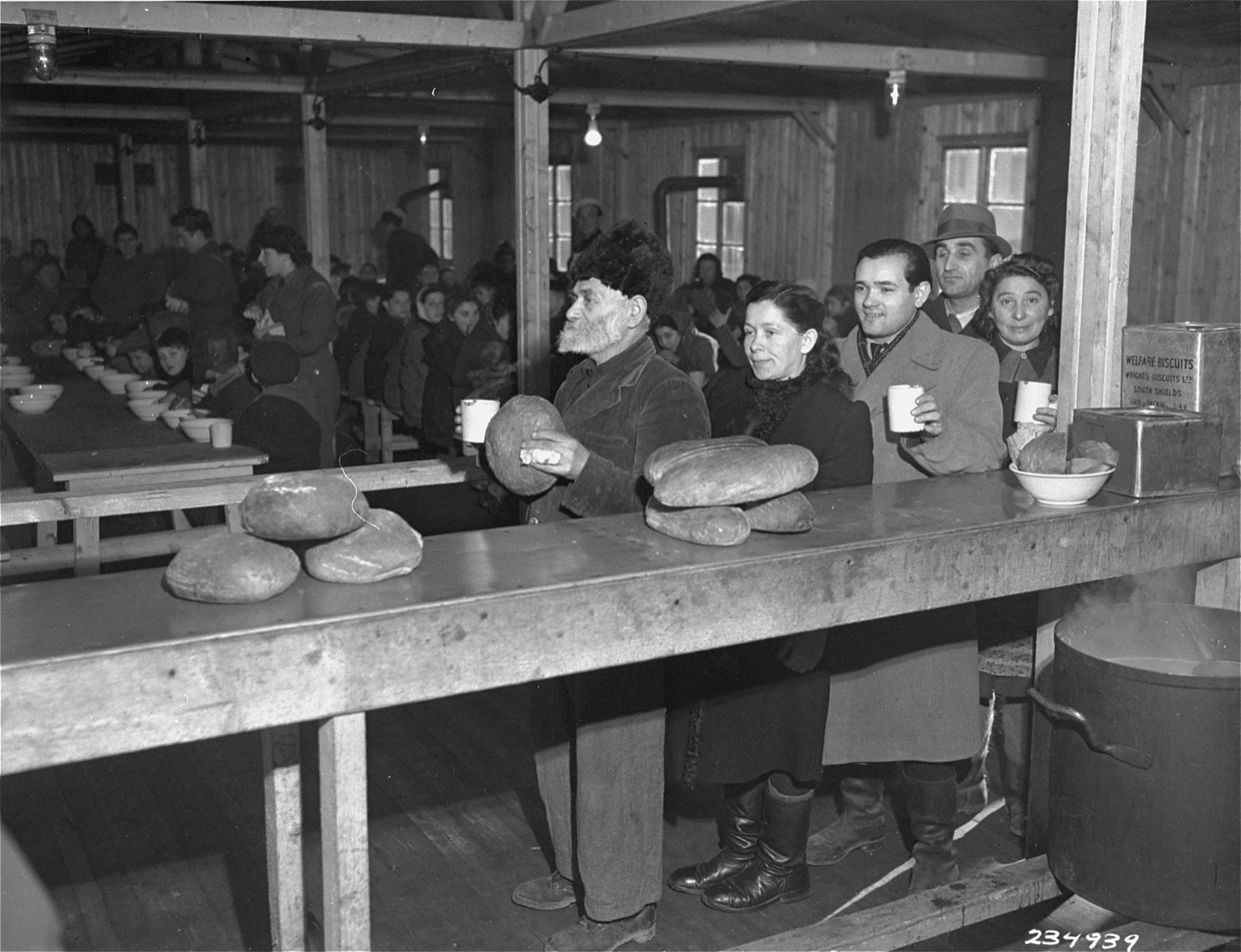
Jewish displaced persons collecting bread rations at the Bindermichl camp in Linz.
Photographed at the time Lepore · after 1946 · United States Holocaust Memorial Museum, USHMM pa1074604 Public domain View the record: Jewish displaced persons collecting bread rations at the Bindermichl
The survivors did not wait to be organized. Three days after the liberation of Bergen-Belsen they elected Josef Rosensaft to head the first Jewish committee in a displaced persons camp. They were known as the Sh'erit ha-Pletah, the Surviving Remnant. In mid-1945 the American officer in charge of the Landsberg camp, Irving Heymont, wrote to his wife that the people of his camp appeared demoralized beyond hope of rehabilitation. Within months its 5,000 survivors had built one of the most flourishing communities of the Surviving Remnant.
In early 1946 the Anglo-American Committee of Inquiry visited Landsberg and found no children there between the ages of one and five. Within 15 months of Foehrenwald's opening, about 200 women there were pregnant at the same time. There were many weddings in the camps, and many births.
Orthodox life came back with them. Foehrenwald was a center of Orthodoxy, and its yeshiva, a religious academy, had 150 students and was the administrative headquarters for all the yeshivos in the American zone. Landsberg had a Talmud Torah, a religious elementary school, and a Klausenburger yeshiva; it had a mikvah, the Jewish ritual bath, a kosher kitchen and a society for keeping Shabbos, the Sabbath, and early in 1946, 2,643 Orthodox Jews there registered for kosher beef. Feldafing's religious community founded a Talmud Torah, a yeshiva and the seminaries Bet Medrash Lita and Bet Medrash Ungarn, and the camp had a rabbinical council of its own. Yeshivos opened at Bergen-Belsen too, and the Jewish holidays became the great gatherings of the year.
The Klausenburger Rebbe, Rabbi Yekutiel Yehuda Halberstam, had lost his wife and eleven children. After the war he became a leader of the Orthodox survivors, worked to revive Jewish life in the camps, and founded yeshivos and seminaries. On Yom Kippur 1945, at Foehrenwald, he went through the opening words of the confession, Ashamnu, we have sinned, Bagadnu, we have been unfaithful, and asked whether those sins could be theirs.
Gazalnu, did we steal? From whom did we steal in Auschwitz and Mühldorf? ... This Vidui (confession) was not written for us.
The Klausenburger Rebbe, Rabbi Yekutiel Yehuda Halberstam, Yom Kippur 1945, Foehrenwald. Yad Vashem's translation Read it at Yad Vashem: The Klausenburger Rebbe
Then, in Yad Vashem's account, he named sins the prayer book does not list: the times they had begged God to take their souls. He asked them to pray for their faith to be restored.
After two months in a hospital with typhus, Shmuel Bella went to Feldafing and then to Foehrenwald. The boys in his room were Hungarian and had been away from home for less than a year. He had been away for almost six.
So, the, the, the boys there, there was five, six boys there, same room. I was only Polish from Poland. And they were already asking to eat kasher [kosher] because the Klausenburger [Rebbe] had, they arranged, they should kasher, they made yeshiva there. ... they were constantly nagging me, "Stop eating. Stop eating. Stop eating." I was laughing their face. I didn't wanna know about this. ... And I was eating a sandwich with some salami. I threw it away. ... No more. They took me over to the Rebbe. I started to go to yeshiva. I was close to the Rebbe. He took me in to talk to me. And they started to bring me back to my, that's, that's how I became back Jewish. I was all out, completely out.
Shmuel Bella, who learned in the yeshiva at the Foehrenwald camp after the war. Project Witness testimony. Watch the full testimony. This passage begins at 1:47:02: Shmuel Bella, Project Witness
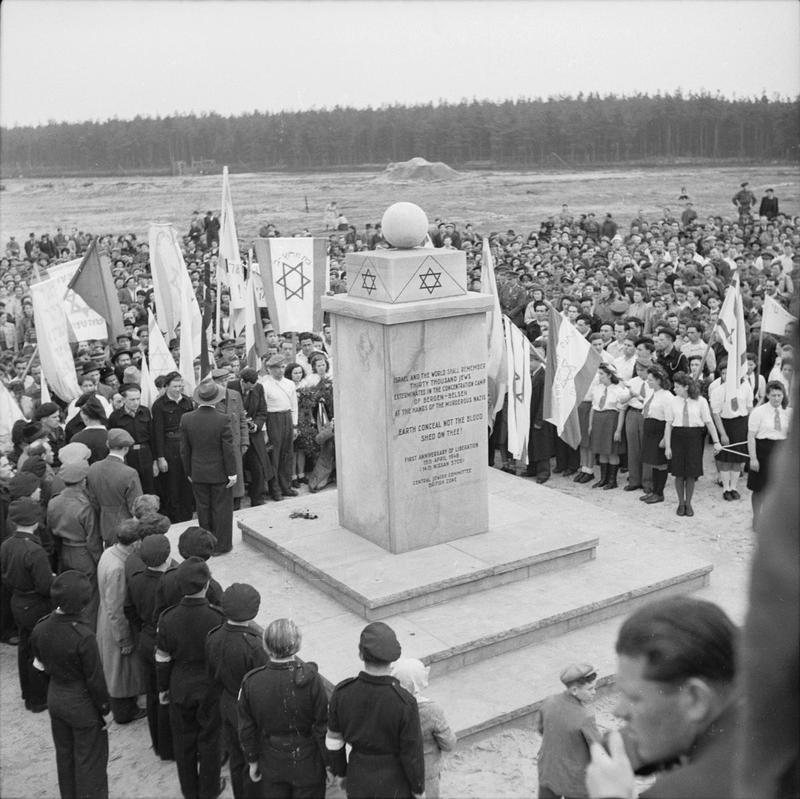
Survivors at the unveiling of their memorial at Bergen-Belsen on April 15, 1946, the first anniversary of liberation. The stone gives the date as 14 Nisan 5706, the eve of Pesach, Passover, and reads: Earth conceal not the blood shed on thee. The words echo Job: Earth, do not cover my blood. It was put up by the Central Jewish Committee for the British Zone.
Photographed at the time Sergeant R. Makin, No 5 Army Film and Photographic Unit · April 15, 1946 · Imperial War Museums, BU 12580 Public domain View the record: Survivors at the unveiling of their memorial at Bergen-Belsen on
Most, Harrison had noted, wished to go to Palestine, the Land of Israel. The Anglo-American Committee of Inquiry proposed admitting 100,000 of them, and Britain, which ruled Palestine, rejected its report. From 1945 to 1948 the Brihah, Hebrew for escape, moved more than 100,000 Jews past British patrols and into Palestine illegally. The British captured many of the ships and held the passengers in camps on Cyprus.
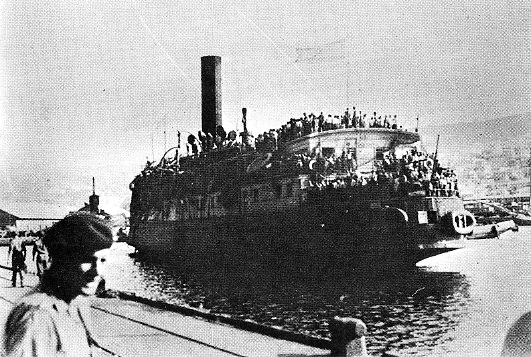
The Exodus 1947, which carried over 4,500 Jewish refugees, all of them displaced persons or survivors. The British towed the ship to Haifa and sent its passengers back to Europe on three navy transports. A British Admiralty photograph.
Photographed at the time Photographer unknown · 1947 · Wikimedia Commons Public domain View the record: The Exodus 1947, which carried over 4,500 Jewish refugees
Mrs. Gluck, from Sighet, married after the war, and in 1947 she and her husband sailed for the Land of Israel with the Haganah, the Jewish underground. Their ship was a different one, and it was stopped too.
We were newly married, and we were on our way to Israel. ... Oh, this was in '47, ... So we were supposed to go like, with the Haganah, like refugees, and they captured the, our ship. ... People were waiting. They knew that we have to arrive. People were standing with flags and, and, and singing Baruch Haba'im and all kinds of songs, and they were dancing. ... Okay, they took us to Cyprus. ... And then my daughter was born there.
Mrs. Gluck. Project Witness testimony. Watch the full testimony. This passage begins at 45:45: Mrs. Gluck, Project Witness
In the end over 80,000 Jewish displaced persons reached the United States, about 136,000 settled in Israel, and another 20,000 went to Canada, South Africa and elsewhere. The American door opened slowly: the Displaced Persons Act of 1948 was unfavorable at first to Jewish survivors and was amended in 1950. Almost all the camps had closed by 1952. Foehrenwald, the last of them, ran until 1957, twelve years after the war ended, as a home for Jews who had nowhere else to go.
The dates
The war ends in the middle of this list, not at the end of it.
July 22 to 23, 1944
Soviet troops reach Majdanek and find it virtually intact.
January 17, 1945
The evacuation of Auschwitz begins. Tens of thousands are marched 55 or 63 kilometers in winter.
January 27, 1945
Soviet troops enter Auschwitz and find over 6,000 prisoners alive.
April 11, 1945
American forces reach Buchenwald, where a prisoner resistance organization has already taken control.
April 15, 1945
British forces liberate Bergen-Belsen and find around 55,000 people alive.
May 7 to 9, 1945
Germany surrenders unconditionally.
By July 1945
More than 13,000 of the people found alive at Bergen-Belsen have died.
August 24, 1945
Earl Harrison delivers his report on the displaced persons camps to President Truman.
July 4, 1946
Rioters in Kielce, Poland, kill 42 Jews.
July 1947
The Exodus 1947, carrying over 4,500 refugees, is towed to Haifa and its passengers are sent back to Europe.
1948
The United States Displaced Persons Act authorizes 200,000 displaced persons to enter, on terms unfavorable at first to Jewish survivors.
1952
Almost all the displaced persons camps have closed.
1957
Foehrenwald, the last displaced persons camp, closes, twelve years after the war.
Show the other 4 dates
April 1945
American troops liberate Dachau, Dora-Mittelbau and Flossenbürg.
Early May 1945
American forces reach Mauthausen.
September 1945
Yom Kippur at Foehrenwald: the Klausenburger Rebbe's sermon.
April 15, 1946
On the first anniversary of liberation, survivors unveil their memorial at Bergen-Belsen.
Questions people ask
When exactly did the Holocaust end?
There is no clean date. Majdanek was reached in July 1944, Auschwitz on January 27, 1945, Germany surrendered on May 7 to 9, 1945, and almost all the displaced persons camps had closed by 1952. Foehrenwald, the last, ran until 1957. If you date it by when the last survivors stopped living in a camp, it ended twelve years after the war.
Why is January 27 an international day of remembrance?
It is the date Soviet troops entered Auschwitz in 1945. United Nations General Assembly Resolution 60/7 designated it, in 2005, as the annual International Day of Commemoration in memory of the victims of the Holocaust.
Why did the SS march prisoners out instead of leaving them?
To stop them telling the liberators what had happened, to keep them working in armaments, and because some SS leaders, Himmler among them, believed Jewish prisoners could be used as hostages to bargain for a separate peace. The Holocaust Encyclopedia calls that belief irrational.
How many people died on the death marches?
Yad Vashem estimates that between 200,000 and 250,000 concentration camp prisoners died on the marches from the summer of 1944 to the end of the war, and that between a quarter and a third of them were Jews. Guards shot prisoners who collapsed or could not keep up, and others died of exposure, starvation and exhaustion.
Why did so many people die after being liberated?
They were too ill to recover. Bergen-Belsen had been swept by typhus, tuberculosis, typhoid fever and dysentery, and the survivors were starving. More than 13,000 died of malnutrition or disease there in the three months after the British arrived.
What did the liberators find at Auschwitz?
Over 6,000 emaciated prisoners still alive, after the SS had marched most of the others west, and what the Germans had failed to destroy: hundreds of thousands of men's suits, more than 800,000 women's garments, and more than 14,000 pounds of human hair.
Could survivors go home?
Most from eastern Europe were unable or unwilling to, because their communities had been destroyed and antisemitism persisted. Those who went back often feared for their lives; in Kielce, Poland, on July 4, 1946, rioters killed 42 Jews.
What were the DP camps?
Displaced persons camps in Germany, Austria and Italy, where more than 250,000 Jewish survivors lived between 1945 and 1952 while they waited for a country to admit them. Many were in former concentration camps and German army camps. The survivors called themselves the Sh'erit ha-Pletah, the Surviving Remnant.
What was the Harrison Report?
A report on the displaced persons camps that Earl Harrison delivered to President Truman in August 1945, after visiting 30 camps. It found Jewish survivors living under armed guard behind barbed wire, and it led General Eisenhower to set up camps for Jewish survivors alone, raise their rations and remove the wire.
Where did survivors eventually go?
Over 80,000 to the United States, about 136,000 to Israel, and another 20,000 to Canada, South Africa and other countries. The Allies deliberated and delayed for years before resolving the crisis.
What was the Exodus 1947?
A ship carrying over 4,500 Jewish refugees, all of them displaced persons or survivors. The British towed it to Haifa and sent the passengers back to Europe on three navy transports. Their plight became a symbol of the struggle for open immigration into Palestine.
For educators
Free, and made for a classroom
Project Witness is a nonprofit Holocaust education organization in New York. Leave your school email and we will send you materials for your classroom.
How we know
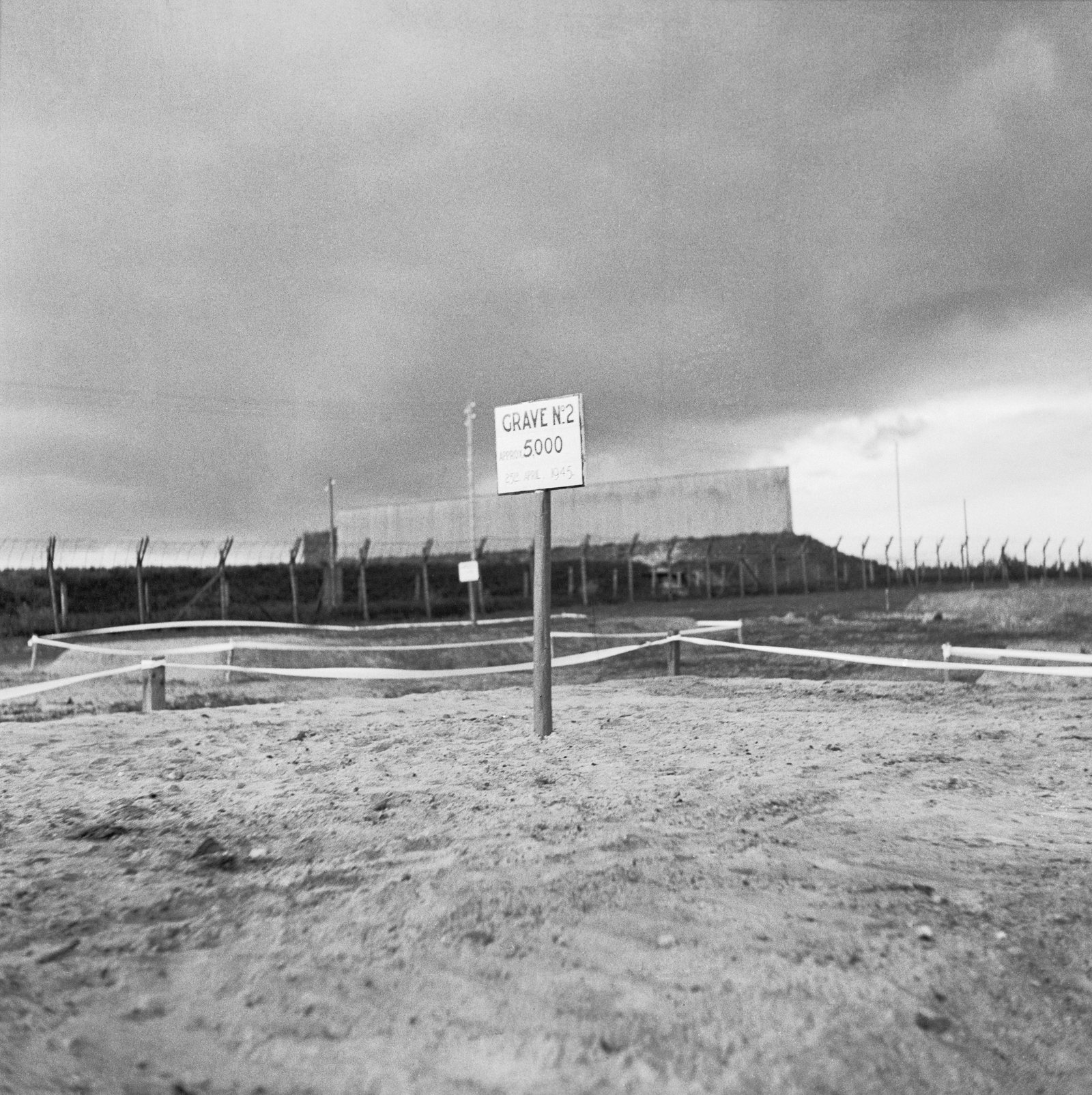
The map is drawn from the records of the Project Witness camps directory; the table under it gives the source for every camp. The page shows no photographs of the dead. Where it shows the evidence of the killing, it is a filled-in mass grave and its marker.
Except for the Klausenburger Rebbe, whose words are Yad Vashem's translation, the survivors quoted on this page speak in Project Witness's own recorded testimonies. Each passage was checked against the audio of the recording, and the link under it says where in the testimony it begins.
Every source this page rests on.
- Death Marches United States Holocaust Memorial Museum, Holocaust Encyclopedia
- Last Jews in the Last Months of the German Reich Yad Vashem
- Liberation of Nazi Camps United States Holocaust Memorial Museum, Holocaust Encyclopedia
- Bergen-Belsen United States Holocaust Memorial Museum, Holocaust Encyclopedia
- A filled-in mass grave at Bergen-Belsen, April 1945, BU 4847 (photograph record) Imperial War Museums The record of the photograph on this page's hero.
- Israel Meir Lau leaving Buchenwald, digital ID D608-037 (photograph record) Israel Government Press Office, National Photo Collection The record of the photograph of Israel Meir Lau.
- Rabbi Israel Meir Lau, Chairman of the Yad Vashem Council Yad Vashem
- Yad Vashem Mourns the Passing of Naphtali Lau-Lavie Yad Vashem
- The Aftermath of the Holocaust: Effects on Survivors United States Holocaust Memorial Museum, Holocaust Encyclopedia
- Displaced Persons United States Holocaust Memorial Museum, Holocaust Encyclopedia
- Displaced Persons: Administration United States Holocaust Memorial Museum, Holocaust Encyclopedia
- The Harrison Report United States Holocaust Memorial Museum, Holocaust Encyclopedia
- Foehrenwald Displaced Persons Camp United States Holocaust Memorial Museum, Holocaust Encyclopedia
- Landsberg Displaced Persons Camp United States Holocaust Memorial Museum, Holocaust Encyclopedia
- Feldafing Displaced Persons Camp United States Holocaust Memorial Museum, Holocaust Encyclopedia
- Sermon on Yom Kippur by the Klausenburger Rebbe, delivered in the Foehrenwald DP camp, 1945 Yad Vashem Yad Vashem's English translation of the sermon is quoted on this page.
- The Jewish memorial stone at Belsen unveiled, April 1946, BU 12580 (photograph record) Imperial War Museums The record of the photograph of the survivors' memorial.
- Job 16:18 Sefaria
- Leviticus 23:5 Sefaria
- Exodus 1947 United States Holocaust Memorial Museum, Holocaust Encyclopedia
- International Day of Commemoration in memory of the victims of the Holocaust United Nations
Words used on this page
Show the term
- Displaced person (DP)
- A survivor or refugee living, after the war, in a camp or urban center rather than at home. More than 250,000 Jewish displaced persons lived in them in Germany, Austria and Italy between 1945 and 1952. Almost all the camps had closed by 1952; Foehrenwald, the last, ran until 1957. Source: USHMM Holocaust Encyclopedia, Displaced Persons and Foehrenwald Displaced Persons Camp, for Displaced person (DP)