Before we begin
Historical context
From 1940 to 1944, Nazi Germany occupied France. The German administration worked closely with the Vichy French government, a collaborationist regime that chose to cooperate with the Nazis rather than resist them, to enforce anti-Jewish laws, conduct censuses of Jewish residents, and organize mass deportations. Identity papers were not optional. Every person in France was required to carry them and present them on demand.
For Jewish people, those papers were death warrants: the documents identified their religion, making them instantly visible to authorities. Forged documents that removed or changed that designation were not merely useful. They were the difference between life and death. The network of forgers who produced them operated in constant danger, working against the bureaucratic machinery of genocide.
Adolfo Kaminsky was eighteen years old when he joined this network. His prior training was in a dye shop, where he had learned the chemistry of inks. That chemistry proved decisive. Specifically, Kaminsky learned that lactic acid (the same compound found in sour milk) could dissolve iron gall ink, the ink the French state had chosen for its forgery-resistance. This discovery became the load-bearing science of rescue.
Key terms you will encounter
- Carte d'Identité
- The French national identity card. From 1940, required by law to be carried by every person in occupied France. For Jews, the card was stamped Juif ("Jew"). That stamp made religious identity instantly visible to authorities.
- Vichy France
- The French collaborationist government (1940–44) led by Marshal Philippe Pétain. Cooperated with Nazi Germany; passed its own anti-Jewish laws (Statut des Juifs, October 1940) and helped organize the deportation of more than 75,000 Jews from France.
- French Resistance
- The collection of organizations, networks, and individuals who fought the German occupation and the Vichy regime in France between 1940 and 1944. The forgery network Kaminsky worked with operated within this wider Resistance ecology.
- OSE (Œuvre de secours aux enfants)
- The Jewish children's aid society in France, founded 1912. Coordinated the network that smuggled, hid, and rescued thousands of Jewish children in occupied France. Kaminsky worked with the OSE in the forgery operation.
- Iron gall ink
- The ink chosen by the French state for official documents. The state chose it precisely because it is permanent and forgery-resistant. Kaminsky's discovery: lactic acid dissolves it.
- Yad Vashem · Righteous Among the Nations
- Israel's national Holocaust memorial and research institution; the Righteous Among the Nations archive documents non-Jewish rescuers who risked their lives to save Jews during the Holocaust. (yadvashem.org/righteous)
- USHMM
- The United States Holocaust Memorial Museum (Washington, D.C.). Maintains the Holocaust Encyclopedia. (ushmm.org)
Predict
Prediction Prompt · Before We Watch
The film is titled The Forger. Its logline is the line "every hour he sleeps, thirty people die." Based on that logline, what do you predict will be the film's central tension? Write your prediction in 2–3 sentences.
The 90-second microshort
A heads-up before pressing play
The film is a 90-second stylized animated reconstruction of Adolfo Kaminsky's 1944 forgery work. There's no graphic violence and no depiction of harm to any person. Kaminsky is shown working alone by lamplight; documents, ink, the chemistry. The film references deportation orders and the children who would have been killed without the forgeries; none of those children, and no act of harm, is depicted. The arithmetic is spoken in voice-over. The line states, "every hour he sleeps, thirty people die."
If you need to step outside at any point, you can do that without asking. You don't need to explain. You can come back when you're ready. There is no penalty.
Watch the film now
Open The Forger on the class screen, or follow the link your teacher provides.
Hold onto the prediction you just wrote.
Analyze
Affective Check-In · First, Before Any Analysis
Take a moment. One word for what you felt. This is not analysis yet. It is just noticing.
Discuss
Work through these questions first in writing on your own (5 minutes silent), then with a partner (5 minutes), then as a full class.
Text-Dependent Analysis
- Now that you have seen the film, what does the word "forger" suggest about the kind of heroism this story depicts? How is Kaminsky's heroism different from what you might expect?
- The narration opens with a specific, concrete detail: the number 300 children, 3 documents each, 900 total. How does the story use numbers to build tension? Why numbers rather than names?
- The logline tells us Kaminsky's calculation before we watch. How does knowing the arithmetic in advance change how you experience the film's pacing?
- The film presents Kaminsky's story without interviewing survivors or showing the children he saved. What effect does this absence have on how you understand his significance? What might be gained or lost by including their voices?
Historical Sourcing
- What specific claims in the film can be corroborated through other historical sources? What remains unverifiable from the film alone?
- The film states Kaminsky saved 14,000 lives. How might historians arrive at or dispute that kind of figure? What does it mean to count rescued lives?
- What questions does the film leave unanswered that you would want to investigate further?
Hook Analysis · the opening as author's choice
- Identify the film's opening narration. These are the words spoken before any image of Kaminsky, the laboratory, or the documents. The writer made a deliberate choice about what to say first. What does the opening commit you to feeling before you have seen anything?
- The film's central line is "If I sleep for one hour, thirty people will die." That line converts moral weight into arithmetic. How does the structure of that sentence work? What does the math do that a sentence like "Many people depended on his work" could not?
- Compare the film's opening to a conventional Holocaust-rescuer-story opening (e.g., "Adolfo Kaminsky was a Jewish refugee from Argentina who became a forger for the French Resistance..."). What does the film's choice accomplish that the conventional opening would not? What does it risk?
Investigate Further · what the film does not answer
A question the film deliberately leaves open. Take it home; come back with what you found.
- The film states Kaminsky saved 14,000 lives. How was that number arrived at? The film does not tell you. Historians have debated the figure. Some confirm it, some give wider ranges, and others argue it is unverifiable in principle. Find one specific scholarly or journalistic discussion of the 14,000 figure (Sarah Kaminsky's A Forger's Life, the 2023 obituary coverage in the NYT, Le Monde, the Washington Post, or peer-reviewed scholarship). What is the basis for the count? Who attests to it, who contests it, and on what grounds? Bring back what you find. Then write 3–5 sentences on what it means to teach with a number that is publicly known but historiographically contested.
Create
"I did the math — in one hour I could make thirty blank documents, which meant that if I slept for one hour, thirty people would die. So I worked through the nights — pen to paper, stamp to paper, next sheet — until my hands could barely move."Adolfo Kaminsky, as recalled by his daughter Sarah Kaminsky in A Forger's Life, 2009
Argumentative Paragraph · MEAL Format (150–200 words)
Kaminsky never accepted payment for his forgeries. This was true not during the war, and not after. Write one well-developed argumentative paragraph using the MEAL structure. That structure has four parts: Main claim, Evidence, Analysis, and Link back to claim. Your paragraph should answer the following question:
Was Kaminsky's refusal to accept payment a moral necessity, the only ethical response possible given the circumstances? Or was it an extraordinary personal choice that went beyond what we can reasonably expect of anyone?
Use evidence from the film and your historical knowledge to support your position. Anticipate a counterargument.
When you submit: Underline your main claim sentence. Circle your evidence.
Reflect
Affective Consolidation · First
Take 30 seconds. Say one word out loud for what you're carrying right now. Don't analyze it. Just name it.
Written reflection
Complete the following sentence frame as a written reflection. Be specific. The strongest reflections name something particular that you learned, not just general impressions.
Share with a partner
Share your reflection with a partner. Where do your reflections overlap? Where do they diverge? What might explain the difference?
Full-class closing discussion
Your teacher will invite 2–3 voices from around the room. Listen for divergence. Pay attention to where you disagree about what resistance means in this story, not to where you disagree about facts. The fault line you may notice: some students land closer to "resistance is dramatic action against the regime"; others land closer to "resistance is the relentless, unglamorous, undocumented work of one person at a desk." You are leaving the room with different definitions of resistance. That is the work.
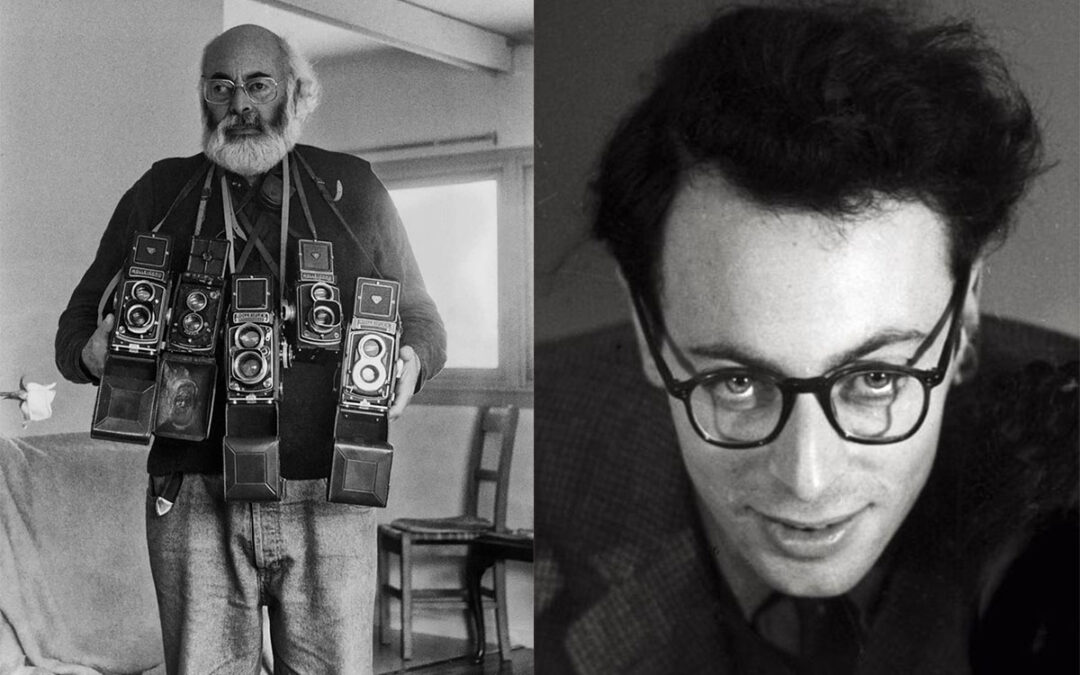
This is Kaminsky in Le Marais, Paris, the Jewish quarter where he lived the rest of his life. He died there in January 2023.
"All humans are equal, whatever their origins, their beliefs, their skin color. There are no superiors. No inferiors."Adolfo Kaminsky (1925–2023)
Make your own microstory
You will create a short original work in any medium, such as film, writing, audio, comic, photo essay, or song lyric. Model it on the craft of this series. The constraints are the lesson; the medium is your choice.
Pick a subject
For this episode, the natural subject is any person. That person can be historical or contemporary. Their ordinary professional skill (forgery, chemistry, photography, printing, translation, accounting, cooking, sewing, plumbing, driving) must have been turned to a moral purpose at personal cost. Suggested fields:
- Other Holocaust-era rescuers whose work depended on professional craft. Examples include Chiune Sugihara (Japanese consul, visa-issuing diplomacy), Aristides de Sousa Mendes (Portuguese diplomat), Varian Fry (American journalist running an escape network in Marseille), Hannah Senesh (poet-turned-paratrooper), and the OSE (the Jewish children's aid society Kaminsky worked with).
- People in other times whose ordinary skill carried extraordinary weight. Examples include an Underground Railroad station-master who was a blacksmith, a Tiananmen "Tank Man" photographer, and a doctor running an underground clinic for undocumented patients.
- A person from your own family or community whose ordinary work carried someone else through a hard time.
Get your teacher's approval before you begin so the historical claims you'll make are defensible.
The constraints that apply to every medium
- One named person at the center. Not "the French Resistance." One specific person, named, whose story you can stand inside.
- Hook-first. Your first sentence (or first shot, or first line, or first panel) must commit. The Forger's arithmetic-of-conscience opening is the line "If I sleep for one hour, thirty people will die." That line tells the entire story before the story begins.
- Hard compression. Pick your medium; live inside its cap.
- One primary-source anchor. Reference, describe, depict, or quote one specific verifiable historical artifact and credit the source.
- No invented dialogue from the dead. If a historical figure's words are not documented, do not put words in their mouth.
- If numbers serve, use them honestly. Kaminsky's arithmetic worked because the numbers were real (300 children, 3 documents each, every hour of sleep). If your subject can be told through honest numbers, use them; if not, do not invent them.
Pick a medium
- A short film or video may run up to 90 seconds.
- A flash fiction or micro-essay may run up to 250 words.
- A poem, in any form, may run up to 20 lines.
- A spoken-word or audio piece may run up to 90 seconds.
- A podcast cut may run up to 2 minutes.
- A comic or illustrated sequence may run up to 6 panels on one page.
- A photo essay may use up to 5 images from public archives, ethically captioned.
- A song lyric may consist of one verse and one chorus.
Submit a 200–300 word craft defense alongside your work
- Why you chose this medium (and not another).
- What your hook does, and what choice it commits to. Your hook is your first sentence or shot.
- Which primary source you anchored to, why it specifically, and how it appears in your work.
- What you cut, and why.