Before we begin
This story is true. The names are real. Read carefully. The people you are about to meet in 90 seconds were once as alive as you are.
Words to know before we watch
- Occupied France
- From 1940 to 1944, Nazi Germany controlled much of France. German soldiers were in the streets of Paris and other French cities. The French government that worked with the Nazis was called Vichy.
- Carte d'Identité (French national identity card)
- A document every person in occupied France had to carry. For Jewish people, the card was stamped Juif. That French word means "Jew." That stamp could lead to arrest and deportation. A forged card could save a life.
- French Resistance
- The network of people who fought against the Nazi occupation. They printed underground newspapers, hid Jewish families, sabotaged Nazi operations, and forged documents. Kaminsky worked with this network.
- Forgery
- Making a fake version of something so that it looks real. It could be a document, or it could be a signature. In normal life, forgery is a crime. In Kaminsky's situation, it was rescue.
- OSE
- A Jewish children's aid organization in France (its initials stand for the French Œuvre de secours aux enfants). The OSE hid and rescued thousands of Jewish children. Kaminsky's forgeries protected many of them.
Predict
Prediction Prompt · Before We Watch
If you knew that every minute you rested, someone else would be in danger, what would you do? How long could you keep going? Write two or three sentences before we watch.
The 90-second microshort
A heads-up before pressing play
The film is 90 seconds. It shows Kaminsky working alone by lamplight. You see documents, ink, and the chemistry he used. There is no graphic violence and no depiction of harm to any person. The film mentions the deportation orders and the children whose lives would have been lost without the forgeries, but no act of harm is shown. The arithmetic is spoken in voice-over. The line states that "every hour he sleeps, thirty people die."
If you need to step outside at any point, you can. You don't have to explain. You can come back when you're ready.
Watch the film now
Open The Forger on the class screen, or follow the link your teacher provides.
Hold onto your prediction.
Analyze
Affective Check-In · First
One word for what you felt. This is not analysis. It is just noticing. Your teacher will collect 4–6 words from around the room.
Discuss
Answer these questions first in writing on your own (5 minutes). Then talk with a partner (5 minutes). Then your class will discuss together.
Comprehension Questions
- Who was Adolfo Kaminsky, and what skill did he have that made him valuable to the Resistance?
- Why were identity papers so important for Jewish children in occupied Paris?
- The film references a mathematical calculation. Explain it in your own words: what did the math mean for Kaminsky's decision?
- What did Kaminsky sacrifice to complete his work? Think about his health, his sleep, his safety. What did it cost him as a person?
Moral Reasoning
- Kaminsky was only eighteen when he began forging documents. Do you think an eighteen-year-old should have to make choices like this? Why or why not?
- Kaminsky calculated that every hour he slept, thirty people would die. When you put an exact number on what happens if you stop working, how does that change the decision? Start with: "Knowing the number changes things because..."
- After the war, Kaminsky never accepted money for his forgeries. Why might that have mattered to him? Would the documents have meant something different if he had charged for them?
- If you found out you had a skill that could save lives but you would have to break the law to use it, what would you think about before deciding? Name at least two things you would weigh.
Investigate Further · what the film does not answer
A question the film leaves open. Take it home; come back with what you found.
- The film tells you Kaminsky's forged documents saved an estimated 14,000 lives, but it does not introduce you to any of the people whose lives were saved. Find one specific rescued child or family. Use Yad Vashem's Righteous Among the Nations, the USHMM Holocaust Encyclopedia, the OSE archives, or other credible sources. Bring back their name, where they were rescued, and one detail about what their life was after the war. Then write 3 sentences on what changes for you when the "14,000" becomes one specific person you know by name.
Create
Choose one of the three options below. Allow about 20–25 minutes, or work on this as homework if your teacher prefers.
Option A · Letter Writing
Imagine you are one of the three hundred children whose life was saved by Kaminsky's work. You are now an adult, and you have just learned his name for the first time. Write a letter to Adolfo Kaminsky. You know that he has already passed away. Write the letter anyway. Your letter should include:
- A specific moment from your childhood that you are now able to connect to his sacrifice
- What you would want him to know about the life you were able to live
- A question you would have asked him if you could
Option B · Personal Narrative
Kaminsky pushed through exhaustion because the stakes were too high to stop. Write a short personal narrative about a time you had to keep going even when you wanted to give up. How did you make the decision to continue? What did it cost you, and what did it mean when you got to the other side?
Option C · Kaminsky at 3 AM
It is 3 AM in the attic. Kaminsky has been working for hours. Describe what his workspace looks like, sounds like, and feels like at that moment. Use details from the film and what you know about his situation. Then write 3 sentences about what he might be thinking right now. Is he afraid? Is he counting? Is he thinking about the children, or just the next blank page?
Reflect
Affective Consolidation · First
Take 30 seconds. Say one word out loud for what you're carrying right now. Don't analyze it. Just name it.
One-Sentence Takeaway
Write the single most important thing you are taking away from this lesson in one complete sentence. Then answer: Where do you see a connection between Kaminsky's story and something happening in the world today? Your connection can be about courage, injustice, identity, or the power of one person's skill put to moral use.
Exit Prompt
Complete both parts on a notecard or in your journal:
1. The most important thing I'm taking from this story is: ___
2. This connects to what's happening today because: ___
Closing discussion
Your teacher will ask: "Whose connection to today surprised you? What did they say?" Listen to a few voices from around the room. Most students will go to one of a small number of themes. These usually include courage, ordinary skill put to moral use, and the cost of doing the right thing. You don't have to agree on which part of Kaminsky's story matters most. You do have to remember that he chose, and that you can too.
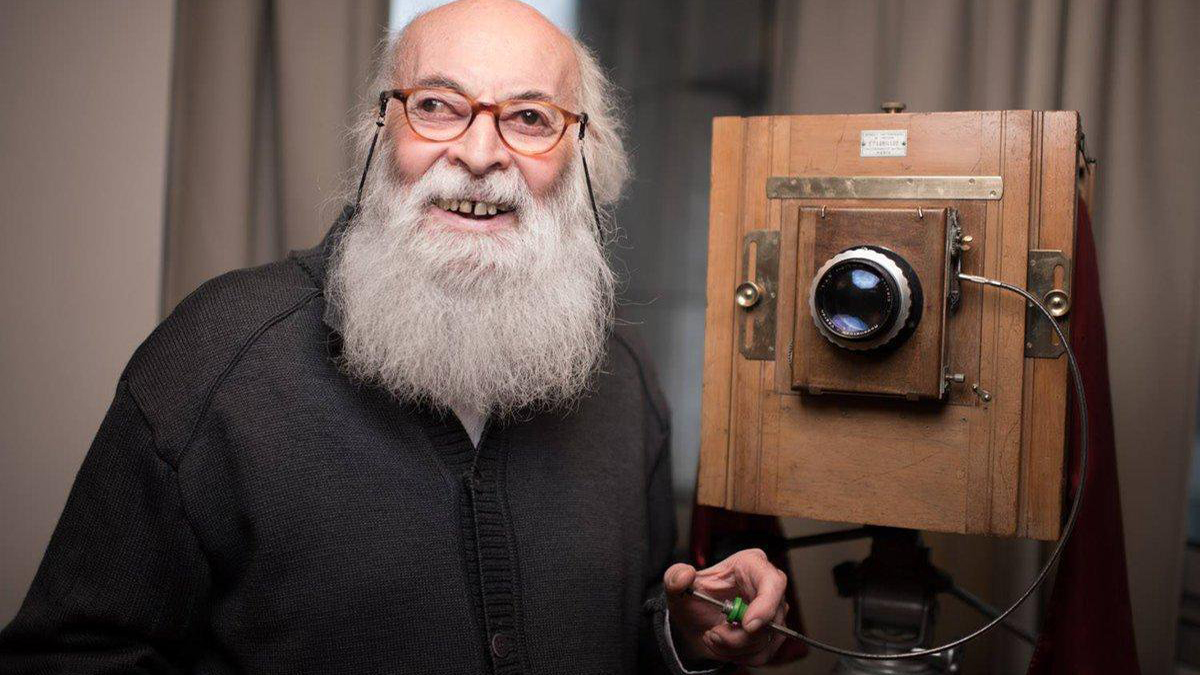
This is Kaminsky in his later years. He still believed in equality despite everything.
"All humans are equal, whatever their origins, their beliefs, their skin color. There are no superiors. No inferiors."Adolfo Kaminsky (1925–2023)
Make your own microstory
You will create a short original work in any medium, such as film, writing, audio, comic, poem, or song. Model it on the craft of this series.
Pick a subject
Pick one person whose story matters to you:
- Another Holocaust-era rescuer (you can find names in Yad Vashem's Righteous Among the Nations).
- A person whose ordinary skill was once used to help someone in a dangerous situation. That skill could be sewing, cooking, driving, photography, or anything else.
- A person from your own family or community who carried something difficult forward.
Ask your teacher to approve your subject before you start.
The rules for every medium
- One person. Not "the Holocaust." One specific person, with a name.
- Hook first. Your first sentence (or first shot) must commit. No throat-clearing.
- Hard limit. Pick your medium and stay inside its cap (see below).
- One real thing. Your work must mention or show at least one real artifact. It could be a photo, a document, or an object. Say where you got it.
- No invented words from the dead. If you don't know what a real person said, don't make it up.
- If you use numbers, use real ones. Kaminsky's math worked because the numbers were true.
Pick a medium
- A short film or video may run up to 90 seconds.
- A flash fiction or short essay may run up to 250 words.
- A poem may run up to 20 lines.
- A spoken-word or audio piece may run up to 90 seconds.
- A comic or illustrated sequence may run up to 6 panels on one page.
- A photo essay may use up to 5 images from public archives, with captions.
Submit a one-paragraph reflection with your work
Your reflection (4–6 sentences) should answer:
- Why did you choose this person?
- What is the real artifact (the primary source) you used, and where did it come from?
- What is the one thing you most wanted the reader or viewer to feel or know?