Before we begin: a world that was erased
"My grandfather said the port of Thessaloniki closed on Shabbat. He said his mother lit candles on Friday night in a kitchen that smelled of almonds and orange water. He said he was nine years old when the Germans came, and he did not know the word for what was about to happen. When he came back, there was no one to light the candles. There was no one to say the blessing. He was the only one who came back."Testimony of a Thessaloniki survivor, recorded in Israel, 1997 (adapted from accounts in the USC Shoah Foundation Visual History Archive)
Salamo Arouch was one of fewer than two thousand Thessalonikan Jews who returned. His community had existed in that city for more than four centuries. It did not.
Historical context
For more than four centuries, the Greek port of Thessaloniki was home to the largest Sephardic Jewish community in the world. The community had arrived in 1492 as refugees from the Spanish Inquisition, welcomed by the Ottoman Sultan Bayezid II. By the sixteenth century, Jews were the majority of the city. They maintained fifty-nine synagogues. They published thirty-five Ladino-language newspapers. The port closed on Shabbat.
In March 1943, the Germans began deporting Thessaloniki's Jews. Over the next five months, nineteen transports carried more than forty-five thousand people to Auschwitz in sealed cattle cars, eighty to a car, on a journey of a thousand miles and five to nine days. Ninety-four percent of the community was murdered. Fewer than two thousand returned. The Jewish cemetery was one of the largest in Europe, with five hundred thousand graves. The Germans destroyed it and used the tombstones to pave roads and build a university campus. The university still sits on the cemetery grounds today.
Key terms you will encounter
- Thessaloniki (also Salonika)
- The Greek port city home to the largest Sephardic Jewish community in the world for over four centuries.
- Sephardic Jewry
- Jewish communities originally from the Iberian Peninsula (Spain and Portugal). Most Thessalonikan Jews descended from refugees of the 1492 Spanish Inquisition; their daily language was Ladino (Judeo-Spanish).
- Maccabi Thessaloniki
- The Jewish sports club where Salamo trained as a young boxer (founded 1908, part of the international Maccabi movement). Twenty-seven undefeated bouts; nickname "the Ballet Dancer" for his footwork.
- Selection
- The process by which SS personnel at Auschwitz decided which new arrivals would be sent immediately to the gas chambers and which would be registered as prisoners.
- Death March
- The forced marching of prisoners over long distances in brutal conditions. In January 1945, as Soviet forces approached, the Nazis marched tens of thousands of prisoners out of Auschwitz; at least nine thousand died along the way.
- Yad Vashem
- Israel's national Holocaust memorial and research institution (Jerusalem). The primary repository of survivor testimony. (yadvashem.org)
- USHMM
- The United States Holocaust Memorial Museum (Washington, D.C.). Maintains the Holocaust Encyclopedia and the Holocaust Survivors and Victims Database. (ushmm.org)
- Auschwitz-Birkenau State Museum
- The Polish state museum on the site of the former camp. Documents the operational history of the camp system. (auschwitz.org)
Predict
Prediction Prompt · before we watch
The film is titled The Boxer. Its logline reads, "every victory meant another man's likely death." Based on that logline, what do you predict the film's central tension will be? Write your prediction in 2–3 sentences. Is this a story about winning?
The 90-second microshort
A heads-up before pressing play
The film depicts Salamo Arouch's forced boxing matches at Auschwitz, framed by his pre-war life in Thessaloniki and his liberation at Bergen-Belsen. The matches are stylized. There is no graphic blood, no facial detail of impact, and no recognizable depiction of what happens to the losing fighter. That fate is conveyed by an empty floor in the next shot, not by depiction. The destruction of Salamo's family is named in voice-over; nothing is shown.
If at any point you need to step outside, you can do that without explaining anything. You can come back when you're ready. There is no penalty.
Watch the film now
Open The Boxer on the class screen, or follow the link your teacher provides.
Hold onto the prediction you just wrote.
Analyze
Affective Check-In · first, before any analysis
Take a moment. One word for what you felt. Not analysis yet. Just noticing.
Your teacher will collect 4–6 words from around the room. You only have to share if you want to.
Discuss
Work through these questions first in writing on your own (5 minutes silent), then with a partner (5 minutes), then as a full class. The best discussions come from individual thought first.
Text-Dependent Analysis
- The film opens with the line, "Win, you live. Lose, you die. So he never lost." What does the structure of that sentence do? Why does the film choose to give you the resolution ("he never lost") before the story has begun?
- The narration tells us the fights happened in a warehouse where SS officers drank and bet on the outcomes. How does this detail change the meaning of a "victory" in that ring? What kind of audience is a fighter performing for?
- After Salamo wins, the film does not show his fallen opponent. It shows only the empty space on the floor where he fell. What is the effect of that absence? What does it keep us from seeing, and what does it force us to feel?
- The film refuses a triumphal ending. There is no swelling music, no raised arms, no victory pose. Instead, it ends with an aging face and dark brown eyes. What does this ending argue about what survival actually was?
Historical Sourcing
- The film states that Salamo fought "over two hundred bouts by his count." Why does the phrasing matter? What does it tell us about the historian's obligation when dealing with survivor testimony?
- The Auschwitz-Birkenau State Museum documents that boxing matches took place at the camp. Other specific details rely on his own account, such as the exact number of Salamo's fights. How do historians decide what to treat as established fact and what to treat as testimony?
- What claims in the film could you verify through independent sources (newspapers, museum archives, academic history)? What claims rest on Salamo's account alone? Does that distinction change how you read the story?
Hook Analysis · "Win, you live. Lose, you die. So he never lost."
- The film opens with these eleven words. The writer made a deliberate choice about what to say first. That choice tells the entire story before the story begins. Identify the three sentences. Mark the one-word shifts: win ↔ lose; live ↔ die; he ↔ never lost. What does the structure of these eleven words do? What does the reversal in the third sentence ("so he never lost") commit you to feeling?
- Compare the film's opening to a conventional Holocaust-history opening (e.g., "During the Holocaust, six million Jews were murdered...") or to a conventional sports-film opening (e.g., "He was the best amateur boxer in Greece..."). What does the film's choice accomplish that the conventional opening would not? What does it risk?
Investigate Further · what the film does not answer
A question the film deliberately leaves open. Take it home; come back with what you found.
- The film does not name the men Salamo defeated. Other prisoners also boxed at Auschwitz, and we have at least four of their names: Tadeusz Pietrzykowski (Polish political prisoner, lost a bout at Auschwitz I and survived), Harry Haft (whose story is told in Harry Haft: Survivor of Auschwitz, Challenger of Rocky Marciano, Syracuse, 2006), Victor "Young" Perez (former world flyweight champion, murdered on the death march from Auschwitz, January 1945), and Jacko Razon (a Greek-Jewish boxer who in 1989 sued Arouch claiming his own story had been conflated). Pick one. Using Yad Vashem, USHMM, the Auschwitz-Birkenau State Museum, or other credible source, find out what is documented about their story. Bring back one specific verifiable detail. Then write 3–5 sentences on whether what you find complicates the "Win, you live. Lose, you die" framing the film opens with.
Create
"We fought until one went down or they got sick of watching. They wouldn't leave until they saw blood."Salamo Arouch, interviewed in People magazine, 1990
Argumentative Paragraph · MEAL Format (150–200 words)
Salamo survived Auschwitz by winning more than two hundred fights, by his own count, against other prisoners. When they lost, these men were often killed soon after. Write one well-developed argumentative paragraph that answers the following question. Use the MEAL structure, which stands for Main claim, Evidence, Analysis, and Link back to claim:
Is Salamo Arouch's survival best described as a "triumph," as something more complicated, or as something the word "triumph" cannot capture at all?
Use evidence from the film, from Lawrence Langer's framework of "choiceless choices," and from your historical knowledge to support your position. Anticipate a counterargument.
When you submit: Underline your main claim sentence. Circle your strongest piece of evidence.
Reflect
Affective Consolidation · first
Take 30 seconds. Say one word out loud for what you're carrying right now. Don't analyze it, just name it.
Written reflection
Complete the following sentence frame as a written reflection. Be specific. The strongest reflections name something particular that you learned, not just general impressions.
Share with a partner
Share your reflection with a partner. Where do your reflections overlap? Where do they diverge? What might explain the difference?
Closing discussion · full class
Your teacher will invite 2–3 voices from around the room. Listen for divergence. This is not about where you disagree on facts. It is about where you disagree on what survival means in this story or what the hardest part is. The fault line you may notice: some students land closer to "Salamo's survival is the moral center"; others land closer to "the men he defeated are the moral center, and the film does not give them to us." You are leaving the room with different questions about what 'survival' carries. That is the work.
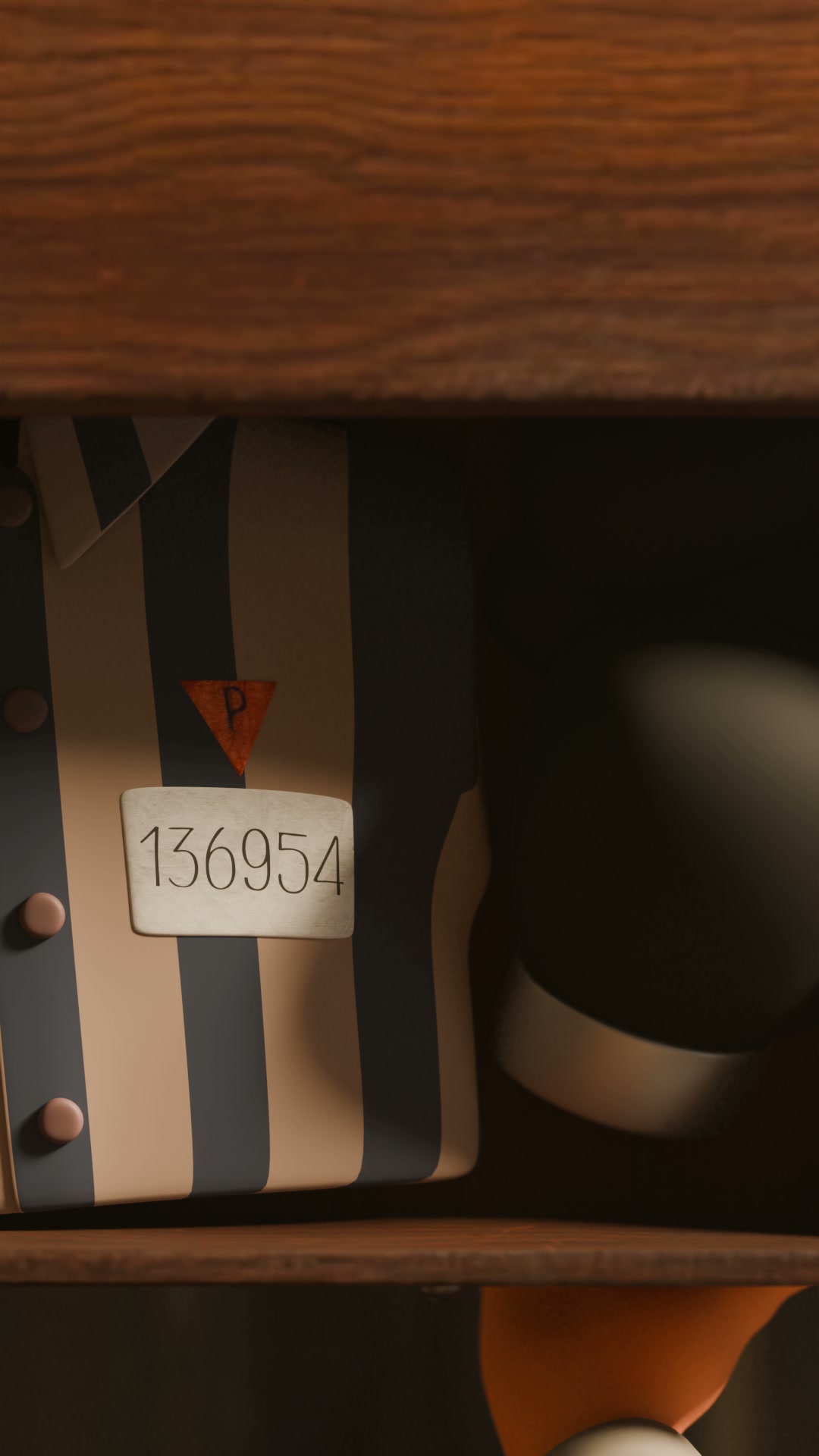
Salamo Arouch carried the number 136954 on his left forearm for sixty-four years after the war.
He met his wife, Marta Yechiel, in the camp hospital shortly after liberation. They married in November 1945, had four children, and were married sixty-four years until his death on April 26, 2009, at the age of eighty-six. He carried the weight of every fight for the rest of his life. That is not a metaphor.
"We fought until one went down or they got sick of watching. They wouldn't leave until they saw blood."Salamo Arouch (1923–2009), interviewed in People, 1990
Make your own microstory
A short original work, in any medium, modeled on the craft of this series. Choose film, writing, audio, comic, photo essay, or song lyric. The constraints are the lesson; the medium is your choice.
Pick a subject
For this episode, the natural subject is any person, historical or contemporary, who faced a "choiceless choice" and had to decide. Or, in keeping with the silence in the historical record: any person whose absence from the record is itself part of the story. Suggested fields:
- Another camp athlete (Pietrzykowski, Haft, Perez, Razon) or any prisoner forced into a system of survival that traded another's life for theirs.
- A member of the Greek-Sephardic communities lost in the deportations, such as the rabbis, the press editors, the dockworkers, or the children of Thessaloniki, Rhodes, Corfu, Janina.
- A person from history or the present who acted under a choiceless choice and either lived or did not.
- A person from your own family or community who carried something forward through impossible conditions.
Get your teacher's approval before you begin so the historical claims you'll make are defensible.
The constraints · apply to every medium
- One named person at the center. Not "the Holocaust." One specific person, named, whose story you can stand inside.
- Hook-first. Your first sentence (or first shot, or first line, or first panel) must commit. The Boxer opens with the line "Win, you live. Lose, you die. So he never lost." That line tells the entire story before the story begins. Yours must do something equivalent.
- Hard compression. Pick your medium; live inside its cap. The cap is a wall, not a target.
- One primary-source anchor. Reference, describe, depict, or quote one specific verifiable historical artifact and credit the source.
- No invented dialogue from the dead. If a historical figure's words are not documented, do not put words in their mouth.
- Refuse the easy ending. Salamo's story has no triumphal close. Your work should resist the urge to "wrap" the subject into resolution.
Pick a medium
- Short film or video · up to 90 seconds.
- Flash fiction or micro-essay · up to 250 words.
- Poem · any form, up to 20 lines.
- Spoken-word or audio piece · up to 90 seconds.
- Podcast cut · up to 2 minutes.
- Comic or illustrated sequence · up to 6 panels on one page.
- Photo essay · up to 5 images from public archives, ethically captioned.
- Song lyric · one verse and chorus.
Submit a 200–300 word craft defense alongside your work
- Why you chose this medium (and not another).
- What your hook does, and what choice your first sentence or shot commits to.
- Which primary source you anchored to, why it specifically, and how it appears in your work.
- What you cut, and why.
- How you refused the easy ending. What did you choose to leave unresolved, and what argument does that choice make?